U.S.-Iran War Energy Transition "Accelerant" to Nuclear & Other Renewables
About this episode
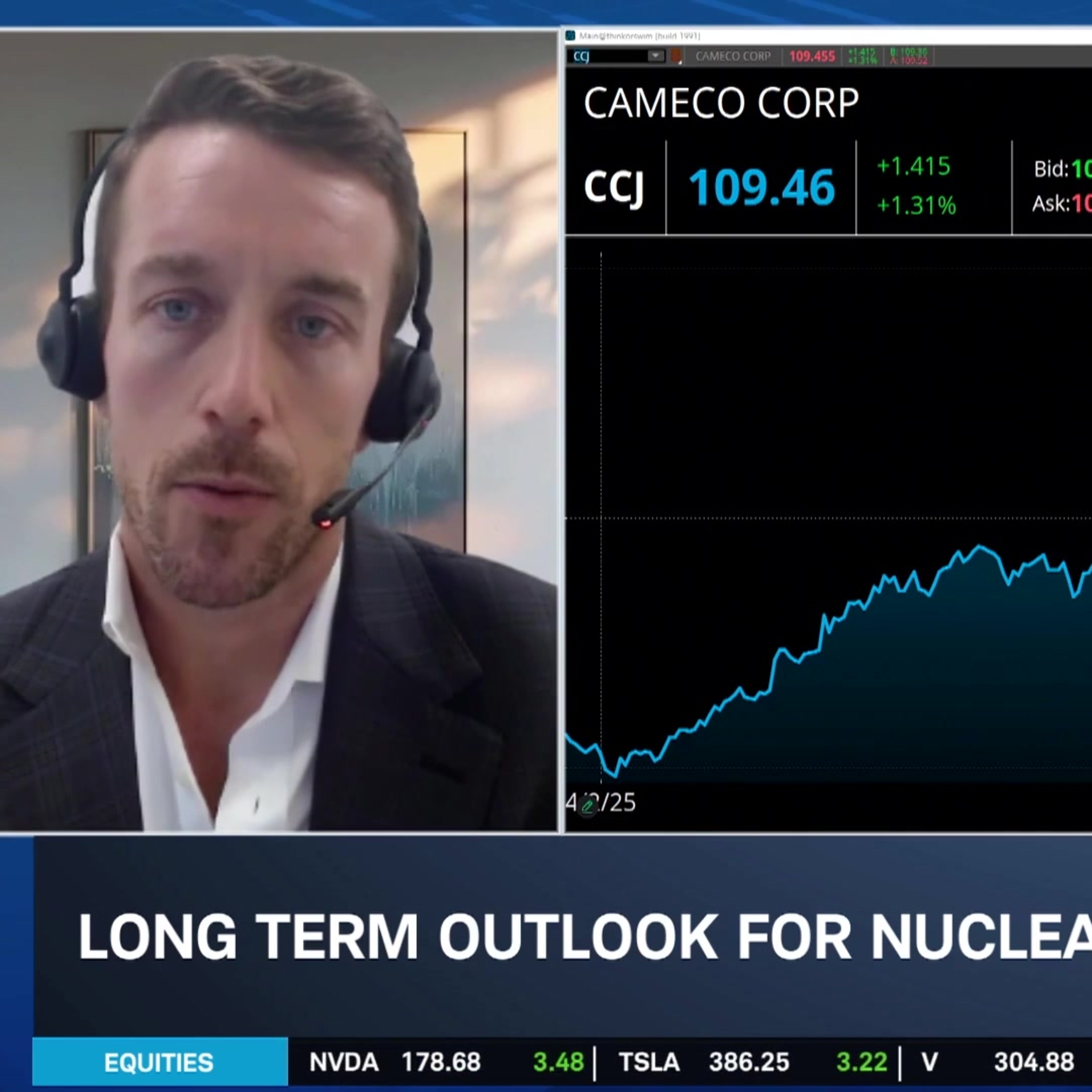
The nuclear energy trade is back in focus with more traditional power sources like crude oil and natural gas experience supply shocks. Eli Horton calls the current disruption an "accelerant" for energy transition in discussing bottlenecks and opportunities in these energy sources. In the nuclear power space, he points to Cameco (CCJ) as a name to watch.
======== Schwab Network ========
Empowering every investor and trader, every market day.
Options involve risks and are not suitable for all investors. Before trading, read the Options Disclosure Document. http://bit.ly/2v9tH6D
Subscribe to the Market Minute newsletter - https://schwabnetwork.com/subscribe
Download the iOS app - https://apps.apple.com/us/app/schwab-network/id1460719185
Download the Amazon Fire Tv App - https://www.amazon.com/TD-Ameritrade-Network/dp/B07KRD76C7
Watch on Sling - https://watch.sling.com/1/asset/191928615bd8d47686f94682aefaa007/watch
Watch on Vizio - https://www.vizio.com/en/watchfreeplus-explore
Watch on DistroTV - https://www.distro.tv/live/schwab-network/
Follow us on X – https://twitter.com/schwabnetwork
Follow us on Facebook – https://www.facebook.com/schwabnetwork
Follow us on LinkedIn - https://www.linkedin.com/company/schwab-network/
About Schwab Network - https://schwabnetwork.com/about
Get every episode summarized
Each time Schwab Network publishes, we email you a written briefing from the transcript — the topics, who appeared, and any specific claims, with the ad reads skipped.
Email me new episodesFree for 3 shows. No card needed.
Hosts & guests

Transcript ready
158 searchable segments. Every word is indexed and playable.
Full transcript
Schwab Network — U.S.-Iran War Energy Transition "Accelerant" to Nuclear & Other Renewables. Machine-transcribed; use the interactive transcript above to jump the player to any line.
Welcome in our next guest to focus on what's happening in energy. Now Eli Horton, managing director, the TCW Group. Eli, thanks so much for joining us. What has this conflict over in the Middle East taught us about the energy security story? Thanks for having me. It's good to be here. We're at such an interesting time in the world right now. I think we are seeing an acceleration of demand for power and electricity. Just as we're seeing what I would call the largest supply shock that the energy system is seeing in modern times, we'll get through this. It will be temporary. But I believe that the implications of this will be lasting and structural. This type of supply disruption will expose, and it is exposing vulnerability. It's hardening political will. It's refocusing corporate attention on energy security. I believe this is very much an accelerant for the energy transition theme. And so as we look at everything going on, highlighting some of these areas of concern,
the accelerating energy demand, geopolitical risks that we don't know how long are going to be, how big the impact is going to be, how much the damage is going to impact things. Where do you see capital flowing first, and which sectors are best positioned to benefit? Look, I think before we started this conversation, I think you were mentioning that crude is down and so stocks are up, and so much of what investors are trying to do is predict the short-term movement of crude. That's almost a military intelligence exercise at this point, or perhaps understanding what might come out on true social next. We stay away from that, and we look at where have things structurally changed and where might there be bottlenecks? A couple of things that I like. First, we think the opportunity in LNG is quite interesting. Why? What's happened? A significant amount of industry supply, but basically 20% has come offline. There's been significant damage in Qatar to the largest LNG export facility in the world.
That will remove a good portion of global supply for the next several years, as well as future expansion plans inside of Qatar. What happens? Customers are looking to diversify their supply chain away from the Middle East, and they will look for swing suppliers. We think there's a couple of industry businesses in the North American LNG chain that have that capacity, that are opening new capacity, that will capture this demand, and increasingly higher spread. You can see what's happened with the material increase in LNG prices of late. But to us is less of a bet on what happens over the next two weeks or three months on energy prices, but more a structural change in supply that takes meaningful capital and meaningful time to change, and it's creating this bottleneck. But Eli, when you talk about, obviously, the US, for instance, bringing on extra capacity I'm under the assumption that this is not going to happen for a number of years. When you talk about governments accelerating that transition, are we seeing anything happening
faster or any progress on that front to bring some of that capacity online sooner, even if it's here or somewhere else, that can start to address some of the concerns in these markets about just how long that's expected to actually come online, given the crisis here and now. Right. Look, a couple of thoughts on this. This is actually what creates the investment opportunity. It creates the bottleneck. Again, change is more quickly in these capital intensive industries that supply can react. You can't just go build a new LNG export terminal or a liquefaction facility quickly. We're talking billions of capital and years to build separately. We think there's some finishing opportunities in nuclear, but it takes six years, at least, to build a large scale plant. So you can only do this so quickly that creates bottlenecks that creates investment opportunities. I do believe, though, that history is instructive here, provides some interesting lessons. The 1973 oil embargo was really the catalyst for U.S. investment in energy security.
Nixon had his project independence where he wanted to have energy security and independence by 1980. In 79, there was the revolution that the Carter administration jumped all over and that was a huge catalyst for domestic U.S. investment in R&D and development for the solar industry. When these crises happen, it spurs awareness and awareness of vulnerabilities and actions. I do believe that history is a good example of that. We'll see it this time, but it takes a while to build this out. And Eli, when we're talking about natural gas, you get a lot of the big names mentioned with North American opportunities. New York comes up all the time as a big exporter, but is there also an infrastructure play here because you mentioned the liquefocation process that's required to actually transport it. Then there's the transport itself. Is there more than just playing the actual commodity here that's an opportunity? Yeah, 100 percent. I don't know that I would necessarily call it, Shania just playing the commodity either. We could debate that. Our jobs, so we manage a portfolio that invests in the energy transition.
There are about 1,000 businesses we could theoretically own. That's our universe. And we own 20 to 30. So we try to be selected and be stock figures. Let's talk about the natural gas industry. You could own anything from the drillers to the pipes that move the natural gas to applications like LNG, to companies that make the turbines. We're looking for where are there the bottlenecks? Where will the economics accrue? I do believe just focusing on this Middle East topic. I think the opportunity for you to economics to accrue to the LNG businesses, such as Shania, venture global and other machine business, I think that picture has changed. The opportunity set has changed meaningfully for them. And so those have been areas where we've become incrementally more interested. You mentioned nuclear, but obviously we know the story with this one because we track a lot of stocks in that sector with respect to how much capital is being thrown at it on the hope that obviously there's this promise that it's going to offer that base load power to provide all the AI energy needs.
But I do want to just get your thoughts as you talk about the transition and what sort of investment opportunities you look at, whether this episode has shown a spotlight more on the renewable stuff as well. Look, of course, we're talking about energy security. We think the, we back up really quickly. So we think the energy transition is this very capital intensive, very long duration, migration of our economy that will be built on a renewable or a mission, a lower emissions form of energy. So mostly a renewable driven economy versus fossil fuels. Why? One, decarbonization, of course, matters. Two, energy security matters meaningfully. What are the most secure sources of energy? Well, nuclear, you can certainly argue is extremely secure. In the US, we have a abundant natural gas that doesn't fit the emissions profile. So it's a transition fuel source and then renewable such as solar and wind. Those are very secure as well.
They are intermittent, however, which has implications for running a 24 seven economy when you need base load power. That is one of the reasons we think nuclear is such an important part of the energy transition and is somewhat been forgotten. Our nuclear industry in the US has been dormant for the better part of this century who built three reactors since the year 2000. There's 10 being worked on right now, large scale reactors. We think there will be more to come. It's carbon-free, it's secure, it's 24 seven base load. We think it's a very important part of the solution. And I talked to you about natural gas generation and export, but let's talk about nuclear here too. So beyond nuclear power generation, there are lots of picks and shovel plays in this space too. How do those niche players fit into the broader energy security story? And are there any names specifically that you like? Sure, I mean, I'll highlight a couple. So there's companies that own the nuclear plants,
but others in the value chain that we own, Camico is perhaps fairly well known by name at least, but the company has essentially two parts to it. They own 49% of Westie now's, which is essentially equipment for the nuclear industry. And then it has a business involved in uranium fuel, which is the fuel source for nuclear reactors. Another company that's very high quality and certainly less known that we own is a business called Mirion. They are the dominant radiation detection systems provider. They're on 95% of the world's reactors. They keep reactors operating safely. They keep communities around plants safe. They keep employees safe. It's a very high quality razor razor blade model that also fits the same quite nicely. Well, Eli, we really appreciate you being on with us to talk about the energy story and to take closer look at some of the opportunities here in the current environment that's Eli Horton from the TCW Group. Thanks again for being with us.
More episodes
More from Schwab Network

Stock Market Today: ORCL & ADBE Earnings, AEO Plunges Near 52-Week Low
Schwab Network

Thursday's Final Takeaways: Crude Taps $103 & PPI Hotter than Expected
Schwab Network

Balancing High-Conviction AI With High-Dividend Diversification
Schwab Network

EARNINGS PANEL: ORCL, ADBE
Schwab Network