About this episode
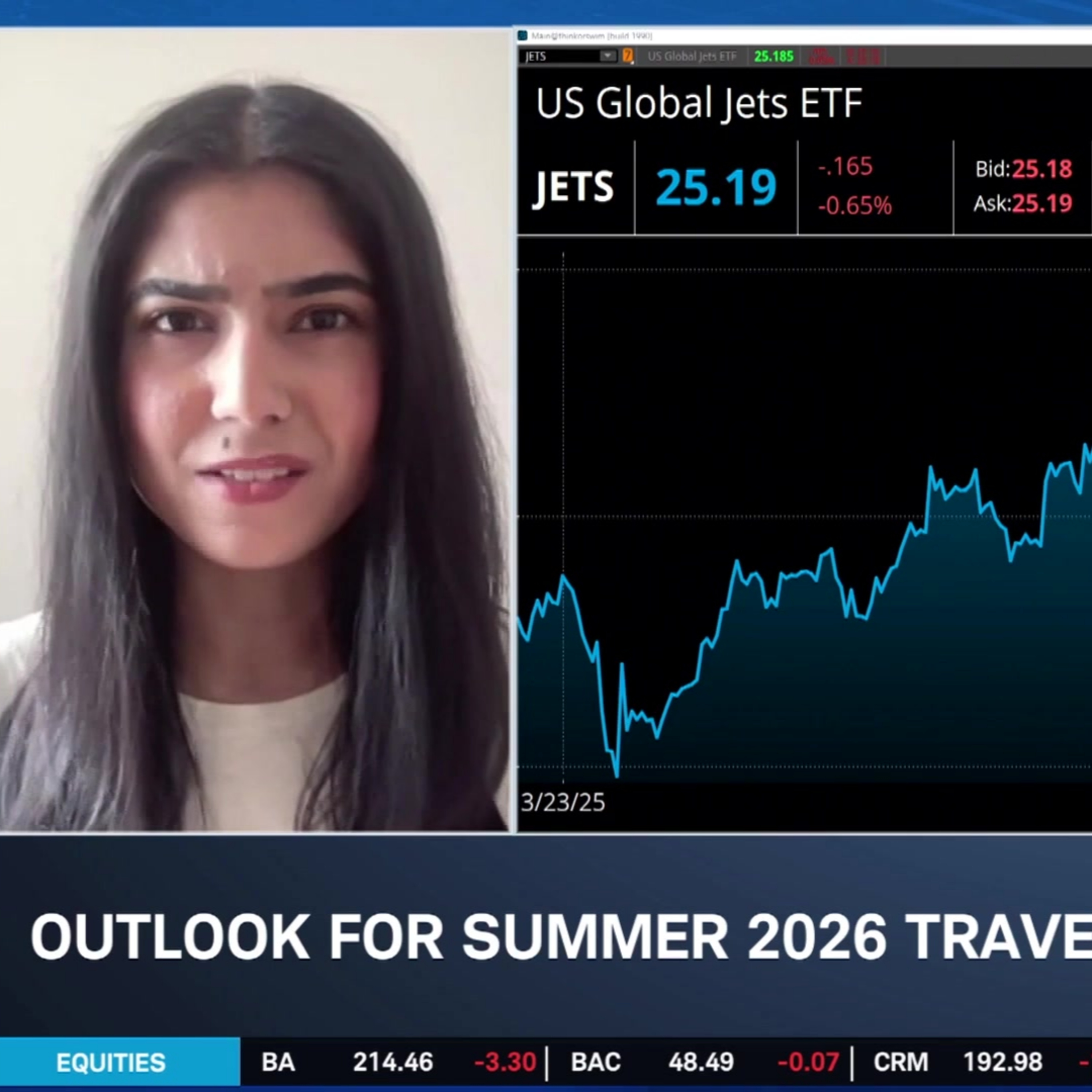
Meghna Maharishi covers the latest on the airline and travel sector. She estimates that the U.S./Iran war could cost airlines up to $24 billion extra in fuel. However, she thinks they will pay less by cutting flights and conserving cash in other ways. If not, this would “wipe out” profits across the sector, she says. “This could be particularly bad for the ultra-low cost carriers,” she adds. Meghna compares the impact of the conflict to the impact of the Russia/Ukraine conflict in 2022.
======== Schwab Network ========
Empowering every investor and trader, every market day.
Options involve risks and are not suitable for all investors. Before trading, read the Options Disclosure Document. http://bit.ly/2v9tH6D
Subscribe to the Market Minute newsletter - https://schwabnetwork.com/subscribe
Download the iOS app - https://apps.apple.com/us/app/schwab-network/id1460719185
Download the Amazon Fire Tv App - https://www.amazon.com/TD-Ameritrade-Network/dp/B07KRD76C7
Watch on Sling - https://watch.sling.com/1/asset/191928615bd8d47686f94682aefaa007/watch
Watch on Vizio - https://www.vizio.com/en/watchfreeplus-explore
Watch on DistroTV - https://www.distro.tv/live/schwab-network/
Follow us on X – https://twitter.com/schwabnetwork
Follow us on Facebook – https://www.facebook.com/schwabnetwork
Follow us on LinkedIn - https://www.linkedin.com/company/schwab-network/
About Schwab Network - https://schwabnetwork.com/about
Get every episode summarized
Each time Schwab Network publishes, we email you a written briefing from the transcript — the topics, who appeared, and any specific claims, with the ad reads skipped.
Email me new episodesFree for 3 shows. No card needed.
Transcript ready
83 searchable segments. Every word is indexed and playable.
Full transcript
Schwab Network — U.S./Iran War Could Wipe out Airline Profits. Machine-transcribed; use the interactive transcript above to jump the player to any line.
sector was flying high entering the year, trading at multi-year highs just a month ago, but the partial government shut down, and then the conflict in the Middle East have hit this industry hard. Joining us now to take a closer look, Magna Maharishi, the airline reporter, over at SCIFT. Magna, thanks for being with us. Such an important time to have you on. You were high. I was having a conversation about the Jets ETF earlier today and looking at the airline industry. And you've done some interesting research here and some analysis that says that the war with Iran could cost U.S. airlines up to $24 billion in extra jet fuel. How would the airlines possibly even cope with that massive increase? So, those estimates, I think they're built on a lot of assumptions that maybe airlines don't do anything else other than, you know, increase fares. Maybe they won't, you know, ground aircraft or they won't, you know, cut capacity. Although I think we can expect to see that play out in reality if these prices do continue to rise. I will say, though,
you know, the $24 billion cost like that would pretty much wipe out the industry's profits that it made in the last year. I believe last year, the airline industry had an operating profit of around $13.5 billion. So it would be very difficult for airlines to cope with. I think a few carriers might be able to eke out a small profit if jet fuel prices do continue to spike. I think the Delta's and the United's and maybe even a Southwest might still be able to do well. But I think everyone else will definitely be struggling and this could be particularly bad for the ultra low cost carriers, like the spirits and the frontiers who've already been struggling financially. And Megna, with jet fuel being the largest single expense for most carriers, I think it's roughly about a 20% of total costs on the average here. Realistically, how long can any airline go without passing on some of the price increases in terms of fairs? Yeah, airlines can't go on too long without passing these, you know, increases onto customers.
We're already seeing other airlines around the world starting to adopt fuel surcharges. We haven't seen anything in the United States yet. But, you know, Australian carriers like Quantus and like also New Zealand's air New Zealand have started adding fuel surcharges air India announced yesterday that it would also enact a fuel surcharge to its fair. So it is already impacting other parts of the world. I think the US, we will also probably start to see some impact pretty soon. I think United and airline CEO Scott Kirby, he said in remarks to some reporters last week that, you know, the impact will start in just a few weeks. And as we, you know, look at this potential impact analyst are estimating about a 10 to 11 percent average fair increase can be expected if this does continue on. And we start to see some of these cost increases passed on to the consumer in terms of fair. Would you see this leading to a drop in travel demand? I mean, historically has seeing this rise, you know, I guess the Ukraine conflict would be the most recent one that I can think of.
Did we see a drop off in demand for travel or did travelers just pay up? Yeah, in 2022 when, you know, fuel prices were spiking during the outbreak of the Ukraine war, airlines did raise fairs back then. But I think right at the end of 2022 and to 2023, we were entering that, you know, quote unquote revenge travel period where demand for travel was just very, very high. We were coming out of the pandemic and people wanted to, you know, travel the world. And I think that really did prop up airlines profits. And it also didn't really make that fair increase like sting too much for consumers. I would say now like demand is still high. We're not at those like revenge travel levels. So, you know, fair increases could cause some pain for consumers. But it is also worth noting that a lot of the demand that we've seen for travel in the past year or so has really been propped up by those wealthier travelers who want to, you know, fly internationally and they want to fly business class first class. That's really propped
up the profits of Delta and United. And so far, at least in some comments that we've heard from United CEO Scott Kirby, he has a net demand is still holding up. I still think it does remain to be seen like how long the demand holds up or if it does actually hold up, if these prices do actually continue to increase. And Magnum, for those people in traveling internationally, are there, are there certain hubs that should be avoided right now or anything specific that people traveling internationally should be made aware of? Well, right now in the Middle East, that's the obvious one to avoid right now. I think most of the people that are in the Middle East are trying to get out. And it's pretty difficult to get a flight there right now. You have like some carriers operating the very limited capacity. And I think the travelers that are getting priority to leave the region, you know, are those that are maybe like, you know, contacting like the state department step program and the like. So, you know, that part I would avoid for sure, at least for some time now. I would also say, you know, the the word is impacting Asia, travel a bit as well.
You know, Dubai and Doha are really big connecting hubs for travel to Asia and those airports are all but basically closed right now. So, you know, I think like that might also send airfares for routes to countries like India, like spiking potentially. And that might also be something to reconsider if you are, you know, considering traveling internationally anytime soon. And Magnum, there's a lot of confusion, you know, particularly if they're driven by some commentary on social media about what rights travelers actually have, particularly US travelers. You and I know you're pretty well versed on the Department of Transportation rules if flights are canceled because of a conflict. So, could you just walk our viewers sort of through that process or anything they should be aware of or signed up for or checking if they're planning to travel for spring break or have upcoming travel. And they end up in a position where their flight is rebooked or canceled. Yeah, so at least in the United States, you are entitled to a refund in the event, you know, your flight gets canceled due to any sort of event such as a war breaking out in the Middle East,
like your flight, you are entitled to a refund. However, you're not entitled to a refund if you do decide to rebook. So, that is worth keeping in mind if you are in that situation right now. You know, the rules are also different for like the EU or the UAE and it depends on where your flight I believe is departing from. So, it is also worth checking in with your airline and also keeping track of your airlines apps like updates. I would also say if you are traveling internationally, it is definitely worth enrolling in the State Department's step program. They do give you minute minute updates on what's going on. And, you know, if for some reason if you are in the Middle East or if you are in a country that is impacted by this, that program should be able to help you return to the United States. Magnum, we really appreciate you being with us some helpful advice there in advance of a busy travel season spring break coming up and also some uncertainty tied around to how long this is going to go on for us. So, we appreciate the closer look at the airline industry and also the potential impact to travelers. That's Magnum Ahareishi reporter over at SCIFT.
More episodes
More from Schwab Network

Stock Market Today: ORCL & ADBE Earnings, AEO Plunges Near 52-Week Low
Schwab Network

Thursday's Final Takeaways: Crude Taps $103 & PPI Hotter than Expected
Schwab Network

Balancing High-Conviction AI With High-Dividend Diversification
Schwab Network

EARNINGS PANEL: ORCL, ADBE
Schwab Network