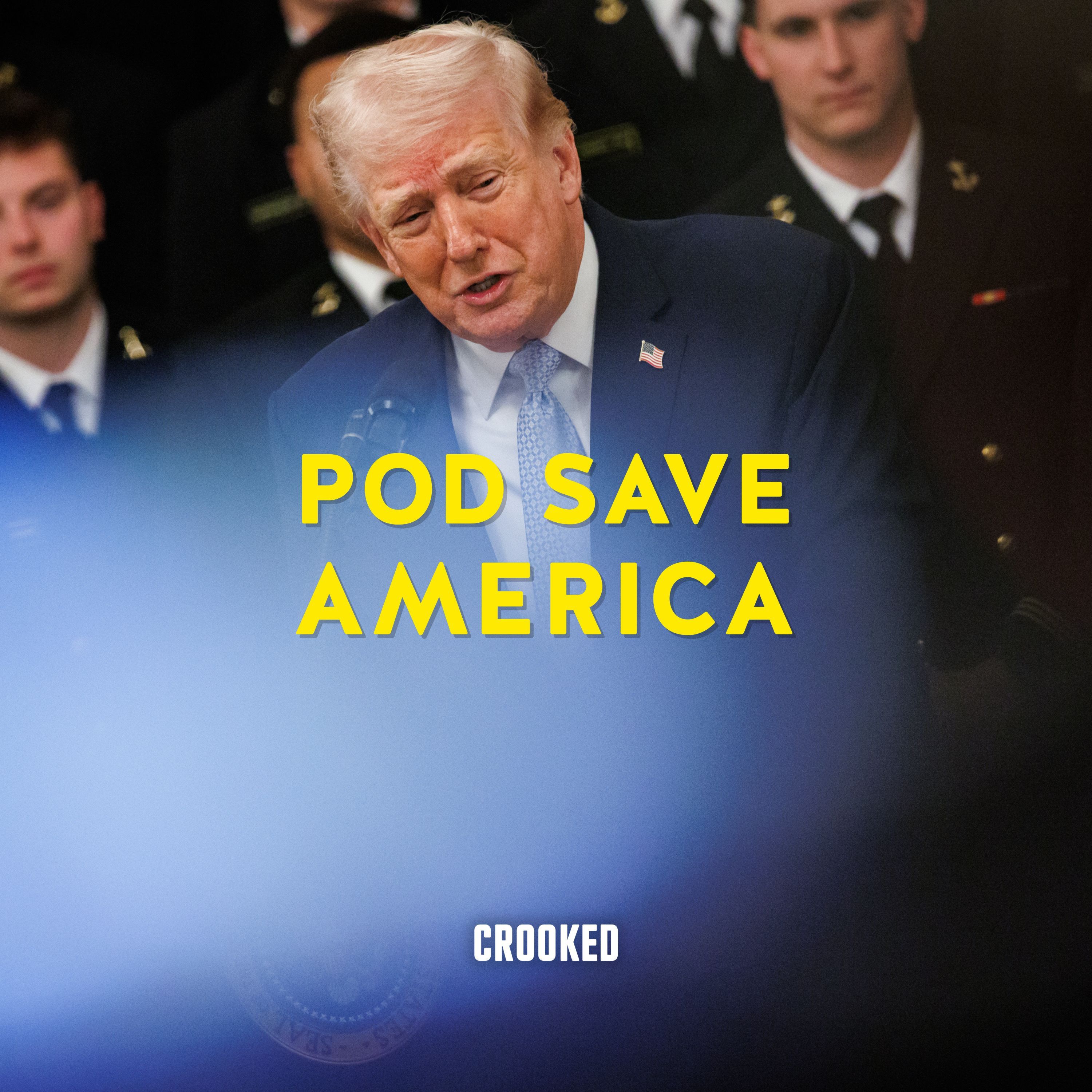
About this episode
Jen Psaki, Joe Biden's former White House Press Secretary and host of MS NOW's The Briefing with Jen Psaki, talks to Dan about the ways the Trump administration is trying — and failing — to sell its war with Iran to the American people. The two discuss the White House's meme-forward messaging campaign, MAGA media's break with the president over the war, and how Trump's cell phone interview habit is shaping media coverage. Then, Dan and Jen discuss how a series of contentious Senate primaries are reshaping the Democratic Party and whether "fuck Trump" is a strong enough message heading into the midterms.
For a closed-captioned version of this episode, click here. For a transcript of this episode, please email [email protected] and include the name of the podcast.
Get every episode summarized
Each time Pod Save America publishes, we email you a written briefing from the transcript — the topics, who appeared, and any specific claims, with the ad reads skipped.
Email me new episodesFree for 3 shows. No card needed.
Hosts & guests

Transcript ready
1,313 searchable segments. Every word is indexed and playable.
Full transcript
Pod Save America — Trump’s Wartime Messaging Disaster (feat. Jen Psaki). Machine-transcribed; use the interactive transcript above to jump the player to any line.
Welcome to PodSate America, I'm Dan Fife. You're about to hear my conversation with my good friend, Jen Socky, former White House Secretary for Joe Biden, and hosted MSNOWs The Briefing with Jen Socky. Jen is one of those folks I could talk to you for hours about anything, but this week I invited her on because I wanted to talk to her, one former White House com staffer to another, about how the Trump administration is trying to sell its war in Iran to the American people and how the media has covered it. We also talked a bit about the midterms, including how important Democratic primaries in Maine, Michigan, and elsewhere are shaping the future of the party. Hope you enjoy it, and if you do, I hope you will consider subscribing to Friends of the Pod. Friends of the Pod subscribers get our new extra episode of PodSate America called PodSate America Only Friends. Other subscriber only shows, like my show Polar Coaster, access to all of our excellent
sub-stack newsletters like PodSate America Open tabs, add free episodes of all of your favorite cricket pods, and you get to feel good about supporting independent pro-democracy media. So head to Cricket.com, slash friends, and subscribe. And while you're feeling good about supporting independent media, hope you will consider subscribing to Message Box. My newsletter that gives you in-depth political analysis to cut through the BS, and helps you understand what you can do to defeat MAGA in this election and beyond. I have a special deal for Cricket fans. Go to Cricket.com, slashy. Yes, we did. And for 20% off of your subscription. Here's my conversation with Jen Socky. Jen Socky, welcome back to PodSate America. It's great to be here. How are you? I mean, the world is a shit storm, but otherwise I'm good. Okay, we'll take that. That's a caveated good in Donald Trump's America. There are always, I could talk to you anytime and unfortunately, because we live on other
sides of the country, we only get to talk to each other on podcasts, mostly. Or when you were doing sold-out events, then those two. Yes, yes. Please emphasize or sold out for everyone to know. There's always a good time to talk to Jen Socky, but this is a particularly good time given what's happening in the world. And before you were a cable news star and a White House press secretary, you also very specifically worked at the State Department as a spokesperson. And people may not know this. At the outset of the Obama administration, you were the person in charge of economic message or in the financial crisis. We're now in the middle of a war and an emerging global economic crisis because of said war. And so you have a lot of expertise to bring to this. And I want to have a conversation here that takes a little bit of a step back and looks at, of course, what's happening in the world, but also like your perspective on how Trump is selling this war. But before we get to that, what's just your reaction to, what was your reaction when you woke up that Saturday morning to discover that we had gone to war with Iran?
Both your reaction is a person, an American, and a member of the media would have to cover said war. First of all, just as a sidebar, I didn't even do this for you, but I have in my coffee is an economic report to the president mug from 2009. A relic, I got from the economic team at the time, just to prove that you were there. I think like so many Americans I woke up and was scared because it is always scary when the country you're living in goes to war. And it is not a decision as you know well and I know well that any president makes lightly to use military force, even if it's for a smaller engagement than this is. But I think I felt fear because Donald Trump has no impulse control. He's not a planner. He's not a policy wank or expert. He doesn't listen to anyone around him. And so the concern I had once I had some coffee and digested a bit was how are we going unwind from this?
I mean, you know, even, even initially, even in that first day, because the military strikes and the military action and we have the best military in the world, bar none, that is true. You know, it's very difficult to dig out of what the impact of that is. And that was evident very quickly, I mean, within days. This seems we're now three weeks into the war. It things seem to be getting worse, not better, they're expanding, not contracting. We seem to be further away from extricating ourselves than we were three weeks ago. As we sit here recording this on Friday morning, there is reporting that the White House is getting closer to using ground troops, talking, there was some White House Aids quoted on the background saying how ground troops have been used in every war. Why wouldn't they be used here that it's not that big a deal? Just help us understand both the substantive and political impact of putting ground troops either in a ran proper or in the islands like Carg Island in the middle of the straight of Formos.
Well, it's a very slippery slope. And so even as we've seen the buildup of troops sending more even to the Middle East over the past couple of weeks, I think there was something like 50,000 plus there was another announcement a couple of days ago about a couple more thousand. It is a slippery slope where it becomes kind of clear that in most scenarios of war, our troops on the ground, as they say, that's where it was headed. And I think that is alarming on so many levels because that is something that is very difficult to dig out of. Once you have people on the ground, you have the military and the commander in chief and others are going to want to do what they feel is winning. And that is a get a question we don't know the answer to. What is winning here? How do we win? I mean, it's a big freaking question that they have not answered. Also we have a different view of that than Israel, which is a huge, massive, separate, important issue. On the political front, I mean, I think, you know, we have, there have already been
lives lost. You and I both know very well. And I think we've both heard Barack Obama say this many times. I heard Joe Biden say this many times. The most difficult phone call, the most difficult letter any commander in chief writes or should write. And I don't know how Trump feels. And I know he's like devoid of human feeling and emotion in a lot of ways. This to the family of somebody who died, even in a moment of a, you know, a member of the military, even when they are defending the country, even when they are doing something that is of great honor and great sacrifice. And certainly they all are. But this is a war that no one has any idea what it's about, right? It feels like it's about his ego. It's about his feelings. And so if you're these families, who's 18-year-olds, 20-year-olds, or 30-year-olds, or your husband is going, you know, that impacts not just that family, but it impacts communities, impacts states on, it makes people question the worth of this. And then there is, of course, the issue that is beyond the impact on the military.
And I think about the military impact in a lot of ways, like states, I mean, just to be super political. And I know we'll get there. Yeah, of course. We'll talk about this in talk about this. Texas has the largest number of veterans in the country, right? It also has, I think, maybe the most or almost the most number of military bases in the country. The most interesting Senate races in the country. Now a lot of those people probably voted Republican and probably voted for John Gornan. And maybe most of them will again. But if some of them are like, what is this about? This feels a little Iraq war like. This feels, I mean, that's, you know, also Georgia, a huge military presence, right? I mean, these are, this is, it can flow into that. And then there's, of course, the gas prices issue and the lack of the longevity of a war, like this. We've already seen it. I'm just going to go economic nerd, but I'll have the data in front of me. You have the mug to prove it. So go for it. I have the mug. I love data. I mean, I think as of last night, it really depends on the part of the country. But it was like anywhere between like 88 cents and over a dollar, more per gallon, right? And gas.
And there is no way to change that. You remember almost, Hockstein, we, we had him on, like, talk to him last night. Yes, yes, yes. It was a little nerd. I was embracing. I just like wanted to keep it going. But there's no way, and we've seen military analysts and others say this. There's no way to end the kind of dysfunction or the disturbance in the global oil markets, unless the straight-of-formoses reopened, right? And that is either going to require a negotiation or military action. So if you go back to the political front, we're already at 88 cents or a dollar, whatever it may be, it could be larger. And if Israel keeps striking places and they keep striking back in the Middle East, and so there are other, like what happened in Qatar, there are other oil fields off market could be even higher. And that is a massive political problem for Trump and for Republicans running for office. Yeah, it's obviously no one voted for Donald Trump for the goal of going to war with Iran.
In fact, people probably voted for the, if they voted on war at all, they voted for the opposite of that. A lot too. Don't you think, I mean, one of the most fun, well, interesting to watch is like the complete division in the MAGA base land of over this, right? Yeah. The thing is, that part is really interesting because you have the high-profile people like Megan Kelly and Tucker Carlson and Sean Ryan, who's the very prominent podcasters of former Navy SEAL, who he put out an Instagram TikTok post about like just running through the quotes of all the people who said this would not happen, JD Vance, Stephen Miller, etc. But at the same time, you have the, you know, 85 to 90% of self-identified MAGA voters are okay with a proof of the war with Iran. And that is like a very interesting divide, which I'm curious what you'd make of that divide. And whether that's sustainable or... I don't know that it's sustainable.
But I think it's probably just pure loyalty to Trump and his continued hold on a still a huge percentage of the MAGA base. What do you think? Yeah. So I think there are a couple of things going on here. I think one, they're, these are hardcore Trump voters. They're going to be four whatever Trump is for, right? And there, look, I, we should also wear, we have hardcore voters on our side, right? Like if you look, we have, this is not the same thing, it's not that I was going to stipulate this before I get destroyed for saying it's not the same thing. But we had people who like a hardcore support of number of Democrats refused to acknowledge that Joe Biden was too old, right? Like we had that too, right? Despite that. Like they're like we had, like you, they're just people like we're for our team, whoever our team is, right? Now, I think there is a much greater set of hypocrisy in what's happening on the Republican side here. Yes. But like the thing that from like a purely political perspective, and I'm going to get this to the, the messaging around this thing in a minute, but from a purely political
perspective, the terms of like winning races, right? Taking the majority, winning the electoral college. We do not care that much that 85% of self-identified, mag of Republicans are with Trump. Right. Like that, that is not, that is not the issue. Now, if we all the sudden we want to start competing in North Dakota, we got to get the number to like 65, but in terms of winning, even winning in Texas, Alaska, Iowa, Ohio, that is a sustainable number. What we care about are independence of voted for Trump and Republicans who do not identify as mag. Because I think, I think we've all in the sort of political conversation, post 2024, convinced ourselves that mag is a movement based on a set of views, right? It is, it is, you know, anti-immigration. It is anti-trade. We believed it was America first nationalism, smaller government, those sorts of things.
It is not those things. No. It is, MAGA is another way of saying Trump. What Trump is for, they are for, and that is just that we have to accept, when you accept that reality, you start then realizing two things, one, those people are not leaving Donald Trump anytime soon, if ever, and that the party could look very differently after Trump. Now, I am not arguing that all of a sudden, like our friends of the bull work are going to be, like the bull work republicanism or, you know, or Mitt Romney Republicanism is coming back. I don't think that, but that it is a very open question about the Republican party looks like going forward, because once Donald Trump is sort of out of politics per se, so that sort of might take on it. Totally. I mean, that is such an interesting way of laying it out. I mean, we are, it's not, it Republicans in Pennsylvania are not eight, not 85% mad, right? And so states that we need to compete, Democrats need to compete in in 2026, and then 2028,
it's not that majority base, I mean, just to, I know we'll talk about the electoral politics of this, but on the mega side, I mean, one of the most interesting characters to me and all of this is JD Vance and how he has navigated this, and you may remember, I've been trying to think about kind of normalcy and what a vice president would do. Now, I mean, Joe Biden, when Barack Obama was president, kind of came to the table with more foreign policy experience, right? So he, and he was more for engagement in a lot of ways, military action at a lot of times than Obama necessarily was. So he would have probably been more front and center, not that we would have done this at all. But it feels, I mean, JD Vance has been so silent, right? And when he has spoken, it's almost like he's speaking in the third person about a war that his government is, that the government he is, the vice president for is, is waging and that to me goes to what use, it's like, it's like in his mind, he's got to be loyal
to Trump, but he also knows there's like a part of the base that's sort of his, his people too, right? Who aren't for this. So it's so awkward, but I think that's what's going through his mind. The JD Vance thing is interesting, because this, this, this doesn't make a lot of sense because Joe Biden actually ran for president and became president, but for the, almost the entirety of the eight years of the Obama administration, no one thought Joe Biden was running for president. And he wasn't doing a single thing to prepare himself for a president. He wasn't forming a pack. He wasn't going to early states. It honestly wasn't until late, early 2015, when I, we were in a meeting in the situation room and the vice, then vice president pulled me aside and said, told me that he was thinking of running for president and he wanted, that he had definitely had not fully ruled it out yet, and he wanted to sit down and talk about it. And that was the first, like, I almost fell out of my chair. I was, like, because I was surprised about it. But why that matters is it? And then you had Cheney for eight years, who was never running president. So we haven't had a presidential candidate in waiting in the vice president's office since
Al Gore. He's the political calculations at all times. Yeah. And, and having to balance that loyalty to the president with their future political ambitions. And so we're seeing that with you. I think he's handling this incredibly poorly, and it just shows a very simplistic view of politics. Like, just imagine the world where JD Vance is running in the Republican primary, right? So Donald Trump serves this full term, doesn't go to prison, JD Vance is running, there is going, other people will run, right? And that one of those, the, the most likely candidate who was not JD Vance is someone who was running against Trump, either from the right or the left, or maybe both. And so JD Vance wins by being the Trump candidate, not by splitting the difference between the Trump candidate and the non-Trump candidate, because if he's something different than Trump, he's never going to be the purest version of something different than Trump. And so the worst thing that can happen to him is being seen as this so disloyal by Trump that Trump does not back him, because he needs Trump to back him to win.
Yeah. Yes. And right now, I feel like reading a couple of these stories, just given how many stories you and I have pitched between us, probably thousands, where it's like a source close to JD Vance says in a meeting, he expressed concerns about the impacts of the war, right? And then it's like, then they're on the record saying, he's support, you know, he's here to support whatever they're saying. It's probably the same person. The same person. Let me tell you, we're going on background, let me tell you something on the record. The other thing I was going to see about electoral policy, not that elected officials in Washington are the determinant of what the politics in the country are, but one interesting thing I think that's interesting to watch in DC is whenever this supplemental package comes together, right? Because there's been a range of reporting this week on it being $200 billion, maybe it'll be exactly that, who knows, without any specifics around it. No, Mike Johnson is like, yeah, that sounds good. That would just so predictable.
But there are a number of Republicans kind of telling democratic senators on background basically saying, like, I don't, I'm not for that. Now we'll see what actually happens, Lisa Murkowski was a little, you know, publicly, we'll see what actually happens. But you know, it could fail. Like a supplemental funding vote could fail. And that would be a pretty significant loss for Trump. Yeah. I think it's probably an L.A. thing, although if you're on the East Coast and it's been really cold, it's nice to use spring to kind of get all his allergens out of your house, kind of reduce some things that have not been working for you.
And one thing you should think about for a better life is a new mattress because Helix is the most awarded mattress brand. They're tested and reviewed by experts like Forbes and Wired. Helix makes buying a mattress easy. Take the Helix sleep quiz and it'll match you with the perfect mattress based on your personal preferences and sleep needs. Get free shipping and seamless delivery. Helix delivers your mattress right to your door with free shipping in the US. The happy with Helix guarantee offers a risk-free customer first experience designed to ensure you're completely satisfied with your new mattress so you can rest easy with seamless returns and exchanges. Helix even offers a 120 night sleep trial and a lifetime guarantee. Look, Helix mattresses are incredibly comfortable. It's still comfortable. We have on in our guest bedroom every time someone comes to visit, they say, I love that bed. I never slept better. And it's so easy. It just gets shipped right to your home. You can take the sleep quiz, figure out what you need, highly recommend Helix. Go to helixsleep.com slash crooked for 20% off-site wide, that's helixsleep.com slash crooked for 20% off-site wide. Make sure you enter our show name after checkout so they know we sent you helixsleep.com slash
crooked. Pots of America is brought to you by Willie's remedy. Are you tired of waking up hungover and worried about what happened last night? Now you can have fun or relax about any of their threats with Willie's THC infused social tonic. A lot of non-alcohol alternatives promise a great feeling but don't deliver on the buzz with Willie's. Relax and you fork in only 15-ish minutes. I love Willie's genuinely. You recommended it so I took a bottle home from work the other night and had a little little dash of Willie's. It was fantastic. Yeah, like today. Last night, I did love to leave it and Paul Feig was the guest and he made Martinez. And I got like honestly a little bit drunk and then I had to come in and interview Governor Josh Shapiro and I really wish that I'd had Willie's instead. It's a low calorie, low sugar alcohol alternative that actually works delivering a fast acting euphoric social buzz without the regrets that come with alcohol. Willie's is a premium THC infused social tonic, crafted by the legendary Willie Nelson. Willie's social tonics come in 5MG and 10MG doses with the best in class flavor experience. So smooth and balanced. You'll barely realize you're drinking a THC product at all. I went for the lower dose.
That's better for me. You can enjoy the tonics as a shot sipped over ice or mixed into your favorite mocktail. Willie's is not that feared at W8 too much in college. Each bottle of Willie's is third party lab tested for accurate dosage so you can trust and customize your experience. Willie's unique blend of THC, CBD, CBG and L theanine delivers a feeling of calm clarity euphoria and relaxation. One shot of Willie's helps you relax, unwind and de-stressed. We were in those wild, wild west early days of edibles here in L.A. And listen, there was a boy, they figured out the dosing. Yeah, man. There were some moments. I don't know. I actually can't remember what we've talked about a mic before. So I'm not going to do it in this ad, but boy, boy, yeah. We needed Willie's. We needed clear dosing. That's right. Low dosing. I mean, the edge off at the end of a long day or socializing with friends. Willie's offers the kind of feeling that makes good company even better. Willie sold out three times in the first six months with over 50,000 happy customers. And they just restocked. Willie's ships directly to your doorstep in 40 states. Order now at drinkwillys.com and use code Cricut for 20% off your first order plus free shipping on orders over $95 and enjoy life in the high country.
Let's come back to supplemental funnics. I do want to get to Trump's messaging on the war. I think that is the precursor to the larger political conversation about how it's going. And it also, I think, the messaging is also a proxy for the entirely messed up policy process that brought us to this because if you can't explain why you did it, it's possible you didn't know why you were doing it, but let's take a listen to some of the very Trump administration explanations for what we're doing in Iran. Our objective is to defend the American people by eliminating imminent threats from the Iranian regime. We knew that there was going to be an Israeli action. We knew that that would precipitate an attack against American forces and we knew that if we didn't preemptively go after them before they launched those attacks, we would suffer higher casualties. It's real force you're having to launch these threats against Iran. No, I might have forced their hands. You see, we were having negotiations with these lunatics and it was my opinion that they
were going to attack first. If we didn't do it first, they would have done it to Israel. We did an excursion. You know what an excursion is? We had to take a little trip. You just said it is a little excursion and you said it is a war. So which one is it? Well, it's both. I think that was your old sparring partner Peter Ducey at the end asking that question. I have to say, he's had a couple of good moments of asking real, legit questions which make Trump mad because of their real, legit questions. So there's a lot of people. Yes, but as a communications professional who's worked on, not, but worked on like high national security issues, what's your, what's your sort of take on what's been happening here? I mean, first of all, I have no idea what the message is. Nobody knows what the message is. In part, because the message, as you know, well, it's not magical. A sheet of talking points is not a magic document. It's based on the justification for why you're doing something, right? And what you want to achieve through it. And if that doesn't exist, it's really hard to write good talking points.
Now there are still things that aside, like the continued use of excursion that you're like. Yes. That means incursion. He means incursion, but I keep saying excursion. And so it sounds like he's talking about like a sale, you know, like a little boat sale or something. You know, I think what's clear, what, what it's made me think a little bit about is during the Iran negotiations, Ben Rhodes used to lead these kind of twice weekly call, civets call, so calls that you're in the, the sit room for, that where you would talk about what was happening with the negotiations and what the messaging was going to be, right? What were the parameters of what you could say publicly? How were we all explaining from the Defense Department, the State Department, the White House, CIA, not that they say a lot? What we were saying, because you want to be singing off the same song sheet, not just for, because it's better, but also for members of Congress, as you're trying to get them to
do things for our allies and partners, even for our adversaries. I mean, this looks like a freaking disaster, right? If you're China or Russia, you're like, well, they, I'm just going to sit back here and watch this craziness unfold. So there's certainly that. It also, I mean, you know, we both worked in a White House where there was a lot of memo writing, right, and a lot of red teaming, as we called it, which is a good process in government, though, where you're sitting in a meeting, and we did that, but there were people who were national security leaders who were doing that at a much more highly consequential level than us, right? Mapping out what would the impact be of military action in Iran? Well, it's entirely predictable. Any national security expert will say that it would have impacted the straight-of-formos, that it could have led to the conversation about troops on the ground, that it's really difficult to actually get any of this nuclear material out point being that process happens
before you even are developing, right, the public talking points, and in the process of making a decision, and because that didn't happen, and it seems like Trump, I don't know the facts here, woke up on like a Friday and was like, let's do this, it looks disjointed and confusing, and meanwhile, people are like, I don't know what the hell is happening, but my gas is a dollar more a gallon, right, or it's $20 more to fill it up. So yeah, I would give them a F minus on that. Yeah, it doesn't go low enough to do it. That's the thing, I don't even, it's like probably their worst messaging, I think, of things they've done in this term, but that's just my... Oh, for sure, for like, I think without a question, it's their worst message, because they don't actually have a message, it's just a rotating series of rationales that are often in conflict with each other, right? It's Rubio saying, the imminent threat was not, first is Trump saying there was a Iran was going to attack us, there's imminent threat. Then Rubio says the imminent threat is actually, yeah, yeah, Israel attacking Iran and then
Iran retaliating against us, then there's Trump saying, no, no, we made Israel do it. In the first several hours after the attack, Trump said it, the purpose was for the freedom of the Iranian people. Then he said it wasn't Iran, it wasn't regime change, then it was, it could last two weeks, it could last 30 days, it could last longer, just there's no story. And I think there was a lot to criticize in their communications here and their messaging here. This is ultimately a policy problem. Well, yeah, I guess that's sort of the question, but this was the thing you and I would say all the time is, you know, unemployment would be at 10% or the healthcare.gov website would not be working. People will come and say, well, why don't we get, you know, what's the press strategy? What's the messaging? And you'd be like, it's not a messaging problem, it's not a comp's problem, it's a policy problem. And I think it's actually both. Yeah, that's true. And I used to have a mug that said, NACP not a comp's problem because this is, get a lot of mugs.
You really express yourselves through ceramic parts. That is true. And not to like, take any blame off of Steven Chung here who is, but what are you working with here? Right? It's like, okay, why are we in this war? You know, what are the basic questions, right? Because as you will know, and I know, you sit in a meeting about policy, a policy decision is being made, and you're sitting there saying, okay, how are we going to explain this in your pressure testing the things, right? Why are we in this war? Well, because there's an imminent threat based on what also the intel communities about to contradict us. So like, you know, there's like, that doesn't even work as a comp's thing, right? Okay, we're going to go get the nuclear material. How? Well, it's really difficult to get the nuclear material. So that's not great. So point is, it's like, their messaging is terrible. And obviously they should throw themselves in front of him every time he says the word excursion. But, but it's, if I, and I cannot, I doubt their pressure testing things in the same way
we would have or other people who are running competent communications operations would have, but they have very little to work with here because of all the reasons. Yeah, I mean, there is, like, there's no messaging strategy that helps that sells a war, a protracted war in the Middle East that leads to huge specs and gas prices. Like, there is not the place where I think you that is fair to be critical. And I will also say, it's not the communications department's job to come up with the reasons why you go to war. It's the people we're supposed to have that reason before we go to war. You can't, that's not our thing. Exactly. But, where I think they did make a fundamental mistake that is making their problems much worse than they otherwise would be and they would be pretty bad under even the best of circumstances is that they spent no time before the war trying to explain why we would go to war. Yes. Like, Trump gave the longest state of the Union in history and spent like two minutes on Iran. Uh, also, that's true. And it was like, what, a week before, I mean, not even.
It was four days before. It was, I think it was the Tuesday and then we went to war that Friday night, every month. I don't even remember hardly anything in it. Um, also he did a speech which the networks gave him time for. I would just know that I don't even remember what it was about. A prime time address and he didn't choose to do that for this. Yeah. That is, that is all true. Now, what's all so true now, I feel like I'm like defending this even John, which is a weird place. No, no, no. Let's stipulate you're not defending Stephen Chung is, uh, it felt so it, and we don't know. And there's, you know, reporting on this, I guess they'll be more reporting, but as much as, as Trump has clearly kind of wanted to do something like this, we also don't know if like he literally made the decision two days in advance, right? You know what I mean? It's like, and it's communication team was like, okay, like here we are. So that is possible too. I don't, I don't know. Yeah, it's very, because you, when you see in the polling, right, the polling is all very bad for this war, but how bad it is really depends on how the question is asked.
Like there's a poll out this morning, which asked the question in terms of whether you approve of the war to, uh, take out the I told and stop their nuclear ambitions. That polls much better than do support with the war with the rent. And, and so like, like, it's all bullshit because they were Trump told us a few months ago that he obliterated, not even a few months ago. He told us like two weeks before the war that he had so obliterated their, their nuclear capacity that we would have to bomb the dust, right, that left over dust. But if you, there was a, there was a way, like if you want to take the country to war, you have to do, you have to have a reason to do it. You have to do an immense planning process for what happens after the first bomb stopper. So they did not do here. Right. They absolutely did not do. They seem flummoxed by everything that's happening. But you also have to go to the country and go to the world and build a case for it. And they did, they did not even try. That may have failed. That probably would have failed under all scenarios. Yeah.
But they didn't try. One of the reasons why I think they didn't try is the people around Trump who wanted to do this knew that if you talked about it, everyone would say don't do this. And so they really tried to do it, make the biggest, most dangerous, most consequential decision a president makes on the cheap. Yeah. Without putting any of the work in to tell the story. Now, I mean, it also is why this is, I think, the most unpopular first couple of weeks of a war ever. Yes, ever. Yeah. There was no polling at the outset of the Vietnam War, but I suspect this would be even more popular than that. Right. And the interesting thing as you will know very well about, since you do the polar coaster as a listener, about the phrasing of that poll, right, is like, are people going to care in two months that the Ayatollah is dead and his son, who's more hard blind than he is and younger? Actually, if they pay attention, they'd be like, I don't know that that's better, right? Yes. And they're, they're not really paying attention. They're paying whatever more for gas and they've lost servicemen and women from their
community. They care that the Ayatollah is dead. Yeah. And then it's like, we're not ending their nuclear program because they still have know how to do it. And we can't actually, I mean, David Sanger wrote a very nerdy, but well done story of the difficulty. I don't know why I'm not going to spend a lot of time here. And I'm not an expert on this, but I found it interesting of like, they, the Iranians know they've probably divided it up into many, many canisters, right? All of those canisters, like you could, even if our military had to go in on the ground or these railings or whatever it is and get those canisters, they could drop. They could employ. Anyway, point is, it's really difficult and we don't even know where all of it. And you'll never know if you got it on. You've never know. You got it all. Exactly. Exactly. And all the things that it's asked are pot save America is brought to you by fast growing trees. Did you know fast growing trees is America's largest and most trusted online nursery. With thousands of trees and plants and over two million happy customers, they have all
the plants your yard or your home needs, including fruit trees, privacy trees, flowering trees, shrubs and house plants, all grown with care and guaranteed to arrive healthy. Whatever you're looking for, fast growing trees helps you find options that actually work for your climate, your space and your lifestyle. Fast growing trees makes it easy to get your dream yard. You just click, you order and you grow and you get healthy, thriving plants delivered to your door. They're alive and thrive guarantee promises that your plants arrive happy and healthy. No green thumb required, just quality plants you can count on. Plus you get ongoing support from trained plant experts who can help you plan your landscape, choose the right plants and learn how to care for them every step by the way. That is one of the best parts about fast growing trees. They have these experts who can tell you, okay, you live here, your space is this big, it's shaded at this time and not at that time. This is what you should buy, this will look good, this is what you can keep alive easily. This is a little more advanced because look, we've all probably gone to the nursery, looked around, bought something cool and it's dead in a week and that's some fun. You don't want that. You don't want that. They have great deals on spring planting essentials up to half off on select plants and listeners
to our show get 20% off their first purchase when using the code crooked to check out. That's an additional 20% off better plants and better growing at fastgrowingtrees.com using the code crooked to check out fastgrowingtrees.com code crooked. Now's the perfect time to plant. Let's grow together, use crooked to save today, offer his valid for a limited time, terms and conditions apply. An interesting thing I'm curious to take on as a communications ever and a member of the media now is one of the ways in which Trump has been communicating about the war is not through your typical, you know, National Televice press conference, although he has them one of those or an address to the nation is that he is basically just doing, but he's not calling anyone. He's just picking up random calls from reporters, Tommy tried to call him on the show last week because his number is so available that Tommy was able to get it. Your colleagues definitely rule. I think spoke to me their last night or this morning and had a 15 minute interview with him. Just first started it from your perspective as a constant for what sort of agita would
it give you if reporters were just calling Barack Obama or Joe Biden on their cell phones like at all times. You just pick up the call and you're discovering he took the call by the tweet. I mean, a whole host of agita like not to sleep at night. I mean, it is, there's also this larger like is accessed what should be applauded when access is like, well, yeah, I want to ask you about that too, whatever, we'll get there. I have no, but it is tons of agita for a range of reasons. First of all, I mean, every president knows they should know Trump is a little unique. Everything there is to know, right? It doesn't mean about like how they're thinking about policies and the status of things and many things that are secret. It's not their job to know entirely, although they should always be reading and stuff what's been reported, right? What's out there like the difference between what is known about what happened in a private
meeting and what isn't known. So, you know, it's like they should know that, but they don't always because they're running the country, right? So, there are things like that, but yeah, it would give me a great deal of agita, I think. They don't seem to, though, they're kind of, I mean, just watching Caroline Levitt communicate about this sometimes feels like, I mean, she, it's like an elk, whatever it was, a week and a half ago, she left on the table that there might be a draft. Can you imagine when you were the comms director, a senior advisor, if somebody out there on a Sunday show had done that, you would have lost your freaking mind, you know? I would have marched, I would have taken, I would have met them at their house, take it, put them in a car and driven them directly back to the Sunday show to refute it. Right. Exactly. I don't even know what you would have done, but like it is those type of things happen because they're just, it's just like they just want to please daddy, you know, and it's a crazy way to run a White House. On the question of access, right? There, you know, I was one of the people who was pretty critical of Biden, pretty in the last couple of years for not doing enough communicating, not talking to enough people.
I've been of the view that Democrats, that in this media age, politicians need to be communicating all the time. That approach has benefited Trump in a lot of ways. It helped get him here. So there's two questions on the self thing. One is, like as a member of the media, what do you make of just the fact that we, is it like, is that put it, put the specifics of Trump's aside, but like, is it a good thing that people can just call the president all times? And then, like, what do you see as the limits of this as a communication strategy? On its face, I don't think it's a bad thing necessarily. I mean, it's like, I'm like, I mean, I think that anybody running for president in 2028, all 117 of them, right, they're going to have to do a ton of interviews, right? And they should. And they should talk to everybody. All of them on your show and our show. Right. Most of them should be there. Yes. Whatever else they want to do. But, but I agree. But primarily your show and our show. Correct. Sorry. No bulwark. I'm just kidding. I know.
They can do the bulwark just after us. Right. Fair, fair. It's make them fifth. Yeah. So, um, I agree with that. And like, they have people have to be out there. And whenever somebody is even coming on our show, I'm sure for you guys, and they're like litigating, like, we can't do 10 minutes. We can only do six. You're like, okay, you know, just wait till you have to do like, around, around, and of 12 interviews when you're like on the road or whatever it may be. So I think that's a good thing. I think the thing that is challenging or concerning, and it's hard to even monitor this, really, is sometimes people, reporters, journalists, talk to a president, and then they feel like giddy about it, right? They feel like, oh, I can call Donald Trump. And like, I can talk to him. And like, he has, gives me all this access. And, you know, he calls me and teases me about my interviews or whatever it may be. And there's no way that doesn't shade how they report things or talk about them. Even if it's not conscious, now there are many people who don't do that, right? So it's, but it's like, it's a very hard thing to monitor.
I feel like I was reading this interview with, or saw it, I don't remember, it's all running together, with Jeffrey Goldberg, right, that I think he did with Ben Smith, where he talked about how, after he reported on signal gate, Trump was like, you won this one. Why don't you come see me more, right? And like, Jeff Goldberg doesn't give a shit about that, right? He's not going to like, change his reporting because Trump is like, come see me. I don't know that that's true for everybody. And even if it's not conscious, and I think that is the thing that's a little tricky. Yeah, look, I mean, every president does the access thing when we were, I mean, we were talking about the records and like, we would bring in columnists off the record all the time to meet with Obama. You'd bring it people, you know, you do want the record stuff too, but one of the way she just, like, you hope it shapes coverage. And it's not just like grifting in terms of the statement coverage, you're like, the idea of the off the record conversation is to have, or the background conversation. Like, and you can, we can dispute the, like, journalism ethics of participating in these things. But the argument for it from our side was, you want people to understand why the president
is doing certain things in ways in which he can't, if you were to just, you're never going to ask him those questions, and everybody would have explained the strategy and for his general approach to politics, policy, et cetera. You're at least interpreting the things you see him saying and doing through the framework of what we're doing. Like David Plough and I, we were in the White House. We used to do a, I think it was a weekly meeting, you know, deep background meeting with the White House press that we would do, which I have to try to explain. It's people like, like, this, I want you to understand how we see the world. Yeah. So when you see what we're saying, you understand, for our perspective, you can, yeah, you can think it's stupid or wrong or bad or whatever else. But at least you understand what our thought process is. I think the hard part with the Trump cell phone thing, and this is unique to Trump is there in you, you sort of, you hinted at this, but there is this confusing access with information, which if the president talks to you, but he doesn't tell you anything, and lies, right? Yes. It's like, what is the, like, it is certainly true, and I believe this that people should
take what the president says seriously, even Trump. And Trump gets away with saying a lot of things because a lot of people in the press don't take him seriously. Like, I was yelling about this with John yesterday, but Trump said that he believed that Iran was about to strike the United States and that they were going to have a nuclear weapon within a short period of time. That is a lie. Yeah. That is not borne out by any of the intelligence. His own DNI and CIA director would not say that under oath yesterday. And we just sort of like, ah, Trump says things, you know? And so there is, like, I wouldn't even take it seriously, but it's like, there is something that's like uncomfortable with the breathless, like, selfie videos, reporters were taking, which is like, I just got off the phone with Trump, and here's what we told me. And it's like, well, what's the context for that? Like, what is that contradict, like contradicts what he said before what he's going to say after, like, what, like, I don't know the right answer, I'm not a reporter, it's not for me to decide. There is just something uncomfortable with, like, I both want people that reporters who
take what he says seriously and hold them to account for those things, but also not treat his every utterance as, like, this huge exclusive get when he's just vomiting words into your phone. You know, it's like, it's very hard. It is very hard. And, and I think, and, you know, there have been moments of headlines where you're like, what the fuck? You know, I mean, it's like, we're about, I mean, things Trump has said, but thinks as the administration has said that just are not true, that, like, there isn't enough testing of, right, and pushing of, right, and maybe that is easy for me to say, but it's like, I don't, I mean, this wasn't, I guess, Trump driven, but I remember when Tom Homan went in, right, and was like the new czar, whatever, in, in, in Minnesota, and you're like, they were like, this is a, a leaf, a new leaf turned, you know, and you're like, is it? Like, this is the guy. I mean, it's kind of, anyway, that's kind of a random example. But yes, to your point, it's a little, there's something that's uncomfortable about it, even though I think Democrats who are running, and the next Democratic president should
do a lot more engaging with the press, right, and I don't mean coming into the press briefing room and doing that, like they can, but like, I mean, doing a range of other things, and it should be constant. It should be like daily or almost daily, and, um, and that's true, but yeah, there's something that's uncomfortable about the selfie videos after a call where it's like, and Trump says there was an imminent threat, and you're like, but there wasn't, you know, so it's like, kind of hard, yeah. The, the other thing about this is I remember in, I was actually thinking I was coming to see you in the White House after the election in 2016, and, and I was in town, like, I think I came in to see you, uh, in my old office, uh, and then I went into see Obama, and as I was walking in, like, Susan Rice, who's national security, and a bunch of the national security people had just walked out, Obama had just done a call with a world leader, and they're all, you know, all the goons are in there, briefing them, they got these, all
these experts, and he said to me as I walked in, he's like, well, we're about to find out if all of the prep, you know, and the policy really matters as much as these guys say it is, and Trump navigated, he got very lucky in his first term, and was able to like half ass a bunch of things, and nothing bad happened until the pandemic, then something horrendous happened. But from a foreign policy perspective, it was kind of a quiet time, but here is the example. This is the chickens coming home the roost of a president who doesn't pay any attention to policy. Isn't interested in it doesn't think seriously about these things and surrounded by people who don't think seriously about these things you end up here, and that applies communications wise too, which is when you're just talking about the economy or immigration, maybe you can just like fly by the seat of your pants, say what you want here and there, but when you're talking about a war, what you say matters, and if you're just talking out of your ass every time someone calls you on the phone, you're going to have like a domestic political
and an international public diplomacy disaster. That's kind of what we see here. Yeah. I mean, because it's not just him kind of saying weird stuff about the Texas Senate primary, right? It's like, you know, it's him throwing things out there about like it may be over tomorrow or maybe months, right? It may, you know, it's like, and people kind of pay attention out there to what he says. Now, some of it, I'm not a market's expert, maybe some of it's baked into the markets. I don't even know, but like it's still for people who are trying to understand like where this is going and why and what the impact is going to be, whether it's an ally or an adversary or a senator or a person with a child in the military, it's like, you have no idea. It's real. And it's, it's not like fun in games, obviously. It's like, I remember, I just remember how much time we spent thinking about the things that we said, not just Barack Obama, but the White House press secretary, anyone on TV,
anyone who spoke on behalf of the president, anywhere in the government, how those words would be interpreted by not just the American people, and that matters a lot, obviously, but the markets, like there are times during the financial crisis where things that people said could send the market, reeling, how it would be viewed by other governments around the world, both friend and foe, and then tell me you were talking about this the other day, but just like as we were engaged in the wars in Iraq and Afghanistan, one of the things we were thinking about a lot was how the rest of the Muslim world was seeing what the United States was doing in terms of what that would mean for people being radicalized against the US, how we were combating the recruiting efforts from al-Qaeda and ISIS and the rest of the thing about those things, and they're thinking about none of those things as far as I can tell, like it's just sort of wild to take it so unsuriously. I mean, exactly, and you think about, and I remember when I was at the State Department as the spokesperson there, you think about how people inform capitals, right? Every single day, yes.
They read those transcripts because they see it as indications of where the United States is, and sometimes it's, I mean, and currently it's like a lot of people are looking for other partners, looking for other kind of global leaders or global superpowers to be partners with economically or otherwise. I know, the Pete Hegseth management of all of this, I mean, it's like, is he playing Colin Joes, does Colin Joes playing him? I don't even know what he's playing, it is, but it is, there are moments certainly where anyone who's worked in a White House wants to just screaming yell about the press, right? But his strategy of berating reporters for asking very valid questions about war also is, I think people are watching that around the world, right? This is the Secretary of Defense, right? It is, you know, so it's not just, it's certainly Trump, but it's also the some of the people
around him who are contributing to the lack of seriousness, they're which, you know, where the war is being portrayed or how the US government is handling it is being portrayed, of course. This episode of Pots of America is brought to you by Wildgrain. Wildgrain is the first bake from Frozen Subscription Box for sourdough, breads, artisan pastries, and fresh pastas. Like many store-bought options, Wildgrain uses simple ingredients you can pronounce and a slow fermentation process that can be easier on your belly and richer in nutrients and antioxidants, plus all items conveniently bake in 25 minutes or less with no fine required. Wildgrain's boxes are fully customizable, in addition to their variety box, they have a gluten-free box, vegan box and new protein box, protein bread, what the heck? I love Wildgrain, we got a big box from the company there and we had a bunch of family town over our things Thanksgiving and then again, a Christmas. And we had in the freezer baked croissants and loaf of bread and chocolate, whatever.
It was so good and you just turn on the oven, you preheat it, it's like whatever 350 you throw it in there and it's like a fun thing to do with the little kids and then it comes out and it tastes delicious, it's like your house is a bakery, you pull these little delicious morsels apart and you eat them, I don't know, it's fun to do, it tastes great, give a shot. Great, and do they have croissants or is it just the croissants? You know, I would never forget being a diner in Boston when I was younger and someone I was with ordered like the croissant and said it right and it was like, yeah, that's right, that's what we mean. That's right. Imagine having, he took four years of French, okay? He took four years of French, all right? We. All right, so, you know, incredibly, I don't know, I can't, I don't know, I'm not French. Imagine having fresh bakery quality bread, pastries and pasta at home without any trips to the store and don't just take our word for it, they have over 40,000 five star reviews and have been voted the best food subscription box by USA Today for three years in a row. For a limited time, wild grain is offering our listeners 30 dollars off your first box
plus free croissants for life when you go to wild grain dot com slash cricket to start your subscription today, free croissants for life, you know, old man, you know, looking back on your life, wishing you'd spent less time at the office, but boy, you'll have fresh croissants. That's $30 off your first box and free croissant for life when you visit wild grain dot com slash cricket or you can use promo code cricket at checkout. Let's pivot to domestic politics for a second. Another reason why you were an excellent guest for the show is even before you went for Brock, went to work for Barack Obama, you were at the D triple C when the Democrats took the house in 2006, you know, you've worked on a lot of campaigns in your life, sort of in the initial, this even before like Democrats were probably favored to take the house before the war, that's sort of depending on how this goes or how long it stands, that's obviously going to probably not be great for Trump and the Republicans. But right now, as like we look at the main conversation about the midterms has been
about the primaries, democratic primaries, right? The amount of attention that was spent on both in Texas and nationally, I'm sure on, you know, your, your network and our network as well on the Texas primary between James Tellerico and Jasmine Crockett, honestly, we have spent so much time talking about the main primary. There's a fascinating Michigan primary coming up this way in a couple months, there's another primary Massachusetts, another one of Minnesota. As you sort of look at, you know, we Democrats currently are a party a little bit adrift in terms of like what we stand for, these primaries are supposed to be, I think, a way of trying to figure that out. What do you see sort of as the major dividing lines in the party that's sort of manifesting itself in the primaries here, and that it could be that the primaries are each individually different, but curious to take on it? Yeah, they do feel a little bit individually different to me at least. I mean, Maine, I know we've spent a lot of time talking about Maine, I know you guys have to, and it is, what is fascinating to me about that race is that in many ways, Scram
Platner has like defied political gravity, right, from what you and I maybe have lived through or known through doing many, many campaigns over the course of years, which is like if you have a big scandal that comes out, that's old that people didn't know about, it's going to change the perception of voters of you, right? What does that tell you? Well, maybe scandal matters a lot less than it did back in the age, the day. Maybe Trump has muted that a bit for people, right? Also, people are looking for, and it's so hard to describe this. I guess somebody they feel, they identify with as being like them. Now is it like, oh, he's like me because I also had a Nazi tattoo, I covered up, no, I'm not saying that, but just made mistakes imperfect, doesn't feel like a politician. I think that doesn't feel like a politician is a big factor to state the obvious, doesn't feel like Washington, this is a big, I live in Washington or Virginia, but like, it feels
like a very anti-establishment, anti-Washington trend that may be universal across a lot of these races. I mean, even if you look in the polling in Michigan and we haven't seen the primary outcome yet, right? Grand Platner, I don't know, without knowing what his political affiliation is, if you don't listen to like every position he has, right? You might not know if he's a Democrat or a Republican, probably same with Talleriko, and they're both very progressive on a range of issues, right? So that may be a unifying thing, somebody who can kind of break through and is an effective communicator. All of this stuff sounds very obvious if, as I say it out loud, but like traditional old school politicians who have risen up through elected office feel less like this is their year to stay perhaps the obvious. What do you think? Yeah. Yeah, so I think the focus on Texas was interesting because I think it's the least relevant of all of the divides because I sort of see that I see there are sort of three divides
that are sort of dominating the party. One is center and left, right? Every primary has some way an opportunity to litigate an ideologue, you're going to have a more liberal candidate, a more moderate candidate. And Talleriko and Crockett were basically having the exact same positions for all in sets of purposes. They were both sort of down the line in terms of the like what they actually sport. They're kind of like down the line, normy Democrats, like there are a couple things here in there. They talked differently about how they wanted to win the electorate, right? Their divide was one, yes, was a political strategy fight, right? Is it, is it fire up the base or is the middle? The second divide is generational, right? That is, that's a plan or mills. That is Seth Molten and Ed Markey, he's just, it's like, you see that a bunch of these house races. You're seeing a ton of younger candidates taking on older candidates, like that, that is obviously a central race. And then the third one is inside outside.
In the inside outside one is one of the reasons why the main thing is interesting, which is, and it's hard to, you never know what's causation and what's correlation with these things. But as far as we can tell, Platner is winning the primary and see, by how much is an open question, you see polls with him with a huge lead, you see polls with us narrow lead, but the gist of the polling is that Platner has an advantage. Now we haven't seen polling since Janet Mills went on the air with an ad highlighting the reddit post in those sorts of things. So we'll see if that changes. But it's just very interesting that, you know, this oyster man who has went through a brutal media cycle who is leading the incumbent governor of the state who is endorsed by the DSCC and Chuck Schumer and everyone else, like that is just, and so is that is Platner winning because he is a unique political talent, maybe.
Is Platner winning because he's younger and Janet Mills would be the oldest person elected to the Senate, I believe, you know, certainly in our party after everything we went through with Biden, maybe, is he winning because she's endorsed by the establishment and including Chuck Schumer and Chuck Schumer has a minus 31, approval rating among Democrats right now, maybe. So it's hard to know what that is, but those are sort of the things happening every race is different, right? Yeah. Michigan has an establishment ish candidate and Haley Stevens who's endorsed also also picked by Schumer. So there's that. Yeah. Also picked by Schumer and the DSCC and then you have a Bernie candidate and Abdul Said and then you have no more who's not an anti-establishment candidate per se, but is it endorsed by Elizabeth Warren? So like that one's a little hard to tell. Yeah. And then the other thing you raise it's interesting in these is, you know, communication styles, right? Like we are a voter, what are Democratic voters looking for because a lot of these are about, we're asking ourselves these questions about who's the best person, that was what was mentioned about Texas.
Who's the best person to flip a red state? Who's the best person to beat Susan Collins? Who's the best person to make sure that we keep Michigan? And they're making, you know, people are Democratic primary voters are projecting what they think general election voters will think and the communication stuff comes into play with that as well. Yeah. Yeah. And speaking of communication stuff, I want to talk a little bit about the messaging. And Friday's podcast, I talked to Julianna Stratt, who's the lieutenant governor of Illinois, who just became the nominee to replace Dick Durbin and send it in Illinois. There you go. Yes. She is going to be it. She would not want to talk to her. She was being very cautious to say. Of course. Yes. I kept saying when I see you in the Senate, she kept wanting to point out to me that she saw an election together, which is what hurt she's supposed to say that, but. Of course. But we can say that. As I said to her, if she's not in the Senate, things have gone horribly, horribly wrong for the Democrats. We're bad. Very bad. I'm scratch. And that was a primary that didn't get a ton of attention. It did also, like Texas, didn't fit exactly into some of the colors and fun back because you had two younger candidates, both relatively establishment figures, although there were
some ideological differences. But one interesting thing that raised is that Julianna Stratt and Rand, what I think might end up being the most interesting ad of the cycle, I'm going to play that ad for you right now. Oh, yeah. Fuck Trump. Vote Julianna. Fuck Trump. Vote Julianna. Fuck Trump. Vote Julianna. They said it. Not me. I'm Julianna Stratt and I'm proud to have lived my whole life on the south side of Chicago. I'm not scared of a wannabe dictator. I'm running for Senate to stand up to Donald Trump. I'll abolish ice and hold Trump accountable for the crimes he's committed. Just like they said. Fuck Trump. Fuck Trump. Fuck Trump. Vote Julianna. That's why I approve this message. For those who are not watching on YouTube, the last fuck Trump comes from Senator Tammy Duckworth. Yeah. And the last vote Julianna comes from Governor JB Pritzker who made a endorse to his lieutenant governor. What do you think of the ad? I mean, I'm like, get it, girl, and I can't wait for her to be in the Senate, which she will be. But the thing is that that message in a primary, it wasn't exactly Jasmine Crockett, who's
also an incredibly talented politician, but there was stylistically Jasmine Crockett is like one of the most fierce call out Trump politicians out. That's kind of her aura is fuck Trump. Yeah. Her aura is fuck Trump, right? And so that now there's so many factors in every race, of course. But so that won't work everywhere. The fact that it worked in an Illinois primary, maybe not surprising. I mean, they have dealt with ice overtaking their city. They've dealt with Donald Trump targeting Illinois because of JB Pritzker. So it works there, but I don't think that works in Michigan, Texas, and I mean, a bunch of other states. Yeah. A good friend of ours who lives in Illinois, and there's a big Julianna Stratton fan, texted me the ad when I first came out to get a personal political act for three act take on it. And I think this person was uncomfortable with the ad, like was this too far, was it? And I think if you were, we're of a certain era of politics, where the idea that you
would say fuck someone and an ad seems crazy. But like my take on the ad was, and it was bleeped on broadcast television, but that's not where most people get their information anymore. So a lot of people saw it as just heard the fuck Trump. And my take on that ad is, that's the, that is the true belief of most Democratic primary voters is fuck Trump. And they want to, in their mad that not enough Democrats will say, either in their words or their actions. And it was a, like, and this is what Lieutenant Governor Stratton said to me, was it, it was the moment where she broke through. She was being massively outspent. People were not paying a ton of attention to the primary. So all of a sudden people saw her and she did sort of very cleverly used it to get her own message out. Yeah. Because it's like fuck Trump, fuck Trump. Oh, also, I'm Julianna Stratton. I'm from South South Chicago. I went to abolish ice. I'm going to do these things. And then it shows popular governor, Jimmy Prince, like I like the fuck Trump lady. Yeah. Yeah. Yeah. Being the fuck Trump lady helps. And in Illinois, there's no consequences for doing that because she's going to win
the general election. Yeah. Yeah. If Jasmine Crockett or, you know, Mallory McMorrow or Janet Mills won a primary on a fuck Trump, maybe that would work in Maine, but on a fuck Trump message in a, um, in a purple or red state. Maybe there's consequences for that. I don't know. But, um, the lesson to me from it is you have to get your message heard and you have to be willing to break with old ways of doing politics, get your message heard and take some risks. Because she was, she was trailing by a lot at the time. So it's like, what do you have to lose? No. Yeah. I mean, and this is going to be, well, and it'll be very interesting to see and we still have some time to go, but not that long before there's a presidential primary. And it's like people, for people who just want to hang in there, right, and raise enough money in the first or second quarter. What do they have to do? Is it, is it a fuck Trump message to hang in there? Yeah, but that's, that is the, I mean, can you imagine what the Democratic presidential primary is going to be like in that situation? Like I was even thinking back to the O4 primary, which you worked on, uh, for John Kerry.
Yeah. But I just remember there was like this bidding war of like people saying Bush was the worst president ever and people kept saying it like in stronger language. Yeah. That part may have swore, but like this time it's going to be like someone will say fuck Trump will something like mother fuck Trump, just like mother fuck Trump and everyone he's ever been with. It's just going to get like up and up and up and up and around it. It's going to be crazy. I know exactly because there's going to be a tier of people who could be great presidents, but aren't as well known can't raise as much money and are going to have to find a way to break through. Do you worry as we look at the primary that we, that there's this incentive, which is fuck Trump? It not only just like Trump is bad, but like a literal message of like equivalent of this is like fuck Trump is a great way to get attention and raise money and maybe even get some support in a democratic primary, but and so you have the short term incentive to do those things. Yeah. But it has, you know, potentially long term consequences, both for party branding and, um, and the general election for whoever wins the nomination. Yeah.
I mean, it's like fuck Trump and, right? So it's a little and the challenge and, and we're all guilty of this. It's like you're going to cover the fuck Trump ad, right? So there's a responsibility that lays everywhere to kind of cover things and have conversations about things that go, um, beyond that. I, I think I'm interested to see and I got a, I, it's like not in front of me right now. You probably are more familiar with the timeline of when we'll know this, like what the order of states is, the primary states and how people will have to campaign because the other thing that I think is going to be a challenge that, that is kind of comes in partnership with the fuck Trump type of ads is if there are a lot of states where it's really like a money and media driven campaign and you're not really required. I mean, you know, a lot of caucuses have been, they've done away with them for good reason. But like, where are people going to really have to campaign and have those conversations? I don't know that we know the answer to that yet. So that to me is an important question too, because I think that's part of what makes people stronger.
Yeah. We don't know the calendar yet. I think they have to figure it out at the end of this year, but it's almost certainly going to be a more expensive endeavor than it's ever been before because you're going to have larger, some larger states at the front, Iowa will not be at the front. I think New Hampshire still will be in some role, but we don't know that for sure. But I think it's Michigan, Georgia, I can be, I'm not too, a western state, yeah. Nevada. Nevada. And some of these, Nevada, not that expensive, smaller, at least two media markets, but you're going to have some bigger states. Iowa, New Hampshire, South Carolina was a pretty cheap, relatively speaking, in terms of like media spend. But then also that now you're going to spend less money on linear TV. But yeah, your point is it's going to be harder for, under this new map, it's going to be harder for someone with little money to break out and be able to, like, people to judge did in 2020. Yes. Yes. So I think that that like, and that will push people down that path. The other thing that I think is, it's also, we just don't know how big, like I guess
Trump will never go away, right? He's always going to be a dominant part of the conversation. I mean, I think he will go away from the White House, just before people panic and start throwing their phones into the ocean, but I think he will, I think he will be out of the world. He's going to be reelected to a third-servant island, but I do think, by the time we get to the general election in 2028, Trump's going to feel a little bit like George W. Bush, which is, yeah, like the past, right? Are you turning the page on the past? Yes. There'll be lots of ads of JD Vance or whoever else hugging Donald Trump like we ran of John McCain and George W. Bush in 2008, but it's going to feel old. You can kind of feel it happening right now before us, like people are like, oh, they're over it. You know, I mean, and maybe this is because I got to know you best when we were working for the Hopi-Changey guy, but like, I also think politics often happens in cycles, right? And there's a question of, is it, is, fuck Trump enough, right?
Or are people going to want to feel, and I think I'm a believer in this, maybe as an optimist, that there are part of a more positive movement, like something that, not that you can't do both, you can, but you have to consciously do both, right? Where there's a vision for the future and also something that you're excited to do with your neighbor and not like, that's uplifting, right? And not just like, you know, negative downtrodden doom scrolling. I, I believe, like once again, we, we are, we have shared the same bias here of being people who truly learned about politics from Barack Obama, but I do believe to the core of my soul that the best Democratic candidate in 2028 is going to be someone who seems both tough enough to fight for people and fight against a broken system and to hold the people who exploited that system under Trump to account for their crimes, but also is appealing to something bigger and better. The idea that we as a country are better than what we have had for the last 15 years
of Donald Trump at that point, right? And that that's possible. I mean, the last thing. It is possible. It's, it's a more hearted version of Obama in08 for sure, we've been through a lot in that time, but it, there is that we are, that we are better than this, like counterproductive non-never ending division in this country that we're seeing from in our politics, in our media, in social media, there's something better than this and that we are better than this as a country and that people will want that. I do truly believe that if we survive long enough to get there as a nation, but like, and who that candidate is, great question, does that candidate exist? I don't know. They'll have to prove themselves, but I think that's where we have to get to. And you may have to say, you should say fuck Trump along the way and you shouldn't hesitate to say that, but it's got to be something bigger than that. Don't edit yourself. Just have more to say. Yes. I think it's sort of the answer to that. You know, I think the other thing I've thought about a little bit with this, who knows this 2028 field and who will be in it, and it'll be interesting to watch because everyone
is the answer. Everyone will be in it. Everyone, your mother, all of it is, you know, actually, Telleriko said something about this, you know, that reminded me of this. One of the things about Obama that I think was undervalued, and again, I know we're biased here, but that he wasn't afraid to piss some people off, including from within his own party. And not in a way that's like, let's piss somebody off tomorrow, but in a way that was sometimes essential, because you weren't beholden to, like, keeping everybody happy at all times, right? And I think Telleriko said something about immigration in this regard, and people can agree or disagree, but I think that's an interesting thing. You have to have a very tough skin to run for president and to be president, and that is one of the things I think will be interesting to watch and see as this starts happening next year. It's going to be, it's going to be fascinating. Jen Socky. Mom on our show first, and then their show or book. Yes, that's the, that's the, what do we say to the early states you have to win?
We mean Jen show in pot-safe America. Correct. That's it. Really, you know? It was great talking to you as always. It's great talking to you as always. Thank you for doing this, and we'll talk to you again soon. Thank you. Good to see you. That's our show. Thank you to Jen Socky for joining us. Love it, Tommy and John, and we back in your feed on Tuesday. Bye, everyone. If you want to listen to pot-safe America, add free and get access to exclusive podcasts, go to Cricket.com slash friends to subscribe on SuperCask, Substack, YouTube, or Apple podcasts. Also, please consider leaving us a review that helps boost this episode and everything we do here at Cricket. Pot-safe America is a Cricket Media production. Our producer is Saul Rubin. Our associate producer is Farah Safari. Austin Fisher is our senior producer. Reed Churlin is our executive editor. Adrian Hill is our head of news and politics. The show is mixed and edited by Andrew Chadwick. Jordan Cantor is our sound engineer with audio support from Kyle Seglund and Charlotte Landis. Matt DeGroat is our head of production. Naomi Sengel is our executive assistant. Thanks to our digital team, Elijah Cohn, Haley Jones, Ben Heffkoat, Mia Kelman, Carol
Pellavive, David Tolls, and Ryan Young. Our production staff is proudly unionized with the writer's Guild of America, East.
More episodes
More from Pod Save America

Dallas Bribers Club
Pod Save America

Will Trump's Postal Service Seize This Mail Bag?
Pod Save America

Poll Me Twice, Shame On Me
Pod Save America

Republicans Suddenly Have Plans Next Week
Pod Save America