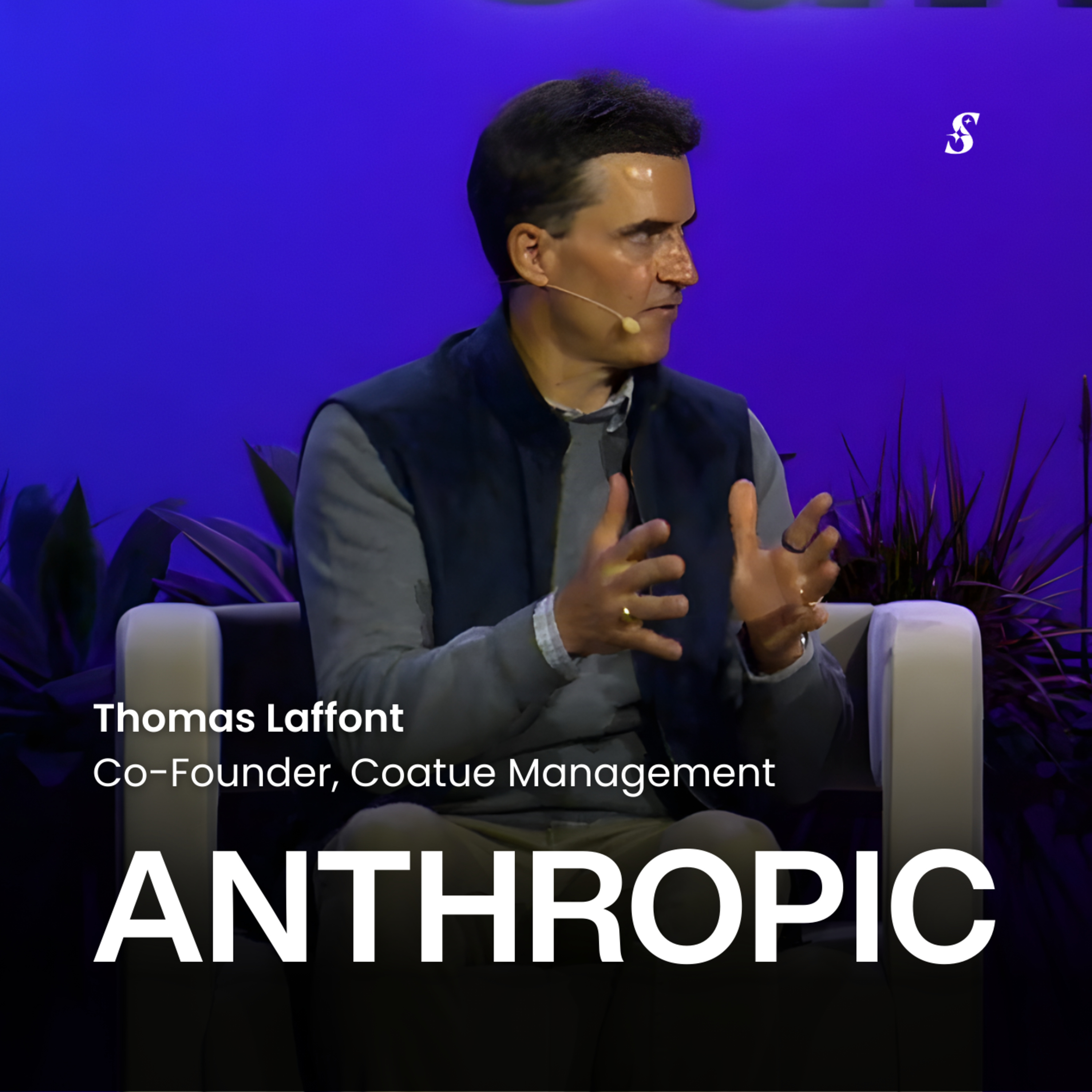
Thomas Laffont, Coatue - Anthropic, Citrini Paper, AI Volatility & Next Mag 7
About this episode
Thomas Laffont, Co-Founder of $70B AUM Coatue, joins Sourcery to break down how AI is reshaping both private and public markets—from Coatue’s investment in Anthropic’s $30B Series G at a $380B Valuation to the growing volatility AI is introducing across SaaS and the broader tech complex.
Recorded live at the Upfront Summit 2026 in Los Angeles on February 25th, 2026, Laffont shares his take on the Citrini “Global Intelligence Crisis” paper, why boardrooms are rapidly expanding AI spend, and which private companies could emerge as the next “Magnificent 7.”
We discuss:
• Coatue leading Anthropic’s latest funding round (recently hit $19B ARR)
• Why AI coding tools are spreading rapidly inside organizations
• The Citrini paper and how investors should interpret it
• Why SaaS valuations are being repriced
• The “Next Mag 7” candidates in private markets
• Coatue’s philosophy of Big Idea Investing or (“BFI) and risk management
Thomas Laffont: https://www.linkedin.com/in/thomas-laffont-02430914/
Molly O’Shea: https://x.com/MollySOShea
Sourcery: https://x.com/sourceryy
𝐄𝐏𝐈𝐒𝐎𝐃𝐄 𝐋𝐈𝐍𝐊
YouTube: https://youtu.be/otqg7UaZb4E
𝐒𝐏𝐎𝐍𝐒𝐎𝐑𝐒
• Brex—The modern finance platform, combining the world’s smartest corporate card with integrated expense management, banking, bill pay, & travel. https://brex.com/sourcery
• Turing—Turing delivers top-tier talent, data, and tools to help AI labs improve model performance—and enables enterprises to turn those models into powerful, production-ready systems. https://turing.com/sourcery
• Deel—Deel is the global people platform that helps startups hire, manage, pay, and equip anyone, anywhere. Trusted by more than 35,000 fast-growing companies, Deel is the people platform that just works, so teams can scale without the chaos. Visit: https://www.deel.com/sourcery
• Public–Investing platform Public just launched Generated Assets, which lets you turn any idea into an investable index with AI. With Generated Assets, you can build, backtest, refine, and invest in any thesis with AI. Gone are the days of one-size-fits-all ETFs. https://public.com/sourcery
Follow Sourcery for the latest updates!
Disclosure
Paid Endorsement. Brokerage services by Open to the Public Investing Inc, member FINRA & SIPC. Advisory services by Public Advisors LLC, SEC-registered adviser. Crypto trading provided by Zero Hash LLC, licensed by the NYSDFS. Generated Assets is an interactive analysis tool by Public Advisors. Output is for informational purposes only and is not an investment recommendation or advice. See disclosures at public.com/disclosures/ga. Matched funds must remain in your account for at least 5 years. Match rate and other terms are subject to change at any time.
𝐓𝐈𝐌𝐄𝐒𝐓𝐀𝐌𝐏𝐒
(00:00) Thomas Laffont, Co-Founder Coatue Management
(01:18) The rapid rise of Claude Code
(04:15) Anthropic’s revenue growth and trajectory
(05:25) Where capital is flowing: private vs public markets
(08:10) The Cetrini paper and AI market volatility
(10:15) Are new Claude releases hurting SaaS companies?
(17:22) Will AI reduce the number of engineers?
(19:38) The ATM analogy for AI and jobs
(21:02) Could autonomous agents automate investing?
(23:18) How Coatue got conviction on Nvidia
(24:18) Why TAM does not matter
(26:43) Running Coatue with his brother Philippe
Get every episode summarized
Each time Sourcery publishes, we email you a written briefing from the transcript — the topics, who appeared, and any specific claims, with the ad reads skipped.
Email me new episodesFree for 3 shows. No card needed.
Hosts & guests

Transcript ready
217 searchable segments. Every word is indexed and playable.
Full transcript
Sourcery — Thomas Laffont, Coatue - Anthropic, Citrini Paper, AI Volatility & Next Mag 7. Machine-transcribed; use the interactive transcript above to jump the player to any line.
In three or four years, if clot code can rewrite their entire business, that's harder for companies to control. It's one of those companies where depending on which day you're picking, you're going to kind of have a different metric. You're going to want to perform the index over a long period of time, you're going to need exposure to these companies. Some of them will probably go public in the next 12 to 24 months. It is unbelievable the amount of innovation that is now coming from this group of companies. Most companies are now reporting back to their boards the adoption of these tools inside of their organizations. They all want to make sure that they're using the best tools, that they're being the most AI-4. They don't want to be out competed by someone who's using those tools. And so there was a slide in one of the board meetings that said, look, we're spending X on this tool and we think it's way too low. We want it to be much bigger. We expect the spend to at least triple. I read this in 3D paper. I don't think that screaming fire in a crowded room is obviously productive or safe or frankly something you should do. And some people have kind of made that analogy to that report and I don't share that. You and your brother, Philly, run the firm. I promised not to make a brother joke.
But why does he have a French accent when you don't? First, before we start, big thank you to Mark and Carrie. That was a very lovely introduction. I'm quite flattered. I'm so excited to be back at the upfront summit this year. There's clearly lots of volatility in the market and a lot of fun, exciting things happening in AI. We have someone here who knows a lot about that and studies both the private and the public side of things. So today we have Thomas Lafont, partner at CO2. They manage around $70 billion on the private side. They manage around $30 billion. And most recently, I think this is your first interview since leading Anthropics $30 billion around. So let's start there. Did you expect when you invested into Anthropic that every quad release would break the market? It's been amazing and what's the evolution of the company even from when we first kind of started discussing this fundraise that just got announced to eventually when it did get announced.
Which usually in most of these processes takes about two or two to three months before company announces the fundraising kind of formally. What was interesting about this one is the projections and the scale of the business grew materially in between the fundraising kind of being discussed to eventually kind of being announced. And I think that speaks to just the incredible adoption of clock code in particular, which we can dive into. No, I don't think we predicted that clock code would take off as quickly as it did. I think it's indicative of a very kind of powerful trend that it's underlying that we can discuss. I'm actually really proud that the inventor of clock code, Boris, who's a friend, worked at CO2 for two and a half years developing software for us. He's been on an incredible trajectory. So it's funny. I was in a board meeting yesterday. And so I'm just off the cycle of maybe having done six or seven board meetings in the past few weeks.
And most companies are now reporting back to their boards, the adoption of these tools inside of their organizations. And I think it's a they all want to make sure that they're using the best tools that they're being the most AI for. They don't want to be out competed by someone who's using those tools. And so there was a slide in one of the board meetings that said, look, we're spending X on this tool. And we think it's way too low. We wanted to be much bigger. We expect we expect the spend to at least triple kind of next year on these tools. So, you know, when you see, you know, board decks are such a treasure trove of information, right, and insights. And so when you see the same kind of pattern repeating itself across companies, you know that you're onto something big. And I think all of them, by the way, whether it's cortex or clock code or others are benefiting from that. There's some quite viral charts about their growth. So when you invested, what were those metrics like? I mean, it's one of those companies where you can't even pin depending on which day you're picking.
You're going to kind of have a different metric, right. But they they publicly released as kind of part of the as part of this announcement, kind of where the revenue rose, right. And I think they disclose like in excess of 13 or 14 billion or something like that. I mean, it was definitely materially lowered when we started. I think also the fact is like these companies do live in a bit of a, especially these very late stage companies in kind of a quasi public or private environment, right. People do tend to know the revenue scales. Stripe, right, publishes an annual letter, which they just did kind of yesterday. They go on CNBC. They disclose a lot of their metrics, not all the metrics away a public company does, but they did disclose in Stripe's case as an example accelerating your over a year. Revenue, they disclose kind of TPV growth. So these are companies that even though they are private and not in the public market, you do have kind of some disclosure and kind of insights into.
Since we are in a room full of LPs and institutions, how do you think as pretty famous crossover fund from both sides? Value and capital shifting in the private markets in the next five years. Look, my default has been the public market investor. That's where we started. We started the fund in December of 1999. From when we started to about two and a half years later, the market was down 80% or that time frame. And so I do have to remind some of my colleagues who weren't there even maybe in a way that markets can go down kind of that much. So my default view has always been that the public market is the best kind of valuation mechanism. It offers transparency. It offers liquidity. It offers opportunity of access, right, which in a world where we now have Trump accounts is was kind of discussed on the state of the union yesterday, right, which are essentially accounts that are given to children when they're born and hopefully that can grow.
Over a long period of time, I do think giving access to the broader public to all of these companies is incredibly important. So I think that's either going to happen one of two ways, right? It's either going to have to happen where companies create and have incentives to go public or we're going to have to create more methods to democratize access to private companies. So I think it'll probably come from both ends, right? But regardless, if you think about the innovation of these late stage private companies or, you know, one thing we kind of look at is the max seven, which has been a significant driver of returns in the public market over the past few years has essentially kind of been flat over the past. And that's because Microsoft is an example as it has lost almost a trillion dollars of value over that time frame as people are questioning their positioning kind of an AI. So then that leads you to think, well, what would the max the next max seven look like or who would be other candidates to kind of fit into the index of the future. And I think the names that, you know, all of us in this room would probably think of our names like SpaceX.
So I do think it's a really important class of companies. I do think if you're going to want to outperform, you know, the index over a long period of time, you're going to need exposure to these companies. So, you know, some of them will probably go public in the next 12 to 24 months. So that'll be kind of one impact of it. But it is unbelievable. The amount of innovation that is now coming from this group of companies. We used to see startups disrupt other startups and now we're seeing startups and viral expose and the centreni research paper. Apparently, clobber markets. So with that kind of really like hot flash type of volatility, how do you as an investor think about management. Yeah, I read the centreni paper. Obviously, look, I, there's kind of a multiple minds on this, right? I don't think that screaming fire in a crowded room is obviously productive or safe or frankly, some of you should do. However, I don't view and some people have kind of made that analogy to that report and I don't share that right.
I do think bringing up these conversations early is really important. Right. I think by definition, if everyone thinks we're in a bubble, then we're not in a bubble. Right. So I think these, these points being brought up, preparing investors, preparing companies. Right. I'm very happy that in all of our companies, the sense of awareness about AI is incredibly high. That means that our companies aren't head in the sand. Right. So I think the fact that both for governments, for regulators across the world and for big companies to already be thinking about where this could be going is actually incredibly healthy. So I know that the volatility, trust me, is, is difficult on a daily basis and, you know, I live, I live through it every day, but I would much rather have daily volatility, daily questioning, then no volatility or no questioning and then like a massive crash, like three years later.
So I think the fact that all these questions are being brought up forces, governments, forces, companies, executives, founders to constantly be worried and also aggressive about what AI could do to their business. I think that's actually probably pretty healthy. I made a joke when we started that each cloud release is cluttering the markets and erasing hundreds of billions of dollars. Each cloud release is going after different categories of SaaS and so SaaS has been the pinpoint of the volatility. Do you think SaaS and public markets is going to stabilize to a different premium? Do you think it'll always have a premium? Where do you think it lands? Yeah, so I think it's a question that has a lot of different kind of variables. So I'll try and unpack at least my view into them. One of the things I try to explain to companies is you have to think about the opportunity cost and who's the buyer, right? The public market will continuously be comparing the value of your equity and the return of your equity versus others in the market, right?
And I think if you look at SaaS, part of why SaaS was so popular amongst investors for a long period of time is that SaaSters grew faster than other sectors. So you could kind of compound, you know, a lot of SaaS companies were compounding mid 20s to low 30s for a long period of time. There were no other companies in the market that could offer that kind of growth. And so obviously that was really attractive to investors. I think what's happened now is by and large SaaS companies have significantly decelerated, right? So I was on a workday earnings call yesterday, which is an interesting example of founder kind of stepping back in to kind of help lead this company through its next chapter. It's not growing organically revenues about 13%. So I think now investors are saying, well, you're not growing 30% anymore, you're growing 13%. And if I look at your multiple of earnings, right? And I look at gap earnings, which investors are increasingly turning to gap earnings as the gold standard, you're still trading high 20s to, you know, maybe 28, 30 times, right? In that range.
So investors are now saying, well, hold on, I can own a semi company, right? That's probably growing. Avago as an example is growing almost 40%. Right? Avago.com. And it's trading at a cheaper multiple of gap earnings. So I think it's a combination of decelerating growth and expensive valuation. So one of two things we're going to have to change either companies are going to have to benefit from AI and reaccelerate the top line. And I think if you again listen to the workday earnings call yesterday, annealed the CEO essentially set his job is to come in and reaccelerate the company through AI. So he's a product guy and, you know, I think he could do extremely well at that. We'll see what happens. So they're either going to have to reaccelerate, right? Or, right? The multiples are just going to start to rerate to where other companies in the market trade at. And that's, you know, some version of 20s times gap earnings. So to me, that's the dynamic that I see. And we haven't even talked about the threat of AI yet, right? That's even third bucket.
But the threat of AI for these companies isn't actually related to their current valuation or frankly, even their current business. It's more related to the terminal value of, okay, maybe some of these companies are not benefiting from AI today. They haven't reaccelerated. Okay. So it's not impacting the business today. But in three or four years, if cloud code can rewrite their entire business, kind of what happens. That's a much harder. It's a much more sentiment kind of driven. That's harder for companies to control, especially kind of in the near term. So markets will kind of flip a little bit over whether a company's well kind of positioned or not. And ultimately their product execution will determine that. But I think it's a lot of it is the combination of the first two factors now combined with questioning of the terminal value that's leading to, you know, the significant rewriting that we've seen in these companies.
Sorcery is brought to you by Brex, the financial stack trusted by more than 30,000 companies, including one in three venture back startups in the US. Nearly 40% of startups fail because they run out of cash. Brex is literally built to help founders avoid that. Unlike traditional banks that let your money sit idle, shipping away out it with fees, Brex's designs help you spend smarter and move faster. They're all in one solution, combines checking, treasury, and FDIC protection into one powerful account. You can send and receive money globally at lightning speeds, get 20 times the standard FDIC coverage through their partner banks and even high yield from day one. With same day and even same hour liquidity, access your funds anytime. Companies like Scale AI, DoorDash, Service Titan, HIMS, Anthropic, Flexport, Robinhood, and Plod trust and use Brex. Start today at Brex.com slash Sorcery. That's B-R-E-X.com slash Sorcery.
Turing is training the next generation of AI with tasks that require real expertise and real world judgment. That's why companies like Nvidia, Anthropic, Salesforce, and Gemini partner with Turing. Turing builds realistic reinforcement learning environments and data systems based on real operational traces. The kind of infrastructure frontier labs need to train superintelligence. Visit Turing.com slash Sorcery. Some of you may not have heard this yet, but our sponsor public just launched something called Generated Assets. And it brings AI into investing in a way I've honestly never seen before. Here's how it works. You type in an idea like AI-powered supply chain companies with positive free cash flow or defense tech companies growing revenue over 25% year over year. Public's AI then dispatches a swarm of agents that scan every single US stock, evaluates them, and instantly builds a custom index around your thesis. What really stands out is how clearly it explains why each stock is included. And before you invest, you can even back test your idea against the S&P 500.
So you're making decisions with real context, not just guessing. And beyond generated assets, public lets you invest in stocks, bonds, options, crypto, all in one place. They'll even give you an uncapped 1% match when you transfer your investments over from another platform. If you want to build a portfolio that actually reflects your thesis, visit public.com slash Sorcery. Paid for by public investing. Full disclosures in the description. Founders ship faster on deal. Set up payroll for any country in minutes, hire anyone anywhere, and get visas handled fast. So you stay focused on scaling. Deal takes care of onboarding, HR, IT, ER, benefits, and compliance. So your team can grow without borders. It's why more than 37,000 fast growing companies trust deal to move fast. Visit D-E-E-L.com slash Sorcery. That's D-E-E-L.com slash S-O-U-R-C-E-R-Y. So there's around 400,000 estimated software engineers in the Bay area. Do you think there's going to be more or less of them in the next five years?
Yeah, I mean, that's kind of the 64 trillion dollar question right of today. What I can tell you is not a single one of the companies that we're kind of involved with is saying, wow, we're seeing so much more efficiency. We want to car engineering staff in half, right? What they are saying is we hope our engineers are significantly more productive so that we can do way more things. So that we can do features that have never been enabled before, right? And so you could think of companies like a cursor in R&D or rippling in S-G-N-A, right, payroll. Well, what if they move actually from selling you software, which is kind of what they do today, to selling you work, right? Which is kind of different in one year in HR software company and in the other, you're saying, I'm actually selling you HR. So what does that mean? Well, that means, well, as you know, companies have to hire HR people that have to handle a lot of incoming requests from employees about, okay, why is my payroll different this month and last month?
You know, why did my computer benefits not get approved this month or why was I not reimbursed for this, right? And there are just tons of kind of daily actions that are generated. Well, actually, what if I could have the system kind of handle most of those for you, right? So now I'm actually not selling you software that an HR person will use. I'm actually selling you the work of an HR professional. That might mean that my current HR professional now can be repurposed into something that was not strategic but important operationally into something that's way more strategic. Like maybe we need to review or redo our review process, right, or maybe we need to rethink how we recruit our engineers or, you know, whatever. So I ultimately believe I'm not a doomer, right? And I love kind of the bank teller example. I think it was cited in the in the report in case you haven't read it. But in the 1970s when the ATM started being introduced, there was a famous New York Times article that called and said, look, branch tellers are dead.
They were going to see 70% reduction in branch teller jobs. And actually what I ended up happening from the 70s pretty much through the early 2000s was an explosion in bank teller jobs. So what happened? Well, the ATM brought the cost down of branches by a lot, which means companies were able to introduce way more branches, which means that maybe you had fewer employees per branch, but you had so many more branches that you overall kind of tam increased, right? So I think it still remains to be seen what kind of the impact will be if engineers in the US become so much more productive. Maybe you'll have fewer outsourced engineers in India as an example, right? So there's just a lot of different dynamics that play. I can tell you for us, we're not looking to cut our investment staff or our, you know, in half, we're hoping that they can do significantly more things and analyze more companies and just be better at their job.
If that's possible, we'll want to hire more of them kind of not less. I had Michael Barton, sector head at the hedge fund on the podcast a couple months back and he was saying, and I'll clip this and it'll go viral, but he said that 85% of his job could be automated. He could get AI agents to automate that work. How are you and co to thinking about experimenting with autonomous agents? If you are, if you have a ton of Mac minis around, I'm not sure. How are you thinking about that within your own organization? We do. So we brought in someone that recently from Goldman Sachs, who's a cloud native and is really pushing us everywhere in the organization to kind of adopt, you know, coding first kind of approaches. So we're definitely spending a lot of time on that. I do think there's an element, especially to big idea investing, which is something that I spent a lot of my time on and frankly, enjoy the most that I do think is creative and ultimately how machines will do that will see or they just assisting the creative process or they replacing the creative process.
To me, big idea investing is both the creative and actually reflective of someone's kind of taste at the end of the day, right? I remember when the iPhone first came out, right? You know, some people liked it and some people thought, no, it needs a keyboard or it doesn't support flash or it doesn't have 3G, right? These are all the things that were pitched against the iPhone in 2007, and obviously we kind of know how that kind of turned out. I see it definitely for myself as it enables me to express myself in much more interesting coherent ways. I use all of these tools every single day for different purposes, whether it's communicating an idea, whether it's replying to an email, whether it's thinking through a difficult situation. If you don't use these tools for that, I really encourage you to. They're incredible at just teasing your brain and evaluating different scenarios. So, yeah, so for now, I'm investing a lot of my personal time just on how to use these tools and I found that they make me better.
I did hear from a couple of your employees that you are the big idea guy. You were the one who brought in Nvidia, you got conviction on it. Can you talk about Nvidia for a second and then also how big ideas permeate throughout the organization? Yeah, I mean, I love big idea investing, right? I think we have a moniker internally, which is a BFI, which you might guess stands for a big fucking idea. And the reason that we keep kind of the swear word in the middle is when you hear BFI and you hear a big fucking idea, it's jolting for a little bit, right? This is what hold on and that's what a big idea kind of should do. You know, I personally have a view that a lot of entrepreneurs when they pitch you an idea will come and pitch you a tam, right? And it's usually big and it's hundreds of billions or whatever. And I have a personal view that I've developed, which is actually the size of the tam is irrelevant. So I never listen to whenever an entrepreneur will pitch me a tam, I really don't think about the tomb.
I think about two things. I think about number one, whatever number you want to give me for a tam, a hundred billion, seven trillion, you know, doesn't matter to me. But what I do think is, is that tam going to grow between now and let's say the next five or 10 years. So pick whatever baseline you want is the tam going to be two or three X larger in over that time frame. So that's number one, a canonical example, right, is kind of the taxi tam. It didn't really matter what the taxi tam was, right? What mattered was it actually ended up growing five or 10 X because Uber created less friction and kind of grew the entire market. So I care a lot about tam growth over time. That's point number one. And then I care a lot about additional tombs. Okay, so you had one tam initially now you've added another tomb. So continuing the Uber example would be now you've added grocery and you've added food, right?
So to kind of finish on that example, what that means to me is essentially the tam that Uber had initially wasn't kind of super compelling. What was compelling is the fact that number one, the tam grew significantly because of its product. And they added additional tam over their course of their life. And to me, the best companies Apple and iPhone is another phenomenal example, right? I was very lucky to be the analyst on iPhone and Apple for basically starting in 2003 and for almost the next 20 years. And it's kind of hard to imagine. But one of the bare cases as the iPhone was kind of getting started and building momentum was that there just wasn't enough tam for the handset manufacturers, right? They already represented like 150% of the gross profit of the handset industry, right? They were making money and all the others were losing. Well, what ended up happening? Well, that tam grew massively. And in fact, the number one thing that we got wrong in our analysis of Apple in the early days is we had the price of the phone declining 5% in 5 years, right?
Because that's kind of what you did as an analyst. You had to put declining SPs and in fact the opposite happened or the price increased. So the tam performs increased massively and then guess what? They add additional tam through services and kind of other things like that. So you and your brother, Philippe, run the firm. I promised not to make a brother joke, but why does he have a French accent and you don't? You know, sometimes people really, really wonder if we are related and you know, it's purely a function of of age and when we learned English, you know, I was lucky to learn basic English when I was 10. And I think I was just old enough or young enough to be able to somewhat mimic a US accent. He's nine years older. So, you know, by the time he kind of really started to be fluent in English and learning English, the vocal cords were just more set.
And so, you know, you can see it both ways. But you know, I'm still able to once in a while if I really, you know, yes, if I'm in a bar maybe with some friends and you know, but so there you go. What is the biggest lesson that you've learned from Philippe? I think that if you think about our firm, I always say there's kind of two key components. And one is talked about a lot and the other isn't the first one is again, it's de-innovation investing. It's the big idea investing. It's trying to find trends early like Nvidia and others, but that's really kind of half. I think the other half is kind of risk management, right? So, if you look again, I mentioned to you that the market was down 80%. When we started, I think your formative years as an investment manager will kind of just stick with you like a face tattoo over the next kind of decades, right?
And so, we think our ability to manage risk and to constantly be thinking about risk, right, is why we're still around almost three decades later. We don't get everything right and we've certainly made mistakes over time. But we think the ability to endure and compound is what really defines kind of generational investing firms. And so, we're continuously thinking about different risks that could be in not making an investment. It could be in seeking liquidity in a secondary or in a public market when maybe it's not the most invoked thing to do. But that focus on risk management, I think he's one of the best in the world is that. And I think has kept us right in business for that period of time. Amazing. Well, we are out of time. So, thank you so much Thomas. All right. Thank you. Hey, it's Molly. If you enjoy our interviews, check out our newsletter, sorcery.bc, where we deliver a once a week top deals and tech headlines email and also go deeper on our podcast interviews.
Subscribe to sorcery today. And don't forget to subscribe to the podcast on YouTube, Spotify, Apple or wherever you listen. Link in description to sign up.
More episodes
More from Sourcery

Skydio HQ Tour: Skydio Commits $3.5 Billion to Expand U.S. Manufacturing
Sourcery
Skydio Raises $110M Series F at $4.4B Valuation | CEO Adam Bry
Sourcery

General Catalyst's First-Ever Quarterly Review | CEO Hemant Taneja
Sourcery

Financial Advisors Are Cooked – Public Co-CEO on the Great Wealth Transfer
Sourcery