About this episode
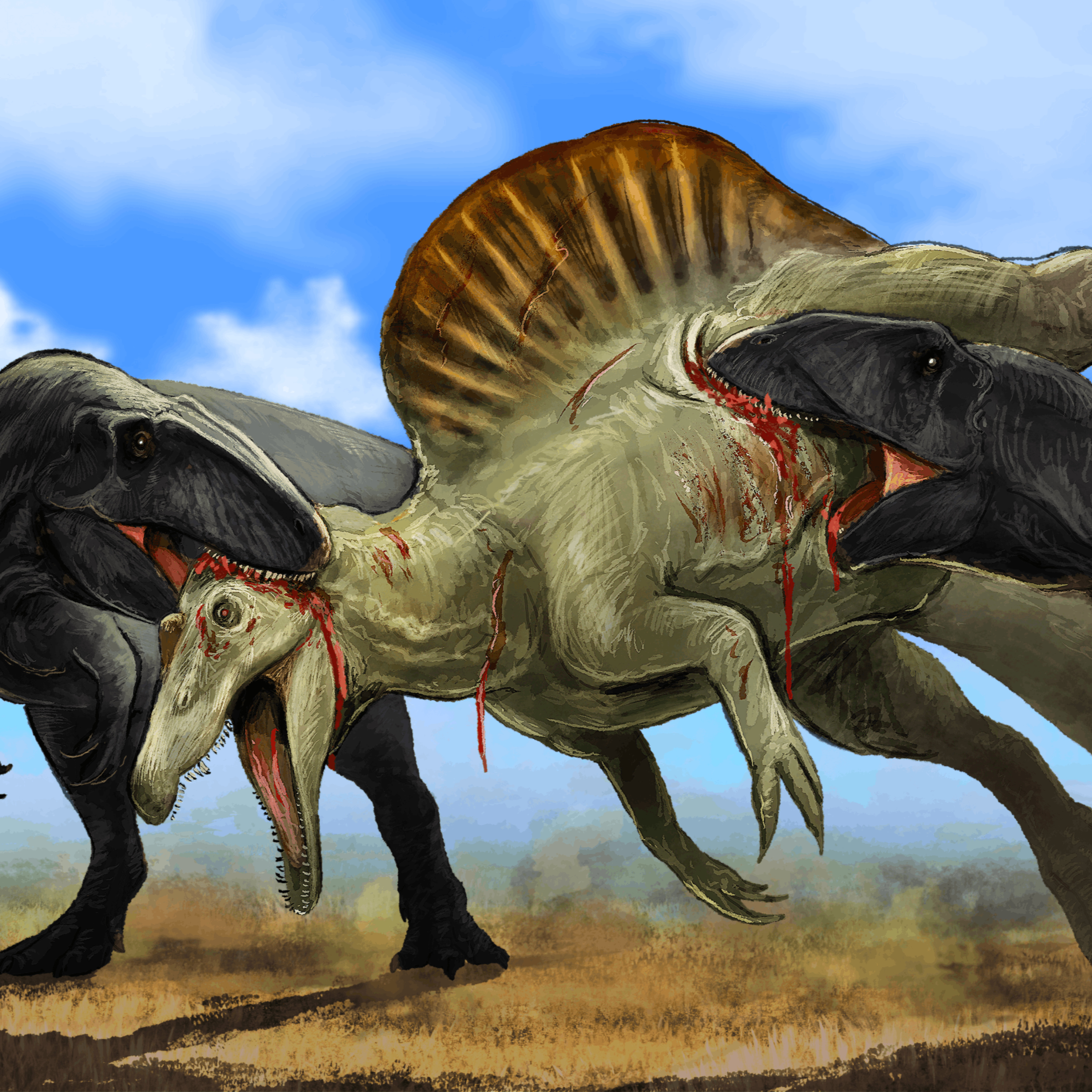
The T. Rex was the sworn enemy of the Spinosaurus, we all know this of course. The only thing is... it wasn't, and the two never even met, being separated by both time and place. BUT, there was a giant predator that did live alongside the Spinosaurus and definitely gave it a run for its money...
Get every episode summarized
Each time ExtinctZoo publishes, we email you a written briefing from the transcript — the topics, who appeared, and any specific claims, with the ad reads skipped.
Email me new episodesFree for 3 shows. No card needed.
Hosts & guests
Transcript ready
355 searchable segments. Every word is indexed and playable.
Full transcript
ExtinctZoo — This Was The Spinosaurus's Real Opps. Machine-transcribed; use the interactive transcript above to jump the player to any line.
New spring arrivals are at Nordstrom Rack stores now. Get ready to save big with up to 60% off Ragnbonne, Mark Jacobs, Free People, and more. I don't know no rack as a deeter, because there's always something new. Join the Nordic Club to unlock exclusive discounts, shop new arrivals first, and more. Plus, buy online and pick up at your favorite rack store for free. Great brands, great prices. That's why you rack. Score more with the college branded Venmo debit card and earn up to 5% cash back with Venmo stash. Got paid back? With the Venmo debit card, you can instantly access your balance and spend on what you want, like game day snacks, gear, tickets, and more. The more you do, the more cash back you can earn. Plus, there's no monthly fear minimum balance. Sign up now at Venmo.com slash college card. The Venmo master card is issued by the Bank Court Bank NA. Select schools available. Venmo stash terms and exclusions apply at Venmo.me slash stash terms. Max $100 cash back per month.
Approximately 99 million years ago, the late Cretaceous was in full swing, and one of Earth's largest therapists to ever live was busy stomping and swimming around in Northern Africa. And this was, of course, the Spine of Soros Egyptiakis. It was an absolute beast of a carnivore that measured up to 14 meters or 46 feet in length, and possibly waited to 7.5 tons, or maybe even 8 tons. And it's sheer size, and the fact that it had a funky build, which obviously included the massive sale, has resulted in an int over the years, becoming one of the most well-known dinosaurs out there, and a fan favorite, mine included. And a lot of this also has to do with its portrayal in a third drastic park, where it was pitted against the infamous T-Rex, leading to perhaps one of the greatest fights in the dinosaur community, and contributing to the idea that these two were sworn enemies. And yet, the pair never met, not from a time perspective, or even a place perspective, with the Rax living in North America, not Africa. However, with that said, there was actually a therapist that did live alongside the Spine of Soros, which challenged its reign and was equally ferocious in its own ways, possessing a bite so catastrophic and lethal that it's often referred to as a giant land shark.
And this would be the Carcordontosaurus. Now, if you are a true fan of dinosaurs, or this channel, I imagine that you've already heard of this name at least once. As in the last decade, the Carcordontosaurus picked up a lot of well-earned steam, beginning a rather recognizable therapist. With that being said, while this dinosaur has been popping off only recently, it has been known to the paleontological world for far longer, with its discovery tracing all the way back to 1914, when a partially completed skeleton was an Earth in Egypt near the Bajaria Oasis, by a German paleontologist. Unfortunately, there was a lot of political tension in the region at the time of that find, resulting in it taking multiple years of skeleton to move at all, only being sent to Germany in 1922. And even then, it would go on a sudden storage from additional 9 years, just collecting dust, before it was finally described by Ernst Stromer, who recognized this discovery not only represented a new species, but also a completely new genus, resulting in describing the specimen as Carcordontosaurus Sehericus. The species portion of the name, Sehericus, was a nod to where the body was unearthed, while the genus portion meant the shark toothed lizard, which was a reference to the absolutely
nightmarish teeth in this bad boy, which shared an uncomfortable resemblance to the teeth of a great white shark. In addition to its very, let's say, peculiar dentition, it was also observed that Carcordont osaurus possessed a multitude of other features that made it anything but your typical theropod. However, right before the research on the Carcordontosaurus was to be released, Tragedy struck, as the place the skeleton was housed in ended up taking a bomb to it during World War II, and thus leading to its utter destruction, along with eradication of many other valuable specimens. Fortunately for the world though, the Carcordontosaurus did not suffer the same final fate as other specimens did in lieu of World War II. As following the clothes of the war, more skeletons belonging to this imposing predator were found, allowing us to better understand the many reasons why Carcordontosaurus was such a successful predator in a land already filled with the brim with other carnivores, as well as, of course, a plethora of tough herbivores. And it seems that one of the more important reasons, on how it became a nearly unstoppable killing machine, was simply thanks to its ridiculous size. Now, the Spinosaurus alone was already one of the largest carnivorous dinosaurs of not only the entire Cretaceous, but of all time.
Yet, I guess there wasn't enough for North Africa, as it apparently said, let's run it back. And boom, then we got the Carcordontosaurus, who was, like its neighbor, one of the largest carnivores to ever walk, period. Yet with that said, this glory does not extend to all Carcordontosaurus's. As in 2007, a new species, dubbed the Equidences, was ascribed, and was stated to only have measured about 10 meters or 33 feet in length, in a way to maximum around 4 tons, making it about the same size of the Tyrannosaurus, Gorgosaurus. And while this is undoubtedly still large and very impressive, these measurements are not enough to make until the list of Earth's largest megatherapods. But the original species, Sehericus, that was a whole different story, as it got far larger. In fact, in 2007, it was estimated that full-grown individuals would have measured a whopping 13.3 meters or 44 feet from stout detail, in a way to Titanic, 15.1 tons. Which if true, meant you could fit over 15 polar bears into a single individual, and giving it an edge over the likes of even the T-Racks. But, as you can maybe tell, these were overestimates.
But it still was an absolute unit, with the most current estimates usually suggesting a length closer to 12.5 meters or 41 feet in length, while standing as tall as an African bush elephant at its hips. And scientists do think it would be occasional mutant, so you could say, exceeded these measurements, with larger specimens possibly being over 13 meters or 43 feet in length from stout detail. And this length that was obviously heavy, yet it turns out that it wasn't really 15 tons, instead weighing at most 7 tons. Which, for perspective, is still over 100 times heavier than your average global joe, while the more fair-sized individuals were thought to have been closer to 5 tons. So, similar in weight to that of an African elephant. And at this size, the Carcordante source is often considered to be the 5th largest therapy pod to ever live. Which also means that it's literally the 5th largest carnivore to ever walk. Which is, certainly impressive, and also means that it's not something I'm necessarily trying to see in person, if, and get my drift. As mentioned, its body size is not the only thing that animals had to worry about when dealing with a Carcordante source. In fact, one could argue that the true weapon to Carcordante source wasn't its length
or weight, but rather, it's seriously nasty bite. As within the mouths of every Carcordante source, you would have found at least 60 nightmares chompers that were as long or even longer than Swiss army knives, and just as sharp. And then on top of that, they were also lined with a vast amount of serrations, about 20 per 1 centimeter, or is there a point for inches of edge. In other words, each tooth had hundreds of these serrations. And so then, when you combine all these, um, pleasant traits together, you get teeth that are eerily similar to that of jaws, i.e., the great white shark. And terrifyingly, on a much, much larger scale. And thus, as a result of this, Carcordante source is capable of shearing massive chunks of flesh, muscle, and other grubits, off of large prey with just a single bite, with its serrations at unique mini-sauz that added additional pressure to each point of contact, making each bite just that much more deep and devastating. And all this carnage was only exacerbated by the fact that its skull was also ridiculously large, too, even when you consider its overall size. In fact, the most completed skulls paleontologists have found rival those of even the T-Rex,
coming in at 1.6 meters, or 5.2 feet in length. So for perspective, basically the size of a gray wolf's entire freaking body. However, unlike the skull of the T-Rex, the Carcordante source's skull was built with much more grass-style and lighter, as it did not rely on a crushing bite to finish animals off. Rather, it leaves lighter or weaker bites, that rely on its teeth more than its muscles to tear and slice, provoking major blood loss, shock, and traumatic amputation, which honestly sounds a bit worse than getting crunched, in my opinion. And don't get it twisted. This isn't to say that Carcordante source had a weak bite, either. As at its maximum power, it still mustered over 11,000 newtons of force in the front teeth, while the back teeth registered at 25,000 newtons of force. Making it 39% more powerful than that of a gray-to-white shark, and that of a saltwater crock. And so clearly at this power, its teeth would have no problems slicing through soft flesh, and even hypothetically bone. Yet, because its teeth were more nimble and slender, it probably would have at least tried to leave the harder bits alone, to avoid the need to go to a dentist. Instead, folks can then power more on removing entire sections of soft tissue from large
animals. Yet, even when silly aiming for the more vulnerable parts of the dinosaur, it does seem that hunting got extremely bloody and messy. For the Carcordante source, that is. Needless to say, definitely for the prey. As paleontologists have discovered that the Carcordante source had one of the highest tooth replacement rates of all therapods, indicating that it was common for teeth to become lodged and meat during attacks. And so conversely, this higher placement rate would have helped mitigate the cost of biting the odd bone, or two. In other research in the hunting patterns of the supersized killer, revealed that it was likely an ambush predator, as it possessed by an ocular vision and a skull angle which was comparable to that of a crocodile. Indicating that it probably scoped animals out, using motion parallax, while using its narrow binocular vision to judge the distance from its prey and how to time attacks, before then using its long, powerful legs to run down the unsuspecting dinosaur, with surprising speed. As its hollow, slender nature made it relatively fast for large therapod, let alone a fifth largest ever. And to go along with a steadily bite, the Carcordante source actually possessed yet another weapon that was surprising located on its skull, its crests.
You see, on every individual you would have found bony bumps that ran along its elongated nasals exposed sides. And in life, these bumps were probably extended by keratin chiefs, creating something akin to a horn or a battering ram. And while it's not actually searching what these horns were used for, in recent times, paleontologists have started to believe that they were likely used to butt heads with other Carcordante sources, perhaps during fight over mates, territory, or resources, while also possibly being used to not prey off balance and then allowing for a better place bite. So, really bad time for any herbivore here. Now despite its head possessing its most important and lethal features, this therapod had a bunch of other tricks up its sleeves, or rather scales, that allowed it to be commonly undisputed apex predator, one of which was actually its arms. Now contrary to the popular belief that therapods in general, and especially the large ones, have only fairly tiny and useless vestigial arms, the Carcordante source had anything but that, and its arms were routinely used whilst hunting. In life, they were sighted longer than the arms found in the T-Rex, and were deceptively both robust and muscular.
Inside his belief that these arms were used, the grasp and hold on to prey in order to prevent any escapes. And it also may have used its arm to literally lift prey up as well, with one study in particular suggesting that an adult Carcordante source was capable of- The world moves fast, you work day, even faster, pitching products, drafting reports, Microsoft 365 Co-Pilot is your AI assistant for work, built into Word, Excel, PowerPoint, and other Microsoft 365 apps you use, helping you quickly write, analyze, create, and summarize. So you can cut through clutter and clear path to your best work. Learn more at Microsoft.com slash M365 Co-Pilot. Picking up a halftun dinosaur, straight off the ground, and then lifting it into its mouth. So in other words, for the halftun animals with Cretaceous North Africa, this theropod was straight up the boogie man. Additionally, the hands themselves were possibly used as slashing weapons, as each digit was equipped with a sharp recurve claw, which shockingly could even be longer than some of its teeth.
And so, this combination of its arms, teeth, vision, and size truly made the Carcordante source a walking nightmare that every other dinosaur must have dreaded to encounter, including by the way, itself. As over the years, multiple specimens have been found with varying breaks, infections, and puncture marks, usually to their heads, that have been suggested to come from their own kind, giving the idea that fights amongst the titanic predator were actually commonplace, not an exception. The puncture wounds and infections are often attributed to facial biting, whereas the breaks and bones are speculated to come from head-on collisions between two individuals crests. But because paleontologists aren't positive on how durable the crests truly were, it's not 100% certain that they were behind the breaks and fractures that are often seen. Now, while these inter-species fights must have been a welcome sight for other animals, as it meant they weren't the targets, right now, the Carcordante source, unforeseen for them, still spend most of its time hunting, rather than starting beef with its own. And it's believed that these unfortunate victims insisted mainly of a mix of our nithopods, smaller theropods, and then even the giant sauropods, which actually they were possibly
even specialized in, being just about the only predator in its region that could threaten a large one. So clearly, the Carcordante source definitely lived up to its name, and gave its family a terrifying reputation. And you might think that being a big scary theropod equals, well, a tyrannosaur. But it wasn't. Instead belonging to a completely separate family of theropods, known as the Carcordante Sourday, who were obviously named after our main character here. They first appeared in the fossil record during a latter part of the Jurassic period, and quickly spread throughout most of the world, with fossils being found in Africa, Europe, South, and North America, plus possibly Asia and Australia too. And during their existence, this group produced some of the most terrifying and largest predators to ever live, including the Carcordante source, obviously, as well as all species more closely related to it than to the Alessaurus, Senniraptor, Monolophosaurus, or the Crylophosaurus. And once you filter them out, you're left with the likes of the Jiggenotosaurus, Moposaurus, Acrocanthosaurus, and the Tyrannot Titan, which were all absolute units. And so unsurprisingly, many members became extremely successful apex predators, with the Carcordante
source, of course being no exception. And it was also able to spread far and wide, but it's remains being found throughout North Africa, such as in Algeria, Morocco, Egypt, Niger, and Tunisia, where it was in fact quite common. And it lived in these lands, specifically between 100 and 94 million years ago, during their earliest stage, the late Cretaceous, the Sennamanian. And of course, when you go back that far, the world becomes very different. The North Africa was no exception to that. Currently, much of it is preoccupied by the giant Sahara Desert. Back then, it didn't exist, and the region was relatively wetter, having made it to tropical humid zones, with a bit of arid regions sprinkled in as well. And then to add on to that, higher sea levels of the time also resulted in the coasts reaching much deeper into land, and partially cutting up her continent down the line, leading to more rivers forming over time, and creating the presence of sprawling wetlands, forests, and mangroves, where gemnospirms and ferns were the dominant flora. And this all helped to create a very rich hotspot for life, which included a plethora of different dinosaurs. And because the Carcordontosaurus, specifically, is known for many of its region's formations,
which were all extremely diverse, we know for a fact that it will have a long side of huge range of dinosaurs, that included the likes of giant sarpods, like Egypt's osaurus, Dicreosaurus, Herbaca'saurus, and Parallel Titan, as well as several types of encountering dinosaurs, iguanodontia, padrosaurus, and even, some of the last Stegosaurus. On top of that, the Carcordontosaurus also lived alongside numerous of their pots, which included the Abelosaurus, Ruegops, and Delta Dromeus, plus the enigmatic giant Bajaria osaurus, and a few other genera that have yet to be identified. And what's crazy is that a shocking amount of these potholes actually came close to rivaling the size of the Carcordontosaurus, and then there was of course a spider-saurus as well, who even outsized it. And due to it having such a high number of large predators in sarpods, many made the comparison in northern Africa, the Jurassic Morse information in North America. And it's believed that these partitioning would have played a big role in mitigating conflict between their pots, with dinosaurs like the Spinosaurus, sticking closer to water, and hunting more specialized aquatic prey, while the Carcordontosaurus preferred to stay a bit more dry, living farther inland, and specializing in megafauna dinosaurs.
However, with that said, there is no doubt that conflict still rose from time to time, especially because, similar once again to the Morse information, northern Africa seems to have been prone to dry seasons that could linger on and become quite extensive, leading to large drops in resources, and causing what would usually be avoidable confrontations. And that, my friends, is where the juicy question comes in, which is, who takes who in a fight, a Spinosaurus, or Carcordontosaurus? And obviously no one knows how this fight would go for sure, but I reckon that it would have come down to the specific Spino, or Carc involved in the battle. On paper, the Carcordontosaurus and much better suited for taking down another giant animal, seeing that, well, that's what it was designed to do. Possessing a much more devastating bite, that could definitely inflate the monstrous damage in one go, whereas the Spinosaurus had a bite that was better for gripping and piercing slimy prey. So, not so great for inflicting mortal damage to something as size of a Carcordontosaurus, and unlikely we would have taken multiple bites from a Spinosaurus to have taken down our boy. But, there are two things we still have to consider. The first is that the Spinosaurus had massively long and robust arms, they came equipped
near equally giant claws, in its day-to-day life, these arms and claws were used to handle and manipulate the absolutely massive fish in the area, as well as rake their bodies apart. In their foreign battle, they could have doubled as devastating sloshing weapons, with a well-placed strike, causing serious damage, while also giving the Spinosaurus a reached advantage, so to speak. Now, the other part of this equation is the size difference, as overall the Spinosaurus was able to get larger than the Carcordontosaurus, and a doubt a four-toned carc, for example, is going to be eager to take on an eight-toned Spinosaurus, let alone beat it. And frankly, at those size differences, I think the Spinosaurus would win just out of pure intimidation. On the flip side, I do reckon that a six-ton or heavier Carcordontosaurus could probably take on just about any Spinosaurus. Primarily because again, it was designed for dealing with large, tough dinosaurs. Not to mention the fact that it also had its horn-like crust, that could have been used as another asset in battle. But again, this was probably not a likely scenario, regardless. And another thing that would have helped North African therapists avoid, fights with each other, was the extremely high presence of non-dinosaurial life in the region, that
could be then used, of course, as alternative food sources. And their presence was largely thanks to the coastal regions and large amount of biomes that created an abundance of their life, the lengths of which is rarely seen in other Cretaceous formations. As for starters, at least 11 different dinosaurs were known to have lived in the same ecosystem as the Carcordontosaurus, which included tapajerids, inhanguaridae, or nithocyrae, and as darkids, with a huge range also being seen in size. With some being small to medium-sized, while a few were able to reach over 20 feet in wingspan, and stand taller than the vast majority of people. Unsurprisingly, Cracodale morphs were also plentiful, and got into some of that giant juice as well, with multiple genera being absolute giants, such as the Echusuchus, making any venture into, or simply near the water, a rather questionable excursion. And perhaps one reason why both the Crocs and Terraceurs were able to get so large, was the fish in the area, as dozens of species were known of, of which some of them actually represent some of the largest freshwater fish to ever evolve, like the absurd Seedlecant Mosonia. Snakes, turtles, lizards, crustaceans, and insects were just some of the other residents
as well. Unfortunately for those with the Entimophobia, which is, by the way, the fear of insects, we know that there was likely a lot of them. As much of the fossilized flora found in the region, show extensive signs of having been munched off by bugs. So bring some bugs, Bray, though to be honest I doubt it matter much when one of the many terrors of this region started to come straight for you. But in the end, while the terrors were a pretty common place here, I do think the very worst thing could have encountered, as far as survival odds go, was a big, gold, Cracodale sauce went hungry. As it was without a doubt, one of the most fearsome apex predators in the entire Cretaceous, and it would end up making its mark in the land and its inhabitants for over 5 million years. So, it's a whole lot of carcorder down to sources. But it does seem that being the fifth largest land predator to ever live, is still not enough to beat the final boss, which is, Mother Nature of course. As roughly 94 million years ago, our protagonist, abruptly disappeared from the fossil record, which is, the plan way of saying that it went super extinct. And as of now, it's not really known what exactly happened to this predator, but if this
appearance does early line up well with the Sennomanian-Toronian boundary event, which was appeared at a time when oceans all across the world have become inoxic, in other words, void of dissolved oxygen. In fun fact, and, thankful fact, this is actually considered the last time the planet has truly experienced a global inoxic event. And, like the disappearance of the Carcorder down to source, you could say that the cause behind this event is not fully understood, with many varying ideas being suggested, especially a cooling event that it occurred just prior. Whatever the situation was though, the point stands that life was heavily impacted, and this event ultimately became an extinction event. The peculiar thing is though, the vast majority of the pain was seen in marine life, not terrestrial life, which is why it's hard to pin the Carcorder down to source's disappearance on it. But, regardless, one thing is very, very clear. By the time the asteroid arrived to the Earth, 66 million years ago, this mighty beast was already long gone. Thanks for watching, and until next time, on Extinct Zoo.
More episodes
More from ExtinctZoo

When Amphibians Were Earth's Main Source Of Nightmare Fuel
ExtinctZoo

Here's What Happens When A Whale Swallows You
ExtinctZoo

Earth's Deadliest Flying Predators From Every Single Period
ExtinctZoo

When The Sahara Was A Jungle
ExtinctZoo