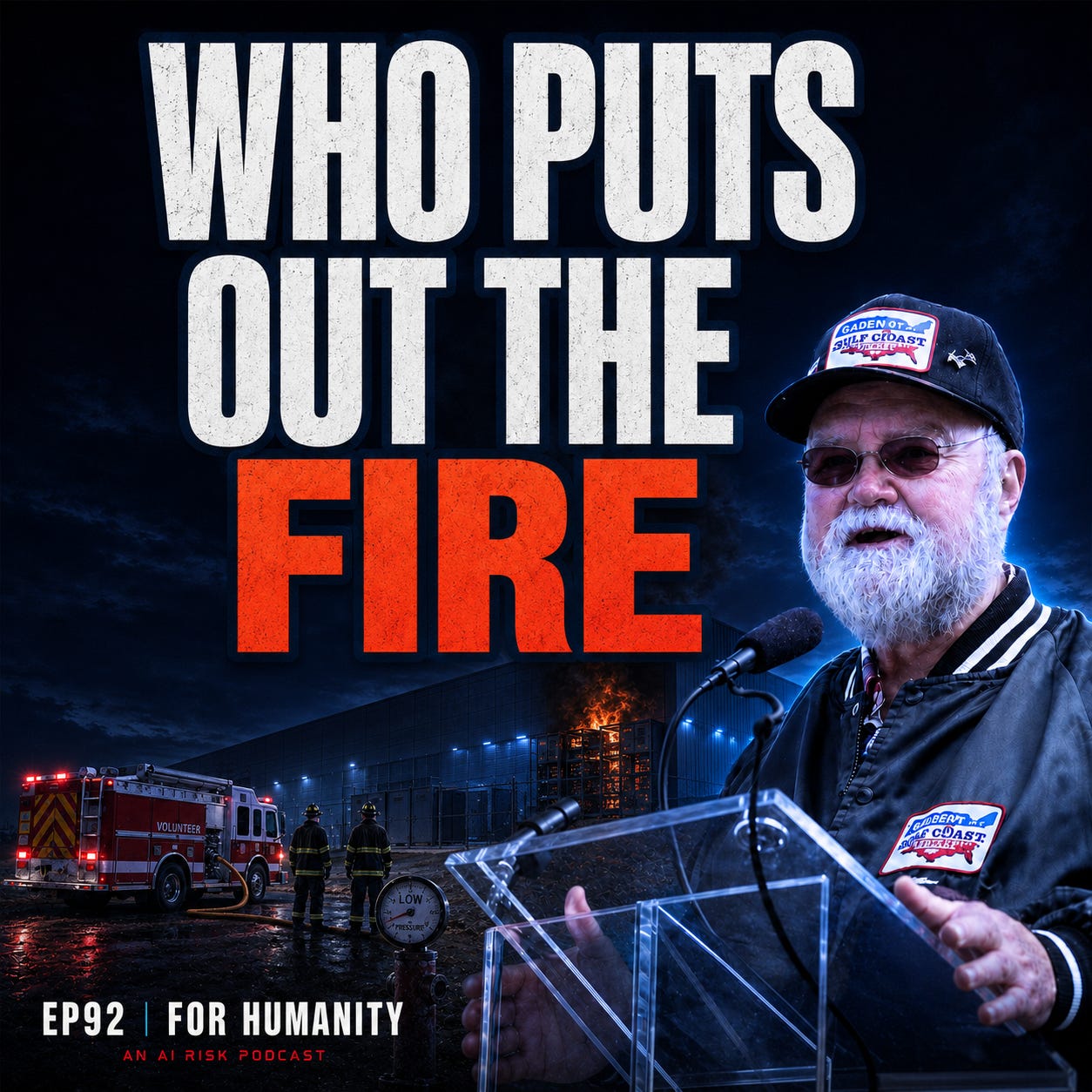
The Volunteer Fire Department's Plan Is To Watch It Burn
About this episode
Three-quarters of Americans say they do not want a data center built near their home. That is the finding of an August 2026 Heatmap News and Embold Research poll of more than 2,000 registered voters, up from roughly 43 percent opposed just a year earlier, in August 2025. Opposition has climbed almost every time it has been measured since.
David Senter is watching that shift from the ground. A fourth-generation Texas farmer and president of the American Agriculture Movement (AAM), he has spent close to fifty years advocating for family farmers and ranchers. On this week’s For Humanity, he tells John Sherman what has changed: wells running dry, land bought with no public hearing, and a question few of these towns have had to answer before: what happens if one of these buildings catches fire?
The 60-second version
* AAM says it passed a unanimous resolution in January opposing data centers on farm and ranch land. No public copy of the resolution text was locatable to verify the exact wording, so this is Senter’s account, not an independently confirmed document.
* A University of Texas at Austin study found data centers could consume between 3 and 9 percent of the state’s total water supply by 2040, concentrated in regions that already depend on a declining aquifer.
* Two fire codes, NFPA 855 and UL 9540, require lithium-ion battery systems to be separated from other structures with dedicated spacing and enclosures. Senter says he has not seen a data center built that way in the rural areas he tracks.
* A named Texas rancher has testified to state lawmakers about a project’s expected water draw and his concerns for his herd. Independent scientific evidence linking data centers to livestock health outcomes broadly does not yet exist, according to a recent fact-check.
* National opposition to local data centers has climbed from about 43 percent a year ago to 75 percent today.
The water math over farm country
West Texas sits on part of the Ogallala Aquifer, a fossil water source that recharges far slower than it is being drawn down, and farmers there have relied on it for irrigation and livestock for decades. Senter describes wells, streams, and ponds already drying up in areas where data centers have moved in, and says operators are often not required to report how much groundwater they use.
A University of Texas at Austin research report found that, depending on growth and cooling technology, data centers could account for 3 to 9 percent of Texas’s total water consumption by 2040. Individual hyperscale campuses can draw up to five million gallons a day, comparable to a small city. Five proposed or under-construction projects sit directly on or near the Ogallala, and in April 2026, more than 500 residents protested one of them near San Angelo. Tom Green County commissioners have since passed their own resolution calling for stricter state regulation of high-volume water use. This local, unanimous vote mirrors what Senter describes AAM doing nationally.
“That’s a critical stage,” Senter says of the aquifer. “A lot of areas used to be irrigated farmland. There’s no water there left now.”
Sources for this section: UT Austin water use findings, via HighPlainsPundit - Newsweek: data centers proposed over the Ogallala Aquifer - Water Information Program: water and energy
A fire nobody has fought yet.
The part of the conversation that lingers longest is not about water. It is about what a rural volunteer fire department would actually do if one of these buildings caught fire.
Senter says he has a friend who is a fire chief near Matador, Texas, where a large data center is under construction in open ranch country. His account of the chief’s plan: “they just have to sit and watch it burn,” because the department has neither the water supply nor the specialized equipment for a large-scale fire involving thousands of lithium-ion battery cells.
That gap is not hypothetical. New York City’s own struggle with lithium-ion battery fires, mostly from e-bikes, gives a sense of scale: at least 30 deaths and more than 800 fires since 2022, with a full-time, professionally equipped fire department. Two national codes, NFPA 855 and UL 9540, exist to reduce this risk by requiring battery storage to be spaced and separated from other structures, with exact distances set project by project. Senter says that separation is not what he sees built. “I’m not aware of any of the data centers having a segregated fireproof building for the batteries,” he says. “It’s cheaper just to do it like they’re doing it.”
A Central Texas fire department has already gone on record with the same worry about a data center proposed in its district, which suggests Senter’s concern is not isolated to the sites he happens to know personally.
Sources for this section: NFPA 855 overview, Mayfield Renewables - Lithium-ion battery fires in NYC: 30 deaths, 800 fires, AEE Law, citing NFPA Journal - Data center plans spark concern for Central Texas fire department, KXX.V
The fight that is actually working
Not every claim in this space is settled, and it is worth being precise about which ones are. In Bell County, Texas, rancher Alton Fowler has testified before the Texas House Committee on Natural Resources against a $700 million data center project five miles from his farm, citing an estimated 2.5 million gallons of daily water use and low-frequency noise he says affects his cattle and goats. That testimony is on the public record. Separately, viral claims that data centers have caused cattle stillbirths near other Texas sites remain, per an independent fact-check, anecdotal: real concern from real farmers, without the veterinary data to establish cause and effect. Senter’s own account, that livestock near a new site “get as far away from that data center as they can,” sits in the same category: a firsthand observation, not a study.
What is measurable is the shift in public opinion, from roughly even a year ago to 75 percent opposed today, and the growing list of counties passing their own resolutions. Senter frames it as one of the only issues left that pulls in voters who agree on almost nothing else. “When you unite people from both sides of the aisle,” he says, “politicians have not seen that in quite a long time.”
Sources for this section: Temple rancher testimony, KWTX - Livestock stillbirth claims fact-check - Heatmap News: 75% of Americans now oppose local data center development
The takeaway
Data centers are the physical infrastructure underneath everything else this show covers. The wells, the fire codes, and the county commission meetings are what AI’s buildout looks like at ground level, well before a model release makes headlines. Senter is not an AI safety researcher, and says as much. But the pattern he describes, well-funded interests moving fast in places with the least oversight, is the one this show tracks in the labs too. Whether the guardrails show up at the county line or in a training run, the question stays the same: who gets to decide, and who finds out after the fact.
Full source list
Primary data and research
* Heatmap News / Embold Research poll on data center opposition, August 2026
* University of Texas at Austin, Texas data center water use findings, via HighPlainsPundit
* NFPA Journal lithium-ion battery fire data, via AEE Law
Reporting
* Newsweek: data centers proposed over the Ogallala Aquifer
* KWTX: Temple rancher opposes Bell County data center
* KXXV: data center plans spark concern for Central Texas fire department
* Water Information Program: water and energy
* Mayfield Renewables: NFPA 855 overview
* Factually.co: livestock stillbirth claims fact-check
This is a public episode. If you'd like to discuss this with other subscribers or get access to bonus episodes, visit theairisknetwork.substack.com/subscribe
Get every episode summarized
Each time For Humanity: An AI Risk Podcast publishes, we email you a written briefing from the transcript — the topics, who appeared, and any specific claims, with the ad reads skipped.
Email me new episodesFree for 3 shows. No card needed.
No transcript yet
This episode has not been transcribed. Request it and it moves to the front of the queue.
More episodes
More from For Humanity: An AI Risk Podcast
The Data Center Fire Risk Nobody's Talking About | For Humanity #91
For Humanity: An AI Risk Podcast

The fear inside the AI labs is real, and it keeps getting harder to ignore
For Humanity: An AI Risk Podcast

The AI Buildout Has a Physical Speed Limit
For Humanity: An AI Risk Podcast

She Spent 12 Years Fighting Amazon. Now She Wants to Cut the Power to AI.
For Humanity: An AI Risk Podcast