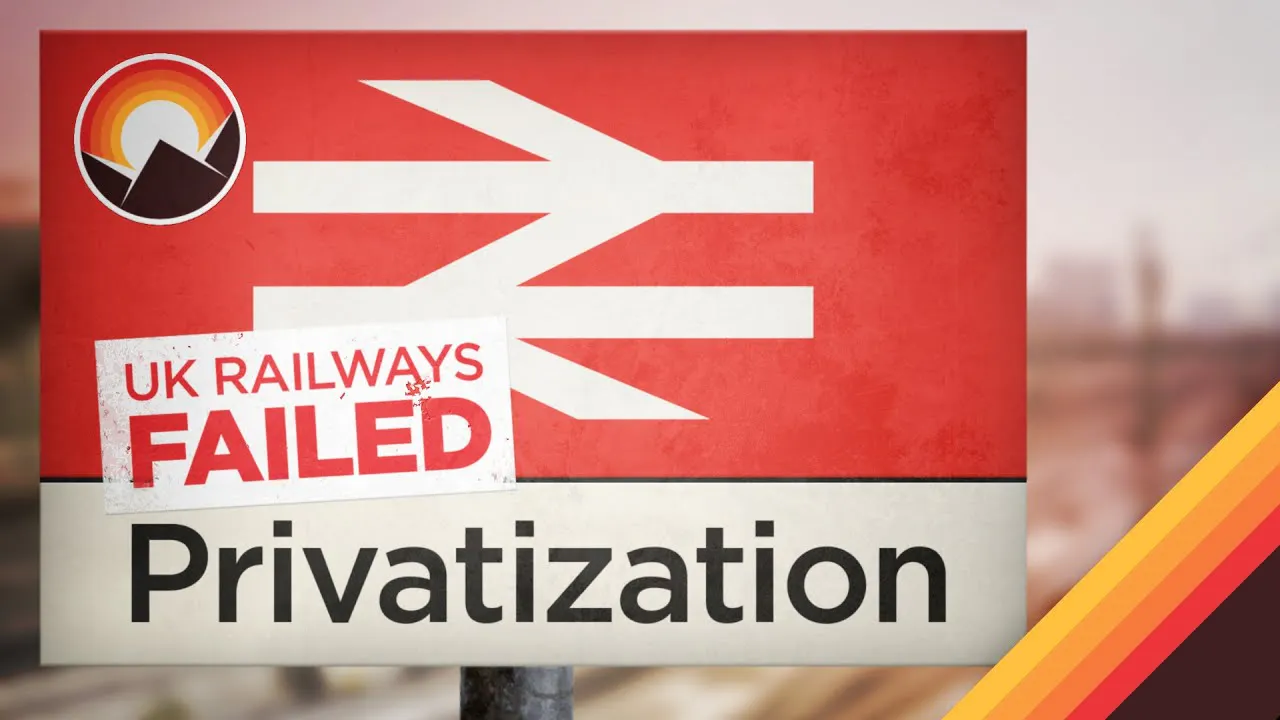
The UK's Failed Experiment in Rail Privatization | Wendover Productions
About this episode
Get every episode summarized
Each time Wendover Productions publishes, we email you a written briefing from the transcript — the topics, who appeared, and any specific claims, with the ad reads skipped.
Email me new episodesFree for 3 shows. No card needed.
Transcript ready
130 searchable segments. Every word is indexed and playable.
Full transcript
Wendover Productions — The UK's Failed Experiment in Rail Privatization | Wendover Productions. Machine-transcribed; use the interactive transcript above to jump the player to any line.
This video was made possible by Hover. Set up an email address or website with a custom domain in about two minutes for 10% off at hover.com slash Wendover. On Thursday, May 3rd, 1979, 31,221,362 voters gathered at polling stations across the United Kingdom to decide on who would fill the 650 seats of the House of Commons. Now, any election is important, but this one held particular significance. Over the years leading up to it, the country's manufacturing industry was collapsing, inflation was wreaking havoc on the economy, mass strikes were plaguing both the public and private sector, unemployment was exploding, and it was quickly becoming clear that Britain was losing ground to Japan, Germany, the US, and other subjects of post-war economic booms. Margaret Thatcher and her Conservative Party proposed a solution. They would curb the power of unions, cut personal income tax, and privatized nationalized industries.
Essentially, it was a complete rejection of the economic ideology of the prior 30 years. However, in the view of the British public, the status quo was what got them to the turmoil of the era, so Thatcher's message resonated. Once the ballots were counted, the Conservative Party picked up 62 new seats, bringing their total to 339, a majority, and therefore making Margaret Thatcher Prime Minister of the United Kingdom. The era of British privatization started quite quickly, first with British petroleum, of which Thatcher began selling off shares just months following her appointments. But then, in the new decade, the trend kicks into high gear with British aerospace, British gas, Rolls Royce, British airways, British steel, national express, British telecom, British Layland, the British Airports Authority, and dozens more state-owned enterprises being sold off to the private sector. By the 1990s, the concept of a state-owned enterprise was becoming increasingly obscure, but there was just one major sector that the sell-offs had yet to really touch.
The railroads. Thatcher herself didn't dare touch them. Politically, it was tricky. In the country, trains operated at a loss to many rural areas from which her party needed votes. Fully privatizing the industry would mean that those areas would inevitably lose service, and the Conservative Party would inevitably lose votes. In addition, in her view, railroads were just one of the rare examples of sectors that just had to be publicly run. They were just too tricky to run both efficiently and effectively with a purely profit-seeking motive. Her reign ended, though, in 1990, after a leadership battle within her own party and her successors weren't so cautious. Conveniently, in 1991, the European Union acted first. It issued directive 91-440, which read, quote, Where as the future development and efficient operation of the railway system may be made easier if a distinction is made between the provision of transport services and the operation of infrastructure,
whereas given the situation, it is necessary for these two activities to be separately managed and have separate accounts. Essentially, what this said was that the company's organizations or agencies that actually operated the trains had to be legally separate entities from those that operated and owned the tracks upon which trains operated. The reasoning stemmed from the EU's wish for private rail competition against the government-run systems. They were opening the door for companies to operate rail services on any track in the European Union, as long as they pay for it. Of course, that gave the government a perfect first target for privatization. On April 1, 1994, rail track came into existence, a private company that now owned all the tracks, stations, and rail infrastructure in the United Kingdom. There was much work left to do, though. British rails trains went to three newly formed rolling stock companies. Their telecoms infrastructure was sold to Rackle Electronics.
Freight operations were split up and allocated to six newly formed private companies. This process went on and on and on, but then came the question of passenger train services. It was very clear that the solution to privatizing those would not be a quick and complete sell-off. The crux of the problem was exactly what Fatcher had identified when she decided not to privatize the railways. The public had come to expect and rely on inherently lost-making rail operations. While running an 8am train from Edinburgh to London may be profitable, running a 1pm train from Manchester to Bucston probably is not. In order to run trains at the prices, to the places, and with the frequency the public demanded, someone had to at least sometimes take a loss. With that, a structure evolved. Intercity, British Rail's long distance brand, was split into seven segments. Networks out east, which primarily operated commuter services in and around London, was split into ten.
While regional railways, which operated short distance services throughout the rest of the country, was split into eight. These 25 train operating companies would at first be owned and run by the government, but through time, the operations of each would be franchised out to private companies. Now, each of the train operating companies were designed so that their advantages and disadvantages were, in the view of a private company, somewhat balanced. That's rather important, since any franchisee is contractually required to serve certain stations, at certain times, and certain frequencies. For example, the intercity east coast franchise includes the super high demand, high frequency east coast service, from Edinburgh Waverly to London Kings Cross. Two of the busiest train stations in the UK, between which any operator should be able to turn a profit. However, this franchise also requires, for example, the operator to run at least one train a day that leaves London Kings Cross between 11.30 am and 12.30 pm, and eventually calls at the small Scottish town of Kengusi, along with a corresponding southbound service that calls at the town before arriving at Kings Cross between 5.30 and 6.30 pm.
Now, only some 108 people use Kengusi railway station each day, most to get on the regional trains running between Glasgow or Edinburgh and Inverness. A private company likely would not choose to service a station where they'd be lucky to pick up a dozen passengers in a day, so the intention of the franchising system was to balance things out, put a little bit of the bad with the good, so that places like Kengusi would not lose their service. To further balance things out, the government would accept bids from companies to operate the different franchises, and what the government would receive could either be in the positive or the negative. The government would look at all the serious bids, and quite simply pick the one that would make them the most money in incoming franchise payments, or lose them the least money in outgoing subsidies. On the surface, it seemed like the perfect system. The free market would force companies to compete to win a franchise, and in the end, the government and by extension of British taxpayer would spend the least amount or earn the most amount of money possible.
But that's just the view from the surface. If you dive in and take a deeper look at the franchise agreement, the contract between an operator and the government cracks begin to show. This document is the draft of that agreement for the Intercity East Coast franchise, the one that includes Edinburgh to London Service, published by the UK government during the latest tendering process in 2014. It begins with definitions of terms, a statement of governing law, and assorted other legal declarations, but that moves on to exactly how the relationship between a franchisee and the government will work. For example, in Schedule 1.1 Part A Section 4, it lays out the idea that franchisees can not alter the timetable without a long, arduous process of consultation with the government and other stakeholders, including the public. Section 7 establish the requirements for operators to, on average, have the capacity for anyone to find a seat immediately upon boarding enough peak trains and within 20 minutes of boarding for on-peak trains. Section 12, introduced to the concept of breed performance levels, which, if a franchisee exceeds, will put them in breach of contract.
For example, the Intercity East Coast franchisee must not exceed 0.0235 cancellations per 1,000 miles or 1600 kilometers traveled in its second year of operations, and by the end of year 10, if their franchise even lasts that long, the level must be down to 0.0119. Schedule 1.2 Part A Section 6 lays out the requirements for alternate transportation in the event of train cancellation, this section outlines the requirements for timetable publishing and post-redisplay stations. This one defines the operator's data reporting requirements, this one outlined the requirement for operators to accept folding bikes on all its services and full-size bikes, quote, wherever reasonably practical. This establishes the prohibition of the franchisees engaging in any business except for the operation of trains and certain auxiliary services like selling food on board, this outlined the franchisee's ban on entering into any leases without government approval, and leases for stations, depots, and other facilities that it's required to enter into, and this section summarizes what the franchisee is legally required to help with for the operation of the Queen or subsequent monarch's train. So, the government tells franchisees where they must operate, when they must operate, which trains they must operate, which facilities they must lease, the maximum amount they can charge, how long they can operate, so the question is, with very, very little ability to choose how to run their trains, where are they supposed to compete?
The answer is the bidding process. That's essentially the only step in this process where free market competitive economics come into play, but these forces pushed bidders to over-promise and under-deliver. They'd say they expected a certain number of passengers translating to a certain amount of profit, meeting to a certain hypothetical future franchise payment, the main number that the government looks at in a bid. If those passengers didn't appear as predicted, then the profit didn't come either, and the franchisee would fail to make the payments upon which it bid. This is a cycle that happens time and time and time again. G&R, owned by C Containers, was the first operator of the intercity East Coast franchise before it over-bid in its renewal, failed to make its payments to the government and lost the franchise early. To replace them, the government awarded the franchise to National Express in 2007, who would operate the services under the National Express East Coast brand.
However, just two years later, it emerged that they, too, had forecast more passengers than emerged in reality, were not able to make the payments they had bid on, and so they lost the franchise in 2009. After this experience, the government temporarily re-nationalized the railway under the operator of last resort scheme that had been set up for this exact situation. This is simply named East Coast Company, owned and run by the government, operated the line until a new bidding process was opened in 2013. A joint venture between Stagecoach and the Virgin Group won the bid and operated services under the Virgin Train's East Coast brand. It turned out that passenger and therefore revenue growth had not matched the levels they had based their bid upon, therefore they were hemorrhaging money, therefore they could not make their franchise payments to the government, therefore they lost the franchise in 2018, and once again, the government re-nationalized the line and operated services under the London-Northeastern railway brand.
Throughout this nearly 25-year cycle, only one period stood out from the rest. Between November 14, 2009 and February 28, 2015, when the line was run by the government-owned East Coast Train Operating Company, things went well. In its final full-year operation, it was tied for fourth among 23 Train Operating Companies in terms of overall passenger satisfaction, fifth for punctuality, fourth for value for money, and even while being one of the most popular train companies, it generated over 1 billion pounds in profit over the years that went straight back to the government and by extension, the British public. Therefore, when it was announced that the franchise was to be reprivatized, many asked, why? Why should the government hand over a well-run, well-liked, well-profitable company to private hands, which will, at best, just take a portion of those profits away from the British government and people?
Over the following years, this and other related questions, doubting the merits of this almost entirely unique franchise model, grew louder and louder. By the start of 2020, an increasing number of railways stopped operating under the franchising model. Instead, they were run as concessions, where the government contracts a company to operate trains while taking the financial risks themselves, open access operators, were private companies simply pay for track access, typically on the most lucrative routes, without any additional agreement with the government, or the operator of last resort model, such as with the East Coast franchise, where the line is re-nationalized and government run. Simultaneously, it was getting tougher and tougher to find new reputable bidders for franchises up for renewal. Many were extended through direct-award, where the government skipped the competitive bidding process, which goes against the original vision of rail franchising. All around, the viability of the franchising model was coming more and more into question, both domestically and internationally, where complete rail privatization was something few countries had even considered, let alone implement it.
Like with so many things, though, March 2020 dealt a death blow to the United Kingdom's privatized railroads. With the onset of stay-at-home orders in Britain, passenger numbers fell through the floor, and it became very clear, very quickly, that no franchisee would be able to fulfill their obligations to the government. Therefore, after years, even decades of debate on whether the railroads should be re-nationalized, it just happened, in a day. Secretary of State for Transport Grant Schnapps issued a letter to Parliament stating that all franchises would immediately be shifted to a concession model. The government would pay all their costs, plus a small management fee, equal to no more than 2% of the company's costs in the year leading up to the pandemic. Under any definition, even if private companies were operating the trains, this was a nationalized railway.
Originally, this was to go on only for six months, just as a temporary measure. But in the final days of that period, on September 21st, another announcement was made. After 24 years, rail franchising, as an operating model, was done forever. Now, as of yet, it's not known exactly how the country's railways will operate when the provisional recovery measures lapse. The most we know comes from the Transport Secretary, who said in the initial announcements, the model of privatization adopted 25 years ago has seen significant rises in passenger numbers, but this pandemic has proven that it is no longer working. Our new deal for rail demands more for passengers. It will simplify people's journeys, ending the uncertainty and confusion about whether you're using the right ticket or the right train company. It will keep the best elements of the private sector, including competition and investments, that have helped to drive growth, but deliver strategic direction, leadership and accountability.
Passengers will have reliable, safe services on a network totally built around them. It's time to get Britain back on track. Now, there has always been and will always be debates on whether the privatizations of the UK's railways was a failure. It brought the highest number of passengers onto the rails in the country's history, higher even than during the Golden Age of Rail transport in the early 1900s, but it also brought, by most measures, some of the highest fares in all of Europe. An increasingly public satisfaction in the railroads and brought to one of the highest levels in Europe, but counterintuitively, it also pulled the government's rail subsidy up to its highest level in history. Quite decisively, after privatization, the decline of the UK's rail industry turned around for the better, but it's not clear, is how much of that can be attributed to the privatization itself, rather than the increased focus that privatization brought to the rails.
What is clear though, is that the experiment itself failed in proving the resilience of a franchising model. Despite positive public sentiment about the railways as a whole, an overwhelming majority of the British public supported re-nationalization. Therefore, it did not start a domino effect of rail privatization across Europe and the world, it did not commence the general public in its merits, and it proved, most of all, that the model was fundamentally flawed as it only worked in the best of times, and the worst of times will always eventually come. While the privatization and deregulation of the air transport industry, for example, rail's most direct competitor, is almost universally viewed as a success that brought lower fares and industry growth to the point that state-owned airlines are now largely a relic of antiquity, the same cannot be said for rail. No country has really cracked the nut of fully privatized passenger train service in the 21st century.
While many have taken half measures, such as privatizing freight, the rails, awarding concessions to private operators, but taking on the financial risk like the UK now does, or even doing as the UK did before, and effectively fully privatizing railways, none have landed on a privatization model, successful enough for other countries to replicate its on mass. So even if the UK's privatization experiment accomplished some of its goals, it failed on the most elusive one. It failed to convince the UK public and the world that the privatization of railroads was the best path forward for passenger train travel in the 21st century. What the past year has proven time and time again is just how important digital presence is. Having a nice, clean, digital presence is getting to be almost as important as having a nice, clean, physical presence. Whether you're still in school or in the big, scary world of employment, this still applies, and one of the quickest and easiest ways to improve your digital presence is with a custom domain from hover.
Even if you don't want to build a website just yet, it's worth getting one for three main reasons. First, you can direct it to your LinkedIn, YouTube, Twitter, or any other page, so when you share those with someone, it's just one simple link. Second, you can set up a custom email address at that domain, which just looks and feels so much more professional than one ending in at Gmail, Yahoo, iCloud or something else. And third, do wings are going away with every minute, so if you want one that corresponds to your own name, company name, or anything else, it's worth getting now before it's gone. Hover makes all of that super simple and quick, they help you find super unique domains with their over 400 extensions, their pricing is very transparent and fair, and best of all, you can get 10% off and help support this channel by going to hover.com slash windover. So, professionalize your web presence and get your domain before it's gone for 10% off, once again, at hover.com slash windover.
More episodes
More from Wendover Productions

Okinawa vs the US Military: The Decades-Long Feud | Wendover Productions
Wendover Productions

Why Trains Suck in America | Wendover Productions
Wendover Productions

How Maritime Law Works | Wendover Productions
Wendover Productions

Egypt's Dam Problem: The Geopolitics of the Nile | Wendover Productions
Wendover Productions