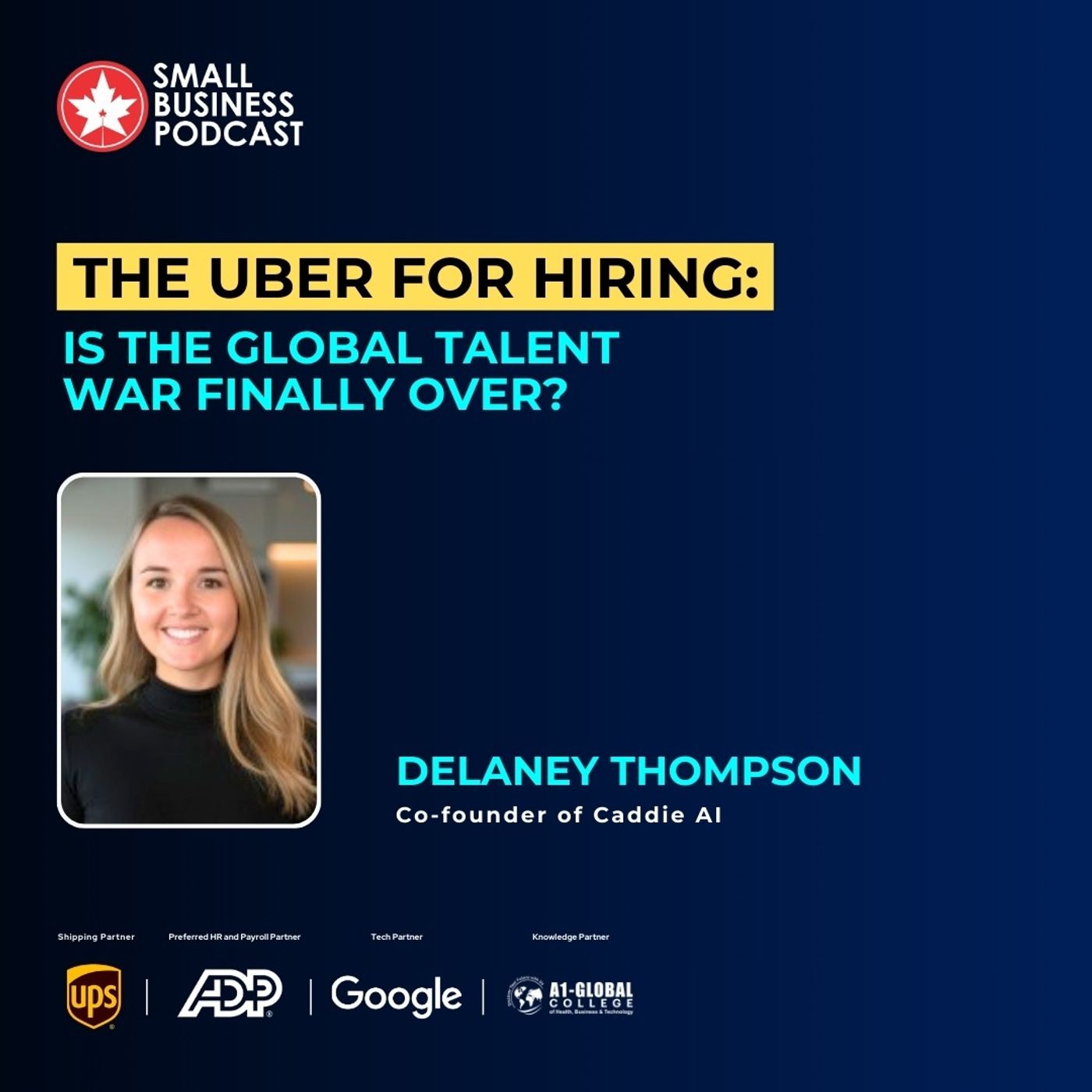
The Uber for Hiring: Is the Global Talent War Finally Over?
About this episode
Welcome to the CanadianSME Small Business Podcast, hosted by Maheen Bari. In 2026, the local talent pool is no longer just your city, it’s the entire world. But as access expands, so does the noise, and the real challenge becomes finding the top 1% without drowning in AI-generated resumes.
Joining us today is Delaney Thompson, Co-Founder and CTO of Caddie AI. A serial entrepreneur and self-described vibe coder, Delaney has built ventures ranging from rum factories to cross-border automotive businesses. Now, he’s reshaping recruitment with Caddie AI, a hiring marketplace designed to help companies secure vetted global talent in days, not months.
Key Highlights
Hiring Marketplace Model: How Caddie AI reduces hiring time and cost through a headhunter-driven marketplace.
Founder Built Product: How Delaney’s builder mindset shapes product design for fast-moving teams.
Global Talent Strategy: Why companies must look beyond local markets and how to reduce hiring risk.
AI with Human Judgment: How Caddie balances automation with expert-led vetting to ensure quality hires.
Hot Bench Advantage: How features like Hot Bench and Slack integration accelerate decision-making.
Special Thanks to Our Partners:
- UPS: https://solutions.ups.com/ca-beunstoppable.html?WT.mc_id=BUSMEWA
- Google: https://www.google.ca/
- A1 Global College: https://a1globalcollege.ca/
- ADP Canada: https://www.adp.ca/en.aspx
For more expert insights, visit www.canadiansme.ca and subscribe to the CanadianSME Small Business Magazine. Stay innovative, stay informed, and thrive in the digital age!
Disclaimer: The information shared in this podcast is for general informational purposes only and should not be considered as direct financial or business advice. Always consult with a qualified professional for advice specific to your situation.
Get every episode summarized
Each time CanadianSME Small Business Podcast publishes, we email you a written briefing from the transcript — the topics, who appeared, and any specific claims, with the ad reads skipped.
Email me new episodesFree for 3 shows. No card needed.
Hosts & guests
Transcript ready
114 searchable segments. Every word is indexed and playable.
Full transcript
CanadianSME Small Business Podcast — The Uber for Hiring: Is the Global Talent War Finally Over?. Machine-transcribed; use the interactive transcript above to jump the player to any line.
Welcome to the Canadian SME Small Business Podcast, a podcast for Canadian Small Businesses. We interview Canadian experts and entrepreneurs to provide expert insight into marketing, innovation, business leadership, technology, and trends that impact small businesses. Whether you're just getting started or already established, UPS is here to help you make the most of your time. Their services, tools, expertise, and team of UPS Small Business Ambassadors can help businesses with all sizes, simplify processes, improve customer experience, and guide you on the path to growth. My name's Elaine Tank-Komo, founder of Easy Dazies, the official schedule for kids, and I want to invite you to visit UPS.com to learn more and save up to 52% or more on shipping. This is a paid advertisement. Hi everyone, this is Maheen and welcome to the Canadian SME Small Business Podcast. In 2026, a local talent pool is no longer just your city, it's the entire world.
But as the map expands, so does the noise. And for fast-growing companies, the challenge isn't just finding people, it's finding the top 1% without drowning in a sea of AI-generated resumes. Joining us today is co-founder and CTO Delenny Thompson from Kedi AI. Delenny is a Delenny's 8th, 5th quarter, a seer entrepreneur who has launched everything for runs, factories, to cross-border car ventures. Together with another co-founder, they built the Uber for Hiring, a marketplace that connects companies with expert headhunters to find better global talent in days, not months. So without a further ado, let's dive in and welcome Delenny. Delenny, we're very pleased to have you on the podcast today. How are you? I'm good, thank you. I'm excited to be here. Thanks for having me. We're very pleased to have you with us. Delenny, you describe Kedi as a Uber for Hiring, which is quite a bold shift from the traditional agency model. Please tell us what is a hiring like marketplace and how does it reduce hiring time and cost?
Yeah, so a hiring marketplace is sort of like Uber in the sense that you're posting the job and the requirements once, and then expert headhunters worldwide can see that job posting and requirements and decide if they want to work on it or not. And then you pay based on the results, so much like Uber, when you, you know, request a ride, they all see it, one will pick you up, and then that's when the payments start. So yeah, it reduces a lot of time in the hiring process, as well as your reach because, you know, when you're only working with one agency, one headhunter, one recruiter, or doing it yourself, you're really limited to, you know, that network, that geo, and also the time and resources of that headhunter or that method. That is such a massive unlock for a startup to have a global network of headhunters that are working simultaneously to fill a single role. Now, just like let's shift our focus to
logic fast with with the a true workaholic mindset, right? How does your founder by round shade Caddy's product design? Yeah, so I would say with that, it's really just that we do use our own product to hire, and we know as business owners what other business owners want, which is really, you know, speed, quality, and to have more time back in your day, which is something that all business owners need. So yeah, we're really, you know, using our own product, which is really influencing the user experience and how we're designing everything. And yeah, I would say that makes it a lot easier as well to sell to other business owners, as well as get their feedback, and then also just get feedback from from each other. So Danica and I are always using our product and saying, you know, like, where can things be better? And how can we improve this? So
right. Now, it is absolutely great to know that when the person building the tool in the Sansa K, awesome startup, the result is a platform that actually removes that friction instead of adding it, adding it more. Now let's focus on how distributed teams unlock global talent. Does any why should hiring teams expand beyond local talent in 2026? And how can you reduce risk? Yeah, so I would say with this, you really don't know what you don't know, especially when you are limited to a, you know, a geography and just your local talent pool. And, you know, competition is always rising with local talent. And when you start hiring and having those conversations with candidates that are abroad, you're going to get different perspectives, different skill sets, different cultures. And, you know, there's a lot that you can learn from hiring people in different places. I would also say the cost benefit is a huge one. You know, for what you're going to pay
in your local geography, you might be able to get three times the amount of people overseas while maintaining the same quality. So yeah, there's lots of, I would say, hot spots for developers. For example, Europe, Latin America, South Africa, specifically in Europe, I would say like Ukraine and Poland right now. So yeah, I would definitely say that cost is a big part, but I would say quality, as well as quantity of people that you can hire also increases, which is a huge unlock for business. And not only for developers, but executive assistance, you know, sales reps. And of course, there's always ROI with that as well. Absolutely, you know, that is great to understand that opening the door to global talent, that just doesn't just lower costs, but it dramatically raises the ceiling for the quality of work that, you know, a team can produce. Now, I mean, let's kind of look at how combining human
judgment with AI improves hiring outcomes. Please tell us, how does caddy balance AI automation with human judgment to maintain quality? Yeah, so definitely with caddy, our philosophy isn't to replace human judgment or even just the human in the loop when it comes to hiring because with hiring, it is really important to have a human, you know, evaluating things like culture fit and, you know, sometimes seeing things that would be beyond the resume when you're having those first conversations with people. So how we use AI with caddy is to help you connect with different talent partners, as well as generate, like, do the tedious tasks that eat up your day, like generating a job description, figuring it out where you want to hire that person, you know, cleaning up your pipeline and things like that. So we do have a chatbot within chatty or within caddy, sorry, where you can say, hey, what has my pipeline looking? What are the best candidates that came in today? Where should my focus be and helps with things
like that? But it's not taking away the actual human doing the interview or reviewing the candidates and, you know, getting on those first calls. Right. No, I love this clarification. It tells us that using AI to handle the search while humans handle the vetting ensures that you find great candidate who's also a great cultural fit. Now, looking ahead, Delany, let's move our conversation to features like Slack that really speed up hiring. How does Slack integration help teams hire faster? Yeah. So in the tech world, most teams do use Slack. However, of course, people are also using things like Microsoft Teams, WhatsApp, and all of that. But with our Slack integration, we found that most of our customers were living in Slack. And instead of, you know, trying to get them away from where they were already in every single day, we decided to bring caddy to Slack. So how it works is they get notifications about new candidates within Slack.
They can remove review candidates there. See their resumes linked in everything in Slack and even leave decisions on them. Even if they were to give feedback on the candidate, they can do that via chat and Slack, which then brings their feedback to the platform for the talent partners to see. So we just built it out with Slack. But I do have on the roadmap that we will have this as well, living in things like WhatsApp, text, and Microsoft Teams and all of those other tools where teams are living as well. Absolutely. You know, turning almost hired candidates into a ready-to-go pool is quite a brilliant way to recycle elite talent within the ecosystem. But this has been a great conversation with you, Deli. Thank you so much for sharing all the great insights and expertise that you were able to in this limited time that we have with our listeners. As you wrap up, what is a one piece of advice for founders that are really searching for their next A player? Yeah, with this, I would say it's something that we use with
our own hiring philosophy and also suggest to other business owners and teams is to really look at the slope of the candidate and not just the, you know, the hard skills right off the bat. I would say if you're evaluating a candidate and you see interesting things that show that they're capable, like, you know, they have really interesting background, maybe their previous entrepreneurs, maybe their super high achievers, that really stands out at least to us more than just that they've completed X amount of years at a job. I would also say for right now, it's really important to look at candidates that are really well versed with AI tools and automations because that's where, you know, the world's going. And if you have a candidate that is really well versed with that, it can grow your business exponentially way more than just somebody maybe that has 15 years experience at a traditional company. So yeah, I would definitely say AI tools, achievements,
and just kind of look at the big picture and the slope more than just yes or no, do they match. Right, a match, a job description. Oh, this is quite a great reminder to stop searching and start connecting. Thank you so much Delany for such a great conversation today and thank you for all the green expertise that you're sure. Thank you for your time. Yeah, thank you for having me. And listen, that was Delany Thompson from Cadi AI, a master class and how to leverage global marketplaces and vibe coding to build a work-class team and in record time. Thank you so much for tuning into the podcast. Please be sure to subscribe and visit CanadianSemi.com to see it for more resources, a special shout out to our partners, UPS, even global college, Google and ADP for their ongoing commitment to empowering small businesses across Canada. Please keep moving forward and we'll see you next one. Thank you for listening to the Canadian SME podcast. Please visit CanadianSME.ca
to subscribe and join us next again as we share more expert advice from Canadian business leaders.
More episodes
More from CanadianSME Small Business Podcast

The Health-Tech Giant: How VitalHub Built a $100M Global Software Empire
CanadianSME Small Business Podcast

How I Scaled 22 Stores in Canada’s Most Regulated Industry
CanadianSME Small Business Podcast

How Calgary Became One of North America’s Fastest Growing Innovation Economies
CanadianSME Small Business Podcast

The $100M Talent Secret: Why Wellness Beats Salary
CanadianSME Small Business Podcast