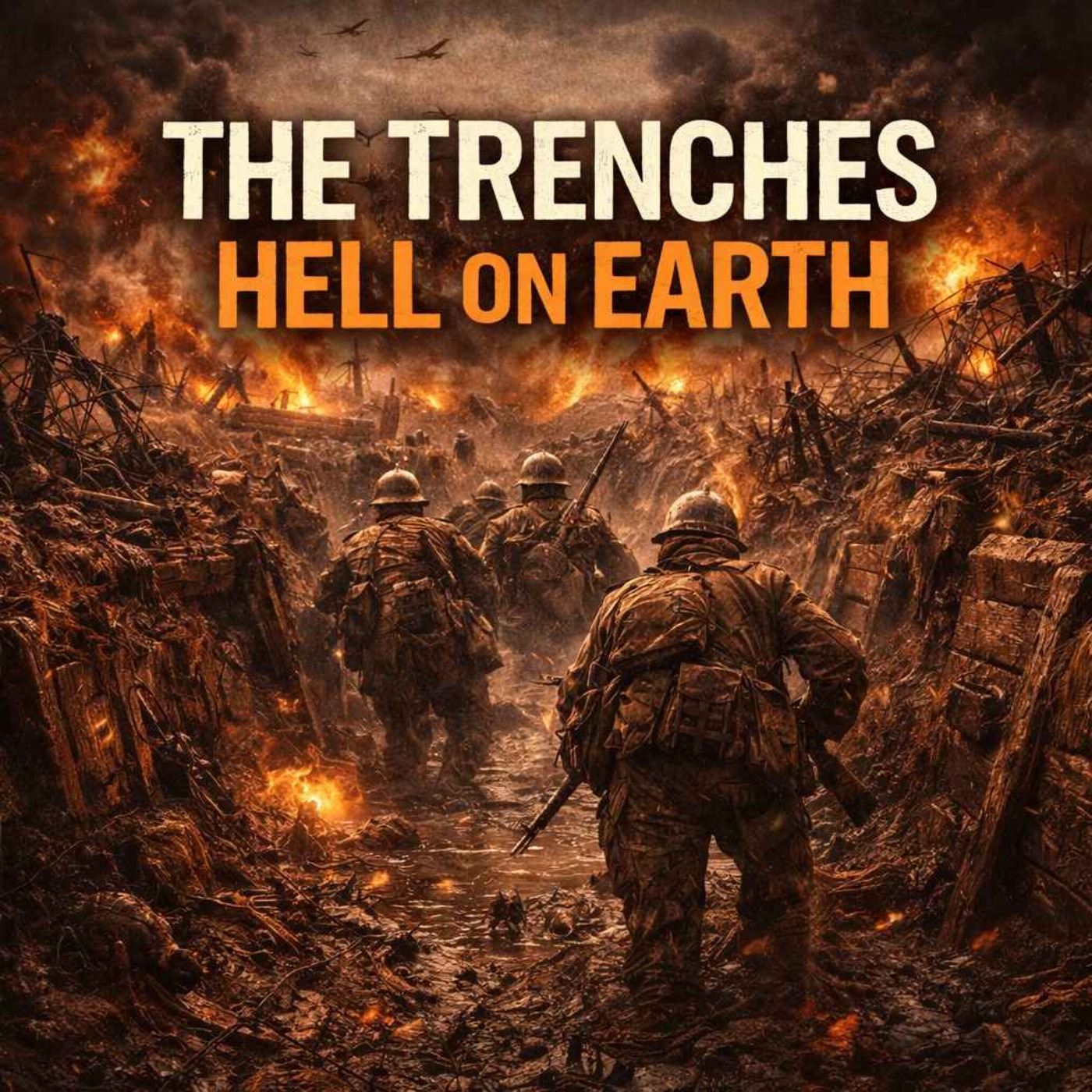
The war had changed. It was no longer fast, no longer moving. It had stopped. By the end of 1914, the armies of Europe faced each other, not across open fields, but across lines carved into the earth, trenches, miles of them, stretching from the North Sea to the borders of Switzerland, a scar across Europe.
This was the Western Front, and here the war became something else. It became a war of waiting. Soldiers lived underground, in narrow ditches dug deep into the mud. The walls were fragile, the ground unstable, and the conditions unforgiving.
Rain turned the trenches into rivers of mud, water filled the floor, boots sank, clothes never dried. Men stood for hours, sometimes days in cold, filthy water, and slowly the body began to break.
Trench foot, a condition caused by constant exposure to wet and cold, skin rotting, nerves damaged, sometimes leading to amputation.
But the environment was only part of the suffering. The trenches were alive. Rats moved through the darkness, large, fearless, feeding on scraps, and sometimes on the dead.
Lice spread through clothing, causing relentless itching, disease, infection, sleep was never complete. Silence never guaranteed.
Because at any moment, everything could change. Artillery, the most feared weapon of the war. Shells fired from miles away, unseen, unheard until it was too late.
Explosions tore through the earth, destroying trenches, burying men alive, the ground shook, the sky burned, and the line between life and death disappeared.
But the most terrifying moment came with a single sound, a whistle, the signal to attack. Men climbed out of the trench, over the top, into open ground.
And in that moment, they became visible. Machine guns opened fire, relentless, unforgiving. Lines of soldiers fell within seconds. There was no cover, no escape, only forward or death.
And yet, they kept going, because behind them was duty, discipline, orders that could not be ignored. Between the two sides lay a stretch of land, no man's land.
A place of destruction, barbed wire, cratered earth, bodies that could not be retrieved. It was silent at times, almost peaceful, but that silence never lasted, because the war never truly stopped.
And then came something even worse. Gas, poison, released into the air, carried by the wind. It crept across the battlefield, invisible, unpredictable. Soldiers scrambled for masks, but often it was too late. Eyes burned.
Lungs filled with fluid, breathing became impossible, a slow, terrifying death. This was not war as it had once been known. This was industrialized destruction, a system, a machine designed to break the human body and the human mind.
Days turned into weeks, weeks into months, and still the lines did not move. Entire offensives were launched, thousands sent forward for a few meters of land. And when it was over, the trenches remained unchanged.
But something else had changed. The soldiers, because in the trenches, war was no longer about victory. It was about survival, about making it through the night, through the next bombardment, through the next attack. It was about enduring, holding on when everything around you was falling apart.
And yet, even in that darkness, moments of humanity remained. Soldiers shared food, stories, silence. On rare occasions, even brief truces, a reminder that beyond the uniforms, they were all the same. Men, far from home, caught in something far greater than themselves.
The trenches were not just a battlefield. They were a test of endurance, of fear, of what it means to be human in a world consumed by war. And for those who survived, they would carry it with them long after the war had ended, because some places never truly leave you. And the trenches were one of them.