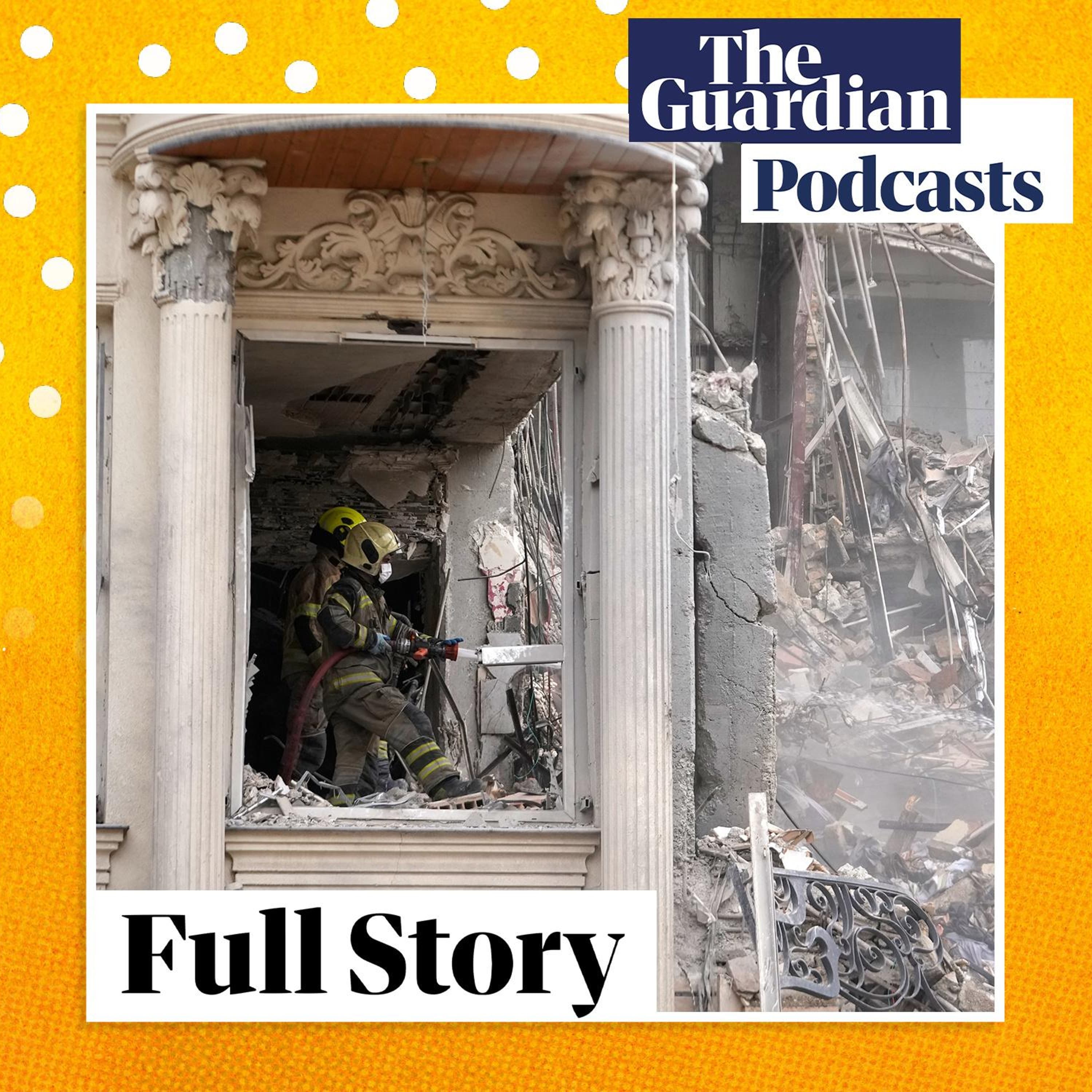
About this episode
Interactive timestamps
Jump to segmentGet every episode summarized
Each time Full Story publishes, we email you a written briefing from the transcript — the topics, who appeared, and any specific claims, with the ad reads skipped.
Email me new episodesFree for 3 shows. No card needed.
Hosts & guests

Transcript ready
54 searchable segments. Every word is indexed and playable.
Full transcript
Full Story — The Sunday Read: When neutrality becomes dangerous. Machine-transcribed; use the interactive transcript above to jump the player to any line.
0:00This is the Guardian. Hi, Regidarmad here coming to you from Gadigal land. Is it possible to stay neutral when your home country is in the throes of war? That's what journalists Shari Khan say if questions this week on the Sunday read. His Shari. Living in London my elder brother someone I have always looked up to makes good use of his relative proximity to our ancestral home in Afghanistan. He travels back and forth so often that from my base in Melbourne I sometimes joke he has visited our village more times in past few years than I have visited any other Australian city. His most recent trip however did not go as planned.
1:01Flight disruptions linked to escalating tensions in the Middle East left him stranded in Istanbul for several days. Eventually he gave up and flew back to London, missing both the anniversary of our mother's death in Kabul and the eat celebrations many of the family members had hoped to mark together at the end of Ramadan. While waiting at the airport we spoke on FaceTime and our conversation drifted back toward remains of our ancestral home which has largely been reduced to ruins now sitting in a mountainous valley in Paktika province in South East and Afghanistan. Time and war have stripped the walls but the memory of what life wants to look like inside them remains vivid. What strikes me most when I look at those photos he sends me is not the amount of destruction but what endures. The house played a central role in hosting guests and allowing for community consultation a process known as the Jirga which was part of our families and the villages way of life.
2:12The Balakhana, the Upper Guest House, common in many Afghan homes was not merely an architectural feature, it was a moral space. This was where disputes were brought to cool down. Neighbours who had quarreled over land, traders arguing over debts or relatives caught in family disagreements would gather here often late into the night. Long before courts or contracts people sat together in these rooms to listen, argue, reflect and whenever possible reconciled. Hospitality and mediation were intertwined, you could not seek justice without first being offered a tea and you could not be heard without first being recognised as a guest. As a child I played a small role in these gatherings. I would pour tea for visitors and carefully line up the issues by the door before sitting cross-legged on the carpets to listen.
3:12For generations elders helped settle disputes among traders moving between Central and South Asia. Many homes were built with the Balakhana designed specifically for hosting travellers and resolving disagreements. Arguments were slowed with Quranic reflection and poetry, for centuries such traditions helped prevent conflicts from spiraling. But wars really respect spaces built for mediation. During the Cold War Afghanistan became one of its most brutal battlegrounds. The Soviet invasion in 1979 and the decades of fighting that followed uprooted millions of Afghans and destroyed much of the country's social fabric. After the Taliban government was toppled in 2001 following the US-led invasion joined by allies including Australia, Afghan civilians again found themselves trapped between powerful armed actors.
4:15In theory they had choices, in reality those choices were often illusions. Across rural Afghanistan, villagers were forced to navigate between international forces. As the Afghan government troops and Taliban fighters moved through the countryside, villagers who offered food to one group might later be interpreted as enemy collaborators by the other. A farmer who allowed Taliban fighters to pass through his village risked being labeled an insurgent supporter. A villager who shared information with coalition troops could face retaliation once those troops withdrew. In such conditions neutrality becomes dangerous, refusing to take sides can itself become a crime. What outside powers frame as choosing a side is for civilians usually something closer to a calculation of survival. Afghanistan is hardly unique in this regard.
5:16Across the Middle East today civilians are confronting the same shrinking of space for neutrality. The widening confrontation involving Iran, Israel and the United States has already demonstrated how quickly conflicts spill across borders. Missile exchanges, airstrikes and proxy attacks have turned entire regions into a battleground. Cities far from the front lines suddenly find themselves under threat. The pressure to pick sides spreads with the conflict itself. This has made worse by the fact that institutions meant to restrain such spirals appear increasingly fragile. The United Nations was founded on the promise that international disputes could be mediated before they consume entire societies. Yet repeated crises from Syria to Ukraine and Gaza and our tensions around Iran have revealed how easily geopolitical rivalry paralyzes the system.
6:21Donald Trump openly questions the value of alliances and international institutions accelerating a broader erosion of confidence in global governance. When international mediation weakens the burden of navigating conflicts falls even more heavily on ordinary people. For centuries places like our villages Balakhana existed precisely to prevent disputes from escalating into violence. They embodied a belief that even the angriest conflict could still be slowed through conversation. But when wars are driven by powerful states and global rivalries those local traditions of peace and harmony struggle to survive. That was journalist Shari Khan Saif. This episode was produced by Karish Maluthria. I'm Regid Ahmed. See you soon.
More episodes
More from Full Story

How much control should we have over the algorithm?
Full Story

Could the US drag us unwillingly into war?
Full Story

Black Box: The Chatbots | Spirals | Ep 1
Full Story

Back to Back Barries: The forces that can stop One Nation’s rise
Full Story