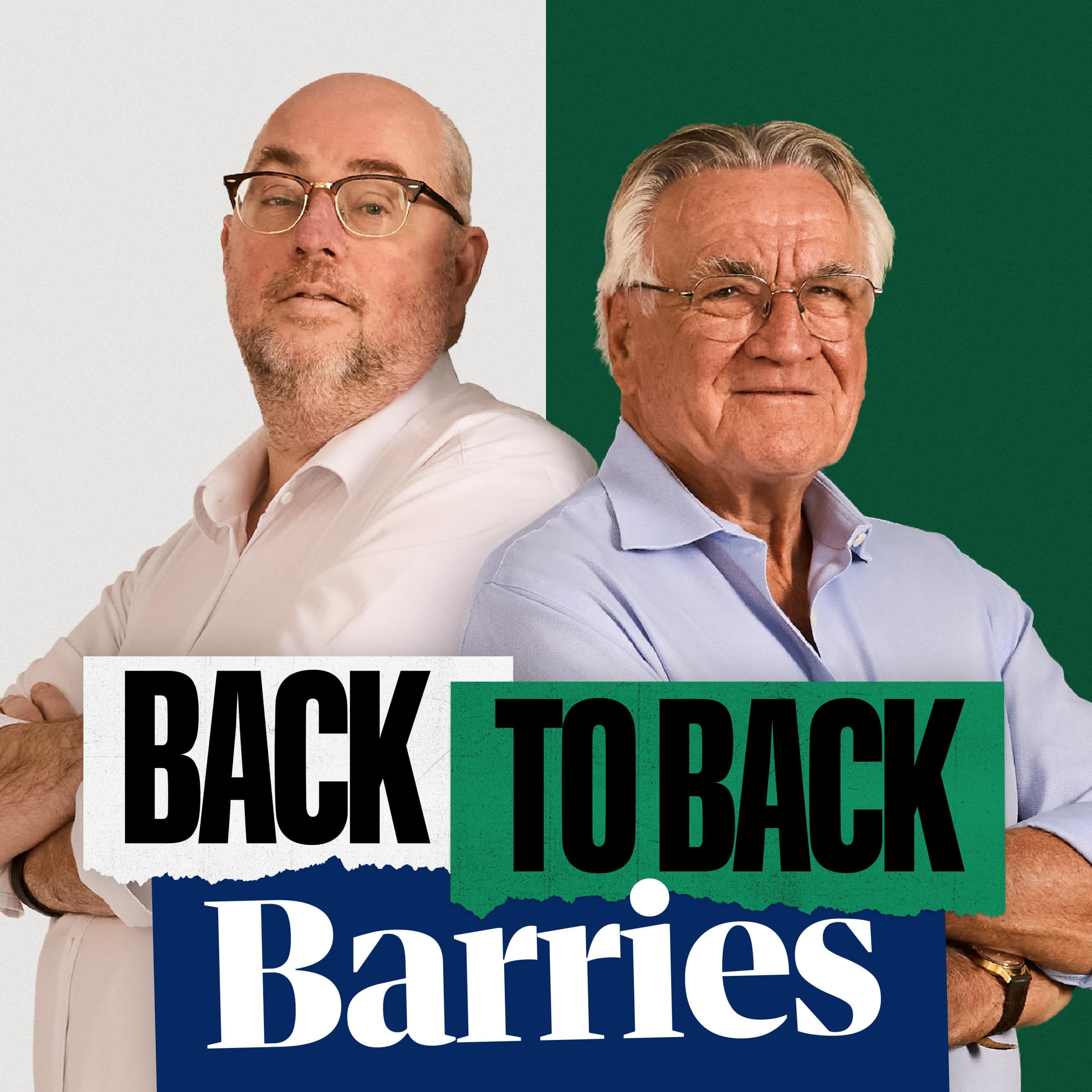
About this episode
Full Story is made possible by:
Get every episode summarized
Each time Full Story publishes, we email you a written briefing from the transcript — the topics, who appeared, and any specific claims, with the ad reads skipped.
Email me new episodesFree for 3 shows. No card needed.
Hosts & guests


Transcript ready
360 searchable segments. Every word is indexed and playable.
Full transcript
Full Story — Back to Back Barries: The forces that can stop One Nation’s rise. Machine-transcribed; use the interactive transcript above to jump the player to any line.
Support comes from wise, the smart way to manage the currencies you need around the world. Your life is global, your money should be too. Some providers promise no fees on overseas transfers. Don't be fooled. Extra costs often hide in bloated exchange rates. Choose wise. You can send, spend and receive money in over 40 currencies. Count on the exchange rates that you'd usually see on Google. That's how millions save billions on hidden fees. Be smart, get wise, visit wise.com, season C's apply. This is The Guardian. I'm Barry Cassidy. And I'm not Tony Barry. I'm George Mickler-J. Well, welcome George and thank you for standing in for Tony who's on a break. It couldn't be more opportune in a sense because we'll be looking at the extraordinary result. In a bi-election in WA, where one nation took the seat from Labour.
And you've just released a new book called Three Shocks. Who we are becoming in the 21st century and it's chock full of information and data that I think helps to explain the historic shifts that are going on in the political landscape and it helps with secret harbours as well. So we'll get to that in a moment but the first time that one nation has taken a seat from Labour, that's significant, and then state where Labour dominates. It squares the circle for one nation in this sense that they picked up 39% of the primary vote in the federal electorate of Farrah, taking the seat from the Liberals but beating off a challenge from a very good independent. And then they turn up in secret harbour, 39% again, same primary vote, but this time they take it from Labour, which kind of suggests that they can beat all comers. It can, in the seats where they can get close to 40% of the primary vote. Now Pauline Hanson, when she re-contested, remember she wins Oxley with a liberal party on her ticket,
but even though she'd been disindoor, she then stood, she left Oxley and stood for Blair in 98 and she finished first in that federal election. Her primary vote was just under 40%. But everybody else put one nation last in that seat and the Liberal candidate came in over the top. I find that part of the primary story, you know, 38 years on from the 1998 federal election, that that is basically the one nation base. When all comers looking to sort of head off the one nation challenged to the two party system, they get close to 40% of the primary vote. So we're seeing a version of history repeat, but now of course, you know, in the end of in 28 years, the two party system has collapsed. So they're 40 or they're 35 or they're 40. It is seat like this where they finish first. They're going to get over the top because a couple of parties will be perfect in the head of the sitting member. And what we need to take into account here in Sheikot Harbour, we're now got some information around Labour and their vulnerability to one nation. It's extraordinary when you look at the
primary vote in Sheikot Harbour in 2021. So it's just five years ago, Labour got 77% of the primary vote in that electorate. And it's almost as if the electorate said, well, look, we can't go on giving them that level of support. There's no healthy. And so at the next election in 2024, they took 31 points off the Labour vote. Made the seat contestable again. Yeah, reduced it to 46. And then in a bi-election one year later, there's another 22 points off it. So it goes from 77 to 22 in five years now. Seriously, I know the elected fall towel. I don't know whether we've seen anything like that anywhere. I don't think you see 50 points swings over the, you know, over the same, it's the same cycle. Obviously that 77% primary vote was the that astonishing election when Mark McGowan wiped out the Liberal and National parties. And he got close almost 90% in his own seat. That was in the middle of COVID in the middle of the early part of the lockdown where all the leaders were pretty
popular. And the National Party remember finished with more MPs in the lower house and the Libs Depp and they become the former opposition and WA after that state election. Now, of course, the Liberal Party are finishing third in this seat. You know, they're not even in the game. And this is a repetition of Farrah. Same thing happened in Farrah. Yeah. That's right. Yeah. Look, I want to look at the demographics now, Shukut Harbour. And this is why we need to bring in some background before that around your book. It's Shukut Harbour told us a lot. But it also, it also told us once you really drill down about the limitations for one nation. And that's really something we need to focus on. But three shocks. And I want to talk about one shock, first of all, in particular, the one that I think is most relevant to all of this. And that's for the first time since Federation, we have a population that's majority migrants and their children. And you explain this very cleverly, I think very usefully, with the use of a family tree, explain Australia's family tree. Yeah. The family tree, I've been looking for a concept to sort of stop writing about a whole lot
of numbers. And so looking for a concept that you could visualize. So in a sense, the reader can feel the numbers without actually having to, you know, sit a mass exam because it's always a bit of a ring. It's within the members. I mean, you and I can remember numbers. But at the end of the day, you know, there's a winner and there's a loser, right? There's a swing this way or there's a swing that way or this voter decided the election. Now, the way I visualize the family tree, every Australian gets included in this. And it's a very, very simple measure. It's time on country. So it's a, it's a generations measure. The roots of the family tree are Aboriginal and Torres Straight Islanders. Obviously, we've ancestors going back to before the first fleet. The trunk of the family tree are what I call old Australians. Now, that's not necessarily by age. That is time on country. Both your parents are born here. So you've, you've been in Australia for at least three generations. You can be British, you can be Irish, you can be Chinese, you can be Greek, you can be Italian, but you're an old Australian for the purpose of this definition. And the branches and the leaves of the family tree is where I put new Australia. That's migrants and their local born
kids. So first or second generation Australians, a pretty simple way to visualize it. Now, the thing that really struck me about this data, because I've got this exclusively from the Bureau of Statistics and David grew in the chief statistician at the Bureau of Statistics helped me cook up this model to make sure that it was robust. And of course, then they, you know, they were then released to start to also publish some of this data after I got it. And Paul enhanced and actually refer to this data to the top line of the family tree. She didn't refer to the family tree. I think it might have been a bit too deep for the audience at the time. But she said, remember in her press club, she's speech, she said more than half of Australians are migrants now or their children. And what do Australians think about that? And I thought that was a very interesting tell from her. The majority of Australians think it's okay, because that's them. Also, I remember saying at the time, what a not question. You're actually talking to the Australians. You're asking Australia what they think of themselves. It's Australia. It's us who are now majority migrant refugees. First or second generation. And it's
not, you know, it's not such a dramatic thing. When it happened, we crossed the threshold around 2018. And in the capital cities, every city on the mainland, except Brisbane, was majority migrant by 2021, by the 2021 census. And even the Gold Coast was majority migrant at that point. But the extraordinary thing about the family tree once I visualise it, is the differences between capitals and the second cities in each of the states. So the national figure is about 51% of the census. It's about, it's heading towards 55% now. First and second generation, new Australians. In Sydney and Melbourne, it's close to two thirds. And in fact, Sydney's now pushing towards 70%. In Jolong and in Newcastle, the second largest city, about an hour, sort of, you know, an hour, sort of west of Melbourne and an hour in a bit north, close to two hours of Sydney for Newcastle, the trunk itself has two thirds of the population. So I'll just, for every two migrants in Melbourne and Sydney, there's only one older Australian. But in the provincial centres, for every
two older Australians, there's only one migrant. And just before you go on with that, the key point being that the trunk is friendly to one nation. Oh, well, whereas the leaves, the branches of the leaves are going to be much harder to penetrate. Well, partly because she herself has said this. She said herself in the press club that she wants a monoculture, not a multi-culture. She said to the majority of the Australian people. She said to the majority of the Australian people, you can really boil it down to city versus country. Capital city is a majority migrant. The rest of the country isn't. The rest of the country, she's cleaning out the coalition. What was Farah about? So Farah, to me, is still the most interesting of all those bi-elections where they're doing well because David Farley swept the booze outside of Aubrey, 60, 70% to party preferred against the independent, but didn't win Aubrey. 90, decision-leave. Yeah, decision-leave.
She's from Aubrey. Yeah. So within Farah itself, obviously, the national electorate doesn't look like Farah. And in fact, Melbourne and Sydney don't look like Aubrey. They're much more diverse, right? Yep. With a better educated population, but better educated, I mean, the complete university or TAFE. So you don't need in a national opinion poll to tell you that everyone's that you've got a two in front of their primary vote. You need to have a look at the seats where people live and who they are. Well, here's the example. Secret Harbour, right? What do they do well in Secret Harbour? Families with more, we just trade is low on university degrees, as you just mentioned, but high on vocational qualifications, but the main point, Anglo-Saxon. Mygons are overwhelmingly in this seat from England, New Zealand and White South Africa. The English ancestry, I'm sure I got this from your book. The English ancestry, 50% in the in Secret Harbour, but 37% in the wider WA. That is classy. It's pretty much
a poetry. It's a, and if you think about, if you think about the sort of Victorian state election implications for it, down the Mornington Peninsula, that's where the British migration now concentrates the older part of the family tree. It's concentrated down the Mornington Peninsula. There are seats down there that are gettable for one nation. Come back to the inner city of Melbourne, which are gentrifying, not a chance. They're not even going to finish second in some of those seats. Yeah. And then look over the era to the Western suburbs and the North West, which is really diverse, really, really diverse, not a chance there either. Yeah. It's a bit like, if you're having a, if you're trying to figure out how one nation is going to go in any electorate, just like doing the formal horses, but in this case, what you look for is the background. It's the background, the demographics. And if it's the trunk, if it's old Australia, they've got a real chance, but if it's the branches and the leaves, not so much. Yeah. And think about why the liberal
party isn't competitive in either part of Australia now. So in the branches, and they say it themselves now, both post mortem, so 2022 and 2025. And in the discussion paper that James McGraw put out just earlier this year, they are not talking to the average Australian. The average Australian today is a woman aged about 38 with at least one migrant parent. Yeah. So she's part, she is part, she, the middle Australian, the median voter is in the branches of the family tree. Yeah. Now, I got an email from Shane who corresponded earlier in the year. And he argues that more and more young people are moving to one nation and he says the bi-election has vindicated his point. And he says, look, I will, Barry will probably point out that it's a state vote. Well, I don't really put much weight on that this time. I think there's something, something to be learned, I learned on this for sure. But he goes on to say that, that one nation did frame this election around Anthony Ormanesey and he went on to make the big statement, the wall has been breached. Now, I go on about the wall, there's a wall around the city.
And the wall has been breached. Well, first of all, Shane, a couple of things. One anecdote that you might, you might actually enjoy. I've just had some, some surgery on as well into the operating theatre and the, and a thesis, a thesis must have figured that I had some interest in politics because she volunteered. The fact she said, I voted Labour the last election and then Victoria, I'm going to vote one nation. And she turned to her assistant and she said, what are you doing? And she said, well, I voted Liberal the last election, but I'm voting one nation. And then I passed out for five hours, not because of what she said, but because of something she'd given me. And you were hallucinating, right? I was hallucinating. When I woke up, I do recall thinking, this is rotten Q and Hidalburg. And this is kind of, you know, conservative territory. And you get that kind of thing. But that's, that's an anecdote, Shane. It doesn't tell you the full story. I still maintain the wall has not been breached. And for this reason, for what we've been talking about, that once you get into the cities and the suburbs, you get a very different demographic to the one where one nation and a very different one to, to Secret Harbour. It's not,
was never a perfect circle or a square. There will be indentations, there will be diversions to take into account those kind of Secret Harbour situations. But I do think the walls will exist. Yeah. Now, the way to think about it also at a state, at a city and state level, more Secret Harbour is in Queensland, rarest hence teeth by the time you had South to Melbourne. There isn't a Secret Harbour in Melbourne, per se. No, Cosum of the Resort, Tony's colleague, identified places in your right on the fringes, Frankson, Carrham, Pachanham. And he also mentioned that the corridors that you mentioned before, the corridors should belong, Ballarat, Bendigo, the corridors of Sydney to Newcastle, those sorts of places. Yeah, absolutely. And the way I described it, the way when I could visualise this data, you get an inversion of identity within an hour of the capital city to the, to the regional centre. Now, another thing to think about,
because this is all well and good that one nation looks like they are not just eating coalition slunch, but also Labor's lunch in the wider parts of the electorate. The population driver in Australia since the latter part of the Howard era has been the overseas migration programme. Migrants, just migrants themselves, born overseas have been responsible for more than half the population graves since around 2005, 2006. In the intervening decade between the GFC and the lockdown for coronavirus, migrants in their children nationally were responsible for almost 80% of the nation's population growth. And across Melbourne, a city that added a million people in that decade, 90% of the population comes from the branches and the leaves of the family tree, 90% right? So, nine out of every ten people that were added to Melbourne over their decade, not going to necessarily resonate with the one nation message about a monoculture. I mean, I might be wrong, but I'm pretty sure if you set yourself up as a political moon against
diversity and the diverse part of the electorate is your majority, there's no credible path to majority government for your party. And this is actually a repetition of the story that the Liberals have been forced to tell themselves in the last two elections. There is no credible path for majority government that ignores metropolitan Australia. Now, two-thirds of all Australians live in the capital cities. Two-thirds, right? And politics is the game of bridge building and coalition building. Coalition small sea. It's groups of voters. You need to be able to put people together. At the moment, you've got a disruptor from the right of politics, carving out a niche that is essentially by identity white, an older Australian and regional. That's, you're democracy telling you that that part of Australia is absolutely pissed off of metropolitan Australia, but it doesn't get your power. What it does do is divide your parliament. Yeah. And that's, there's another aspect of this too, because it's not just this that I think the Liberals have, for some bizarre reason,
kind of ignored, but it also points to the limitations on one nation. There's a second shock that I think has a similar impact. And that's the one I call it the Trump shock, but you don't, you know, you cut you, how do you describe it? Well, it's just allies and trading partners becoming unreliable. It's a, it's shorthand for them going rogue. Both Washington and Beijing went rogue in that same decade. My point around this, though, around the second shock, is that what we saw at the last election, the last federal election was that in, in the early part of the year, February, there were pulses who were saying the Liberals were a 95% chance of winning the election, in majority. Including Redbridge. Yeah, including Redbridge. And three months later, and that's what the figures suggested. Absolutely suggested that three months later, of course, the, the coalition turned in the worst result ever. What happened between that period? Trump was sworn in. Trump. Yeah. In January. Yeah. And Trump became a huge story in Australia. And Peter Dutton was still flirting with some of the concepts of Trumpism. And I think that had a, had a really big impact.
Now again, this is the limitation. I don't know what all I make the same estate next time around, but one nation will, they're already committed. They've got Gina Reinhard backing them. And, and she's, she's Trump. She's full on Trump. And so you're going to get this kind of situation where, when Mago comes up, they're going to embrace the concept to an extent. And that is, that is again, a problem for them. We'll minimize their vote in some places. So I just wonder, what has fundamentally changed between 2025 and 2026? So going into the 25 election, liberal and national party voters sought their side were a chance. No longer think that. And now they're running third and fourth depending on which seats you're looking at. And some seats in Adelaide with the lips of running fourth behind Labour, Green and One Nation. Go figure out Adelaide, which fairly progressive city, but has had a long history of voting liberal. Now, the other thing that's changed between 25 and 26 is obviously the return of inflation and interest rates going back up again. And the war
in Iran. So when I look at those things, does that give me an idea that suddenly the Australian political system is reverting to Paul Enhancer as prime minister? No, it's disrupted, certainly disrupted, certainly fragmented. But the fundamental underlying story between 25 and 26, that if you get too close to the US, your history politically, I think that will still apply down the track. Yeah, if it just enterprise was to do the same thing again, make Australia great again in the middle of an election campaign, working from working from home, Trump is toxic, sacking public servants. What was the other one? The other one was, we'll remember one of the reasons and it was, it was then sort of fessed up in the post-mortem, the 2025 post-mortem for the Liberal Party, that they went into the budget lockup. They had their tax cuts, the charmer's, Albany's tax cuts presented to them and they decided not to back them, remember they were going to block them? Yep. Because I want to save the money to increase defense spending in response to Trump. Right? So this was actually, they're sitting in the lockup. The most
easiest question was, do you just wave them through and then fight on your own terms? He just could do your post-a-tax cut. Or do you pose the tax cuts? Well, I got, I got Donald ringing the bell in my ear going, well, you know, you need increased defense spending to some magical number. I want to come out of this lockup sign, I'll save us a few billion dollars and we're going to buy some more guns. Yeah. For the military doctor. You'll do a nuclear power plant. Yeah, it, look, one thing, one thing I just sort of, a bit of an anecdote in terms of the interviewing process for the books. I had, obviously, the liberal primers was in the book, but there was a number of interviews with Anthony Albanese because I wanted to get an idea of how he was computing these shocks himself. Between the third and the fourth interview and the third interview was midterm, after the voice, they'd already lost the voice referendum and their voter sagging. Trump hasn't come back yet, but there was a sense remember at that point towards the middle half and the second half of 2024 that Labor's best
result would be minority. He nominated the seats that they would win, including Duttons. He said all the polls are bullshit. No one on his side believed him. He turned out to be right, but he is where he wasn't right and it's a difficult thing, I think, diplomatically to admit. He only ever had an eight in front of their best case scenario, a seat count and they got 94. Where do you reckon those extra dozen seats came from? He's in the ballpark. He's in the ballpark. But where did they come from? Trump. They came from Trump. There's a whole lot of seats that they hadn't targeted. Paul Erickson told me that there were about half a dozen more than he expected on best case scenario. But their polling was a rocket ship through the election campaign and the liberal party polling was tanking and Peter Dutton was running around trying to hose things down because he did back down on working from home in the public sector cuts and then of course a couple of days later just in a price said she wanted to make Australia great again. Yeah. The third shock, blue column and no longer the biggest segment of the workforce, professional women. Absolutely. And again, this is an issue that the conservative parties, if they want to make this come back at some point,
have to keep that in mind. That the biggest segment in the workforce, professional women. Yeah, and they outnumber trade is now by a lot. And there's a second segment. If you take low skilled workers and you compare male laborers with female carers, the female carers out now number the male laborers. So women working with their brains and with their hands versus men working with their brains and their hands, there is a huge gap now. And for the nerds, I actually put the graph in the back of the book if you ever wanted to look at the graph. Now, going into the 2016 and 2009 elections, which were very narrow re-election for the coalition, Bill Shorten kept looking to the male trade as the swing voter that they needed to win the election. Come the 22 election, the Labor Party was sort of sickle losing and they looked at the electorate with fresh eyes. And Paul Erickson did this work, which I've detailed now, with Campbell White, the pollster, to work out who the voter was that they needed to latch onto and then build a base around them. It didn't mean throwing blue collar men overboard. It meant concentrating their messaging to the
to the worker that was rising. You talked about something other than you. And Hive is a construction site. Yeah, you'd man and the battle of the tradeee, Tony's tradeee, the aspirational voter. What turns out he is a she and she is tall and tense to purpose, his working class is she in the care sector. And that's the largest employer of either men or women. It's the health and care sector. So when you look back then, if you're writing the history book, you'd have to include every time. Wouldn't you the day that Zali Stegel beat Tony Abbott? That's that's almost your index warning to the Liberal Party that their base was about to abandon them. Now this is their middle class base and sits that they've never lost before and Waringer was the first. Now Malcolm Turnbull tells me that Tony Abbott was in trouble in 2016 and he kicked in a bit of extra money out of his own pocket and Lucy Turnbull's pocket. Obviously to prop up the campaign because they didn't have any donors, I think there's not that much energy around that reelection campaign. And he mused
later that it probably would have been better to let Abbott go in 2016 because he said, I wouldn't know how to majority, but I think I would have got the independence. I mean, it's easy, it's easy in hindsight. But the bigger issue is on that night, remember 2019, which is the Howgwoods Queensland election, there is a massive swing against Abbott. And Morrison gets a swing to him in the sort of metropolitan fringe in the regions. Labor, remember that election, everybody forgets. That even in that election, there was a tell in 2019 in in a metropolitan electorate, there were swings away from the Liberal Party. Josh Friedenberg, a copped a five, six percent primary vote swing. Julie Bishop's seat, because Julie Bishop vacated that she copped us the new Liberal member, copped a swing in Curtain. And everywhere you looked on the map, you thought, well, Labor is kind of, well, this is sort of Liberal territory, why would we bother? And that was the immediate take out after the election. But then they had another look and they said, hang on a minute, women have already been training to us since the early period of the Howg
government. And especially there was an inflection point after Abbott became prime minister. And there's a second story going on, which is obviously professional women, which is in the Liberal base. So these Liberal seats that Robert Menzies identifies as, you know, the forgot Australians, silent majority, if that if that moves from a male professional, a female professional being the breadwinner in the household, not the doctor's wife, but the doctor. And you're sending blokes back talking about you man. Yeah. You know, in Budgie Smugglers and hope, there's a lot to like about, I do still have a saucepot for Tony Abbott. There's part of that character I still find quite a music. And he was not afraid to be that bloke. But that bloke is leading the country and then trying to hang onto his seat when the country is moving in a polar opposite direction to who he is as a politician. He's, yeah, he's not the leader anymore. We still the president. Look, we'll take a break. A couple of other issues. I want to pick up on before we end. Hi, I'm Tom McAroy, the political editor at Guardian Australia. Starting next week, we'll be
launching a new politics newsletter straight from Parliament House. It's the real stories behind their headlines and all the politics and news that really matters to you. Every day in your inbox for free. Sign up at the Guardian.com slash newsletters. on the exchange rates that you'd usually see on Google. That's how millions save billions on hidden fees. Be smart. Get wise. Visit wise.com. Season C supply. Okay, we're back now just a couple of, a couple of his just house prices.
Fallen by something like 4% or more in Melbourne and Sydney in the last year or so. This has happened before when you get those blips sometimes driven by high interest rates, whatever, the forecast is now of maybe 10% per their forecasts. But you can understand why the anxiety level is there. The constant question is, nobody can take even if it's a good thing that house prices go down. Nobody will take the credit. Nobody uses the word cheaper houses. They talk about affordable houses. It's a real dilemma for them. The latest news poll just out this week had the biggest category in the community. 32% of those who are happy to see the prices say where they are. Right. Right. 32%. And then you go into that range of 5 to 15%. Do you want to see them go up or down? 30% would like to see them go up. 32% would like to see them go down. So it's the country split down the middle. You can understand what the politicians, if they beat up the rhetoric, take too much
for whatever. They don't want to alienate half the country by supporting the other half. Yeah. And think about that breakdown by thirds. It's other things being equal. It basically equates to what the household sector looks like. About a third of households own their home outright. A third have got a mortgage, a bit higher with mortgage, a bit lower owning outright. But let's just round it to a third and the other third are renting. Yeah. Now those renters are Labor, Green and Stil Seats. The mortgage belt is much more diverse in the capital cities. That's now Labor territory bit difficult for one nation. Those are owned their home outright retirees. But you think about where they would fit in the family tree during the trunk. They're older Australians. And they're more likely to own their homes outright in regional Australia than they are in the capital cities. And when you look at the extreme, she got the investors on one hand, they might own multiple houses and then on the other hand. Well, they've got mortgages, but they've got mortgages because they want a neculovia gear. Yeah, but they've got mortgages because they're investment properties.
Yeah. And so that's one extreme and they're the other extreme you've got the renters who probably think they can never make it. Now the way I would have this out now, and this is probably the way Jim Charmers is thinking at the moment. And he obviously does take some mentoring from poor kidding. And you'd remember back in the day, Barry, around 89, 90, when those interest rates were going to 17%. Us young economics journalists would be able to get the briefing with the white board to show us at which point interest rates would peak house prices had come down, but unemployment would be okay. And there wouldn't be a recession and we'll be fine by 1990, right? And then by 1993, unemployment is at 11%. And it doesn't matter what the property market's doing because no one can afford to do anything. Oh, John Husson will make it worse, right? Labour are able to think their way out of that crisis. But the way Jim Charmers would be looking at the economic cycle over the next 18 months, I mean, he'd hope that Trump could figure out a way to reopen the straighter hall murs without blowing up the global economy. But let's think about the interaction
between the perception of negative gearing and capital gains tax changes coming out of the budget, which are the law of the land and the property market. Does the property market continue to slide and at election time, people are looking at 10, that those 10, 15% and feeling their living standards constrained? But then you've got another question, which is, and this is where Labour would probably be a little more encouraged. Once you rip the band aid off on the tax changes, at the next election, what's your counter narrative? You want to put the concessions back on? And then you've created a whole other problem in terms of political messaging from Evangelist's tale, is still later, or Andrew Hays, if he succeeds. So once you've been in a tax change as controversial as it is, it's very hard to unscramble that egg. You don't want to. They shouldn't. They shouldn't even be contemplating it, of course not. Well, they talk about it. And Labour are hoping that it's sort of like a repeat of the budget lockup with a decide to oppose the tax cuts. You're going to have to find the money from somewhere else and someone to try and fix the thing that may not
be actually related to the negative gearing and capital gains tax changes. Yep. We may actually be related to soft up global economy, higher interest rates. Well, the other idea that the opposition wants the government to unscramble is the higher exercise on cigarette, take that away, and therefore cigarettes will be cheaper and that'll be the criminals. That's that's the approach. I think it's. And do you want your kids hooked on cigarettes? It's just wiping out all the gains that the this huge increase in exercise is done in terms of smoking, but also the health benefits are go with it. Well, if you looked if you looked at the balance sheet and you assume with an 80% cut in the exercise has been increasing demand because the product is cheaper. Okay. At which point does the health system then have to pardon the metaphor, cough up more money for people with smoke-related illnesses? Yeah. I really think looking back over through my lifetime, one of the most important shifts in society, I think has been the reduction in the levels of smoking. And the fact that
they've got it down to something like 6% of people over 14 is a wonderful achievement. We really shouldn't put that at risk. Well, that's the program for this week. George, we occasionally have an empty seat and we love it when you're able to come in and fill it for us. We thank you for that. The book is called Three Shocks. This podcast was made on the sovereign lands of the Rundrie people. It was produced by Daniel Seymour and Rachel Heron. The executive producer is Hannah Parks. I'm Barry Cassidy. And I'm George Mick Lagenas and this is Back to Back Barriers, a Guardian Australia podcast.
More episodes
More from Full Story

Greg Jericho on One Nation’s superannuation ‘sugar hit’
Full Story

Decoding America: How Trump is powering the global right
Full Story

Why the tobacco tax is lighting up Australian politics
Full Story

How much control should we have over the algorithm?
Full Story