About this episode
Get every episode summarized
Each time Radio Islam publishes, we email you a written briefing from the transcript — the topics, who appeared, and any specific claims, with the ad reads skipped.
Email me new episodesFree for 3 shows. No card needed.
Hosts & guests
Transcript ready
368 searchable segments. Every word is indexed and playable.
Full transcript
Radio Islam — The Social Programme - The Silent Sacrifice of Fathers. Machine-transcribed; use the interactive transcript above to jump the player to any line.
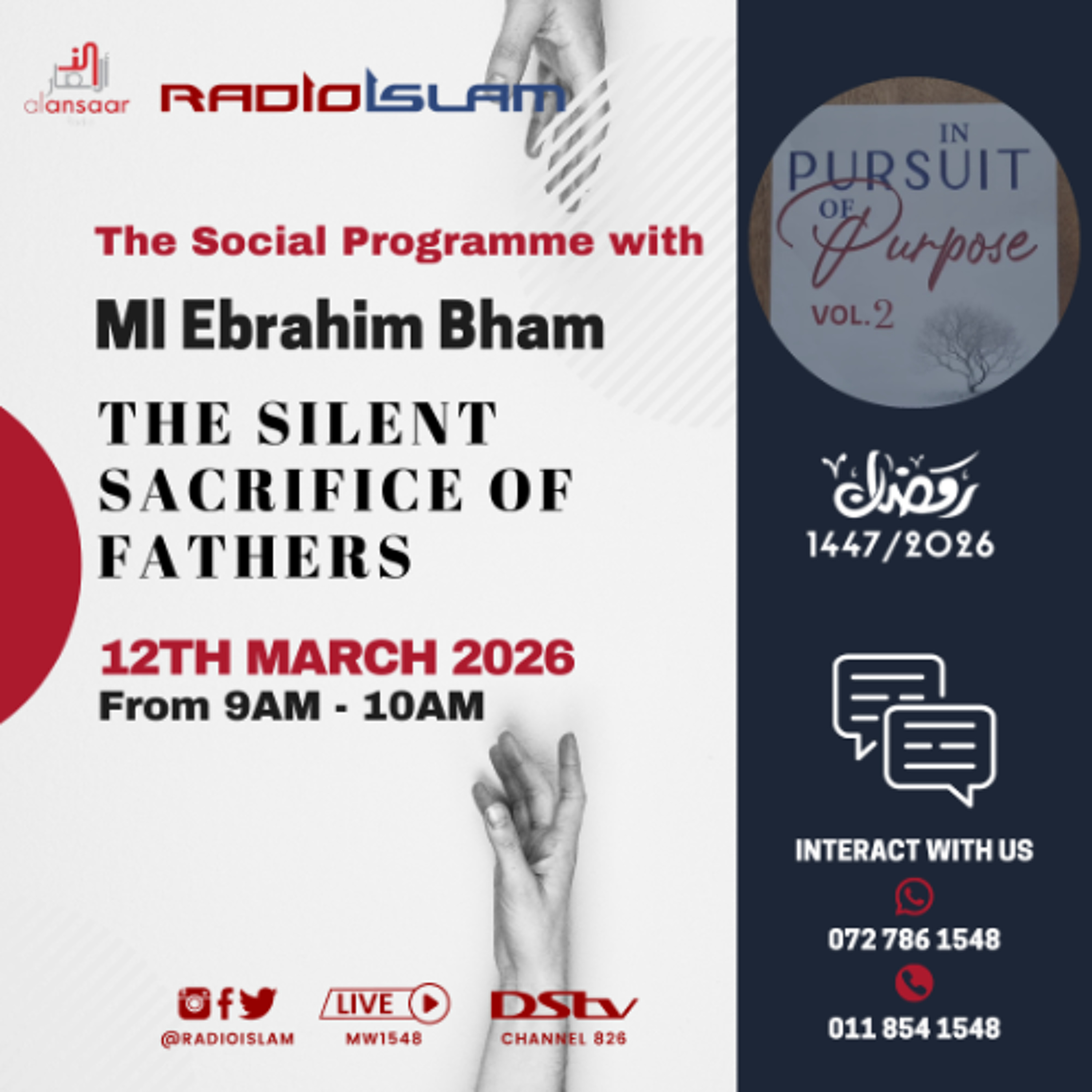
Asalaamu alaykum wa rahmatullahi wa barakatuh, welcome to the social program on Radio Islam International. My name is Habib Bobat and inshallah will be together for this hour. So during the month of Ramadan, we've been doing the book in pursuit of purpose volume 2 of Maulana Suleiman Ravit on this particular program. And this morning we've selected the chapter, the silent sacrifice of fathers. And we'll be talking about this with Maulana Ibrahim Baam, the numbers to keep in mind 0727861548. That's 0727861548. And the number to call 011851548. So we know the position of a mother in Islam that is given, but together with that there's also added emphasis with regards to the father and we're going to be discussing that today. Maulana Suleiman Ravit, wa rahmatullahi wa barakatuh. O alaykum wa rahmatullahi wa barakatuh, and assalamu alaykum to all the esteemed listeners
of Radio Islam. How are you doing Maulana? Terawih finished now. Alhamdulillah. Allah has been good and Allah has been kind. Ramadan has been really marvellous, Allah tala except the clip at here and there, whatever we do, we haven't been able to fulfill the rights of the month sufficiently. But yet, I always tell people in my du'as, you know, in Alhamdulillah, I've already done three Khatam du'as, you know, it's amazing. So in the du'as, I've been saying, Allah, people have been standing up for tarawi for long hours. We did one, two and a half Sufaras. I made another Khatam with two Khatams that were two Sufaras. And the one that did two Sufaras, they continued and are doing a Khatam with five Sufaras. Alhamdulillah, there has been all of these tarawi's taking place. I managed one night to go to West Street and Masjid and was overwhelmed and so beautiful
recitation of Kari Yusuf, O Span and Kari, O Zafa, his Hague. So all in all, it was, you know, now, they're away from the norm where people are finishing tarawi in one hour. They were finishing it up in one and a half hour, but very good crowd and many good youngsters taking part in the tarawi. And then the point that I made in some of the Khatam du'as, Ya Allah, we have not been able to read or listen to the Quran as is the rights of the Quran. But people who don't understand the Quran and yet standing for long hours, for long periods shows some love, some commitment. And we can always take the negative, which many a time there are enough people taking the negative who are always looking out for the faults of the Ummat. There is also look at the positive aspects of the Ummat and one of them is this that people stay in tarawi or periods of time without understanding what they are listening.
And yet they are standing and they are standing solely because of the love that this is the Kalam of Allah, that's why they are standing. They are standing because it is the Kitab of Allah, now they say something, I don't think they, no, no, I don't think, I'm 100% that there is no other religious traditions in the world, that people will stand behind someone for a long period of time without understanding what they are reading other than Islam and Muslims. So Allah, so amazing, have you become a chairman manana? You know half of, sometimes you take the chair, you sometimes take the chair and it becomes a little bit overwhelming, you try to get a balance 10, 10 rakats or 12, 8 rakats. So yeah, insha'Allah it depends on how you go about it, sometimes you do take the chair. Mashallah. You don't think the chair is for us, but for Nafil namaz, there is gunjaish in that
sometimes it's overwhelming. Mashallah. How's the lukma game, are you able to still pull out at this age? Yeah, I have to control myself with regard to lukma because you need to give people a chance to, and I'm not a fan of those who are very quick to take out mistakes. You should give the half of opportunity to correct himself first, you know, it's very important. So it's something that we need to bring about, so I do feel that it should give. And then of course we are not Arabs, we are extremists, so sometimes I suppose in every tarawi, I don't think there is any tarawi in which there is a torture of perhaps rectifying the eras, and if there is something that is missed, then you repeat it, a little except even if it is maybe not the ideal, but a little except in insha'Allah, insha'Allah, Allah will accept. Because in Allah, you do Agil al-Muqsenin, Allah, Allah does not allow anyone's effort
to go to waste. Sometimes it is difficult when a person is reading at a fluent space, maybe not necessarily past, and then he picks up and he misses something or he makes a small mistake. By the time you pick it up, the man has already gone past half a page or one page. Now to bring him back, it becomes a challenge. So you then correct the mistake or you repeat it afterwards. And that is, I suppose, a common practice across everyone who is reading tarawi. True, true. Well, topic at hand today is we are talking about the silent sacrifice of fathers. Yeah, I suppose it is a very interesting thing. I must tell you that I read the chapter before, I suppose the other chapter was about the absent father, but I suppose we will try and blend the two together in insha'Allah. It is very important that we try and get the balance between the responsibility and
also the virtue, which is always the important part. True. All seven, two, seven, eight, six, one, five, four, eight, all seven, two, seven, eight, six, one, five, four, eight, all, double, one, eight, five, four, one, five, four, eight. So now we can take a few points and then maybe insha'Allah listeners will start contributing to our discussion. I think that the first point that I, when I was reading through the chapter, I made my own points. And I drew also from an analogy that I picked up once in Anika Bayan of my honorable colleague, Mufkisul Iman Mulla Sahib, and I thought I will, I will use that as a metaphor in an example to speak about the role of the father. Now, we all know that Allah Allah has given the father a very important role. And perhaps because of his role, if there is such a great, both privilege and a responsibility, Arigalukahu Amun al-Nisab. So even in this chapter, that is the first ayat that has been coated and has been noted.
Arigalukahu Amun al-Nisab and the one previous that Allah has made the man, the authority over the women. Now, of course, it comes with a great amount of interpretation, a lot of different, or am I, given different interpretations, but whatever the interpretation, it does show some sort of authority. Arigalukahu Amun al-Nisab, Arigalukahu Amun al-Nisab. Now, today is that there is a fact that there is a declining masculinity. Now, that declining masculinity is in two ways. One way it is in fathers not playing their own one, and the second thing is that the family structure, maybe many times wives, and the community does not allow or does not see the
role of the father. It works both ways. Father, himself not playing the role, or the structure of the community not allowing him to fulfill his role as an authority in the household. And I always tell people that authority cannot be in any way demanded. It must be commanded. You can't come into the house until I am the head of the household, you must accept me and you must respect me, and the moment you go to that level, the moment you go to that lens, that I am the person you must suppose to respect me, and you are supposed to follow me. You have lost the battle. If you have to command it, you have lost the battle. You must play your role in such a manner that automatically, automatically the children and the wife look upon you as the authority. So the moment you demand it, I would say you have lost the battle.
It must be done by your conduct, by the way you carry yourself, and by the way you carry your authority. So I was speaking about the Mufti Suleiman Mullah, Mullah giving this example which I heard in one of his Nikabayans, and he was sitting together in one of the beautiful life halls. It was amazing. He said the role of the father is like the captain of the airplane, the flight. So we all know that in the flight, the captain is like the defector prime minister of the flight. He is the president of the flight. He is the leader of the flight. And he can even make a call that he can stop a flight and he can bring it down and get a person arrested in a flight who is causing turmoil. And that is the power and authority that he has. So now if you look at the role of the father, the role of the album like the captain of the airplane or the captain of the flight, now you see that he makes the call.
What time he must go, what route he must take and he will make the necessary precautions from the weather, trying to avoid places where there is turbulence, where there is excessive rain, which could cause turbulence, which according to what, no matter how frightened you get about it, and how afraid you get about turbulence, and sometimes it can become quite bumpy, they tell us that turbulence is not dangerous, but there are, you see the clock, you see people have had a severe turbulence and it is called injuries to people. And that's why nowadays they tell you that if you're hit belt on throughout the flight, because for the cause precaution reasons in case you get an unexpected turbulence. So he makes the call when to tell you to tie your seat belt when it becomes compulsory. So sometimes he will tell you that there is mild turbulence where your seat belt and he will allow the meal service to continue.
Sometimes he will tell you that there is a little bit more turbulence and is becoming more bumpy, will allow the meal service, but there will be no hot meals or hot drinks served, because it could fall, because of the bumpiness, and could cause someone to get burned. And sometimes he will say, I'm suspending the meal service because the turbulence is too heavy. Now that is the role of the husband in the house. He is the one who must be able to gauge the turbulence level in the house and take the appropriate steps. So he will say that when she made a comment, I don't have to bring the house down because of one small comment that she made, you know. And that is something that we need to understand. He must make the call. And sometimes he will say, okay, now this is a matter, but more serious, I need to take some extra precaution with regard to bringing the turbulence level down, and to deal with the turbulence. And sometimes he might just say, he's shutting himself off,
and he said, listen, it's no use. And I always tell couples, never ever discuss a matter when both of you are angry, because you'll never get anything done when both of you are angry, because it's a losing battle. It's a losing battle once you get into a situation where both of you are screaming at one another. What are you going to get? So sometimes you just say, the meal service is suspended. Sometimes you have to take the calls here. We're not going to discuss this. We are both angry, but maybe we will find a right in a better way and a better time to be able to discuss it. So the role of the father is like the captain of a flight in the airplane. He is the one that makes the call. And many times, I think that people don't realize that, and people don't understand the role of the father, all the role of the husband in the house. He is the one who provides the temperature. He is the one that provides the control. I remember reading a book from the late, the one who was in the Lodium, what was his name,
now the name just slips me, Professor Doye. So he said that Aridalukahu Amun al-Nusab means that the father must be able to even control, and the husband must also be able to tolerate the outburst and the anger of the wife. So he said that the meaning of Kawamun, that you must be able to tolerate and be able to deal with it. Don't just get angry because your wife would angry. She might have a reasonable situation that come and go because of Natalia has made a such, so you have different emotional periods in the month, the PMS, you know, not Victoria Museum School, the people. Please have, please have, he must be able to understand that, and if he doesn't know that he's not fulfilling the right as a husband or as a father, he must be able to understand that Nadia Karimsausla never,
ever in his life, looked at his end upon his wife, his servants, or anyone, never. So that is as soon as the tumultus spire towards, you know. So I think that that is the cause of that great role, much is expected of the father. And I'm not sure if even if husbands and fathers know that role, Allah has given him. I remember reading also an autobiography of Malcolm X. And he even mentioned, he said, the father must be the first person to get up in the early hours in the morning. He must be the cause. He is the Kawabun. He must be able to set the thing. Are there very rarely happened in our house? Although it's maybe not, it's not a, it's not a Haram halal issue. It is a matter of interpretation of someone interpreting Kawabun that you are the one that's supposed to be in the forefront of any danger. And if there's any danger, if there's anything that is requires some form of someone stepping up in the house with regard to something,
it should be the husband. So I'm not sure if people understand this role, or even if, for example, even the women understand that role that the husband is supposed to provide it, it might be a good exercise to find out from our listeners. If they look at it as such, they expect it as such. In fact, nowadays you're finding many, many women who are saying that we need such a person in our life. Even in a liberal society, you are finding people who are saying we crave for a man who takes care of everything. Let's go for our headlines. And when we return, we'd like to hear from you on 0727861548. Let's continue with our program. Malar is a nice point made in the chapter that fathers often show love differently. Mothers express love emotionally while fathers often express love through provision, sacrifice and responsibility. Many of our fathers sacrifices are silent. He works long hours, carries financial burdens and ensures stability for his family.
Yes, now that whatsoever, men are from us and women are from Venus. I think it comes out very clearly that Allah is wired and Allah has made and created men and women differently, which they show they concern for the children and for the family and different men. One of the things that I always, I pick up and I'm going to share this with the listeners. And if there are any men listening, I suppose many of our listeners at this time of the morning are females, but maybe they can share it with the males, is that males tend to have a very a way of dealing with things that is solution-oriented. You come and tell me something and a man wants to say like, what do you want me to do about it? You know, tell me what I must do about it. And the moment a woman says something, they go into several ways of dealing with a situation. Whereas many a times a woman is not necessarily as
solution-oriented as a man. Many a time it's a venting. And I think if we can understand that many times many arguments in the houses can come to an end. And although I must be safe, I was also acknowledged that sometimes I myself are not as, you know, a dearer than to this because that's a reality. Women sometimes just need to vent and they're not necessarily looking for a solution. They just out there talking about the problem. But as a woman, a man is saying that, no, coward, what are we supposed to do about it? So I think it shows that there is a difference. So one of the ways that men do show, they concern is by working long hours, bringing bread to the table, of course, by bread, we mean the needs. And they go extra mile. There's no doubt. A man with many a times, sacrifice his own luxury and sacrifice buying something for himself, but would see to it that the children get something or even the wife gets something more than what he is. And the one thing is that, you know, that as you said that Allah has created the DNA, the psyche, and the
temperament of a man in other way. Men are not always verbally expressive. They may not use terms of india men as often. And therefore, to show you that, but I think it's something that you will identify with. You go to a wedding, you go to a function, and it's well decked out. And there's a very full arrangement. There's flower arrangements. The woman will sit around and not take away the flower arrangements. And they will sit around the flower arrangement, admiring the flower arrangement. And you'll find men sitting at the table. The first thing they do when they all sit down, they just take out the flower arrangement. He's just pointing out of you, in spoiling our conversation. And that particular person got him spent thousands for that one, particular flower arrangement. And for us, we just miss it by taking it out and putting it in one corner of the hall. So I think it tells us a lot with regard to how men deals with something and how women would sometimes deal with thinking. So, this sometimes creates the impression the way they deal with things that mother loves more than the father. But this could not be further from the
the fact is that many times you have a roof over your head. You don't have the school calling you out for unpaid fees. You can eat from multiple dishes on the table. You go beyond the norm. The topic is many times overflowing with clothes. You wear shoes that is worth many, many amount to great amount on on each day. You go on holidays. You are able to traverse and travel from point to A to point B. Is this not enough evidence that your father loves you? When a child falls off a bicycle, the way one of us human has made mention, the mother may cry, even while the child, the child is not so serious. The father, the father, how you're pleased that the front roll. He might not be expressive, but you will be stern. You will take a difficult decision mother, mother, take to the doctor or not. Now, that type of decisions,
by and large, are the ones that the father takes. So, we must be careful with the way we express ourselves. Men are generally less expressive. So, when you say something hurtful, the father may not respond. Your mother may throw a tantrum. I do everything for you. I cook for you in this way. You talk to me. The father will perhaps remain silent, but silent does not mean that he has not taken offense or is not hurt. His heart feels, even his tongue does not always express it. And I think it's something that we need to understand. And therefore, in the beginning, we all know the famous Hadith that someone came and asked, who is deserving most of my good kindness and my goodness? And we saw some tri-state, the mother, and then he said, the father, but he doesn't mean that the father doesn't have any consideration. One, it's a Samuel of Thani Ramatul Ali, used to say that under the feet of the mother is general, but under the feet of the father is the chumpel. So, there's two ways of looking at it,
that yes, he doesn't have that amount of virtue because the general lies under the feet of the mother. But when you say the chumpel, is that the father makes the difficult decision with regard to the disciplining of the child. And many a times you find even mothers who don't have that ability will tell the child, just wait till the father comes home, and then I will relate to him what you did. So, he does tell you that he plays a very different role, but doesn't mean it's a role that is less significant, it's just as important, even more important. True. So, some of the messages come in through, some men abdicate their role, some men need to be emotionally in tune, and another message says, what a great topic, Maulana, it's just unfortunate that we only realize what our fathers did for us all our lives, only after they return to Allah, and regret why we didn't thank them. Alhamdulillah, Allah has given us the opportunity to thank them by sending for them Isalisawab.
Another one says, Maulana, we have an abuse of father, always fighting and hitting, he keeps throwing his responsibility away. For this year, users, he's first, at the age of 70 years, left the kids to look after her, he does not give my mother a scent, not even a piece of bread, yet they are in Nika. These are some of the messages that I can take for now Maulana. You know, the one thing that the modern world, the capitalist world, has taught us, and we have gone into it sometimes, maybe I won't use the word hook line and think about the fact that it is the father's responsibility to provide. And he'll provide, according to his status, another Zulam that we make is expecting the father to go beyond his means to provide. That's also not correct, but on the other hand, for him not to fulfill his role, that's another extreme. So these are two extremes. One is you put such pressure upon the father that is beyond
him he can. I mean, you left to live according to what he provides. And you have to be contented with that. And on the other hand, the father indicates and he doesn't provide it. And he expects in Islamic terminology and Islamic theology, even if the wife has means, it's still the responsibility of the husband to look, if she gives, they will be Baraka, they will be blessings, she will get reward for it. And the most famous example is the wife of Abdullah Ibn Masudra, the Allah, her name was Zainab, the Allah, who came to me and said to me, they are so I'm allowed to spend on Abdullah Ibn Masudra, definitely. And she was a wealthy woman who spend on Abdullah Ibn Masudra. So it is permitted, but at the end of the day, it doesn't take away the responsibility of the father and the husband to provide. Allah, the Holy Qur'an, when he makes mention of the authority, Allah, specifically, says, what he ma'an faquminam walim, Allah has given you that responsibility of being an authority
because you spend your wealth upon your family. From this verse, it inferred that if you do not spend and you do not fulfill your responsibility, there is going to be an impact on the authority. I mean, it's a natural thing. It goes hand in hand. If you don't fulfill that role, then it impacts upon your authority. And I'm not in any way in saying that people must only respect and obey because the father is giving and if he doesn't give, then he mustn't be treated with respect. I'm not saying that at all. But what I'm saying is that if you do fulfill your role in this field and in this field, it has an impact in terms of your authority. Your authority is someone that is more recognized. I remember someone one day telling me, my friend Rashid Gangat, who used to be the manager, and he used to say a very, very amazing thing.
He used to say, Bajina, Kabbarpur, Nana Bajina Fatiha. Do you ever heard that for a... No, first of all, everybody. It's an interesting concept. If the father provides the rent, he provides the groceries, he does everything, and then of course the Nana Bajina, the father-in-law will come at the time of need and he'll give an expense of gift, might give for use or whatever. Now, everyone needs wah-wah for the Nana Bajina because he gave that. So maybe that gift might be 5,000, 5,000, 10,000, whatever it is. But the 50,000 that the father spent in looking after the basic needs, no one looks at that. So the Gujarati state is Bajina Kabbarpur, Nana Bajina Fatiha. So Gujarati state is very amazing. So that is one of the things that were there that I picked up
because that we sometimes tend to not regard the father's contribution, which is the basics. And if someone comes out from under and gives us a little bit extra, so it's just an natural thing, you know, that the extra things we tend to look at, but the basic things you don't look at. What is provided? Yeah. This message says, my father worked two jobs when you were growing up only now that I have children of my own, do I realize how much pressure he carried me, Allah reward our fathers. The next one says, Mawlana, I'm listening with my teenage son in the car right now. I told him this discussion is more for him than for me. I see the other one is that I mean see, we talk about the rights of the mother and this is something that before I forget it and we don't relate it before the end of the program, the resource from said al-wali do also to Abu Abwabil Jannah. Father is the middle door of Jannah. But in shaytah, pahavi, dalik al-bab, with pahzuh.
If you wish you may neglect it or if you wish you may safeguard the middle door of Jannah. Well now that doesn't come through many times. So we know about the fact that Jannah lies under the feet of the mother, something that is always mentioned and we know all the hadith that three times the resource that made mention be kind most to your mother, mother, mother than your father. But just hadith for example that your father is one of the doors of Jannah. If you wish you can safeguard it or if you wish you can neglect it. Subhanallah, what an amazing aspect with regard to the rights of the father. Subhanallah, the next one says he does not even fulfil the basic needs and requirements of the family and this one says how is he entitled to be called a father and claim money from his children if he is or her working for rental etc. yet you are living in the same house.
I think we call it the just of what they are trying to say but that is what one message says. Yeah, these two things I think I need to make mention. One is the role the father has to play and then of course we have people who don't fulfil that role. Now obviously if they are not fulfilling that role it is said it is unfortunate and they must step up because a lot of expects a lot from them but having said that still at the end of the day they still a certain degree of respect that is also for a father although I make mention and I do understand that if he doesn't fulfil that role and he behaves abusively there is no justification. I made mention that we saw still have never ever lifted his hand never in his lifetime is it recorded that we saw still have lifted his hand over his wives over his servants over his children never. That we saw still have was on another level with regard to kindness and compassion to his children. I mean especially the
grandchildren. Nabi saw still used to sometimes make them sit on his back there is that Hadith of Ibn Abi Leyla that he says that we are sitting with Nabi saw still have been on a grandson or sitting on Nabi saw still have and he passed water he urinated and we all became better because we love Nabi saw still have when we rush and Nabi saw still have said no no no no don't worry don't worry don't don't disturb my grandchild he has done whatever he has done is a natural cause don't you get excited bring me a bowl of water I will wash myself and this will not be a caring source from death he doesn't get angry now here we sometimes the daughter of the daughter in law gives you the child in the child messengers and throws up and all the father throws up such a tantrum I mean now that is not in the control of the daughter not the controller in the daughter of the daughter in law I mean if the child you know automatically throws up in Nabi when you ever the father picks up like automatically it detects something you know so it it throws up when it's only by the father you know so whatever it is so we're not supposed to get angry we
supposed to be the father figure and the father figure is a very important role and that father figure requires wisdom requires patience and requires much more than what many a times people realize or practice upon that poorly as a child by his own mother and father now as they are getting older and we are also getting older he keeps his distance he doesn't disrespect them but keeps his distance is he wrong appearance also not answerable for their flock of sheep yes no doubt as the Umaravil Autonus one day of course father came to complain to Umaravil Autranu I read that in Jumar magazine many years back and when he approached the father the child the child told him what the father was doing and Umaravil Autranu rebuked the father he said you're expecting and you came to complain to him what the child don't tell me what you are doing so yes there is the I mean see it's a natural human being even an animal if we show kindness to it it responds
now any and if we show it you know a certain degree of harshness it will also respond like that so we are human beings I mean we are going to respond according to how you treat and the father doesn't treat the child properly then obviously it's going to happen and yes I would agree that if for example you feel very hurt and it must be proper circumstances and proper reasons with regard to the hurt maybe there was abuse or you saw him treating your mother in a not another good manner abusing the mother then instead of showing disrespect is better to stay at a distance rather than being openly disrespectful true umaravil have to stop you go one more aid break inshallah if you if you'd like then we can maybe continue the discussion next he will look at another topic I think I think maybe we should maybe we should look at the reasons why sometimes the father does not fulfill that role inshallah so if we are good we will be
able to do two very important chapters of the book in the in Ramadhan and Hamdulillah
More episodes
More from Radio Islam

How Children Shift The Dynamics of Marriage: Guest Fatima Talia
Radio Islam

The Big Picture with AB Dawjee – Sat,05.09.2026
Radio Islam

Your Sunday Reset (06.09.26)
Radio Islam

A Chef's Journey of Passion & Purpose: Chef Sameera Ismail
Radio Islam