newsJun 8, 20261:24:26pending
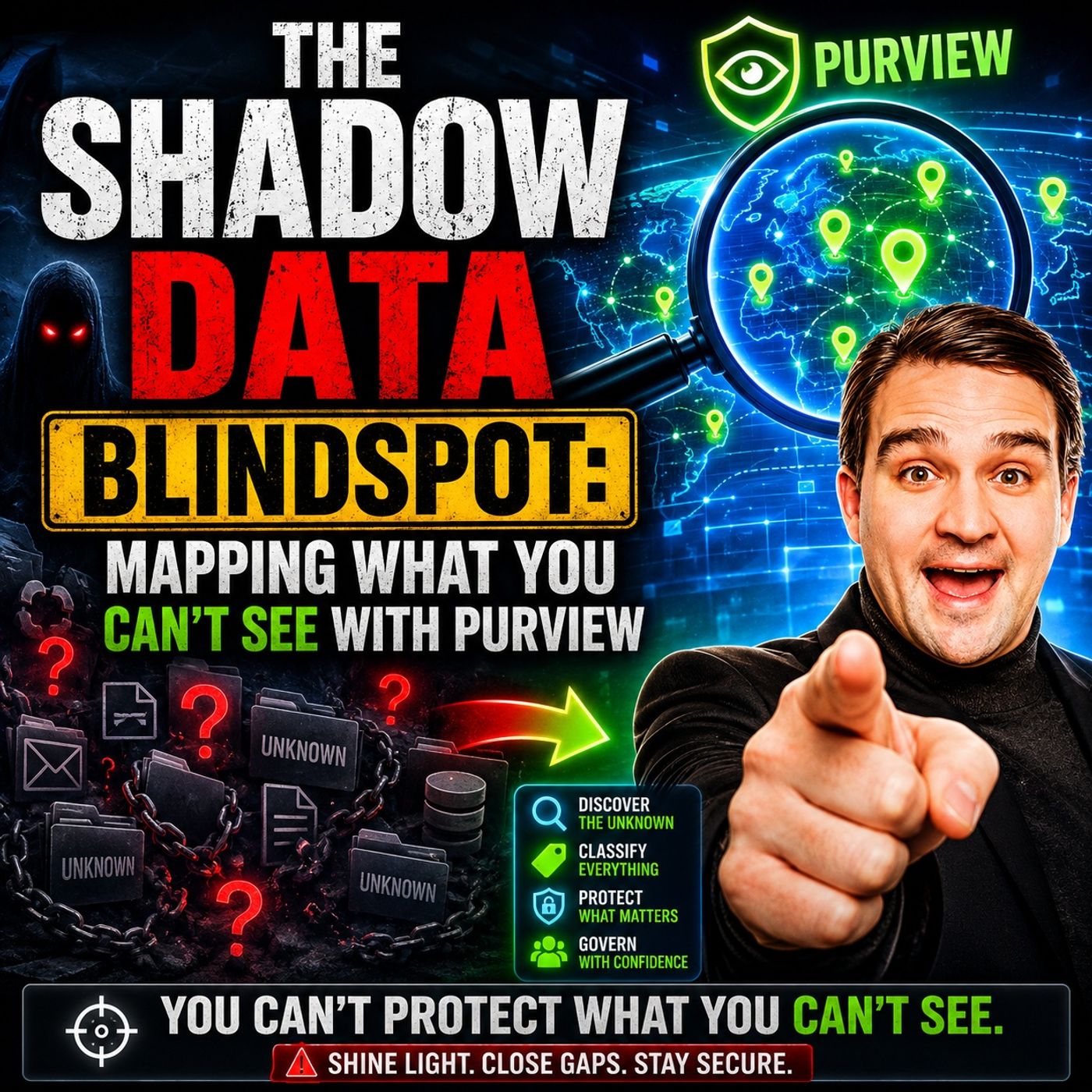
The Shadow Data Blindspot: Mapping What You Can’t See with Purview
About this episode
Your data map is supposed to show everything.Yet in most organizations, it only shows the data someone remembered to register.It doesn't show the forgotten storage account a project team created two years ago. It doesn't show the customer records copied into a personal OneDrive folder for "temporary analysis." It doesn't show abandoned development databases populated with production information, or AI training datasets stored in unmanaged cloud environments. Most importantly, it doesn't show how sensitive information continues to spread throughout the enterprise long after governance teams believe it is under control.In this episode, we explore one of the most significant challenges facing modern organizations: shadow data. While most enterprises invest heavily in cybersecurity, compliance programs, and data governance initiatives, many still have visibility into only a fraction of their actual data estate. The result is a growing blind spot that creates security risks, compliance exposure, operational inefficiencies, and increasing challenges for AI adoption.We examine why traditional governance approaches are failing in cloud-first environments, how remote work and SaaS adoption accelerated the problem, and why artificial intelligence may be making the challenge even more severe. Using Microsoft Purview as the foundation, we explore how organizations can shift from periodic audits and manual inventories toward continuous discovery, automated classification, and real-time visibility.The reality is simple: if you cannot see your data, you cannot govern it.
UNDERSTANDING THE SHADOW DATA PROBLEM
Many organizations confuse shadow data with shadow IT, but they are fundamentally different challenges.Shadow IT refers to unauthorized applications and technology platforms. Shadow data refers to the information itself—the files, databases, reports, spreadsheets, exports, backups, and copies that exist outside formal governance controls.The problem is far larger than most organizations realize.Sensitive information often appears in places nobody expected:
HOW MODERN WORK CREATED A DATA VISIBILITY CRISIS
The shadow data problem did not emerge overnight.For decades, employees created local copies of information to work around system limitations. What began as spreadsheets and database exports eventually evolved into cloud storage accounts, SaaS platforms, collaboration environments, and mobile devices.The rapid adoption of remote work accelerated this trend dramatically. Employees needed faster ways to access information from multiple locations and multiple devices. Teams adopted new collaboration tools, created temporary repositories, and shared files across environments that were never designed to become permanent business systems.At the same time, cloud adoption enabled business units to deploy storage and applications independently of central IT. Every new SaaS platform created another potential data repository. Every new integration created another copy of sensitive information.Today, organizations operate in an environment where data can move faster than governance processes can track it.
THE FINANCIAL IMPACT OF INVISIBLE DATA
Shadow data is often viewed as a security issue.In reality, it is a business issue.Organizations spend millions of dollars each year dealing with the consequences of unmanaged information. Security incidents involving shadow data frequently take longer to detect and contain because the affected repositories are unknown to governance teams.The impact extends far beyond breach costs.Employees waste countless hours searching for information spread across disconnected repositories. Different departments maintain conflicting versions of the same data. Projects slow down because teams cannot determine which source is authoritative. Compliance programs become more expensive because auditors require evidence that organizations often cannot provide.The hidden cost of invisible data frequently exceeds the cost of the technology required to discover it.
WHY AI MAKES THE PROBLEM EVEN MORE SERIOUS
Artificial intelligence has introduced an entirely new category of shadow data risk.Data science teams routinely create copies of production datasets for experimentation, model training, testing, and validation. These copies often contain highly sensitive information and frequently exist outside traditional governance frameworks.The challenge becomes even greater when organizations begin deploying Microsoft Copilot, Azure AI services, and custom AI solutions.AI systems depend on trustworthy data.If organizations cannot verify:
WHY TRADITIONAL GOVERNANCE FAILED
Most governance frameworks were designed for a world where data lived in known locations.Databases were centralized.File shares were controlled.Infrastructure changed slowly.That world no longer exists.Today, data is created, copied, transformed, and shared continuously across cloud platforms, collaboration tools, SaaS applications, and AI systems.Manual inventories cannot keep pace.Quarterly audits cannot keep pace.Spreadsheet-based governance cannot keep pace.By the time an inventory is completed, the environment has already changed.This is why many governance programs appear successful on paper while remaining blind to a significant percentage of the actual data estate.
MICROSOFT PURVIEW'S DISCOVER-FIRST APPROACH
Microsoft Purview approaches governance from a fundamentally different perspective.Rather than assuming organizations already know where their data lives, Purview assumes the inventory is incomplete.The goal is not simply to govern known assets.The goal is to discover unknown assets.Using the Purview Data Map, organizations can continuously scan and catalog data sources across cloud, on-premises, and SaaS environments. Instead of relying on manual registration, Purview builds a living inventory that evolves alongside the environment itself.This shift from static governance to continuous discovery represents one of the most important changes in modern information management.
AUTOMATED DISCOVERY, CLASSIFICATION, AND LINEAGE
Discovery is only the first step.Once assets are identified, organizations must understand what the data contains, where it originated, and how it moves throughout the enterprise.This episode explores how Purview combines:
FROM DISCOVERY TO ACTION
Finding shadow data is only valuable if organizations can act on what they discover.We explore how modern governance programs operationalize visibility through automated classification, sensitivity labels, retention policies, stewardship workflows, and remediation processes.Rather than relying exclusively on centralized governance teams, modern programs increasingly adopt a shift-left model where data owners participate directly in remediation efforts.This creates a more scalable governance framework that aligns responsibility with ownership while maintaining centralized oversight and policy enforcement.The result is a governance model that can operate continuously rather than periodically.
BUILDING AN AI-READY DATA ESTATE
The future of governance is no longer primarily about compliance.It is about trust.Organizations that understand their data can build more effective AI systems, improve decision-making, reduce security exposure, and respond faster to regulatory requirements.Organizations that cannot see their data will struggle to govern it, protect it, or use it effectively.As AI adoption accelerates, the ability to discover, classify, map, and govern information across the enterprise will become a foundational capability rather than an optional one.The future belongs to organizations that replace assumptions with visibility.Because before you can govern your data, you must first find it.
WHO SHOULD LISTEN?
This episode is designed for Microsoft 365 Architects, Azure Architects, Enterprise Architects, Data Architects, Governance Leaders, Compliance Officers, Security Teams, Microsoft Purview Administrators, Data Stewards, AI Engineers, Data Scientists, CIOs, CTOs, and CISOs.If your organization is investing in Microsoft Purview, Microsoft 365 Copilot
Become a supporter of this podcast: https://www.spreaker.com/podcast/m365-fm-a-microsoft-mvp-podcast-by-mirko-peters--6704921/support.
UNDERSTANDING THE SHADOW DATA PROBLEM
Many organizations confuse shadow data with shadow IT, but they are fundamentally different challenges.Shadow IT refers to unauthorized applications and technology platforms. Shadow data refers to the information itself—the files, databases, reports, spreadsheets, exports, backups, and copies that exist outside formal governance controls.The problem is far larger than most organizations realize.Sensitive information often appears in places nobody expected:
- Personal OneDrive accounts
- Departmental storage repositories
- Forgotten test environments
- Rogue cloud storage accounts
- Developer sandboxes
- AI training datasets
HOW MODERN WORK CREATED A DATA VISIBILITY CRISIS
The shadow data problem did not emerge overnight.For decades, employees created local copies of information to work around system limitations. What began as spreadsheets and database exports eventually evolved into cloud storage accounts, SaaS platforms, collaboration environments, and mobile devices.The rapid adoption of remote work accelerated this trend dramatically. Employees needed faster ways to access information from multiple locations and multiple devices. Teams adopted new collaboration tools, created temporary repositories, and shared files across environments that were never designed to become permanent business systems.At the same time, cloud adoption enabled business units to deploy storage and applications independently of central IT. Every new SaaS platform created another potential data repository. Every new integration created another copy of sensitive information.Today, organizations operate in an environment where data can move faster than governance processes can track it.
THE FINANCIAL IMPACT OF INVISIBLE DATA
Shadow data is often viewed as a security issue.In reality, it is a business issue.Organizations spend millions of dollars each year dealing with the consequences of unmanaged information. Security incidents involving shadow data frequently take longer to detect and contain because the affected repositories are unknown to governance teams.The impact extends far beyond breach costs.Employees waste countless hours searching for information spread across disconnected repositories. Different departments maintain conflicting versions of the same data. Projects slow down because teams cannot determine which source is authoritative. Compliance programs become more expensive because auditors require evidence that organizations often cannot provide.The hidden cost of invisible data frequently exceeds the cost of the technology required to discover it.
WHY AI MAKES THE PROBLEM EVEN MORE SERIOUS
Artificial intelligence has introduced an entirely new category of shadow data risk.Data science teams routinely create copies of production datasets for experimentation, model training, testing, and validation. These copies often contain highly sensitive information and frequently exist outside traditional governance frameworks.The challenge becomes even greater when organizations begin deploying Microsoft Copilot, Azure AI services, and custom AI solutions.AI systems depend on trustworthy data.If organizations cannot verify:
- Where training data originated
- Whether data was properly classified
- Which users had access
- Whether regulatory requirements were satisfied
- How information moved through the environment
WHY TRADITIONAL GOVERNANCE FAILED
Most governance frameworks were designed for a world where data lived in known locations.Databases were centralized.File shares were controlled.Infrastructure changed slowly.That world no longer exists.Today, data is created, copied, transformed, and shared continuously across cloud platforms, collaboration tools, SaaS applications, and AI systems.Manual inventories cannot keep pace.Quarterly audits cannot keep pace.Spreadsheet-based governance cannot keep pace.By the time an inventory is completed, the environment has already changed.This is why many governance programs appear successful on paper while remaining blind to a significant percentage of the actual data estate.
MICROSOFT PURVIEW'S DISCOVER-FIRST APPROACH
Microsoft Purview approaches governance from a fundamentally different perspective.Rather than assuming organizations already know where their data lives, Purview assumes the inventory is incomplete.The goal is not simply to govern known assets.The goal is to discover unknown assets.Using the Purview Data Map, organizations can continuously scan and catalog data sources across cloud, on-premises, and SaaS environments. Instead of relying on manual registration, Purview builds a living inventory that evolves alongside the environment itself.This shift from static governance to continuous discovery represents one of the most important changes in modern information management.
AUTOMATED DISCOVERY, CLASSIFICATION, AND LINEAGE
Discovery is only the first step.Once assets are identified, organizations must understand what the data contains, where it originated, and how it moves throughout the enterprise.This episode explores how Purview combines:
- Automated discovery
- Sensitive data classification
- Custom classifiers
- Metadata enrichment
- Data lineage
- Relationship mapping
FROM DISCOVERY TO ACTION
Finding shadow data is only valuable if organizations can act on what they discover.We explore how modern governance programs operationalize visibility through automated classification, sensitivity labels, retention policies, stewardship workflows, and remediation processes.Rather than relying exclusively on centralized governance teams, modern programs increasingly adopt a shift-left model where data owners participate directly in remediation efforts.This creates a more scalable governance framework that aligns responsibility with ownership while maintaining centralized oversight and policy enforcement.The result is a governance model that can operate continuously rather than periodically.
BUILDING AN AI-READY DATA ESTATE
The future of governance is no longer primarily about compliance.It is about trust.Organizations that understand their data can build more effective AI systems, improve decision-making, reduce security exposure, and respond faster to regulatory requirements.Organizations that cannot see their data will struggle to govern it, protect it, or use it effectively.As AI adoption accelerates, the ability to discover, classify, map, and govern information across the enterprise will become a foundational capability rather than an optional one.The future belongs to organizations that replace assumptions with visibility.Because before you can govern your data, you must first find it.
WHO SHOULD LISTEN?
This episode is designed for Microsoft 365 Architects, Azure Architects, Enterprise Architects, Data Architects, Governance Leaders, Compliance Officers, Security Teams, Microsoft Purview Administrators, Data Stewards, AI Engineers, Data Scientists, CIOs, CTOs, and CISOs.If your organization is investing in Microsoft Purview, Microsoft 365 Copilot
Become a supporter of this podcast: https://www.spreaker.com/podcast/m365-fm-a-microsoft-mvp-podcast-by-mirko-peters--6704921/support.
Get every episode summarized
Each time M365.FM - Modern work, security, and productivity with Microsoft 365 publishes, we email you a written briefing from the transcript — the topics, who appeared, and any specific claims, with the ad reads skipped.
Email me new episodesFree for 3 shows. No card needed.
No transcript yet
This episode has not been transcribed. Request it and it moves to the front of the queue.
More episodes
More from M365.FM - Modern work, security, and productivity with Microsoft 365

Constraint-Based Scheduling: The Architecture That Makes Production Plans Real
M365.FM - Modern work, security, and productivity with Microsoft 365
Sep 15, 20261:51:40completed

A Machine Goes Down. How Should Your Production Plan React?
M365.FM - Modern work, security, and productivity with Microsoft 365
Sep 15, 20261:41:43completed

Can Value Stream Mapping Become a Live Data Model?
M365.FM - Modern work, security, and productivity with Microsoft 365
Sep 15, 20261:48:32completed

How Finite Capacity Scheduling Actually Works in Manufacturing
M365.FM - Modern work, security, and productivity with Microsoft 365
Sep 14, 20261:54:54completed