newsMay 12, 202618:55pending
The Service Principal Crisis: Why Personal Accounts Are Killing Your Security
About this episode
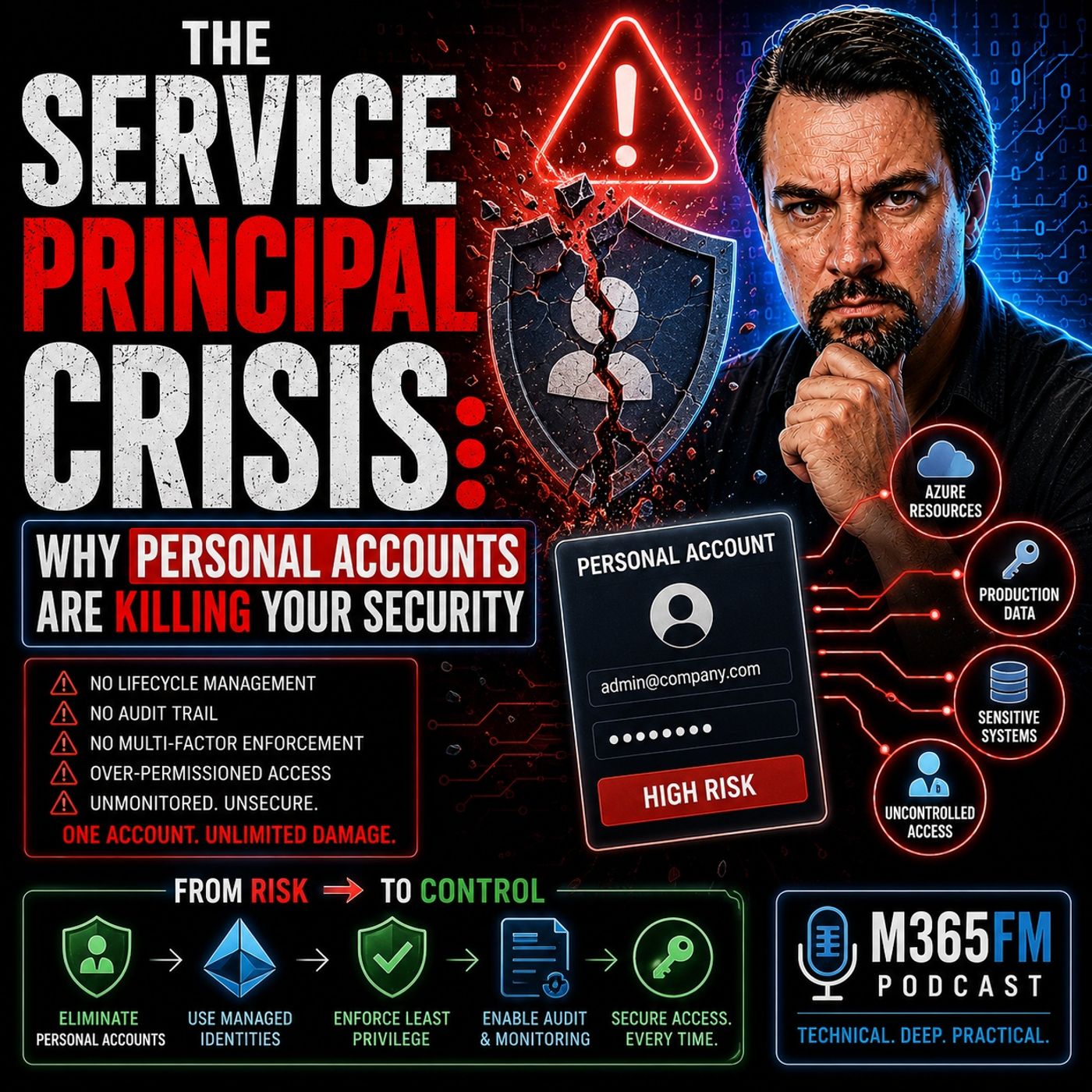
Your Microsoft 365 automation environment is probably running on borrowed identity. In this episode of the M365FM Podcast, we expose one of the biggest hidden risks inside modern cloud architecture: enterprise workflows tethered to personal user accounts. It starts innocently enough. An engineer builds a Power Automate flow, connects a Logic App, configures a Power BI refresh, or deploys a SharePoint integration using their own credentials because it is fast and convenient. But the moment that person changes roles, resets a password, triggers Conditional Access, loses MFA access, or leaves the company entirely, the entire automation chain collapses. This is identity rot. Organizations across the world are unknowingly building mission-critical infrastructure on top of human dependencies instead of infrastructure identities. The result is brittle automation, failed workflows, silent outages, security gaps, and operational chaos that often goes unnoticed until production systems fail. As Microsoft moves toward the 2026 identity model, the era of service-principal-less automation is ending. Legacy authentication patterns are being deprecated, old Azure AD Graph integrations are disappearing, and modern workloads are being forced toward identity-first architecture. This episode breaks down why Service Principals, Managed Identities, Federated Credentials, and Zero-Secret authentication are no longer optional modernization projects. They are now foundational requirements for operational survival. If your automation breaks when an employee resigns, your architecture is already unstable.
THE SHADOW ACCOUNT TRAP
Most identity problems begin with convenience. An engineer connects a workflow using their own Microsoft 365 account because the permissions already exist and the deployment is faster. The automation works immediately, the project launches successfully, and nobody realizes they just embedded a hidden human dependency into critical infrastructure. Until the password changes. Until Conditional Access blocks the sign-in. Until MFA expires. Until the employee leaves the company. This episode explores why modern enterprises are trapped in what we call the Shadow Account Model:
WHY MICROSOFT IS FORCING THE SHIFT
Microsoft has officially recognized the structural flaw of user-based automation. As we move toward 2026:
Automation must have its own identity. This episode explains why organizations are no longer fighting technical debt alone. They are now fighting the direction of the platform itself. The old model asked:
“Which person is running this automation?” The new model asks:
“Which workload is authorized to perform this action?” That architectural shift changes everything.
IDENTITY AS INFRASTRUCTURE
Modern identity is no longer a human construct. It is infrastructure. In this episode, we explore how Service Principals function as non-interactive runtime identities that represent workloads instead of employees. We break down:
MANAGED IDENTITIES AND ZERO-SECRET AUTHENTICATION
The strongest credential is the one nobody ever handles. Managed Identities fundamentally change how enterprise authentication works because Azure manages the entire lifecycle automatically:
FEDERATED CREDENTIALS AND THE END OF STATIC SECRETS
Static secrets are one of the largest liabilities in enterprise automation. This episode explores how Federated Credentials and OpenID Connect (OIDC) are replacing long-lived secrets inside GitHub Actions, CI/CD pipelines, and multi-cloud integrations. You’ll learn:
THE PERMISSION CREEP CRISIS
A resilient identity with excessive permissions becomes a high-speed weapon. One of the biggest architectural failures in Microsoft 365 automation is permission creep. Engineers frequently assign massive Graph API scopes like Application.ReadWrite.All or Directory.ReadWrite.All simply to eliminate deployment friction. The result:
Overprivileged Service Principals operating silently across the tenant. This episode explores:
Become a supporter of this podcast: https://www.spreaker.com/podcast/m365-fm-a-microsoft-mvp-podcast-by-mirko-peters--6704921/support.
THE SHADOW ACCOUNT TRAP
Most identity problems begin with convenience. An engineer connects a workflow using their own Microsoft 365 account because the permissions already exist and the deployment is faster. The automation works immediately, the project launches successfully, and nobody realizes they just embedded a hidden human dependency into critical infrastructure. Until the password changes. Until Conditional Access blocks the sign-in. Until MFA expires. Until the employee leaves the company. This episode explores why modern enterprises are trapped in what we call the Shadow Account Model:
- Personal accounts acting as infrastructure identities
- MFA incompatibility with headless automation
- Authentication rot across Power Automate and Logic Apps
- Offboarding failures causing workflow collapse
- Service accounts operating as unsecured ghost users
WHY MICROSOFT IS FORCING THE SHIFT
Microsoft has officially recognized the structural flaw of user-based automation. As we move toward 2026:
- Legacy SharePoint 2013 workflows are being retired
- Azure AD Graph is being deprecated
- Service-principal-less authentication is disappearing
- App-only modern authentication is becoming mandatory
Automation must have its own identity. This episode explains why organizations are no longer fighting technical debt alone. They are now fighting the direction of the platform itself. The old model asked:
“Which person is running this automation?” The new model asks:
“Which workload is authorized to perform this action?” That architectural shift changes everything.
IDENTITY AS INFRASTRUCTURE
Modern identity is no longer a human construct. It is infrastructure. In this episode, we explore how Service Principals function as non-interactive runtime identities that represent workloads instead of employees. We break down:
- The Decoupling Principle in enterprise security
- Why workloads need independent identity boundaries
- The shift from human-centric to resource-centric authorization
- Why identity must become a deployment artifact
- How infrastructure-native authentication improves resilience
MANAGED IDENTITIES AND ZERO-SECRET AUTHENTICATION
The strongest credential is the one nobody ever handles. Managed Identities fundamentally change how enterprise authentication works because Azure manages the entire lifecycle automatically:
- Credential generation
- Rotation
- Storage
- Expiration
- Trust enforcement
- Why Managed Identities eliminate secret sprawl
- How Zero-Secret authentication reduces breach risk
- Why workload-bound identity changes operational security
- How Azure ties identity directly to resource lifecycle
- The security benefits of infrastructure-native trust
FEDERATED CREDENTIALS AND THE END OF STATIC SECRETS
Static secrets are one of the largest liabilities in enterprise automation. This episode explores how Federated Credentials and OpenID Connect (OIDC) are replacing long-lived secrets inside GitHub Actions, CI/CD pipelines, and multi-cloud integrations. You’ll learn:
- Why client secrets become long-term attack surfaces
- How OIDC token exchange works with Entra ID
- Why workload federation eliminates stored credentials
- How temporary trust outperforms permanent passwords
- Why federated identity is the future of automation security
THE PERMISSION CREEP CRISIS
A resilient identity with excessive permissions becomes a high-speed weapon. One of the biggest architectural failures in Microsoft 365 automation is permission creep. Engineers frequently assign massive Graph API scopes like Application.ReadWrite.All or Directory.ReadWrite.All simply to eliminate deployment friction. The result:
Overprivileged Service Principals operating silently across the tenant. This episode explores:
- Why app-only permissions are extremely dangerous
- The hidden blast radius of over-scoped principals
- How attackers target machine identities for persistence
- Why compromised tokens move faster than compromised humans
- How broad Graph permissions enable tenant-wide takeover
Become a supporter of this podcast: https://www.spreaker.com/podcast/m365-fm-a-microsoft-mvp-podcast-by-mirko-peters--6704921/support.
Get every episode summarized
Each time M365.FM - Modern work, security, and productivity with Microsoft 365 publishes, we email you a written briefing from the transcript — the topics, who appeared, and any specific claims, with the ad reads skipped.
Email me new episodesFree for 3 shows. No card needed.
Hosts & guests

No transcript yet
This episode has not been transcribed. Request it and it moves to the front of the queue.
More episodes
More from M365.FM - Modern work, security, and productivity with Microsoft 365

How Finite Capacity Scheduling Actually Works in Manufacturing
M365.FM - Modern work, security, and productivity with Microsoft 365
Sep 14, 20261:54:54completed

Why Your Critical Path Changes When Production Changes
M365.FM - Modern work, security, and productivity with Microsoft 365
Sep 14, 20261:51:17pending

How AI Changed Software Development Forever — Building the Agentic Future with A...
M365.FM - Modern work, security, and productivity with Microsoft 365
Sep 3, 20261:11:37completed

Architecting Power Platform for Complex Enterprise Solutions with Ian Tweedie [M...
M365.FM - Modern work, security, and productivity with Microsoft 365
Sep 2, 20261:01:31completed