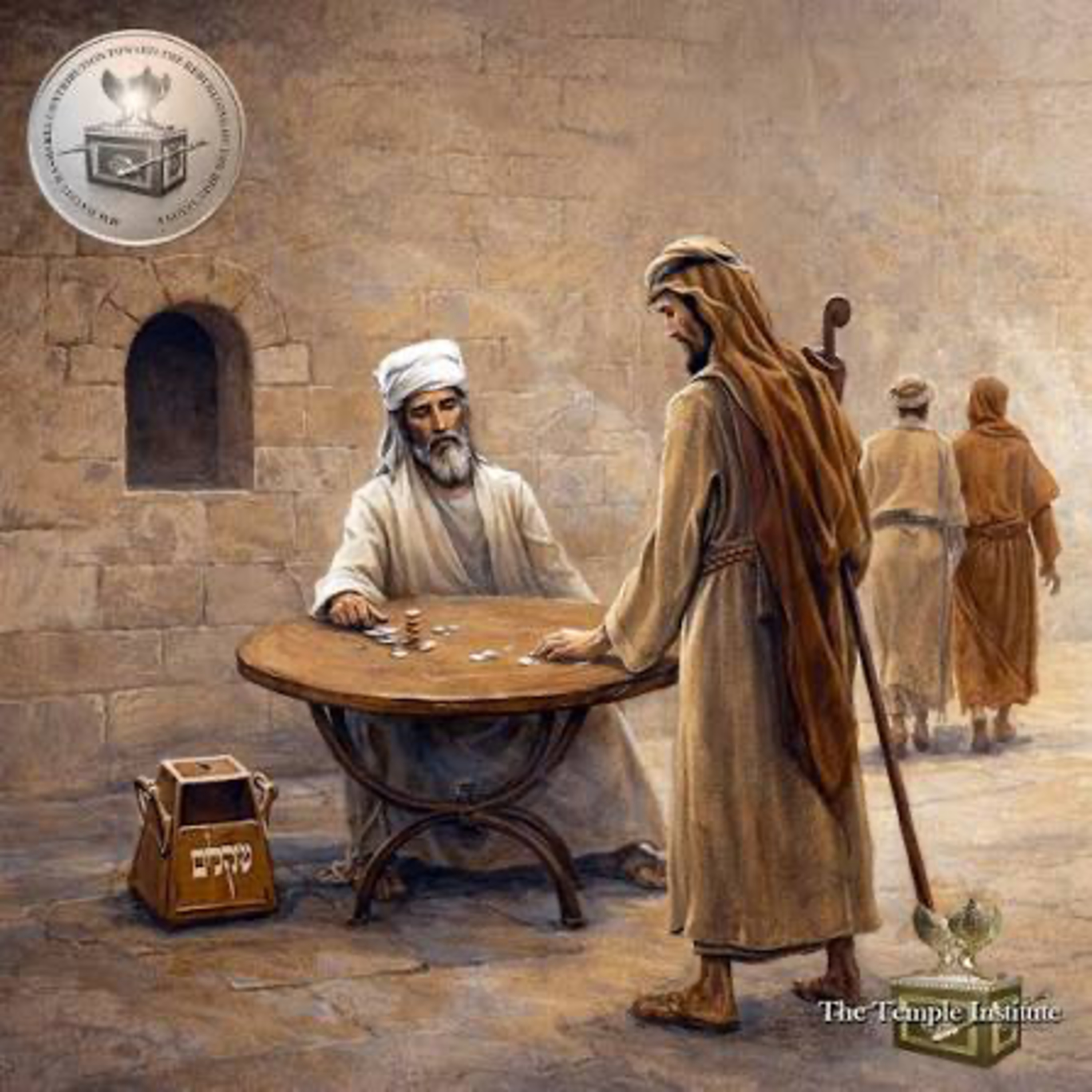
The Ransom Money—Exodus 30:11-16
About this episode
11 Then the Lord spoke to Moses, saying: 12 “When you take the census of the children of Israel for their number, then every man shall give a ransom for himself to the Lord, when you number them, that there may be no plague among them when you number them. 13 This is what everyone among those who are numbered shall give: half a shekel according to the shekel of the sanctuary (a shekel is twenty gerahs). The half-shekel shall be an offering to the Lord. 14 Everyone included among those who are numbered, from twenty years old and above, shall give an offering to the Lord. 15 The rich shall not give more and the poor shall not give less than half a shekel, when you give an offering to the Lord, to make atonement for yourselves. 16 And you shall take the atonement money of the children of Israel, and shall appoint it for the service of the tabernacle of meeting, that it may be a memorial for the children of Israel before the Lord, to make atonement for yourselves.”
Get every episode summarized
Each time Preaching and Teaching from St. John Ev. Lutheran Church (Sherman Center), Random Lake, Wisconsin publishes, we email you a written briefing from the transcript — the topics, who appeared, and any specific claims, with the ad reads skipped.
Email me new episodesFree for 3 shows. No card needed.
Hosts & guests
Transcript ready
330 searchable segments. Every word is indexed and playable.
Full transcript
Preaching and Teaching from St. John Ev. Lutheran Church (Sherman Center), Random Lake, Wisconsin — The Ransom Money—Exodus 30:11-16. Machine-transcribed; use the interactive transcript above to jump the player to any line.
Hello and good day. I'm Pastor Gillespie from St. Johnnie Vangelical, Lutheran Church in school, Sherman Center, Random Lake Wisconsin. It's good to have you with us here for the congregation of prayer, guide for daily meditation, and prayer around God's Word. It's Thursday, September 3, 2026, and our Catechesis this day will continue in both the Book of Exodus and the furnishings and the functions and the like of the temple, or excuse me, Tabernacle. And then while here of its fulfillment in Christ from the Book of Hebrews, where Hebrews takes it in expansively, treats not only Exodus and Leviticus, but all the the priestly functions and buildings and furnishings and everything into Christ. All right. If you missed last evening, divine service, we had to get attendance again. Nice to see so many folks coming out consistently now. I'm a sermon will be available later today, God willing, as I get to it. Okay.
Yeah, that's a big gloomy. I think it's going to rain. So a little bit darker on camera, but so it is. All right. Let's begin. In the name of the Father, and of the Son, and of the Holy Spirit, amen. I believe in God the Father Almighty, maker of heaven and earth, and in Jesus Christ is only Son our Lord, who was conceived by the Holy Spirit, born of the Virgin Mary, suffered under Pontius Pilate, was crucified, died, and was buried. He descended into hell the third day he rose again from the dead. He ascended into heaven and sits at the right hand of God the Father Almighty. From thence, he will come to judge the living and the dead. I believe in the Holy Spirit, the Holy Christian Church, the communion of saints, the forgiveness of sins, the resurrection of the body, and the life everlasting. Amen. It's para-salm for the week, Psalm 32. Blessed is the one whose transgression is forgiven, whose sin is covered. Blessed is the man against whom
the Lord counts no iniquity, and in whose spirit there is no deceit. For when I kept silent, my bones wasted away through my groaning all day long. For day and night, your hand was heavy upon me. My strength was dried up as by the heat of summer. I acknowledged my sin to you, and I did not cover my iniquity. I said, I will confess my transgressions to the Lord, and you forgave the iniquity of my sin. Therefore, let everyone who is godly offer prayer to you at a time when you may be found. Surely, in the rush of great waters, they shall not reach him. You are a hiding place for me. You preserve me from trouble. You surround me with shouts of deliverance. I will instruct you and teach you in the way you should go. I will counsel you with my eye upon you. Do not like a horse or a mule, without understanding which must be curved by bit, or with bit, and bridle, or it will not stay near you. Many are the sorrows of the wicked, but steadfast love surrounds the one who trusts in the Lord. Be glad in the Lord and rejoice, O right, O righteous, and shout for joy, all you upright,
in heart. Glory be to the Father, and to the Son, and to the Holy Spirit, as it was in the beginning, is now and will be forever. Amen. Let's do a meditation on the Psalm. This is from Father Reardon. Psalm 31, Hebrew 32 is the second of the traditional penitential Psalms, which express the themes of sin, repentance, mercy, and forgiveness. The correct interpretation of certain Psalms comes more readily than others, and the task is rendered easier still, if the Psalms meaning has already been made plain in the New Testament, agreed. The New Testament is, after all, the key to the full, that is to say Christian understanding of the Old. When the New Testament tells us the meaning of some passage in the Old Testament, then the matter of authentic interpretation for us Christians is settled, such as the case with Psalm 31, Hebrew 32, which begins, blessed is he, whose transgression is forgiven, whose sin is covered. Blessed is the man.
Blessed is the man to whom the Lord does not impute iniquity. St. Paul explicitly quotes these lines near the beginning of Romans 4 to illustrate, quote, the blessedness of the man to whom God imputes righteousness apart from works. The Apostles thesis here, as in Romans generally, is that we believers are not justified before God by our own merits, by the effort of our works, by a correct and meticulous observation of the Mosaic law. But by receiving in faith, God's gracious justification of us for the sake of Christ our Redeemer. I don't know if that's not a summary of the gospel. I don't know what it is. Beautiful, right? Receiving in faith, God's gracious justification of us for the sake of Christ our Redeemer. Psalm 31, then, is the prayer of those who standing at the foot of the cross and for swearing all righteousness of their own, commit their lives and entrust their destinies entirely to God's forgiving mercy, richly and abundantly poured out in the saving, sacrificial blood of his son. Because, quote, God was in Christ reconciling the world to himself,
not imputing their trespasses to them. Second Corinthians 5, 19. See, put that next to Romans 4, you've got the whole gospel. And such is the key to the proper understanding of Psalm 31, such as is the correct context for praying the rest of the Psalm. I acknowledge my sin to you and my iniquity I have not hidden. I said, I will confess my transgressions to the Lord and you forgave the iniquity of my sin. Our justification by God is no contrivance, no legal fiction. It is truly renders us wholly even glorious in his sight, quote, whom he justified, these he also glorified Romans 830. Thus Psalm 31 speaks to the justified as blessed, godly, righteous and upright in heart. This forgiveness of God has ongoing implications for how we are to live. And as much as we have been bought at a price for Scrantian 620, we may no longer live as though we belong to ourselves. Do you not know that you are not your own first Corinthians 619?
He died for all, that those who live should live no longer for themselves, but for him who died for them and rose again 2 Corinthians 515. Those who are justified in Christ will live quite differently, or Christ is our Lord and teacher as well as our Savior. Quote, God did not call us to uncleneness, cleanness, but in holiness. First, that's the loners 4.7. Thus the Psalm continues. I will instruct you and teach you in the way you should go. I will guide you with my eye. How we walk in Christ is of critical importance. We are not to take this responsibility lightly since Psalm 31, be not like a horse or like a mule which have no understanding, which must be harnessed with bit and bridle, or else they will not come near you. Above all, the forgiveness that God grants us for Christ's sake is the source of our ongoing confidence. For this same God will never abandon us. Quote, he who did not spare his own son but delivered him up for us all, how shall we not
with him also freely give us all things? Romans 832. Our Psalm, the speaks of the constant refuge we have in this God of mercy no matter the trials that face us. Quote, for this cause everyone who is godly shall pray to you in a time when you may be found. Surely in a flood of great waters they shall not come near him. You are my hiding place, you shall preserve me from trouble. You shall surround me with songs of deliverance. Many sorrows shall be to the wicked, but he who trusts in the Lord mercy shall surround him. The Psalm is likewise a call to gladness. Joy is not just an option for the Christian, it is an imperative. As well as a gift of God, joy is a sentiment that the believer is commanded to engage. Hard to hear, commanded, we think law. From the bleakness of his prison cell, Paul sent forth this order, rejoicing the Lord always again, I will say rejoice, Philippians 4.4. Thus our Psalm, a canticle celebrating the divine forgiveness of our sins, closes on the theme of
godly exaltation. Be glad in the Lord and rejoice, you righteous and shout for joy, all you upright in heart. I think the challenge we have with the command to joy is that we think of joy as an emotion, not the response of faith, not an objective reality. And that's because, well since the medieval period, but especially in the last maybe 200 years or so, the therapeutic or the emotional has taken hold as the priority of, especially Protestant Christians, but I think most Christians. And this is, well, it's not the scripture. The scripture speaks objectively with an external word about what is true and what is false, what is good and what is right and what is evil. And tells us these things objectively. And in one sense, the scripture doesn't care about your feelings. It doesn't care where you feel like rejoicing. The command is to rejoice because of
what the Lord has done for you, because of what you have just heard. Same thing with singing, by the way, the command is to sing whether you feel like it or not. The command is to confess, whether your heart's ended or not. And by the way, it's not the heart, it would be the gut. Bible speaks differently as to where the seat of emotions are. We think of it as the heart, and that's why we've made emotions, the priority. But in the scripture, the heart refers to, not head knowledge, but to conviction, to confession. Whereas it's the gut that's the seat of the emotion. And the emotions are dread and fear, but also compassion and love and mercy. All right. So in any case, that's why sometimes the scripture seems to say things that we just have a hard time believing because our faith has been grounded upon emotional response and not upon the objective word of God. So we're going to have to seek to bring correction to that frequently.
Wisdom time. First of all, the scoffer does not love one who corrects him, nor will he go to the wise. All right. Scoffer or fool. Sometimes as he's described, this may be your experience too. It's the ones who most need godly wisdom that refuse to hear it, that refuse to consult with those who have them. Not only do they hold those who have wisdom and contempt, but I guess ironically, by refusing to listen to them, by refusing to go to the wise one, they prove themselves to be scoffers or fools. And they persist in their deviant ways. And in contrast to the wise, there may be even more obvious, which I think that's something we haven't discussed, but I think it's I think it's true here. One of the questions that might be asked as a consequence of everything we've heard from from wisdom here from Solomon is well, then how can the scoffer become wise if
he refuses to heed wisdom? If you won't go to the one who would bring him correction. And often Solomon will have instruction to leave the scoffer alone. So how is it that they're going to come back to wisdom? Unless we're speaking of here, not just simple earthly foolishness, I should say, as far as way of life, economic matter, as these sorts of things, but the foolishness of unbelief. How is he going to come to belief, to faith, through the wisdom of Christ? So you can see that there's a parallel in earthly fools and spiritual fools. The parallel there is that both need to be converted, need to be made wise, and it's going to be done despite them. Right? They will not come to wisdom on their own. Wisdom has to come to them and make them wise. All right. And let's say our verse for the week. Lord, you have been our dwelling place in all generations. Before the mountains were brought forth, wherever you had formed the earth and the world
from ever last, even from everlasting to everlasting, you are God. Psalm 90 verses 1 through 2. And our catechism, 10 commandments. First commandment, you shall have no other gods, which is this mean, we should fear love and trust in God above all things. And the second commandment, you shall not misuse the name of the Lord your God, which is this mean, we should fear and love God so that we do not curse, swear, you say, Tannikart, lie or deceive by his name, but call upon it in every trouble, pray, praise, and give thanks. All right. Today we're going to talk about everyone's favorite topic. And that is stewardship. No offerings. So it goes right. Then the Lord spoke to Moses saying, when you take the census of the children of Israel or their number, then every man shall give a ransom for himself to the Lord. When you number them, that there may be no plague among them, when you number them. This is what everyone among those who are numbered shall give. Half a
shuckle according to the shuckle of the sanctuary, a shuckle is 20 garras. The half shuckle shall be an offering to the Lord. Everyone included among those who are numbered from 20 years old and above shall give an offering to the Lord. The rich shall not give more, and the poor shall not give less than half a shuckle when you give an offering to the Lord to make a tonement for yourselves. And you shall take the atonement money of the children of Israel and shall appoint it for the service of the tabernacle of meeting, that it may be a memorial for the children of Israel before the Lord to make a tonement for yourselves. Okay. Not a long reading, but here we have the command of a census, account of citizens, right? And every male above age 20, what do they have to pay? Here it's called a ransom, a ransom. The price demanded for the freedom of a captive. Ah, so we're already being taught here that apart from some ransoming, we are slaves of Christ.
Our slaves, I should say. Slaves to something. Ah, we want to be slaves of Christ, slaves to sin. Yeah. They need to pay it. It says, therefore, a tonement, that's the word. It's an atoning. All right. So this is limited to the males. I suppose the question is why, why, why males only? Are they the only ones that have to be ransomed, bought back? Give you some new testament as we just heard from Father Reardon, New Testament, and Tributes old. And whoever of you desires to be first shall be slave of all. Jesus says, for even the Son of man did not come to be served, but to serve and to give his life a ransom for many, to give his life a ransom, not just for himself, but for many. So there's a contrast made there. We have something similar in 1 Timothy 2. There is one God and one mediator between God and man.
Men, the man Christ Jesus who gave himself, there's the word, a ransom, anti-litron, a payment for all to be testified and due time. So the promise was that one male would be the ransom from all sin. So this is a symbolic act. Does it actually ransom them? Yes, but only temporarily, and it points forward to the full ransoming that will be purchased and one for them in Christ. Verse 12 says, the ransoming will prevent or keep plagues away from them. But you say, I know that they experienced plagues. Why were they they weren't always free from plagues? What are some examples of that? Exodus 32. Let's see what happened there. This is after the golden calf incident, right? Yeah, what happened after the golden calf incident? I went too far. Behold my angel, Shugo, before you. Never the last in the day when I visit.
For punishment, I will visit punishment upon them for their sins. So the Lord plagued the people because of what they did with the calf, which Aaron made. All right, so there's an example. Another one. When they complained about the quail, but while the meat was still between their teeth, before it was chewed, the wrath of the Lord was aroused against the people and the Lord struck the people with a very great plague. And they called the place Gibraff Hadova, because there they buried the people who had yielded to the craving. So that's two plagues. We have another one. The people complained again and Moses went into the tabernacle and Moses said to Aaron, take a censor, put in it, put fire in it from the altar, put incense on it and take it quickly to the congregation and make a tonement for them for the wrath. For wrath has gone out from the Lord, the plague has begun. Then Aaron took it as Moses commanded and ran into the midst of the assembly, and already the plague had begun among the people. So he put in the incense and made a tonement
for the people, and he stood between the dead and the living, so the plague stopped. Now those who died in the plague were 14,700, besides those who died in the Korah incident. That was the previous one we heard. That's three plagues sent by the Lord on God's people. Hmm. Of course these are referred to in 2 Samuel 24 as well. Oh no, that's another plague. Hmm. With David and God, for David's sin, seven years of famine come on your land. So not always free of plagues. So how did these experiences prepare them for the coming of Christ? So they are to make the ransom payment. It says the plagues would be kept away from them, but they yet they persist in their unbelief. So the plagues show them their need to be ransomed from sin and from death. And of course, pointing forward to Christ, Jesus alone made a tonement for us so that we are free from the captivity of sin. Was there a distinction made between the amount required of the rich and the
poor? Interestingly, no. One sacrifice, right? One purchase price for all men. They all gave half the shackle. And again, we have there in verse 16, the other name for this. Ransom price also here called a tonement money. Ransom price atonement money. All this will come back in the New Testament, of course. A price must be paid to mark the people as belonging to the Lord. A ransom price was to be paid that might be free, that we might be freed or they might be freed from the curse of death, which afflicted them in the plagues. So we are to see the need for a better and perfect ransom of whom we sing during a advent of calm, oppressors, ransom, calm, only hope for sinful mortals. Our only hope for freedom from the captivity of death is that Jesus came to pay the price of ransom, not with gold or silver, but with his holy precious blood and with his innocent suffering and death, that we might be his own and live under him in his kingdom, right? Catechism
also first Peter, only such a ransom can bring us over from death to life. So we'll see that frequently through the Old Testament scriptures is that there is a appointing forward to Christ, and yet you hear it as, well, is that sufficient, right? Was that ransom price sufficient? And of course, no, but it pointed forward to Christ, and it would teach them the need for an eternal ransom. All right, also a brief reading them from Hebrews chapter three, therefore holy brethren, partakers of the heavenly calling, consider the apostle and high priest of our confession, Christ Jesus, who is faithful to him who appointed him, as Moses also was faithful in all his house. For every house is built by someone, but he who built all things is God, and Moses indeed was faithful in all his house as a servant, for a testimony of those things which would be spoken afterward, but Christ as a son over his own house, whose house we are if we hold fast,
the confidence and the rejoicing of the hope firm to the end. There it is, confidence and rejoicing again by command, by command. So why does the preacher to the Hebrews here call us, holy brethren, partakers of the heavenly calling, think back to the ransom money, the atoning price, Christ has sanctified us and made us his brothers, I think baptism language as well. What does it mean that Jesus is the, what is the column here, the apostle and high priest of our confession, apostle sent one, sent by the father to speak God's word to us. And what is our confession? Confession is saying back to God the same words he has spoken to us, same saying would be a good way to translate that, con Fesio, same saying, where did God call Moses, faithful in all his house? That's a quote actually, that's from Numbers chapter 12, and that's where Aaron and Miriam have an
argument. Let's see, where is that? Oh, this is when Moses comes forward to judge between Aaron and Miriam. Here, now my words, if there is a prophet among you, I the Lord make myself known to him in a vision, I speak to him in a dream, not so with my servant Moses, he is faithful in all my house. I speak with him face to face, even plainly and not in dark sangs. Actually, this is the Lord coming down in the pillar of cloud and speaking, oops, I speak with him face to face, even plainly and not in dark sangs, and he sees the form of the Lord. Why then were you not afraid to speak against my servant Moses? So Aaron and Miriam speak against Moses, then the Lord speaks to them out of the cloud and says, why don't you listen to the one I am sent? All right, so you see here, why did they not listen to Moses? Here, Jesus is sent to us. We listen now in these last days, he is spoken to us by his son. And of course, Christ is counted worthy of more glory than even Moses, because what did Moses not do? He was faithful in his house, but Christ has built the house that
has more honor than the house. Hmm, builder of a house that is more honor than Moses's house. So for what does it confess about Christ who built all things out? I see how it goes. Not only a tabernacle, but indeed a priesthood of the holy house of God, the body of Christ, right? Heaven and earth. He is the true God by whom all things were made. We heard that I think yesterday as well from chapter 2. As a faithful servant, what did Moses' ministry testify of? Is there? Well, especially of the coming of Christ, we had that at the beginning. In many and various ways, God spoke to the people of old, by the prophets, but now in these last days, he is spoken to us by his son. Or his God's promise to Moses, the Lord your God will raise up for you a prophet like me from your myths, from your brethren, him you shall hear according to all you desired of the Lord your God and horrid in the day of the assembly saying, let me not hear again the voice of my God, nor let me see this great fire anymore. Lest I die. Of course, that comes up then in John 5, I think it is.
For if you believed Moses, Jesus says, you would believe me, for he wrote about me, but if you do not believe his writings, how will you believe my words? Moses testifies of Christ. That's what Jesus himself says. So what is the house over which Christ is son? That would be we are. We are a holy pre-student royal nation, living stones with Christ, the cornerstone, God's own household. To I like that word, household, the hold. I don't use household that often. That would be good word. It says here, let us hold fast the confidence and rejoicing. It means confidence here means boldness of speech. This is the free speech of children before their father. What has won us this freedom? We'll see it in chapter 4, the next chapter. The blood of Jesus which opens the throne of grace to us. Now we dare to speak. The name of Christ and of all the things that he has done. And of course, who keeps us fast? Who holds us fast? Here it's if we hold fast, but who keeps us
holding fast? Firm to the end. Think of Philippians 1. God who has begun this good work and us bring it to its completion, right? Preserve us through his word. That was the sermon last night too. Striving, our striving doesn't save us, but we are called to strive. And that striving is actually the work of Christ and us as his spirit strives against the old Adam until the last day or until our dying day. Good. So every house is built by someone and the church is built by God himself. Moses was a servant in the house, faithful to carry a word that was not his own and all his service. The tabernacle, the sacrifices of the law was a testimony of the things which would be spoken afterward when the sun came. Christ is no servant in the house, but the sun over it, true God by whom all things were built. And his glory outshines the glory of Moses as the builder outshines the building. And his house is not stone walls, we are his house, the congregation gathered by the gospel and built on Jesus as living stones. Because his blood has opened the way we speak in this house
with all freedom as dear children before their dear, before their father, confessing back to him the very words he has spoken to us, praying and singing without fear. Our holding fast is not our own grip. The faithful God who began his good work and us preserves it to the end through the preaching of the gospel and the gifts of the altar. So the house stands and we remain in it where Christ still speaks and the hope he gives has reason to rejoice. Perfect. Let's sing our hymn for the week with the Lord begin thy task. We'll back to the top. Our hymn is made and counseled out. Jesus will perfect it. Every horn which Jesus draws
and when day is ended, it is named and flows your eyes, each hear him comment there. Let each day begin with prayer, praise and adoration, upon the Lord cast every care. He is your salvation. morning evening and at night, Jesus will be here you, save you from the attempt to pray. We do have a commemoration this day and that is Pastor Greg, also known as Gregory the Great.
One of the great leaders in Europe at the close of the 6th century, Gregory served in both the secular and sacred arenas of his era. As mayor of Rome, he restored economic vitality to his native city, which had been weakened by enemy invasions, pillage and plague. After he sold his extensive properties and donated the proceeds to help the poor, he entered into full-time service in the church. On September 3rd, 590, Gregory was elected to lead the church in Rome as Bishop of Rome. He oversaw changes and growth in the areas of church music and the church development, missionary outreach to Northern Europe and the establishment of a church here, calendar still used by many church bodies in the Western world today. His book on pastoral care became a standard until the 20th century. I would say it's still into the 20th century. The rule of Gregory is back here. And Gregorian chant, not as widely used as it once was. Incidentally, the assertion of Gregory,
and we'll have to take him out as word, is that he put into Western notation the chanting of the synagogue. So it's probably the closest we have to have the Psalms were sung. I mean, it's 600 years after the time of Christ. So it's hard to say for sure, but, or 500 years. But probably with a very traditional liturgical church, I mean, we confess the same Catechism we did 500 years ago. Right? So these things can be preserved for that kind of length of time and maybe even the form of singing of the Psalms. So perhaps we should learn Gregorian chant in order to in a way, repristinate the Psalms singing of the synagogue. Maybe, or anyway, because it's a great tradition of the church. And it's not as hard as it sounds. Anyway, good. Oh, we should say a prayer to remember Pastor Greg. Almighty, merciful God, you showed up, or you raised up, Gregory of Rome to be a pastor to those who shepherd God's flock and inspired him to send missionaries to preach the
gospel to the English people. Preserve in your church the Catholic and apostolic faith that your people may continue to be fruitful in every good work and receive the crown of glory which never fades away. Through Jesus Christ our Lord, who lives and reigns with you and the Holy Spirit, one God now and forever. Amen. Almighty, never lasting God, give us an increase of faith, hope, and charity and that we may obtain what you have promised, make us love what you have commanded. Through Jesus Christ, your Son, our Lord, who lives and reigns with you and the Holy Spirit, one God now and forever. Amen. Heavenly Father, you teach us to call upon your holy name in prayer every day. You promise to forgive our sins for Jesus' sake. You promise to work for our good through the suffering, sickness, persecution, and tragedies that we face. For Jesus' sake, forgive us for failing to pray. Forgive us for cursing, for swearing falsely, for seeking help from Satan, and for lying or deceiving by your name. By your forgiveness, teach us to believe in your promises and in every joy and sorrow of life to pray, praise and give
thanks to you. Through Jesus Christ our Lord, Amen. You pray this day for the church and our pastors, for missionaries, teachers, deaconses, musicians, and other servants of Christ in his church, for the fruitful and salutary use of the blessed sacrament of the Lord's body and blood. Let us pray to the Lord. Lord have mercy. Through prayer this day with Rodgers celebrating his baptism, with all the households of our church, especially that of Dale and Pam, Dick and Jean, Julie, Angie, Jack and Patty, and Dennis, we pray for those ill-receiving treatment of recovering, especially Patty, Joe, Jim, Sheila, Gus, Vicki, Karen, Debbie, Dan, Dick, and Norm. Our homebound Sophie, Joan, Paul, Dolores, Ruth, and Paul Leane. Our mission of the month, that of Lutheran Bible translators, pray an intercession, behalf of Logan, who's expecting, Joanne, and of Bob, who's in hospice, or women desiring children as well. And we pray with the family, Julie and St. Peter are our principal, her family, as they grieve the death of her cousin.
For all this, let us pray to the Lord. Lord have mercy. Our Father, who art in heaven, howl, it would be thy name, thy kingdom come, thy will be done on earth as it is in heaven. Give us this day our daily bread, and forgive us our trespasses, as we forgive those who trespass against us, and lead us not into temptation, but deliver us from evil, for thine is the kingdom and the power and the glory forever and ever, O man. I thank you, my heavenly Father, through Jesus Christ, your dear Son, that you have kept me this night from all harm and danger, and I pray that you would keep me this day also from sin and every evil that all my doings and life may please you. For into your hands, I commend myself, my body and soul, and all things, let your holy angel be with me, that the evil foe may have no power over me, my man. Let us bless the Lord. Thanks be to God. The grace of our Lord Jesus Christ, and the love of God, and the communion of the Holy Spirit, be with you all. Amen. That's our congregation of prayer for
today. What is it? Thursday, September 3, 2026, and it's been a blessing to be with you, of course. I hope it has been for you as well. Come to each day at about 9 a.m., to pray, and to confess, and to sing, and to remember the saints of old, especially notable figures like Gregory, who is worthy of our remembrance, and thanks for all that he has contributed to our church, especially the gift of our electionary, and which Leo, I think, finalized, and then also the sacred tradition of chanting, the song of the church. And, of course, his pastoral rule. Let's see anything else. No, I don't think so. So you can look forward to listening or watching the sermon later as I get that posted. Otherwise, God be with you. Make Christ blood cover you, may he who has built you into a holy house, keep you safe, and secure there as living stones with him. He is the cornerstone, the household of God. God may God grant it, name of Jesus. We'll see you soon.
We welcome you to join us for divine service on Sundays and Wednesdays. We offer Bible class and Catechesis for youth and any interested adults. If this podcast is a benefit to you, please consider supporting the work of our congregation by going to sjrl.org, sjrl.org, and clicking the donate link. Join us to receive the Lord's Word and His gifts.
More episodes
More from Preaching and Teaching from St. John Ev. Lutheran Church (Sherman Center), Random Lake, Wisconsin

The Sunday of the Ten Lepers — September 6, 2026
Preaching and Teaching from St. John Ev. Lutheran Church (Sherman Center), Random Lake, Wisconsin

Jeremiah: Chapter 20 — September 6, 2026
Preaching and Teaching from St. John Ev. Lutheran Church (Sherman Center), Random Lake, Wisconsin

Sunday’s OT and Epistle—Proverbs 4:10–23; Gal 5:16–24
Preaching and Teaching from St. John Ev. Lutheran Church (Sherman Center), Random Lake, Wisconsin

The Sabbath Law—Exodus 31:12-18
Preaching and Teaching from St. John Ev. Lutheran Church (Sherman Center), Random Lake, Wisconsin