Get every episode summarized
Each time Today in Focus publishes, we email you a written briefing from the transcript — the topics, who appeared, and any specific claims, with the ad reads skipped.
Email me new episodesFree for 3 shows. No card needed.
About this episode
Today in Focus is made possible by:
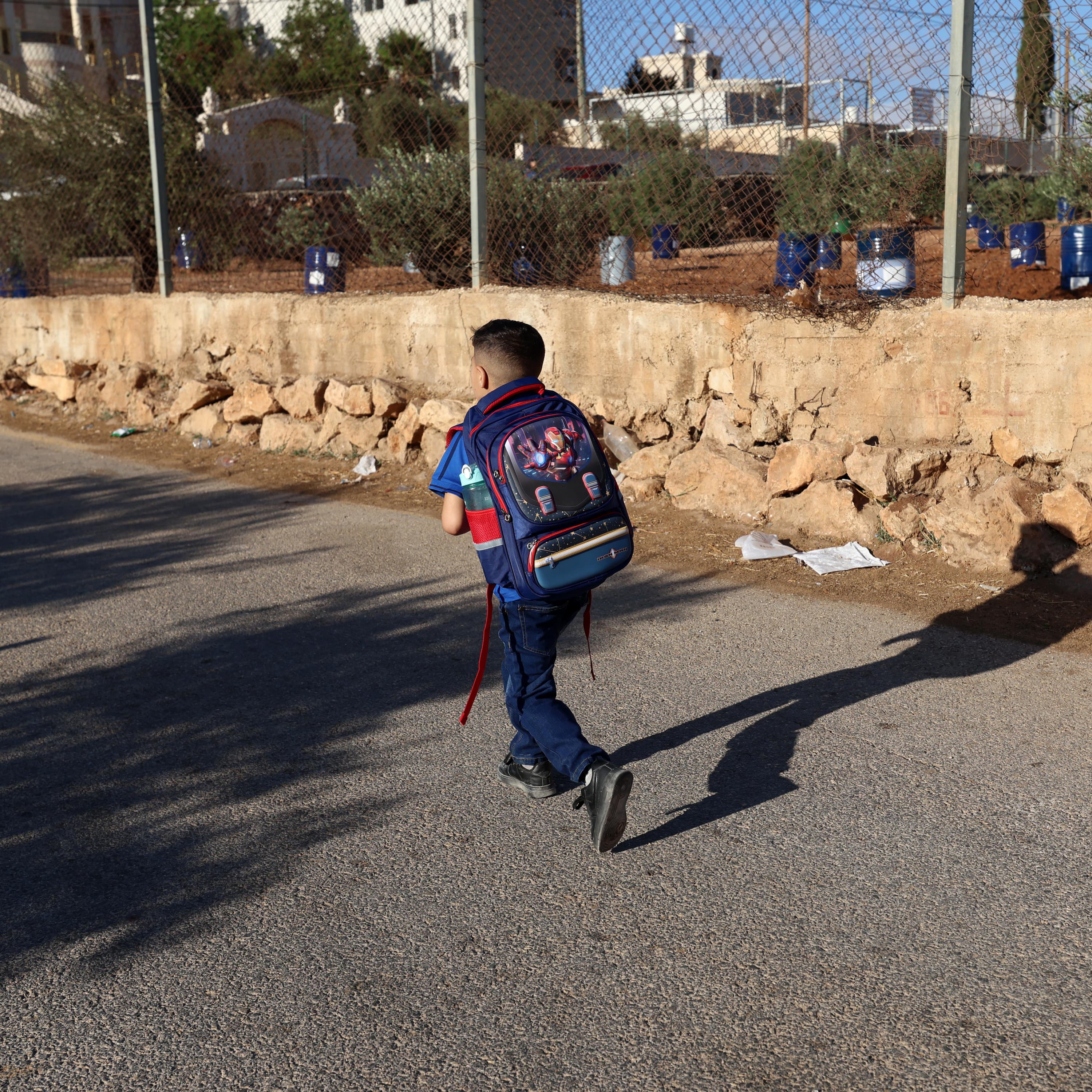
“Today, a new school year begins in the West Bank. Embrace intelligent order fulfillment with shipstation. The only platform combining order management, warehouse workflows, inventory, returns, and analytics in one place.”From the transcript
Get every episode summarized
Each time Today in Focus publishes, we email you a written briefing from the transcript — the topics, who appeared, and any specific claims, with the ad reads skipped.
Email me new episodesFree for 3 shows. No card needed.
Hosts & guests

Transcript ready
284 searchable segments. Every word is indexed and playable.
Full transcript
Today in Focus — The Palestinian school under siege. Machine-transcribed; use the interactive transcript above to jump the player to any line.
This is the Guardian. Today, a new school year begins in the West Bank. 500 orders a month was manageable. 5,000 is madness. Embrace intelligent order fulfillment with shipstation. The only platform combining order management, warehouse workflows, inventory, returns, and analytics in one place. Would used to take 5 separate tools, shipstation does in one. Automate fulfillment and rate shopping to ship up to 15 times more with up to 90% savings. Go to shipstation.com and use code audio to try shipstation free for 60 days. Hello. Hello.
It's the beginning of a school day at the Alma Keir Boys School in the West Bank. And we're speaking via a really bad internet connection to a heath Abu Nain, the school's English teacher. Good morning boys. In the background, we can hear him greeting his students. How are you today? And then when the signal briefly improves, why he turns on his video. And suddenly I'm looking at a classroom full of boys in smartly uniforms. Their hair freshly combed, sitting at desks, smiling and waving. Why he'd English lessons starts with a question. Who's your friend? What's his name? Rater? That's good. I watched the boys shyly point to their favourite classmates, explaining in broken English what they really like about each other.
And then we play together. Before long, why he moves on to their dreams for the future. Doctor. Doctor, you want to be here? Yes, I'm Jean-Yves. Engineer, you want to be an engineer. And it's clear that why he loves his job. Who wants to be a teacher? And who wants to be a teacher? Although we don't get lots of money, I don't care for these things. Because my students, especially in the morning, used to wait for me in the morning when I entered the school until she can't. While going inside their classes. So it's a happy life inside the school. Outside the school is very different. That's why Waheed has spent his summer strengthening and raising the walls that protect the school and its 470 children.
Have a very good week, a hard fence around the schools, around all the school. We were fixing all the gates. Because outside there are men with guns. Israeli settlers and armed soldiers. And the school is in their sights. Because we think that in the next weeks or next month, we need military plan, bring settlers around the school. We think that because they are coming closer to the village every week. Waheed's school is now on the front line between the villages. The settlers who want all of their land and the Israeli military who are backing them up. And the children here have already paid the price.
Five will never return to the school. Can Waheed keep the school open and his students safe? From the Guardian, I'm Annie Kelly. To damn focus. The school under siege. The school is in the village of Al-Mahehr in the beautiful Rolling Hills of the Jordan Valley. It's located about 30 kilometers northwest of Ramallah. Many people who live here have been here their whole lives. We had peace life. Most of people in our village used to keep sheep. We have lots of crops around the village. All of the mountains around the village are blended with olive trees. We used to go to the mountains to take all our families to stay for the night to enjoy. Not anymore.
Our situation at the village here is different than other villages. Here Al-Mahehr and Mughayr village. It is the last village at the east side of Ramallah region. There are no villages to pass after our village. It is the last one and it is surrounded by satellites. This village of around 4,000 people has become completely encircled by a ring of illegal settler outposts. There are now 10 or 11 of them. And it means that the villages of Al-Mahehr have been cut off from the land where they have historically lived, farmed and kept their sheep. The Israeli state has also designated a lot of the land around the village as a military firing zone, which means it is off-limit to locals. Although settlers can be seen grazing their sheep here. Weid says that their community has been under attack for years now, but recently these attacks have become much more frequent and violent.
Nowadays settlers, intergardons of our houses, don't listen to the people who tell them to go out of their houses. They don't listen to them until the owner of the house comes to face the settler. Military soldiers come, that beating the owner of the house and all the family, because they were just trying to let the settlers go out of their houses. When people try to get them to leave, the Israeli soldiers are coming and beating the owners of the houses and telling them that they shouldn't do anything to stop the settlers. Yeah, this is their policy. So for you, the police, the military, and the settlers are basically all one thing. Yeah, all of them are working for the same aim. It is just for violence under the protection of all their military. Now, as well as being completely encircled by settlements, a military checkpoint has also been raised right opposite the school.
It's now on the one open road to the village, the one remaining lifeline for locals, and it's regularly blocked for hours a day. Last week, when the school tried to open after the summer, the kids had to stay home because most of the teachers couldn't make it through the checkpoint to work. Nine teachers are from the same village and others have to come from other villages. So we couldn't continue our work because 17 teachers couldn't pass the school. For one hour, we sent them back because we couldn't control everything without other teachers. And as we speak, why can see more Israeli soldiers arriving from the window of the school? So now in front of me, just now they have increased more military vehicles came now. This is right in front of you now, is it? There are more military vehicles arriving. So how many soldiers can you see right now? There are three vehicles, and out of them, there are five soldiers out of the cars, but cars having more military soldiers inside.
We know almost every child in the town and their families. By April this year, the school had already lost one student to violence. 14 year old Mohabbin Nasan, who was shot by an Israeli soldier as he left the local mosque. But nobody in the town thought the school itself could become a target. It was 12.15 by our time. 21st of April, two little students were out and they were rushing to me to my class to tell me that there are some settlers behind the wall of the school. So I went to that wall. I found that there are six settlers, all of them having long guns. Horses soldiers were behind them just a little far away from them protecting everything. It was the middle of the day and there were children in the playground. But there was also a group just outside the school gates collecting litter.
Why he goes outside to try and get the settlers and their guns to move away from the school. And he starts talking to the soldiers by the checkpoint asking them to help him. I told them to take their settlers back to take them away from our school because we didn't do any problem to let settlers come to attack us. He came in front, the first soldier and raised his gun towards me said, it's not your duty to ask us this question. Go back to your students, go back to your class. We know what we are coming to do here. Then the men outside the school, the settlers and the soldiers, move away from the gates. Some of them start to climb a hill opposite the school so they're positioned on higher ground. They started shooting students who were out. They shot one of them while I was trying to take all the students inside.
I was four meters just in front of him. And when shooting started and when he was shot in his head, he fell down. I've watched a video of this moment and it's horrific. The shooting starts and you can see people running for cover. You can see the bullets hitting the school wall. Several men and why he said he's one of them, run over to where the boy is lying and pick him up and they rush him to a waiting vehicle. Then they drive him to a medical center in the next village. Back at the school, the shooting continues. The settlers were shooting on the top floors to the second to the third floor of the school towards the windows and floors in front of classes.
In other videos, frightened children and teachers are in a school stairwell trying to shelter under a window. Teachers were there at that time. They were just ordering them to lie down under the windows to not get shot until settlers leave. Meanwhile, Waheed is with the 14-year-old who's been shot and they've arrived at the medical center in the next village. It took six minutes to reach there. When I reached the medical center in the next village, the first minute doctors said that we lost him. He was died. So then when I was there at the medical center, my father called me that my brother came to rescue his children and my children at school. And also he was shot by settlers and coming to the medical center.
He also died before he reaches the medical center because he got a bullet in and it's just... So you waited at the medical center and you saw your brother, your brother's body being brought in? Yeah, yeah. I saw him and I saw that he was died before he reaches there. Waheed, I mean, I don't want to say I'm just so sorry. Thank you, thank you for your feeling. Waheed, shooting at a school is so horrific. Did you ever imagine that this could happen? It happened many times at the village by many attacks by settlers. At school, I know it is different because when you plan to attack school, it means that you are attacking all the houses of the village
because all children coming from all the houses of the school, where the village, because each house has a child in our school. So by attacking the school, you're basically attacking every single person in the village. Could you tell me about this boy who was he, the boy who was shot? Could you tell me about him? His name was Aus, he was in the ninth grade. I was his English teacher. He was a good student but he lost his father before seven years. He was shot by settlers. All the people in the village used to be gentle with him to let him feel safe, get hope of the future. But he couldn't forget that habit of losing his father.
I'm a Graham Harrison, you're the Guardians Chief Middle East Correspondence. In April, you traveled to Almachaya in the West Bank to report on the attack on the school. Can you tell us about that experience? We went to a morning tent, it was at the mosque, it had been set up, relatives were gathering, people were coming to pay their respects for house. We spoke to his grandfather, to his uncle, to some of his school friends who were there at this morning gathering. Then we went to the school to see where he'd been killed. Really in this job, I cover a lot of horrific violence. I did find this even so, particularly horrific. The blood was still on the floor where he'd been shot. It was literally one step outside the gate of his school. One of the things that you get when you're able to go visit places and something that as foreign reporters barred from Gaza is particularly frustrating is you can get a sense of things, the reality in a way that you never can over the phone or video calls.
That's very much the case, the school is nestled into this small hill on the edge of the village. You can see that when these gummen went up the hill, it was clear what they were doing, which we're taking up a position of military advantage. Their target in this case was the school full of kids. There's something about, we've documented the hundreds of children who've been killed by its radiacellular settlers over the last three years. But even in that context of regular deadly violence, there is something particularly horrific about someone taking aim at a school full of children, I think. Emma, what's so horrendous is that more students from the school have died since the school attack shot by Israeli soldiers. Is that right? Yeah, it just feels like this is a community that's under attack in so many different ways. House was the second child from that school killed that year. Three more have since been killed. And the most recent incident in which the fourth and fifth students from the Amaraya boys school were killed.
That was an incident of when settlers came into the town, is scorted by police and the Israeli military to steal sheep from inside the town. The Israeli military told us that the police had gone there to recover stolen property. But you know, I asked them so where was the police investigation? Where was the war room? Where was the details of the stolen property? And they sort of didn't have a response to that. Obviously, it's not credible in the first place because we can see that's not what's happening. You can see videos of these things. But it's also kind of to me striking that the military aren't even really attempting to come up with a credible explanation for this violence that they're participating in. One thing that really struck me when I was talking to a heat the teacher at the school was that he was so clear that the violence, the intimidation, the shootings that have been happening in his village were not only perpetrated by settlers, but that the Israeli military and the police were participating, coordinating and also enabling these attacks on local people.
Have you also seen this in your reporting because they could persist this idea that there is a distinction between the Israeli military and the settlers? Absolutely, Annie. And of course, you know, if you accept that the Israeli military are involved in these attacks, it does become a more complicated thing to discuss because then you're talking not about rogue individuals, but you're talking about part of the Israeli state inside Israel. There's very prominent people who have been very harsh in their criticism of what they consider settlers to be doing. They've described it as ethnic cleansing as terrorism, but they want to draw a line between settlers and the Israeli military and, you know, are reporting many, many other people, including Israeli human rights groups is really investigative journalists has shown that that just isn't the case. And there is, you know, a lot of confusion on the ground isn't there? Like in the case of the school shooting, why he's and many others in the village thought the attack was by settlers, the Israeli military says it was an army reservist who shot us.
So, you know, why is there all this, you know, lack of clarity? I mean, we had an investigation that we did earlier this year into these units called Hagmar, which are sort of essentially like local reserve units. They've been at the heart of a lot of the most extreme violence that we've been seeing. We had testimony from Israeli soldiers from the regular army who were horrified by what they were seeing. And so they were telling us that these groups function basically as vigilante militias. What happened after October 7th, the lot of the regular army was deployed to Gaza or to Lebanon. And the government decided to call up what they call territorial reserve units, which is where you basically call up reservists from a local community. What that meant in Occupy Palestine was that you were calling up reservists from a settlement to patrol the area around the settlement. So it was essentially handing uniforms and guns to settlers to do what they want. They were nominally under the control of the regular army units in their area, but of course they tended to know the area better.
They would often be based out of their settlements, whereas the regular army units tend to be based in bases a bit further away. And so you know, these soldiers told us, for instance, they'd often turn up at something they'd been called to perhaps by the police or by activists. And they would find that the Hagmar, the territorial reserve were already there. So that's one unit of the military that's been particularly implicated in violence. But you also have the mainstream now of the Israeli military that seems to be actively participating in much of this violence. You know, I think perhaps one of the clearest examples of that has been happening in a village quite near Almagaya, which is called Kusra, settlers laid the siege. And so the regional commander of the Israeli military for the Occupy-Best Bank went to the village. He said, we're going to sort out this problem. The soldiers then took down a tent that the settlers had set up outside these Palestinian homes. And what they've effectively done is continue to enforce the siege.
And they in fact went further than the settlers. They went into one of the homes, drove out the Palestinians and are still living in that home. The settlers failed to displace the Palestinians. They have succeeded. And that is under the watch of the chief commander for the entire Occupy-Best Bank. So you cannot say that that is a marginal faction of the Israeli military. That's the institution participating in a siege. And I wanted to ask like how what we're seeing in over the last few months or the last year is different to what we've seen before. I mean, that's a good question because in some ways the basic pattern, which is take land, expand the Israeli present, drive out Palestinians, is the same sort of game plan that you've had for decades. This intensification though of both the land grabs, the ethnic cleansing and the violence. I really actually date it back to three years. It's really been the last three years that we've seen this particularly rapid intensification.
It's got even worse in recent months. You could sum that up from the perspective of the settlers by quoting the Minister for settlements, a far right minister or each struck who in I think 2024 described the period after October 7th, the worst massacre of Jews since the Holocaust as quotes a time of miracles. I and many people in Israel find that a pretty extraordinary response and she called it a time of miracles because in her views, the settlement movement was able to advance towards its goals so fast. And that has meant displacement of Palestinians, ethnic cleansing over 60 communities have been entirely forced out, I think at least 18 others have been partially displaced. That's nearly 5,000 people who've been forced out of their homes and large amounts of land that was used by Palestinians whether for farming or as grazing land has been taken over and is now under Israeli control. Coming up, how long can the school hold out?
500 orders a month was manageable. 5,000 is madness. Embrace intelligent order fulfillment with shipstation. The only platform combining order management, warehouse workflows, inventory, returns and analytics in one place. What used to take 5 separate tools shipstation does in one automate fulfillment and rate shopping to ship up to 15 times more with up to 90% savings. Go to shipstation.com and use code audio to try shipstation free for 60 days. Last week anti-burnum government here said it would cut off trade with illegal settlers. The backlash was quite extreme. Could you tell us what the reaction has been like inside Israel? It's an interesting question because obviously the Israeli establishment, I would say like most of the world, were shocked by the scale of the sanctions that Miller banned and now it's the language that he used, that he used the words ethnic cleansing that he talked about terrorism.
In Al Mugayir, 20 miles north of Jerusalem. You know we saw Ed Miller banned reference the killings of these students in his speech. Two teenagers were shot when settlers entered the village under police and military escort. Both died before reaching hospital. Madam Deputy Speaker, 5 teenagers have now been killed from their school this year. It was a much stronger statement than anybody expected because obviously the government's responded very strongly. We've seen the foreign minister saying he's going to close the consulate in Jerusalem. You know there was a lot of political debate among people who follow these things closely about what this meant for Israel, a time of isolation. It was a sign really of further isolation. The fact that 12 other countries came in behind announcing their planning versions of something like this. You know added to this sense of isolation in Israel. But as you know where it was in the news headlines. That came out on the same day that there was a massive expers a in harrots, you know one of the leading newspapers here.
That Netanyahu been personally warned by the leader of the United Arab Emirates that Hamas was planning what we now know is the October 7th attack and had done nothing with that warning. And he couldn't pass it on to his intelligence chiefs. And so that has absolutely as you can imagine consumed the country. Netanyahu's office has called the accusation an absolute lie claiming that he never spoke desired during the period in question and received no warning from him. The scandal another hurdle for the prime minister as he faces national elections next month and his actions surrounding the October 7th attack. I guess with the elections coming up at the end of October considering there are such a hard line elements within that Nya who's government, you know like the Ministry of National Security, Bangavir. And the finance minister, Smotch Rich, who are openly advocating for settlers taking over land in the West Bank. Are you expecting to see the attacks and the violence in the West Bank increasing as we get closer to that election?
Yeah, so I mean, I'm afraid that you know the next three months I'm as things stand. I'm just very unfortunately expecting to see at least the same level of violence and frankly probably an escalation perhaps partly a sense that now is the time to sort of take as much land as you can while you can. It's much harder to pick people once they're in place. Perhaps the only thing that might push the government into action would be some sort of intervention from Trump. No, he's been very quiet, hasn't he? Many in Israel expected him to leap to to Israel's defense when the sanctions were announced and his silence was notable and was considered sort of was read as a sign of displeasure. But I think it's as much disinterest as displeasure probably. And let's just return finally to to the school and the village and look here like do you think that there's any hope that the people there will be able to last this siege out and to remain in their homes. They've already been under a form of siege for years now and there's a great sense of community solidarity. They're very resourceful. They're very committed. There's a Palestinian phrase called summa which means steadfastness staying in your land. They're very aware that if they do get forced out the chances of coming back are very, very low.
I think certainly people in Ambulgar are going to stay on for a long time, you know, where he was telling me they think that a lot of their teachers aren't going to be able to get through the blockade. So they've reached out to the town. There's lots of unemployed people who now can't get out to their jobs. They've looked for Greece of graduates and the subjects where the teachers might be missing and they're having them all accredited. Of course, it's not the education they would ideally like to be offering at the school. But I think it's a inspiring and really impressive example of the resourcefulness, the commitment, the determination that you see there and in so many other Palestinian communities to resist and to hold on. Why did it's one of the first school days back after the summer? How have you been reassuring parents that they should be sending their children back to the classroom? So I was giving raising determinations for all their parents to be brave and send all their kids to be at school on the first day.
You know, the most important thing to come back to school because the Israeli military plan is to close the school to have an ignorant generation for our village to let people think to go out of this village, search about another safety village to live in. At this part, I worked so much and I want all the students to be at school. And I used to tell people that it is safe to continue to think that your children will be safe and since that time they trust me and think and told me that they are your sons. And I think that you have to take care of all of them. Have you ever thought about leaving? I never think of this and I also give the hope to the people inside the village, inside the village not to leave, not only by thinking to myself only.
Because we have to stay, we have to survive. I will not wait to go to live, save our out of my village. If my God have chosen the faith for me that I will die in the front of my house, I will choose that. But we have a hope to continue because our enemy is a Israeli government. Want us to lose hope, especially in this village, want us to live. But I should be strong in the front of my students, have high determination because without that, I will let my students lose the hope of surviving against those blans of Israeli government. So I have to survive, I have to feel hope. Thank you so much, Rahid. We really, really appreciate your time.
Thank you. My thanks to Rahid Abbi Naim and also to Emma Graham Harrison. And you can read all of Emma's reporting on the situation in the West Bank at the Guardian.com. An statement the Israel Defense Forces, the IDF, said that the gunman who shot Al-Sahal Nassan was a military reservist, who stepped out of his vehicle and opened fire towards suspects after stones were thrown at the vehicle. Troops then arrived and acted to disperse a violent riot. An investigation was opened into the deaths of two Palestinians, which is ongoing, and the military reservist was suspended. Responding to the shooting of two other teenagers from the school earlier this month, a spokesperson for the Israeli military told the Guardian that they were killed when Israeli police, army and settlers had entered the village to take sheep claimed by settlers from a Palestinian home. The spokesperson provided no evidence of ownership, theft or investigation into stolen goods.
And that's it for today. This episode was produced by Iver Manley and presented by me Annie Kelly. Sound design was by Brian McNamara, and the executive producer was Horma Khalili. And we'll be back later on this afternoon with the latest. This is the Guardian. 500 orders a month was manageable. 5,000 is madness. Embrace intelligent order fulfillment with shipstation. The only platform combining order management, warehouse workflows, inventory, returns and analytics in one place. What used to take five separate tools, shipstation does in one. Automate fulfillment and rate shopping to ship up to 15 times more with up to 90% savings.
Go to shipstation.com and use code audio to try shipstation free for 60 days. Everything Galeer says one thing and it's actually something totally different. See, not everything is what it sounds like, but hotels.com? It's exactly what it sounds like. Go to hotel.com to choose from hundreds of thousands of hotels. And simply get up to 20% off with member prices and earn rewards on every day. Sign up for free and book today. Otels.com. It's all in the name.
More episodes
More from Today in Focus

The fight to save Sweden’s soul from the far right
Today in Focus

Ed Sheeran support acts quit after Macklemore ‘Free Palestine’ row - The Latest
Today in Focus

Damning Lucy Letby inquiry finds ‘complete failure to protect babies’ - The Late...
Today in Focus

Why crypto-billionaires love Reform
Today in Focus