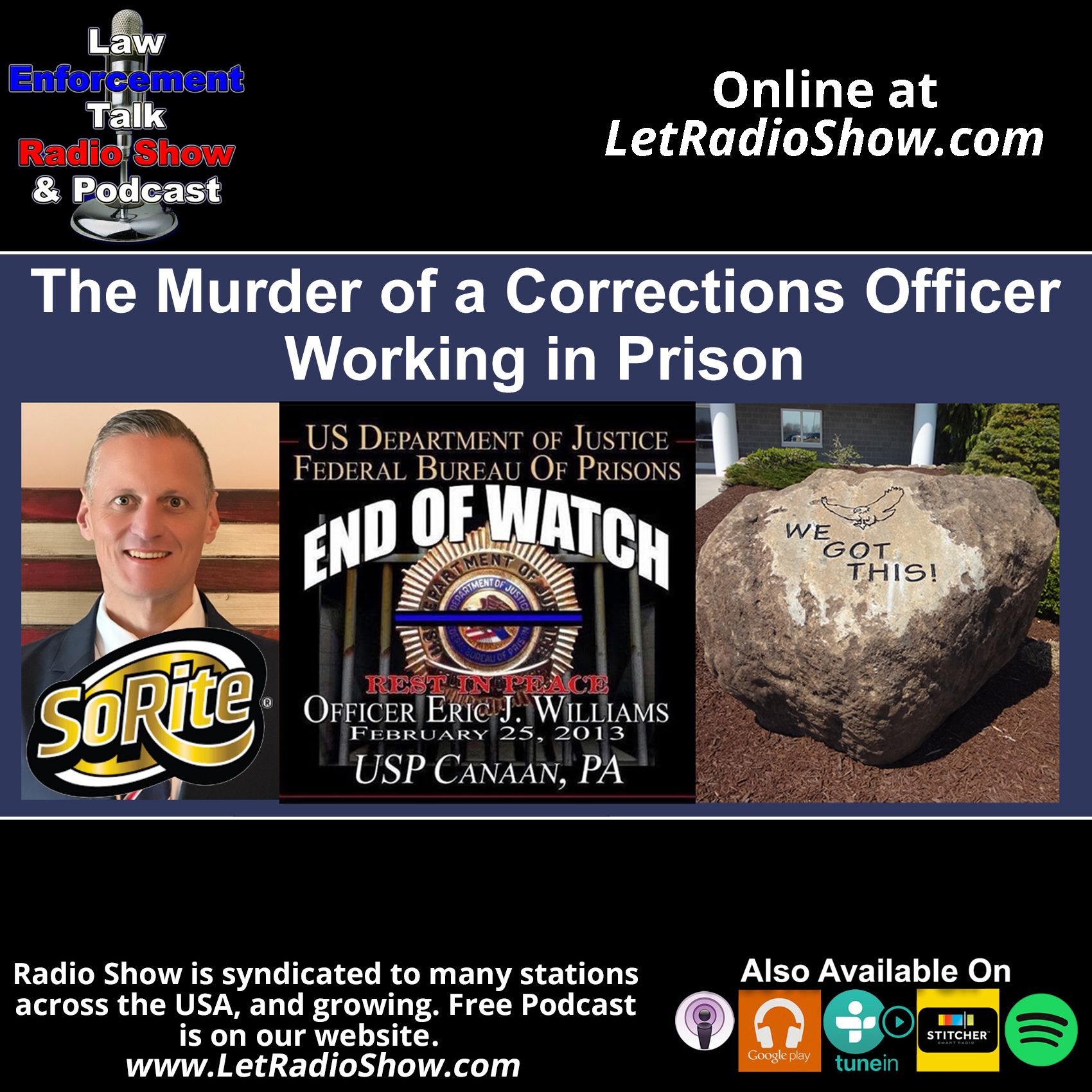
The Murder of a Corrections Officer Working in Prison
About this episode
The Murder of a Corrections Officer Working in Prison: The Impact. The murder of a corrections officer working in prison is one of the most dangerous realities of law enforcement. While police officers often receive public recognition for the dangers they face, correctional officers work behind prison walls where violence can erupt without warning. The Podcast is available for free on the Law Enforcement Talk Radio Show and Podcast website, also on Apple Podcasts, Spotify, YouTube and most major podcast platforms.
In this podcast episode of Law Enforcement Talk Radio Show and Podcast, retired Federal Bureau of Prisons official Robert Sorensen joined host John Jay Wiley to discuss the tragic murder of Eric Williams, the lasting impact on officers who serve in federal prisons, and the policy changes that followed. The Law Enforcement Talk Radio Show and Podcast social media like their Facebook , Instagram , LinkedIn , Medium and other social media platforms.
Supporting articles about this and much more from Law Enforcement Talk Radio Show and Podcast in platforms like Medium , Blogspot and Linkedin. The episode is available across major platforms including their website, Apple Podcasts, Spotify, YouTube, with highlights shared across their Facebook, Instagram, and LinkedIn profiles. Listen to the #Free #Podcast from the National #Radio Show.
The Murder of Corrections Officer Eric Williams
On February 25, 2013, Senior Officer Eric Williams was working inside a housing unit at United States Penitentiary, Canaan, a high-security federal prison. Available for free on the Law Enforcement Talk Radio Show and Podcast website, also on Apple Podcasts, Spotify, Youtube and most major Podcast networks.
During his shift, an inmate attacked him with a sharpened weapon. Officer Williams was stabbed and repeatedly struck during the assault. The Murder of a Corrections Officer Working in Prison: The Impact.
He was just 34 years old.
Williams had built a career in law enforcement before joining the federal prison system. He previously worked as a loss prevention officer and served as a police officer with the Jefferson Township Police Department before joining the Bureau of Prisons on September 11, 2011. Look for The Law Enforcement Talk Radio Show and Podcast on social media like their Facebook , Instagram , LinkedIn , Medium and other social media platforms.
He is survived by his parents, two brothers, and a sister.
His name is permanently etched into the National Law Enforcement Officers Memorial, located on Panel 12, W-29.
“Eric will never be forgotten,” Sorensen said during the interview.
The Federal Murder Case
The inmate responsible was indicted on June 25, 2013, in the U.S. District Court for the Middle District of Pennsylvania.
The charges included:
First-degree murder
First-degree murder of a U.S. corrections officer
Possession of contraband in prison
In June 2017, a federal jury found the inmate guilty. Prosecutors sought the death penalty, but on July 10, 2017, the jury ultimately sentenced him to life imprisonment. The Murder of a Corrections Officer Working in Prison: The Impact. Available for free on their website and streaming on Apple Podcasts, Spotify, Youtube and other podcast platforms.
The Personal Impact on Federal Officers
For Sorensen, the murder of Officer Williams was more than a tragic news headline. It deeply affected the officers who worked inside the prison system.
“When something like that happens inside a federal prison, every officer feels it,” Sorensen explained. “It reminds you how quickly things can turn violent.”
He described the reality correctional officers face every day, supervising violent offenders in a confined and unpredictable environment.
“People often forget that correctional officers are police officers too,” Sorensen said. “They just work behind the walls.” You can follow him on the Law Enforcement Talk Radio Show and Podcast Facebook, Instagram, watch the episode of the podcast interview and case breakdowns on YouTube, or listen to in-depth discussions on their website, on Apple Podcasts, Spotify and most major podcast platforms.
Violence Inside America’s Prisons
The dangers faced by correctional officers are significant. The Murder of a Corrections Officer Working in Prison: The Impact.
According to data from the National Law Enforcement Officers Memorial Fund, the memorial walls include the names of 528 correctional officers who have died in the line of duty.
The first recorded correctional officer killed in the line of duty was William Bullard, who was beaten to death during an escape attempt in 1841.
Today:
More than 200,000 correctional officers work in local, state, and federal facilities.
They supervise approximately 1.5 million inmates nationwide.
Roughly 8,000 assaults on correctional staff occur every year.
In the past 30 years alone, more than 200 correctional officers have died in the line of duty, many during inmate assaults. The Murder of a Corrections Officer Working in Prison: The Impact. It is discussed across News platforms and shared on Facebook, Instagram, LinkedIn, Apple, and Spotify, where audiences continue to get their content.
Recent tragedies highlight the ongoing danger, including the deaths of Jeremy Hall in 2025 and Dustin Pedigo in 2026.
“The public rarely sees the danger correctional officers face every day,” Sorensen said. “But the risks are real.”
Changes in Federal Prison Policies
Incidents like the murder of Eric Williams have forced federal prisons to reexamine policies designed to protect staff.
According to Sorensen, the tragedy sparked discussions about:
Officer safety procedures
Contraband control inside prisons
Tactical response training
Equipment and protective tools for staff
“You can’t eliminate the danger completely,” Sorensen said. “But you can improve training, procedures, and awareness to better protect officers.”
Robert Sorensen’s Career in Federal Law Enforcement
Sorensen spent decades in federal law enforcement before retiring from the Federal Bureau of Prisons. Listeners can find the show on the major platforms such as Apple Podcasts, Spotify, and YouTube, where discussions focus on mental health, leadership, wellness, and recovery from trauma.
He later served as a GS-13 Special Agent with the Office of Internal Affairs, overseeing nearly 1,000 investigations involving staff misconduct, policy compliance, and interagency coordination with agencies including the Federal Bureau of Investigation, Naval Criminal Investigative Service, and the Office of Inspector General. The Murder of a Corrections Officer Working in Prison: The Impact.
He also held operational roles at USP Canaan, where he contributed to crisis management and tactical training programs adopted throughout the region.
Today, Sorensen serves as Director of Strategic Partnerships and Agency Liaison for SoRite, helping develop practical safety solutions for corrections and law enforcement professionals.
“Training and preparation are everything,” Sorensen said. “You have to give officers the tools and knowledge they need to survive the job.”
Honoring the Sacrifice
The story of Eric Williams serves as a reminder that law enforcement service extends far beyond patrol cars and city streets.
You can find the Law Enforcement Talk Radio Show and Podcast on Facebook, Instagram, Pinterest, X (formerly Twitter), and LinkedIn, as well as read companion articles and updates on Medium, Blogspot, YouTube, and even IMDB.
Correctional officers stand on the front lines of the criminal justice system, often in environments that are isolated from public view. The Murder of a Corrections Officer Working in Prison: The Impact.
“These officers deserve recognition and respect,” Sorensen said. “They put their lives on the line every day to keep the public safe.”
For those who serve behind the walls, the memory of fallen officers like Eric Williams continues to shape how federal prisons train, prepare, and protect their staff.
And as Sorensen emphasized during the podcast, the lessons learned from tragedies like this must never be forgotten. The Law Enforcement Talk Radio Show and Podcast social media like their Facebook , Instagram , LinkedIn , Medium and other social media platforms.
Get the Free Clubhouse App, it is Drop In Social Audio. Think of it as your own talk radio show on your phone, and best of all it is free. Be sure to look for me and follow me, that's John J Wiley or @letradioshow you can do all that here.
Find a wide variety of great podcasts online at The Podcast Zone Facebook Page , look for the one with the bright green logo.
Learn and get access to money saving tips and how to increase your net worth at www.LetSavings.com
Download the Free Ebook about ways and tips to improve your health. You can get the ebook for free at www.LetHealthy.com
Be sure to check out our website .
Be sure to follow us on X , Instagram , Facebook, Pinterest, Linkedin and other social media platforms for the latest episodes and news.
Background song Hurricane is used with permission from the band Dark Horse Flyer.
You can contact John J. “Jay” Wiley by email at [email protected] , or learn more about him on their website .
The Murder of a Corrections Officer Working in Prison: The Impact.
Attributions
BOP Fallen Heroes Eric J. Williams
Hosted by Simplecast, an AdsWizz company. See pcm.adswizz.com for information about our collection and use of personal data for advertising.
Get every episode summarized
Each time Law Enforcement Talk: True Crime and Trauma Stories publishes, we email you a written briefing from the transcript — the topics, who appeared, and any specific claims, with the ad reads skipped.
Email me new episodesFree for 3 shows. No card needed.
Hosts & guests
Transcript ready
1,022 searchable segments. Every word is indexed and playable.
Full transcript
Law Enforcement Talk: True Crime and Trauma Stories — The Murder of a Corrections Officer Working in Prison. Machine-transcribed; use the interactive transcript above to jump the player to any line.
The Bleacher Report app is your destination for sports. Right now, the NBA is heating up, March Manus is here, and MLB is almost back. Every day there's a new headline, a new highlight, a new moment you've got to see for yourself. That's why I stay locked in with the Bleacher Report app. For me, it's about staying connected to my sports. I can follow the teams I care about, get real-time scores, breaking news, and highlights all in one place. Download the Bleacher Report app today so you never miss a moment. Every day the world gets a little weirder, and a lot more awesome. Cool Stuff Daily takes a look at everything from mining and space to the latest in the fight against cancer to how AI is basically changing everything. It's all the cool stuff you didn't know you needed to know. Join us for Cool Stuff Daily as we take a quick look at science, tech, and the wait, what stories that make you sound way smarter at dinner. Subscribe to Cool Stuff Daily Now because the future is happening fast and it's way too fun to miss.
He is a retired federal Bureau of Prison's officer. In 2013, a corrections officer he was close with was attacked and killed in the line of duty. He's here to talk about the impact on him, the changes in policies, and much more. Welcome to the Law Enforcement Talk Radio Show. In the Law Enforcement Talk Radio Show, we are joined by Special Guest, talking about their experiences, their wee outies investigating crimes. Plus, those have experienced rents trauma, police, first responders, military, and victims of crime share their stories. Hi, I'm John J. Wiley. In addition to being a broadcaster, I'm also a retired police sergeant. Be sure to check out our website, letradio.com, and also, like us on Facebook, search for the Law Enforcement Talk Radio Show. Of all the radio stations in the United States, there are no other shows like the Law Enforcement Talk Radio Show. On Facebook, there's only one official page. Do a search on Facebook for the Law Enforcement Talk Radio Show, and be sure to like the Law Enforcement Talk Radio Show Facebook page.
Conte is from Pennsylvania. We have Robert Sordensen on the Law Enforcement Talk Radio Show. Robert is retired at a federal Bureau of Prison's corrections officer, and he's here to talk about something tragic. The death, the attack, the assault, the line of duty attack on a friend, another corrections officer. In 2013, he had a huge impact on him, and prison policies. He is a consultant for a company so right, their website is soright.com. That's soright.com. SO-R-I-T-E.com. Be sure to check him out. Robert, thanks for your service, A, and thanks for being a guest on the Law Enforcement Talk Radio. Very much appreciated. Absolutely. It's a pleasure's mind. Thank you. It's good to have you here, Robert. I know we're going to talk. We're not strangers to heavy duty conversations. We're really or not. We've been doing this since 2017, and there is a spot for this. But the one thing that people need to understand, and I'm sure you're going to make people aware, is that for everybody else, life goes on, and we've got to find a way to never forget the loss of our fellow officers,
but how to take their legacy and add a positive thing to it. To build the best life possible. That's what I try to do. Yes, absolutely. And that's kind of how it shaped me as well. And we're talking about your career. So you're now retired from Bureau of Prisons. How long were you in and how long did you retire? So I retired in January of 2024. I served 27 years for the Federal Bureau of Prisons, and I retired out of Washington, D.C. as a special agent. And what year did you start? I started in 1997. Long time ago, by the way, I retired from the, I retired from the Baltimore Police Department in 1992. That's how long I've been out of the game. Oh, geez. I tell people this whole time, and I'm afraid this is a question. But I got hurt and retired young as an act of physical violence, multiple surgeries, and all that stuff. I was 33 when I retired and got into radio about eight years later.
But sometimes, here's a question, Bart, sometimes it feels like a lifetime ago, another guy ago, and other times it's right there. Yeah, that's so true. And sometimes it's shocking, and it kind of rakes you up a little bit, and just kind of reminds you of your past history. And sometimes it's not always good. No, there's good with the bad. The problem is I tend to remember the bad, the horrific stuff. I don't remember the good stuff. How about you? Well, for me, honestly, obviously the bad really kind of shape you, and it's like when you do anything good, nobody ever remembers the good stuff you do. They always remember the bad. And so I think that's really similar to kind of what we're talking about. And the bad things, hopefully you learn from them, and you don't do them again. So the bad definitely make a more indelible mark on you, on who you are, and it shapes what happens. So, you know, I had a guy tell me one time,
the more and more they whittle you down, or the more bad things that happen to you, the sharper you get. And so I kind of took that to heart. It was like a pencil. And you've got to even worn down to get that point, get sharp. Here's the thing that, and by the way, one of the details of the DEA, we put some people, I think it's in Williamsport, federal plant entry from federal charges. And I remember going to Jessup, which is a state correctional facility in Maryland, and for work, whatever reason why. And it was so loud that I could not handle it. How was your first day? I was thinking, what in the heck did I get myself into? I was an MP in the Army, and one of my good buddies said, hey, why don't you put in for the federal prison system? You know, it's a good retirement and everything. And no way did I ever think I was going to work inside of a federal jail. I just remember, and I hired out at USP Allenwood, which is right in Williamsport, PA, right near Williamsport,
probably the same prison you're talking about. Probably. And maximum security federal penitentiary right there, and it's a complex in Allenwood. And I remember my first day, and they were showing us who, where we were going, there was a medium and a low, and then there's a penitentiary and a camp there. And I was assigned to the penitentiary, and I'm thinking, oh, great, it's going to be gladiator school. I'm scared to death. And I remember walking inside of there, and you know, seeing the inmates walk it around, and I'm just thinking, my goodness, what did I get myself into? And so it's definitely a different world, and it's not for everybody, that's for sure. Well, one of the things, and certainly not for me. And I believe that you've got to have some natural abilities, especially in corrections, but a lot of it, policing in general, is learn skill set. I remember, because you better have good point. I remember getting hired by the Baltimore Police Department, and my first thought was, yeah, I got the job. My second thought immediately after that was like, am I tough enough for this? Am I sparring enough for this? Am I going to make it? Yeah, and all those things go through your head. But you know, you get over it.
You have to get over it. And I think one of the best things that correctional officers do, the better communicator you are, the more effective you are. And I think correctional officers are probably some of the best communicators. Obviously, there's some really not so good ones, but that's in every profession that we have out there. But I think if you're not a good communicator, you're going to have a really, really, really tough time working inside of any type of correctional facility at all. Now, the thing with the federal, and this is why I love working with DEA, when they got 25 years, they did almost exactly 25 years. And then some people want to get life. I mean, there is no getting out. Yeah, that's true. I mean, so are you talking about the staff, like the retirement? No, I'm talking about the inmates first and we'll go into your story. The inmates, I guess, let me reef sharpness question. One of the things I say all the time is, prisons are filled with people that, if it wasn't for alcohol drugs,
a big percentage of them wouldn't be there. If it wasn't for 15 minutes of bad decision making, they wouldn't be there. And then there is a very small percentage, very small of lifelong career criminals that will ruin your life. Is that the situation with you guys? Yeah, I've seen that, especially at the federal penitentiary. Everybody seems to think the feds are white collar crime, and that's really not the case. I've seen the worst of the worst, probably some of the most infamous criminals that you can think of, and we can talk about some of the individuals that have come across in my career. But you really see the worst of the worst, at the maximum security penitentiaries. And there's a difference between an inmate and a convict. And inmates are those ones that kind of just bother you and are very needy. Convicts, they don't bother you. And they kind of keep to themselves. But those are the guys you gotta watch out for. They're quiet, silent, type ones. But don't complain. And you gotta keep your head on the silver.
You cannot become complacent in this business. And that's kind of where a lot of people go down and make mistakes as they become complacent. And think that they can become friends with the inmates. And that's a big issue. The other thing that really got to me, and maybe it's true, maybe it's not. I'm gonna ask you, these inmates have nothing but time. They're watching you. They're watching every move you make as a corrections officer. And they adapt. And they're always, not all of them, but there's a certain percentage of having an angle. Was that the case with you guys? 100%. You know, inmates are predators. You know, you gotta look at them as a predator and prey, right? That's how they are on the street. It doesn't change when you get inside of the prison system. It actually becomes the university or where they kind of sharp in their skills, if you will, because they're also predator and prey in there. And so they're eyeballing their sizing people up all the time. And that's really two categories that you're in. And you're either a predator or your prey. You can't be both. You can't be one another.
We're talking about Robert Sorenson. He's retired federal bureau of prison's corrections officer. And he is now consultant. It was so right. Their website is soright.com. It's s-o-r-i-t-e.com. This is the law enforcement talk greater show. Don't go anywhere. We will be right back. How would you like to improve your health? Let's get healthy tips you can use today for free. They don't require any money at all. You can download a free ebook, 15 tips, improve your health at lethealthy.com. It's lethealthy.com. Again, it's lethealthy.com. And let's get healthy for free. Hi, this is Alex Cantrowitz. I'm the host of Big Technology podcast, a longtime reporter and an on-air contributor to CNBC. And if you're like me, you're trying to figure out how artificial intelligence is changing the business world and our lives. So each week on Big Technology, I bring on key actors from companies building AI tech and outsiders trying to influence it.
Asking where this is all going. They come from places like Nvidia, Microsoft, Amazon, and plenty more. So if you want to be smart with your wallet, your career choices, and meetings with your colleagues and at dinner parties, listen to Big Technology podcast wherever you get your podcasts. The sun shining, birds are singing and all feels right in the world. Until the season changes, and suddenly you lose your motivation to get out of bed. In fact, one in five people experience some form of depression no matter the season or time of year. At the American Psychiatric Association Foundation, our vision is to build a mentally healthy nation for all, because we want you to live your best life and be your best you all year round. Please visit mentallyhealthination.org to learn more. The Turner Conversation with Robert Sorenson on the Law Enforcement Talk Race Show. Robert is a retired federal bureau of prisons, corrections officer, and he is a consultant for Sewright.
I love saying that. Sewright.com is a company, website, it's s-o-r-i-t-e.com. Before we get into the story about the death of your friend and co-worker and how that impacted you and the policies that changed, you mentioned early conversation that there are some amazing comics and differences, but you went in some hardcore serious criminals, didn't you? Absolutely, I did, yeah. There's some serious gang dudes and there's some very notorious individuals that I've kind of... I don't want to say I had the pleasure to come across, but I've threw my career cross paths, so definitely. Are you able to mention something by name? Yeah, sure. I think you just actually passed away, but Alder James was probably one of the most famous individuals that I came across when I first started. Alder James was CIA spy back in the 80s, as old secrets to the Russians. So he came across him, he really kept to himself.
A lot of Mafia individuals at USP Island, that's kind of what that individual or that facility was known for. I picked up... I don't want to say I had the pleasure, but I ran across Delaine Maxwell when I was a special agent. We were doing some assessments in New York City, and she was in one of the detention centers there and had to ask you to talk to her. And that went me to her in the back of my neck, stand up a little bit. There's something off about that individual. So anyway, there's been some other high profile people that had come across as well. I did a tour of the ADX out in Colorado, and saw Tim McVade just got moved to the death row in Terajo, Indiana, so he just got moved. But I saw Terry Nichols, which was his co-conspirator, and I saw Ted Gizinski out there. So there's some individual that probably people know around the country
that we've had inside these jails that are around. I also picked up Michael Douglas' son in New York City. He liked the drugs, so I picked him up at the MCC New York and brought him to Lewisburg. One of these people, and some of the people he mentioned Maxwell, and I remember some of these people he had to deal with, most people were not bad. Most of them were not bad at all. And the bad guys, once you're arrested, you usually didn't give you a hard time. It was a very small percentage it did. However, there were certain people that made me feel, I just felt filthy afterwards because being around them, was she one of them? She definitely was one of them. Like I said, me, the hair on the back of my neck stand up a little bit. Like it was just odd. And she's very flirtatious with me and my partner. We were there doing some interviews and she came up to us and wanted to talk to us. And me, like I said, me, the hair on the back of my neck stand,
I feel achy and I've run across in mates that especially working in penitentiens that have been around the murderers, the high profile gang members, guys that have really done some really, really awful things. And there's only been a handful that have kind of given me the Willie's, or made me feel like I need to take a shower afterwards and she definitely was one of them. Yeah, there was certain people and I didn't have this conversation with my then wife life because I didn't want her to worry about stuff. And I thought I had this little nice little psychological trick and involved my soft body armor. There are some people called the bulletproof vest. And I would, the Velcro is attached to Velcro. When I was peeling the Velcro off, I would try to transition from cop J and do husband J and to father J and all that stuff and it worked well until it didn't anymore. Did you have any little tricks you did? I took my boots off and never wore my boots inside the house. I had a young kid at the time and you know, you kind of run across icky stuff that you walk into.
And I just tried to take that stuff off. Number one, to make sure I cut the germs outside. But I wanted to leave all that kind of stuff outside out there. Now, it's difficult. I'm not going to lie. It's really, really hard to flip that switch. Respect is a big thing, especially in jail. It makes really kind of thrive on respect given or not given. And if you don't get respect, you know, bad things happen. And in correctional officers and lieutenants and everybody are the same thing. And so you're really, really honing on the disrespect or the respect. And I had this, I struggled with that in the beginning with my children. If I felt that they back-talked me or disrespected me, I remember we were snapping sometimes in yelling at them. And my wife had to remind me, you know, hey, listen, they're not inmates. And that's one of those things that I had to try to remember and not bring home. But it's a difficult thing to do to flip that switch. And you're always looking for danger, you know, inside of a correctional state.
Every one of them is a convicted silent. And so every one of them has the potential to do violence. And so it's really hard to flip that switch and not be on high alert whenever you go out to eat dinner or whenever you go out and are general public. If you're always eyeballing everybody, or you're always looking at everybody or sizing people up and getting those nonverbal cues if you will. So it's not an easy thing to do. And you have to have coping mechanisms otherwise it'll eat you up. Last question. And by the way, I could relate to everything you talked about. The last question for getting a story. And this is something I personally, I believe corrections officers are law enforcement officers. And there's really no distinction. But some people love to make a scene like there is a big distinction. Have you noticed that? Yeah, definitely. My retirement, I retired as a federal law enforcement officer. I got the same retirement as an FBI agent as a US marshal or the DEA agent. We all have the same federal retirement,
our pension, our health benefits, everything's the same. So there's no difference in that. The only difference is how you do your job. There's a difference between an FBI agent and a street cop, right? An FBI agent is an out there pulling doing traffic duties. So does that make one less than the other? I don't think so, I think just the job duties that people do are totally different. And you have to understand that. So as far, you got to look at a correctional facility as a mini city. You have food service, you have electric, you know, you have plumbing, you have all these types of things, infrastructure, and you have its own society, you have different groups that you have to understand and deal with. So you have to be very, very good at dealing with your own miniature city, if you will. But every single one of those people in your city is a criminal, capable of extreme violence. So you're definitely a law enforcement officer. And every single day you're on edge, you'd never know what the day is going to bring, that's for sure.
And we'll get into some of the tragedies that occur in just a few moments. And this is the last question I'll have for you. Maybe it's the kind of a comment, but Hollywood in particular, when they talk about Hollywood, I mean, television, movies, social media, they portray corrections officers and, by the way, police as well, as being stupid, somehow corrupt, and somehow not trustworthy. You don't seem like any of those. Well, I appreciate that. Now, I don't have it really run across too many of those individuals. Now, there's always bad apples in every single, and that's what kind of drove me towards the end of my career to the internal affairs or the special agent side of the house. But there's always those bad apples that have that. So for the most part, it's nothing like you see on TV. Everybody, there is a brotherhood and a sisterhood, and everybody, you have to take care of each other. And it's not dark and dreary.
You don't have areas that aren't monitored like you see on TV, and those type of things don't happen normally. I'm not going to say there's an exceptions to the rule. But for the most part, in my 27 years, I have never seen anything like that. Good for that, you see on TV. And I'm never in Canada either. We're talking about Robert Sorensen, who's retired Federal Bureau of Prison's Corrections Officer. And we were attorneys also at Consultant, working now for so right. Their website is soright.com. It's s-o-r-i-t-e.com. Be sure to check it out. This is the law enforcement talk race. Everyone take a short break. We'll be right back. Get access to free podcast versions of the show. And more on Facebook. Do a search for the law enforcement talk race show and be sure to click like. College basketball's biggest tournament is here. And I'm hosting the watch party. So I've been getting everything ready and that usually means stopping at my local total line and more. It's nice knowing you're getting the lowest prices
and what makes it exciting is their selection. You can find everything in one place. So whether you're hosting or bringing something to share, shop total line and more in store or online and get ready for the big tournament today. Spirits are not sold in Virginia and North Carolina. Drink responsibly B-21. Whether you're a homeowner creating your dream space or a pro managing multiple projects, discover a new way to shop at Ferguson Home where great ideas become stunning spaces. Visit FergusonHome.com to explore the best selection of bath, kitchen, and lighting products. Or book an appointment at one of our showrooms where you can experience products firsthand and get personalized expert support every step of the way. Bring your vision to Ferguson Home where it all comes together. Shop top brands like Groa or find your local showroom at FergusonHome.com. The sun shining, birds are singing and all feels right in the world. Until the season changes and suddenly you lose your motivation to get out of bed. In fact, one in five people experience some form of depression, no matter the season or time of year.
At the American Psychiatric Association Foundation, our vision is to build a mentally healthy nation for all because we want you to live your best life and be your best you all year round. Please visit mentallyhealthynation.org to learn more. We'll turn our conversation with Robert Sorensen on the Law Enforcement Talk Race Show, connecting with us from Pennsylvania. He's retired at the Federal Bureau of Corrections Officer. He's now a consultant who working for SewRite. Their website is SewRite.com. It's s-o-r-i-t-e.com. And he did 27 years as a corrections officer for the Federal Government, which is lots of applause for that. I couldn't do a day. I really don't think I could do a day. But during your career, Robert, you had the extreme misfortune in 2013 of a friend, a co-worker that was attacked and killed. Yes, and we did.
His name was Officer Eric J. Williams. And it's kind of give you a little bit of backstory before that. I was promoted to a lieutenant. This was at USP Cain, in which is in Northeast Pennsylvania. I was promoted to Senior Lieutenant in 2007. So I was a lieutenant from 2007 until 2012. And then in 2012, I was promoted to our Emergency Preparedness Officer at USP Cain. And so an emergency preparedness officer, and this is important, really kind of in charge of making sure that security, making sure that your crisis management teams get the training and equipment. And we perform mock exercise or mock drills. And so that was a job that I had. I got promoted in February of 2012. And so a year later, this is going to happen, Eric's, you know, the anniversary of Eric's tap here, February 25th. But this was in 2013. I had a major mock exercise. And a major mock exercise is usually consists
of about four hour exercise. And we use various components of the command center and our crisis management teams, our slot teams, those types of things. And I would create a scenario and we kind of just do a drill. And we're required to do those two a year. And so I had one planned for that morning, February 25th, 2013. And so I got a call late at night. And saying, hey, we had a homicide at a bureau facility. And this was one of my good friends. He was down in Washington, DC. He was in charge of emergency preparedness for the whole bureau. And he called me and he said, hey, we had a homicide. I said, what do you mean? He goes, staff homicide. And I said, where? And he said at Kenan, I said, whoa, wait a minute. What do you mean at Kenan? And he told me goes, Eric, Eric Williams. And Eric was an officer. He started maybe about a year, year and a half prior to him being murdered there.
And so I knew who Eric was and I knew he was a good officer. He was a good person. He started out as a police officer on the street and decided he wanted to go into federal corrections for the benefits, the pension, and all the wonderful things that kind of go along with that. And so I called into the facility and I talked to the lieutenant who was on duty. And he was an officer for me for a long time, until he got promoted to lieutenant and I remember talking to him and he just started breaking down a crime. And he said, I couldn't do anything. And so I jumped in my car and I immediately went to the facility. And so what happened that night prior to was, it was some count time. And Eric was getting the unit ready to lock the inmates in their cells and they were going to count at this particular time in 2013. The only weapons that correctional officers had was a set of keys.
They had a radio and that's it. And there was one officer per unit. USP can in each housing unit holds 120 inmates on average. You'd have about 112, 113 inmates in a unit. And you have one officer to kind of control that. And they have like a sister housing unit next to it. So there's one officer over there. So you have an A side and a B side. And so Eric was working in a Charlie unit, Charlie one. And he was getting ready to lock the inmates into their cells for the night. And he was walking up the stairs. There's two levels at the in this housing unit. And he's walking up the stairs and he gets almost to the top of the stairs. And there's an inmate that was waiting for him at the top of the stairs. He was an Arizona Mexican mafia member. And he kicked Eric in the chest. And Eric did a back flip down the stairs and landed at the bottom base of the stairs.
And that inmate was already running down the steps towards him. And Eric got up and ran away. We tried to get away from him. And you know, you can watch the weekend. And I've seen the video numerous times. But you see Eric trying to get away and trying to create space and call for help. And his radio falls out. And so it's kind of dangling behind him. And he gets knocked down onto the ground. And the inmate continues to stab him numerous times. So he ends up stabbing him over 200 and sometimes. And he stomped on him. And this goes on for about 10 or 15 minutes. And he's kind of in that unit by himself. Not one inmate in that unit hit their duress button. Every cell has a duress button that they can hit. And it notifies the control center that, hey, something's going on. And you can send help or do those type of things. Not one of those inmates did that in that unit. So he was all alone in that unit by himself.
And that inmate stabbed him. He stomped on him. You see the inmate go away from him. He goes up to a cell. Takes his shirt off and kind of gets a breather. And another inmate comes out of the cell and gives him a soda. And hands him a soda to drink and he goes in and comes back down and continues stabbing Eric. And it's horrific as I kind of replay it in my mind. Yeah, I don't know that there's a pleasant way to talk about this. And here's the thing that really bothers me about it. Number one, I can't watch these videos. It's very rare to watch videos because it takes me forever. I mean, eight, nine hours to get back to what I call my center. But there's really no way you can describe in a way that normal people will understand the level of violence that people have with each other. And this is what you were doing.
And it's impossible to have that conversation and not feel it. I'm feeling it. I'm feeling that I didn't watch that video and I'll talk about when I did watch the videos. I didn't know 100% everything that happened until later that night. And I was there all day and doing stuff for the FBI and I'll talk about that here in a second how that kind of affected me. But he stabbed him numerous times and actually reached an Eric's pocket and pulled out some gum that Eric had. And you went through his pockets and pulled out a piece of chewing gum and chewed on a stick of Eric's gum. And that's how callous. And that's how violent these individuals are. So this goes on for quite a while and it may goes up to itself. And the officer next door in the sister unit was waiting for Eric to come on over and they count together. Two officers have to count. And Eric didn't come over like normal. So you see him come on into the unit
and Eric's laying there and not moving. And you can see the blood and stuff there. And I can see it right now actually. And it was right by one of the tables. There's a picnic table in that unit and we took it out after that. But he's laying right next to that picnic table and Jeremy comes over and sees him on the ground and doesn't know what's going on, right? Because he just knows that an officer, his partner is on the ground, doesn't know who did it or anything like that. He calls for help and you see the staff arrive. And so they start securing all the cells and they start looking for any kind of a clues, a blood trail, anything like that. And they find the enemy. And they actually deal with the enemy. And now this lieutenant that I spoke to that morning was the lieutenant on duty. And he did a wonderful job. And then if anybody kind of knows who that lieutenant was, is he's usually a big bravada. He looks like the big show from WWE.
And now that's kind of what his nickname was, the big show. And he's, everything's a nail and he's a hammer. But I'll tell you, by the grace of God that night, he did the right thing and the reason I say he did the right thing is he got the, he got the inmate that did the homicide out of the cell. They didn't do any unnecessary force on him or beat him up or anything like that. You would think that would be appropriate to do for somebody like that. And the reason I say that is sure very good. No, we're talking about Robert Sorenson, retired federal bureau prison's corrections officer. He's now consultant that company works for so right. Their website is so right. S-O-R-I-T-E dot com. This is long force and talk ratio. Don't go anywhere. We will be right back. Be sure to check out our website, L-E-T radio dot com. That's L-E-T radio dot com. There you'll find episodes this show available as a podcast after airing on radio. And they're always free.
All that and much more at L-E-T radio dot com. Again, the website is L-E-T radio dot com. The Bleacher Report app is your destination for sports. Right now, the NBA's heating up, March Manus is here, and MLB is almost back. Every day there's a new headline, a new highlight, a new moment you've got to see for yourself. That's why I stay locked in with the Bleacher Report app. For me, it's about staying connected to my sports. I could follow the teams I care about, get real-time scores, breaking news, and highlights all in one place. Download the Bleacher Report app today so you never miss a moment. Hi, this is Alex Cantrowitz. I'm the host of Big Technology podcast, a longtime reporter and an on-air contributor to CNBC. And if you're like me, you're trying to figure out how artificial intelligence is changing the business world and our lives. So each week on Big Technology, I bring on key actors from companies building AI tech and outsiders trying to influence it. Asking where this is all going,
they come from places like Nvidia, Microsoft, Amazon, and plenty more. So if you want to be smart with your wallet, your career choices, and meetings with your colleagues and at dinner parties, listen to Big Technology podcast forever, you get your podcasts. The Touring Conversation with Robert Sornson on the Law Enforcement Chalk Race Show, he's retired federal Bureau of Corrections Corrections Officer, Bureau of Frizzons, and he is an consultant now for, so right, their website is soright.com, that's s-o-r-i-t-e.com. We're talking about the incident where corrections officer was murdered in Atlanta duty in 2013. And one of the things that you said before he went to break was, and Hollywood, and again, I'm not gonna give the explanation, but Hollywood loves to portray this thing that all police want to get hands on with people. All police, all law enforcement, all corrections officer want to get vengeance.
And we may want to, but none of us wants to be the guy that throws a case in jeopardy in court. So we don't. And that sounds like a case with you guys. They took them in the custody, they made the kill the officer, and that was it. Yeah, that's exactly what happened. And that's why I say that Lieutenant did a great job preserving the case, preserving the evidence, and ensuring that a jury trial took place without any kind of incidents or anything that could be held over that case, that could ruin it or jeopardize, seeking the death penalty. And that's ultimately kind of how it played out. So, you know, kind of fast-forwarding. You know, Eric did pass away at the hospital, on the way to the hospital. We had one of our paramedics that rode with him. The Wharton at the time was is the best Wharton I ever worked for, a dear friend of mine to this day actually. He had the unpleasant job of going to Eric's mom and dad,
and you know, letting him know about their son. And I can't even imagine, you know, what that felt for him. So, fast-forwarding that day, we kind of went about our duties, and all the inmates were locked down. I didn't watch that video. I didn't know what happened. The FBI processed the crime scene, the evidence recovery team from Philadelphia came in, and processed the crime scene, took all the pictures, and then they released the crime scene. And this is where it kind of gets personal for me a little bit, is I was told by the captain at the time, let's get an inmate blood spill. That's, you know, we have inmate that are trained in blood spill cleanup. They're specifically trained, and they go and clean up the blood spill, and he's like, hey, let's get the blood spill guys to clean up, and I said, absolutely not. I said, no, I'm not, I'm not having no one may touch that. I said, I'm gonna go do it myself. And so, I went down to that unit, and I took a couple of lieutenant's who went with me, and we didn't say where to each other. And I remember cleaning that,
that blood splatter off the wall. I remember cleaning that off the picnic table, that was in that unit. And after that happened, I took my boots off, and I put them under in the box, and I put them underneath my desk in my office, and my emergency preparedness office. And I don't know why I did that, but those boots sat there until that trial was over. So it was about, must have been a year and a half, two years, those boots were underneath my desk, and I can't explain why, I don't know why I did that, but I threw them away after that trial. And I don't know if that was me subconsciously doing that, or what, but after we cleaned up the blood spill, the regional director came in, and the director of the bureau came in, and we sat in the command center, and that was the first time I watched the video, and just how brutal that whole thing was. And that affected me for about two weeks after that. I almost was like, like, zombie stage. And I remember looking at, you know,
one morning, it was with Gordon, and we were looking at each other, and he looked at me, and we shut the command center to work, because it was just him and I, and he gave me a big hug, and we started crying together, and that was like the next day after that happened, and the EC started crying, I started crying, so we're not gonna cry anymore. And, you know, he went around to every officer, and asked them what they needed, and every one of them said, we got this, sir, we got this. And so if you go to USP Cain and today, there's a big rock outside, and on that rock is engraved, we got this, and that's where that comes from, and there's an eagle there, and that was from the staff. So I really credit the staff, I credit the lieutenant, I credit the leadership at the time, and just to kind of help really get through that tough part. Fast forwarding two weeks, I was acting captain, and we're trying to get back to normal. And the control center officer, named as Greg, and Greg, at the night Eric was murdered, and was working at the control center, and thought he missed something, thought he thought he could have saved Eric's life,
or he messed up, or that was going through his brain. And I got a call that morning, I was acting captain, and said, hey, they found Greg, he committed suicide, he took a shotgun and killed himself with a shotgun at the local gun range. And so that afternoon, I had to call all the staff, and kind of tell them what happened to Greg, and so that just kind of tore the bandaid off the scab that was starting to form from Eric's murder staff, kind of doing their duties and stuff, and then having to deal with Greg's suicide. Those events played a big, huge role on kind of where I start looking at training staff, and the things that I started doing after that, as far as my job. The companies that I started getting involved with, I'm a lead, less legal instructor with the National Tactical Officers Association, the NTOA. I started teaching with them in 2013,
shortly after Eric was killed. They brought me on as a cadre member, and I piped teach for them today. I'm very passionate about staff safety. I'm very passionate about changing one person at a time, and then Eric's homicide and Greg's suicide really kind of molded that and shaped me that you're not going to change everybody, but if you can save and help one person do a job safe or more efficient and better, and that's kind of how I looked at things. And that's really, if you ask me, and I know you're not, it's kind of trying to put a purpose to my pain. You find that being the case with you? Absolutely, I do. I think you have to, if you bundle it up and bottle it up, and don't talk about it, and don't find an avenue to make things better. I think it eats you up, and I think it eats, I think you see that a lot, and law enforcement needs you to do. You talk about PTSD and veterans and people that have been the war. Well, police officers, corrections officers, paramedics,
I think you see some awful stuff. I can't even imagine coming across an accident on a highway with where we're young children and child loves. That has to have some type of effect on you. And so the things that we see in this profession and this line of work, if you don't have an outlet or you don't have a hope to make things better, I think it can be very dark, and I think it can be very, you know, go down a hole that it's really tough to come back from. And I think that's what happens. It is. And by the way, I was at the gym yesterday, and I was having a conversation with the guys, a little bit older than me, not a hole, he's 69. And I told him, by the way, you know, the average life expectancy here for American police officers now is 58. The American male is 73. And by the way, when I was in the police academy, the average life expectancy was 52. And we talked about some of the causes. And PTSD is part of a trauma, stress, poor shift work, poor eating habits, all that stuff, drinking themselves of death. And unfortunately suicide is an issue as well.
You're now a consultant. Tell us a little bit about so right on what you do. So it's kind of odd. I was at the National Tactical Officers Association conference that's passed here in Washington, D.C. And they always have a vendor show. And there's, as one of the less lethal instructors, we try to hit every single booth and see kind of a new technology out there and to save stuff. And so right was one of the booths that was there. And they have a product called DeCon. DeCon, oxidizes fentanyl in 60 seconds. And so it takes that dangerous amount of fentanyl and makes it inert and makes it safe. And so I've never, I didn't know anything like that existed. And the reason this affected me, you know, I saw the fact that I got to get this into the Bureau of Prisons. I got to bring this to my brothers and sisters in law enforcement is because last year at USP Outwater, we had a line of duty death, an officer by the name of Mark Fisher, worked in the mail room going through inmates mail and wasn't wearing gloves and came across some type of substance
which was fentanyl and overdosed and died. And it happens a lot. Not so much that it kills the officers, but they get overdosed and they have to be administered Narcan. And so I didn't know anything like this kind of existed. There was a product that was ready to use and safe. I can spray it on myself. It's not that's non-toxic. It doesn't degrade my equipment. It's sodium chloride, which is a safe substance, but it oxidizes. It's a very good oxidizer. And it depletes that fentanyl, xylazine, mess. And so I said, I need to see the testing. I'm not going to take you word for it. Let me see your testing. And so they had trichlinic laboratory and some other DEA credited laboratories. And they did the due diligence and spent the money and had the testing done. And it shows that the product does what it says. Now, it's stillright.com. It's s-o-r-i-t-e.com. People get more information about that and contact you there as well. Yep, it's B. Sorenson, s-o-r-e-n-s-e-n at stillright.com.
Thanks so much, Robert. Appreciate it. Thanks for being guests on the Long Force and Talk Race Show and telling your story very much appreciated. Thank you. I appreciate it as well. Huge thank you for listening to this episode of the podcast version of the Long Force and Talk radio show. By the way, which is a nationally syndicator radio show and we broadcast on over 115 radio stations across the United States to more than 44 million combined population. If you like our show, there's two simple things we can do. Go to our website, letradio.com. Out of your favorites, check it often. You can find episodes of the show right there. And the second one involves our Facebook page. It's so easy to find great content, including past episodes of the show. And when you see something that you like that resonates with you, be sure to share it with your friends. We'll be back in just a few days, one of the episodes of the Long Force and Talk radio show and podcasts. Until then, this is John J. Wiley. See ya.
Hey, it's Howie Mandel and I am inviting you to witness history as me and my Howie Do it gaming team take on Gilly DeKing and wallow 267's million dollars gaming in an epic global gaming league video game showdown. Four rounds, multiple games, one winner plus a halftime performance by multi platinum artist, Travis McCoy. Watch all the action and see who wins and advances to the championship match against Neo right now at globalgaming league.com. That's globalgaming league.com. Everybody games. Hi, this is Alex Cantrowitz. I'm the host of Big Technology podcast, a longtime reporter and an on air contributor to CNBC. And if you're like me, you're trying to figure out how artificial intelligence is changing the business world and our lives. So each week on Big Technology, I bring on key actors from companies building AI tech and outsiders trying to influence it. Asking where this is all going. They come from places like Nvidia, Microsoft, Amazon, and plenty more. So if you want to be smart with your wallet, your career choices, and meetings with your colleagues
and at dinner parties, listen to Big Technology podcast wherever you get your podcasts. If you liked the show, please take a moment to rate, review, and subscribe. It really does help the show to grow. Thank you for listening.
More episodes
More from Law Enforcement Talk: True Crime and Trauma Stories

Police Shot in the Face, Then Fired by His Agency
Law Enforcement Talk: True Crime and Trauma Stories

Military Combat and Mental Health: Building the Life He Wants
Law Enforcement Talk: True Crime and Trauma Stories

Cop Down, Shot on Drug Arrest by a Sniper
Law Enforcement Talk: True Crime and Trauma Stories

Her Health Challenges And Trauma Led To Unexpected Success
Law Enforcement Talk: True Crime and Trauma Stories