The Minister's Absolute Mandate and Eternal Reward
About this episode
The Minister's Absolute Mandate and Eternal Reward
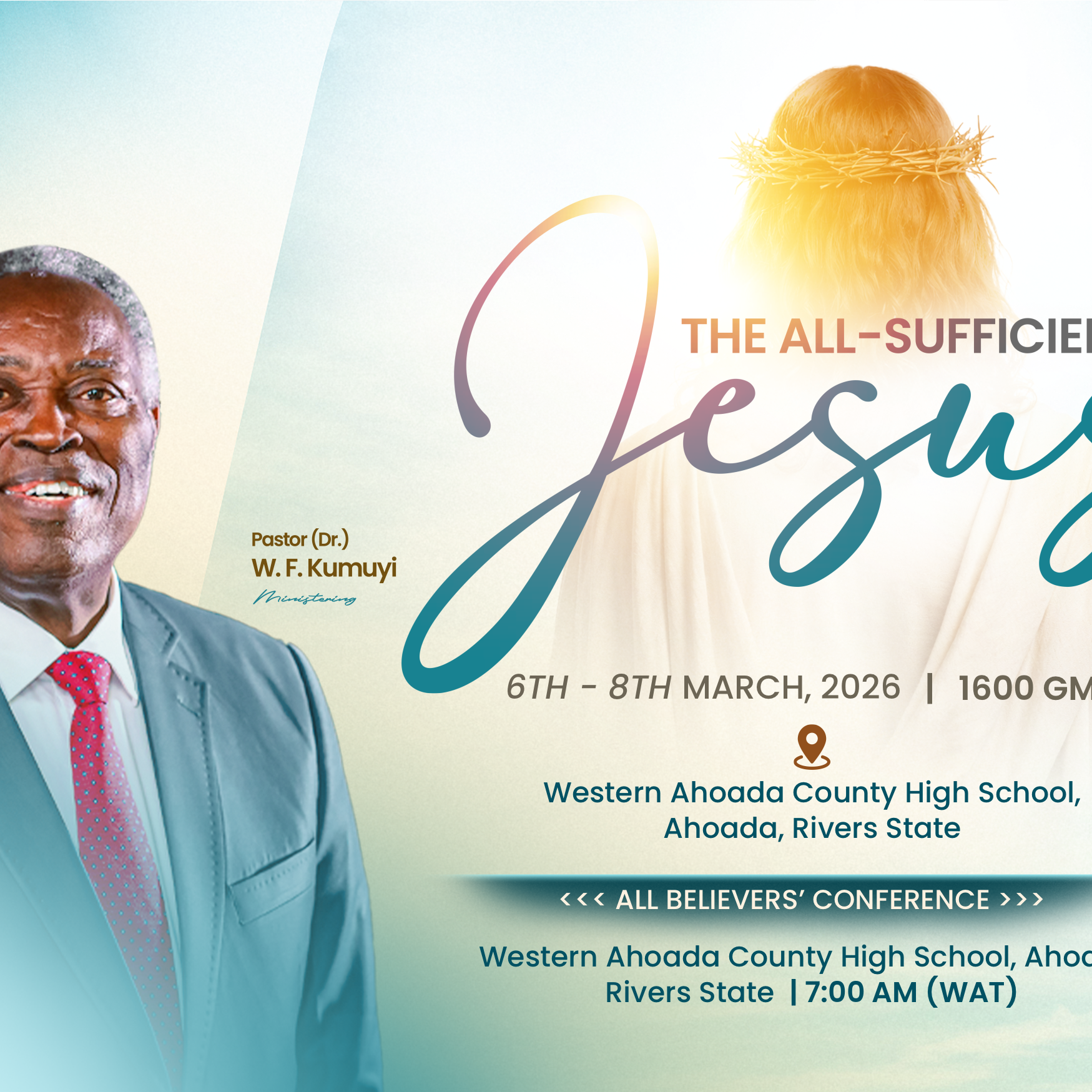
This sermon was delivered by Pastor (Dr) W. F. Kumuyi during the Global Sunday Service at the recent Special Revival Program themed Jesus, the Life Changer held in Bori, Rivers State, Nigeria. The message concerns the spiritual responsibilities outlined in the final chapter of 2 Timothy. The teaching emphasises that a divine mandate is superior to any minister, requiring absolute submission and a life that mirrors the holiness being preached. Believers are urged to maintain spiritual vigilance over their hearts and conduct to ensure they are prepared for the final judgment. The message highlights the necessity of enduring afflictions and performing the work of an evangelist to achieve "full proof" of one's ministry. Furthermore, it calls for steadfast discipline and obedience to leadership as essential components of running a successful Christian race. Ultimately, the materials serve as a solemn charge for Christians to strengthen their convictions and preserve their eternal rewards through integrity.
If you need the complete Pastor (Dr) W.F Kumuyi Message outline, download it via this link - https://tinyurl.com/AcknowMinisterABCMarch2026
Also, we love to hear from you. Send your feedback via this link - https://tinyurl.com/DrWFKumuyiPodcastFeedback
Please share this message with others. God bless you.
Get every episode summarized
Each time Biblical Deep Dive with Pastor (Dr) W.F Kumuyi publishes, we email you a written briefing from the transcript — the topics, who appeared, and any specific claims, with the ad reads skipped.
Email me new episodesFree for 3 shows. No card needed.
Hosts & guests
Transcript ready
304 searchable segments. Every word is indexed and playable.
Full transcript
Biblical Deep Dive with Pastor (Dr) W.F Kumuyi — The Minister's Absolute Mandate and Eternal Reward. Machine-transcribed; use the interactive transcript above to jump the player to any line.
I want you to think about leadership for a second, like really picture a powerful leader in your mind. Right. You're probably default to charisma or personal vision. Exactly. Or maybe just their unique ability to command a room, you know? Yeah. We are so conditioned to put the person on a pedestal. Or 100%. But what happens when the mission is infinitely more important than the actual person leading it. And when you as a leader are nothing more than a temporary steward of an unchangeable absolute assignment. I mean, it completely flips our modern understanding of authority on a tent. Yeah. It really does. Because we live in this era of, you know, personal branding. Yeah. But the entire goal is to make the mission fit your personality. Right. But the concept you're looking at today demands the exact opposite. The focus just violently shifts from your personal ambition to your absolute submission. Welcome to another deep dive. And today, we are pulling from a rigorous, honestly incredibly demanding sermon delivered
just a few days ago. Yeah. March 8th, 2026. Right. It was delivered by Pastor W. F. Cumui of the Deeper Christian Life Ministry, speaking at the All Believers Conference in Bory, Rivers, State, Nigeria. And to be clear, our goal here is to just objectively look at the mechanics of this text, not to endorse the theology itself. Exactly. Our mission for this deep dive is to unpack this fascinating material on the heavy weight of leadership, accountability, and this core concept of an absolute mandate. It's intense stuff. It really is. Yeah. Okay. Let's unpack this. I mean, where do we even begin with a framework that demands this much surrender? Well, we begin by recognizing the architectural blueprint of his worldview here. Pastor Cumui is, he's delivering a deeply theological message. It's anchored in the biblical book of 2 Timothy, specifically chapter four. With the overarching themes like integrity, objective evaluation, strict personal discipline, these are really universal concepts of leadership. Yeah.
Absolutely. Whether you're leading a congregation, a massive corporation, or just, you know, trying to guide your own family, the standard of accountability he lays out is just staggering. And it starts with this foundational premise that the mandate existed long before the minister. That phrasing stuck with me immediately, like the mandate comes first and the minister is, quote, very, very junior to the mandate, exactly. A true leader in this framework does not invent their mission. They inherit it. Right. They inherit it. The mandate is absolute. It's unchangeable. You can't edit it. Pastor Cumui drives home this hard truth that this isn't some shifting message. You can just tweak to make it more palatable. Yeah. You can't just look at the difficult parts of the assignment and say, hey, can we get those parts off like they make my audience uncomfortable? Right. The minister has to bow to the mandate and not the other way around. And taking up that mandate requires what he calls a solemn charge, which, I mean, this isn't just a casual responsibility you can clock in and out for.
No, not at all. It requires this absolute, impenetrable integrity behind closed doors and to illustrate the psychological weight of this, the text uses this highly relatable, honestly intense example of a preacher husband. Oh, right. This part forces you to really look the gap between the public persona and the private reality. Yes. So imagine you're sitting in the congregation, right? And your husband is the preacher. Okay. He stands up in front of everyone, opening the book of John preaching, you know, go and sin no more. He's eloquently telling people to live holy lives, to reject anger, practice fidelity. That sounds great on paper. Right. And why if you know the actual truth of what happens when the microphone is off? You see the contradiction in real time. Exactly. You see all this anger and animosity bottled up. You know how he insults you or emotionally abuses you when he doesn't get his way? Yeah, it's dark. It is. The scenario even pushes it further. Like, maybe you know, he's been caught cheating, doing unprintable things with the household
made. So you're sitting there, hearing this beautifully crafted message. But in your head, you're thinking, well, who makes you a judge over me when I know how we live at home? Right. And the mechanism at work there is just the total destruction of authority. Yes. If a leader's private life completely contradicts their public message, the authority of that message just evaporates, especially in the ears of the people who actually know them. You can't just claim a title without carrying the weight of the mandate in your own personal habit. Exactly. If your private reality is a fraud, your public preaching is powerless. Hmm. Ministry requires living the word, not just reading it. It really makes me think of a business analogy. Like, imagine a new CEO taking over a beloved, century-old legacy brand. Okay. Yeah. You don't get to just change the secret recipe to suit your mood, you know? Your job is to serve the brand. Right. And if you secretly hate the product at home, if you're actively trashing it behind closed doors while selling it on TV, the consumers are eventually going to taste that inauthenticity.
You have to embody what you're selling. What's fascinating here is how the text insists that correction requires personal perfection or, I mean, at least striving for it. Preaching the word includes reproving and rebuking with long suffering. But how can you effectively correct the flaws in other people if your own life is a glaring contradiction? You can't. Right. The messenger must live what is preached. But I mean, holding yourself to that flawless standard behind closed doors creates an immense amount of pressure. So who actually evaluates if you're succeeding? That's the big question. Because human beings are notoriously easy to fool. Yeah. I mean, we all know people who seem to be doing great, but maybe the standards they're being held to are just way too low. Well, that transitions us into the mechanics of evaluation in this source. How is a leader actually tested? The sermon introduces this brilliant concept of the external examiner. It compares our moral lives to an academic syllabus. I love the synology. So think about your local teachers or local pastors.
Yes. They might give you a passing grade on an exam because they know you. They know you're usually a good kid or maybe they know you were going through a deaf time. Right. Human evaluation is always inherently subjective or swayed by affection or pity. We grade our friends on a curve. Exactly. But then comes the final exam. And it's graded by the external examiner, which in this theological framework is God at the final judgment. Yes. The external examiner does not know your excuses. He doesn't look at your personal history of trauma. He only grades strictly against the official curriculum. And to pass that strict examination, one must endure what the source calls afflictions. Affliction? Yeah. You don't get a pass just because things were hard. You're expected to face pressure, heat, public opposition, and still hold the line. And there's a very specific striking anecdote from Pastor Kamui's sermon about this that I have to bring up. Oh, the marriage story. Yes. It's a story about a man waiting to get married. He finds a woman in the church, believes she's the divine will for his life, but her family
rejects him outright. Because of where he's from. Right. They ask what tried he's from and they say, we don't give our gotters to strangers. So he's facing this intense tribal prejudice, which is a huge affliction, a huge one. And instead of giving up or fighting back poorly, he just waits. He waits one year, three years, up to five years. He patiently endures the unfairness because he is anchored to the mandate. It's wild to think about it. I mean, when people face an agonizing delay or unfair prejudice today, the immediate temptation is to look for a shortcut. Exactly. But he views that delay as a necessary affliction to test his commitment. But wait, I do have a question about this framework, like a bit of pushback. Sure. If the local teachers and pastors are seen as too sympathetic and the true test is this solitary endurance, does this mean local support? And networks are inherently flawed, like, are they too soft? Well, the source isn't saying local support is bad or malicious. OK. Rather, it's pointing out that human grading is just inherently subjective.
True accountability has to be objective and absolute, which is why the leader must prepare for the highest standard, the external examiner, not the easiest pass from their local friends. Right. So if the final evaluation is that strict, how exactly do you train for it? As we move from the evaluation to the actual discipline required to succeed. And this brings us to the methodologies of training, specifically the analogy of the inner school sports tournament and the smiling coach. Oh, man, the smiling coach. This was so memorable. It really paints a picture. So imagine you're an athlete practicing at your own school and your coach just smiles at you. You show up late. They smile. Yeah. You break the rules of the game. And they just pat you on the back and say, God bless you. You might walk away thinking, wow, what a nice person. They might be a very nice person. But as a coach, they are actively destroying your potential. Because when you go to the actual race against other schools, you fail spectacularly. You aren't disciplined. You're used to doing whatever you want.
Right. The text places a strong emphasis on bringing the body into subjection. Striving from mastery requires you to be intensely controlled in all things. Here's where it gets really interesting. Think about the difference between casually jogging around the block for fun versus training for the Olympics. Oh, good comparison. Right. If you're just jogging for fun, sure, eat a donut during practice. Stop and pet a dog. It doesn't matter. Yeah, who cares? But if you want the Olympic gold or the incorruptible crown as the source calls it, a coach who lets you eat donuts on the track isn't actually your friend. No, they're robbing you of the prize. Exactly. The rigor gets incredibly granular. Bringing the body into subjection means strict personal boundaries. It heavily emphasizes boundaries between men and women, ensuring behavior remains modest, leaving no room for misinterpretation. Knowing what to say and keeping an appropriate physical distance. Exactly. Which introduces this incredibly powerful mantra from the text, others may I cannot.
Others may I cannot just hearing that feels isolating. It is. It's a realization that people around you might not understand your strict personal consecration. Right. They might invite you to do harmless seeming things, gossip, cut corners, whatever. But you must hold your own boundaries so no one takes your crown. Because you aren't training for the same race. Right. You cannot outsource your discipline. Others may I cannot is basically accepted the loneliness of leadership. So you have the integrity. You've passed the evaluation. You've survived the strict training. What happens when you're actually deployed into the field? Deployment is the final crucible. It's about strengthening the called through absolute obedience to that deployment. The sermon sets this up with a biblical example. The Apostle Paul sending Titus and another worker named Tekkikus to Ephesus. Yeah. And the key detail is what they didn't do. Right. They didn't argue. They didn't gather sympathetic friends to protest the transfer. They just packed up and went. It's a modern application that this is fascinating.
When church leadership or even corporate leadership transfers a worker or brings in a new sectional leader. Oh, this happens all the time. People often engage in what the sermon calls silent rebellion. Silent rebellion. Yeah. They don't explicitly say no or shout, I reject this person. But they drag their feet. They show hidden frustration. They deliberately try to frustrate the new leader because they miss their old one. Exactly. Passive aggressive directed inaction. But I mean, isn't it just basic human nature to resist sudden leadership changes? Like you miss the boss you loved. How do you just switch that off? If we connect this to the bigger picture, you're right. It is human nature. But the entire premise of this text is about overcoming base human nature. Ah, okay. Resisting the appointed leader isn't just viewed as a human resources issue. In this theological stance, it's viewed as resisting the divine order and the spirit of God. Wow, that really escalates the stakes. It does. That's why the text commands listeners to strengthen what remains that is ready to die. It takes active, intentional energy to kill, self-will, and maintain unity.
So what does this all mean? If we step back and summarize this journey, a true minister is entirely subordinate to an absolute mandate. They must have private integrity that perfectly matches the public words. They have to train under strict discipline rather than looking for a smiling coach. Absolutely. They must execute their duties without silent rebellion, knowing they will be graded by an objective external examiner. And while this source is a specific religious framework, the architectural blueprint of this kind of absolute dedication can be profoundly challenging to anyone trying to lead a life of ultimate purpose. It really forces you to look at your foundation. So think about the main pursuit of your life right now. Are you truly serving an absolute mandate that is bigger than yourself? Or are you just trying to build a title for your own ego? That's the real question. And if you are serving a mandate who is your external examiner, thank you so much for joining us on this deep dive. We'll see you next time.
More episodes
More from Biblical Deep Dive with Pastor (Dr) W.F Kumuyi

Divinely Planned Transformation by Grace for Glory
Biblical Deep Dive with Pastor (Dr) W.F Kumuyi

The Transformed Achiever: Lifting Limits through Faith and Diligence
Biblical Deep Dive with Pastor (Dr) W.F Kumuyi

The Sinner's Doom and the Saint's Destiny
Biblical Deep Dive with Pastor (Dr) W.F Kumuyi

The Path of Faith and the Peril of Obstinacy
Biblical Deep Dive with Pastor (Dr) W.F Kumuyi