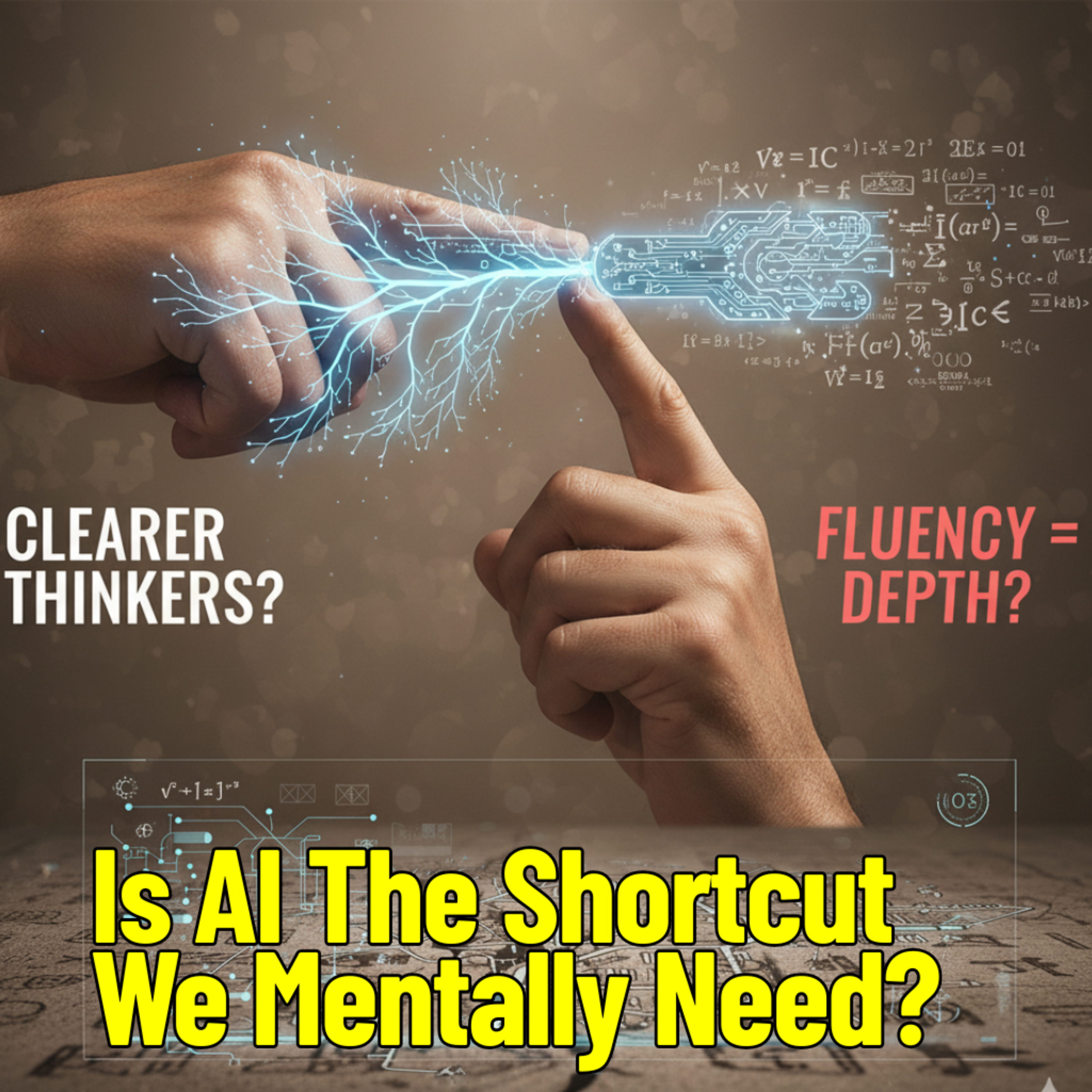
About this episode
For centuries, every leap in technology has helped us think — or remember — a little less. Writing let us store ideas outside our heads. Calculators freed us from mental arithmetic. Phones and beepers kept numbers we no longer memorized. Search engines made knowledge retrieval instant. Studies have shown that each wave of “cognitive outsourcing” changes how we process information: people remember where to find knowledge, not the knowledge itself; memory shifts from recall to navigation.
Now AI is extending that shift from memory to mind. It doesn’t just remind us what we once knew — it finishes our sentences, suggests our next thought, even anticipates what we’ll want to ask. That help can feel like focus — a mind freed from clutter. But friction, delay, and the gaps between ideas are where reflection, creativity, and self-recognition often live. If the machine fills every gap, what happens to the parts of thought that thrive on uncertainty?
The conundrum:
If AI takes over the pauses, the hesitations, and the effort that once shaped human thought, are we becoming a species of clearer thinkers — or of people who confuse fluency with depth? History shows every cognitive shortcut rewires how we use our minds. Is this the first time the shortcut might start thinking for us?
Get every episode summarized
Each time The Daily AI Show publishes, we email you a written briefing from the transcript — the topics, who appeared, and any specific claims, with the ad reads skipped.
Email me new episodesFree for 3 shows. No card needed.
Hosts & guests
No transcript yet
This episode has not been transcribed. Request it and it moves to the front of the queue.
More episodes
More from The Daily AI Show

10,000 AI Agents Attack One Problem
The Daily AI Show
Our Real Atlas Builds and Use Cases
The Daily AI Show
Can We Truly Control The Alien Mind?
The Daily AI Show

The Democratic Bandwidth Conundrum
The Daily AI Show