About this episode
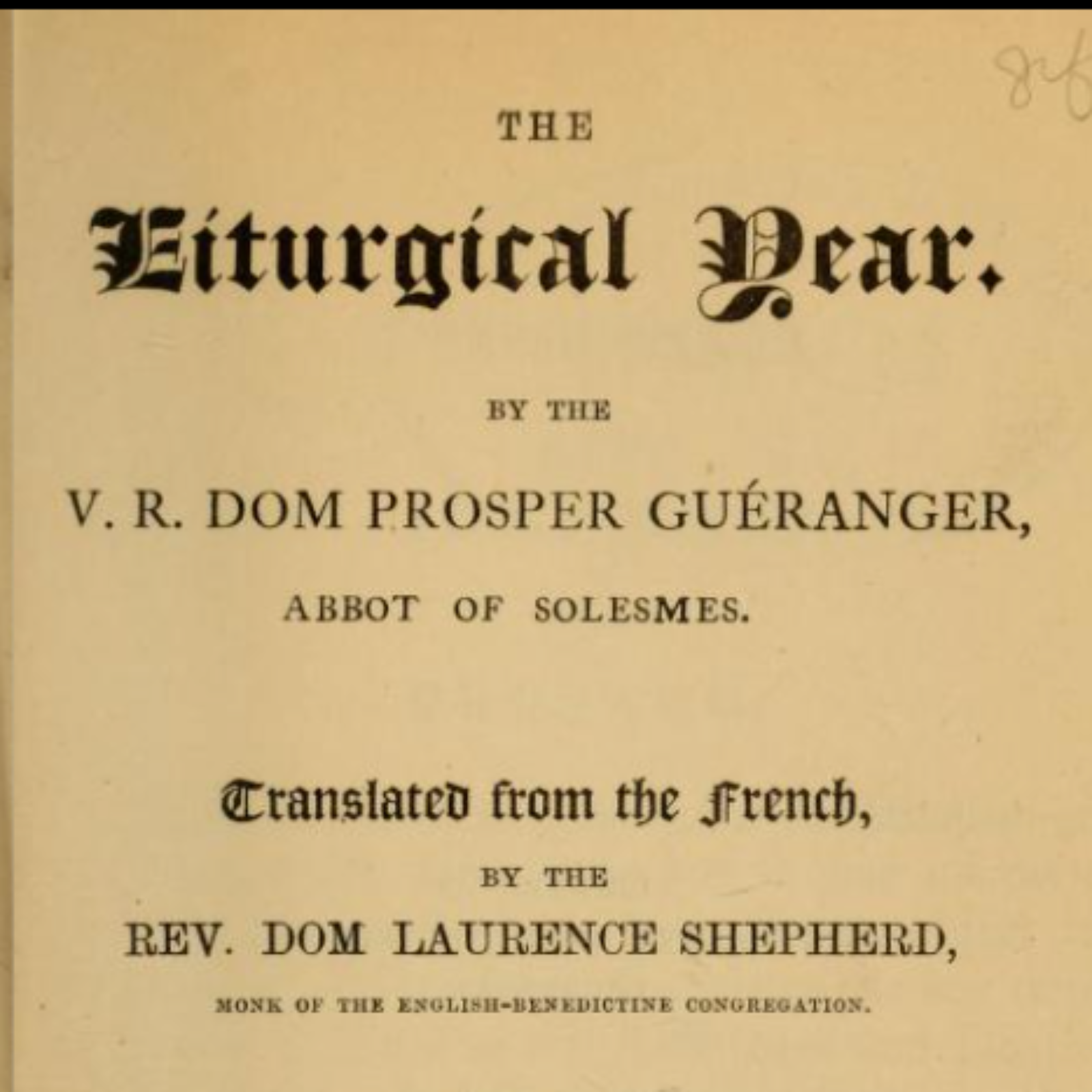
Abridged. The Liturgical Year is a multi-volume work written between 1841 and 1875, by Dom Prosper Gueranger, abbot of the French Benedictine abbey of Solesmes. It is a rich theological reflection on the various feasts and seasons of the Church’s liturgical cycle.
Please consider donating to help keep this podcast going by going to buymeacoffee.com/catholicdailybrief Also, if you enjoy these episodes, please give a five star rating and share the podcast with your friends and family
Get every episode summarized
Each time Catholic Daily Brief publishes, we email you a written briefing from the transcript — the topics, who appeared, and any specific claims, with the ad reads skipped.
Email me new episodesFree for 3 shows. No card needed.
Hosts & guests

Transcript ready
164 searchable segments. Every word is indexed and playable.
Full transcript
Catholic Daily Brief — The Liturgical Year: The Third Sunday of Lent. Machine-transcribed; use the interactive transcript above to jump the player to any line.
The third Sunday of Lent The Holy Church gave us as the subject of our meditation for the first Sunday of Lent, the temptation which our Lord Jesus Christ dain't to suffer in the desert. Her object was to enlighten us with regard to our own temptations and teach us how to conquer them. Today she wishes to complete her instruction on the power and strategy of our invisible enemies, and for this she reads to us a passage from the Gospel of St. Luke. During Lent the Christian ought to repair the past and provide for the future, but he can neither understand how it was he fell nor defend himself against the relapse, unless he have correct ideas as to the nature of the dangers which have hitherto proved fatal, and which are again threatening him. Hence the ancient liturgists would have us consider it as a proof of the material watchfulness of the church that she should have again propose such a subject to us. As we shall find, it is the basis of all today's instructions.
Assuredly we should be the blindest and most unhappy of men, if surrounded as we are by enemies who unceasingly seek to destroy us and are so superior to us both in power and knowledge, we were seldom more never to think of the existence of these wicked spirits. And yet such is really the case with innumerable Christians nowadays, for truths are decayed from among the children of men, Psalm 112. So common indeed is this heedlessness and forgetfulness of truth which the Holy Scriptures put before us in almost every page, that it is no rare thing to meet with persons who ridicule the idea of devils being permitted to be on this earth of ours. They call it a prejudice, a popular superstition of the Middle Ages. Of course they deny that it is a dogma of faith. When they read the history of the church or the lives of the saints, they have their own way of explaining whatever is there related on this subject. To hear them talk, one would suppose that they look upon Satan as a mere abstract idea to be taken as the personification of evil. When they would account for the origin of their own or other sins, they explain all by
the evil inclination of man's heart and by the bad use we make of our free will. They never think of what we are taught by Christian doctrine, namely that we are also instigated to sin by a wicked being whose power is as great as is the hatred he bears us. And yet they know they believe with a firm faith that Satan conversed with our first parents and persuaded them to commit sin and showed himself to them under the form of a serpent. They believe that this same Satan dared to tempt the incarnate son of God and that he carried him through the air and set him first upon a pinnacle of the temple and then upon a very high mountain. Again they read in the gospel and they believe that one of the possessed delivered by our Savior was tormented by a whole legion of devils who, upon being driven out of the man, went by Jesus' permission into a herd of swine and the whole herd ran violently into the sea of Genescerith and perished in the waters. These and many others such like facts are believed by the persons of whom we speak with all earnestness of faith. Yet notwithstanding they treat as a figure of speech or a fiction, all they hear or read
about the existence, the actions, or the craft of these wicked spirits. Are such people Christians or have they lost their senses? One would scarcely have expected that this species of incredulity could have found its way into an age like this when sacrilegious consultations of the devil have been we might almost say, fashionable. Means which were used in the days of paganism have been resorted to for such consultations and those who employed them seemed to forget or ignore that they were committing what God and the old law punished with death and what for many centuries was considered by all Christian nations as a capital crime. But if there be one season of the year more than another in which the faithful ought to reflect upon what is taught us both by faith and experience as to the existence and workings of the wicked spirits, it is undoubtedly this of lent when it is our duty to convince and consider what have been the causes of our past sins, what are the spiritual dangers we have to fear for the future, and what means we should have recourse to for preventing a relapse. Let us then hark into the Holy Gospel. Firstly we are told that the devil had possessed a man and that the effect produced by this
possession was dumbness. Our Savior cast out the devil and immediately the dumb man spoke, so that the being possessed by the devil is not only a fact which testifies to God's impenetrable justice, it is one which may produce physical effects upon them that are thus tried or punished. The casting out of the devil restores the use of speech to him that had been possessed. We say nothing about the obstinate malice of Jesus' enemies who would have it that his power over the devils came from his being in league with the Prince of Devils. We would now merely show that the wicked spirits are sometimes permitted to have power over the body and would refute by this passage from the gospel the rationalism of certain Christians. Let these learn then that the power of our spiritual enemies is an awful reality and let them take heed not to lay themselves open to their worst attacks by persisting in this disdainful haughtiness of their reason. Ever since the promulgation of the gospel, the power of Satan over the human body has been restricted by the virtue of the cross, at least in Christian countries, but this power resumes its sway as often as faith and the practice of Christian piety lose their influence.
And here we have the origin of all those diabolical practices which under certain scientific names are attempted first in secret, and then are countenanced by being assisted at by well-meaning Christians. Were it not that God and his church intervened, such practices as these would subvert society? Christians remember your baptismal vow, you have renounced Satan. Take care then that by a culpable ignorance you are not dragged into apostasy. It is not a phantom that you were announced at the font. He is a real and formidable being, who, as our Lord tells us, was a murderer from the beginning. John 844. But if we ought to dread the power he may be permitted to have over our bodies, if we ought to shun all intercourse with him and take no share in practices over which he presides and which are the worship he would have men give him, we ought also to fear the influence he is ever striving to exercise over our souls. See what God's grace has had to do in order to drive him from our soul. During this holy season, the church is putting within your reach those grand means of victory,
using prayer and alms deeds. The suites of peace will soon be yours, and once more you will become God's temple, for both soul and body will have regained their purity. But be not deceived, your enemy is not slain. He is irritated, penance has driven him from you, but he is sworn to return. Therefore fear relapse into mortal sin, and in order to nourish within you this wholesome fear, meditate upon the concluding part of our gospel. Our Savior tells us that when the unclean spirit has gone out of a man, he walketh through places without water. There he rides under his humiliation. It has added to the torture of the hell he carries everywhere with him, and to which he feign would give some alleviation by destroying souls that have been redeemed by Christ. We read in the Old Testament that sometimes when the devils have been conquered, they have been forced to flee into some far off wilderness. For example, the holy Archangel Raphael took the devil that had killed Sarah's husbands and bound him in the desert of Upper Egypt. But the enemy of mankind never despair as of regaining his prey.
His hatred is as active now as it was at the very beginning of the world, and he says, I will return into my house once I came out. Nor will he come alone. He is determined to conquer, and therefore he will, if he think it needed, take with him seven other spirits even more wicked than himself. What a terrible assault is being prepared for the poor soul unless she be on the watch, and unless the peace which God has granted her be one that is well armed for war. Alas, with many souls, the very contrary is the case, and our Savior describes the situation in which the devil finds them on his return. They are swept and garnished, and that is all. No precautions, no defense, no arms. One would suppose that they were waiting to give the enemy admission. Then Satan, to make his repossession sure, comes with a sevenfold force. The attack is made, but there is no resistance, and straight ways the wicked spirits entering in dwell there, so that the last state becomes worse than the first. For before there was but one enemy, and now there are many.
In order that we may understand the full force of the warning conveyed to us by the church in this gospel, we must keep before us the great reality that this is the acceptable time. In every part of the world, there are conversions being wrought, millions are being reconciled with God. Divine mercy is lavish of pardon to all that seek it. But will all persevere? They that are now being delivered from the power of Satan, will they all be free from his yoke when next year's lent comes around? A sad experience tells the church that she may not hope for so grand a result. Many will return to their sins, and that too, before many weeks are over. And if the justice of God overtake them in that state, what an awful thing it is to say it yet it is true, some perhaps many of these sinners will be eternally lost. Let us then be on our guard against the relapse, and in order that we may ensure our perseverance without which it would have been to little purpose to have been for a few days in God's grace, let us watch and pray, let us keep ourselves under arms, let us ever remember that our whole life is to be a warfare.
Our soldier like attitude will disconcert the enemy, and he will try to gain victory elsewhere. The third Sunday of Lent is called Oakley, from the first word of the introid. In the primitive church it was called scrutiny Sunday, because it was on this day that they began to examine the catacumans, who were to be admitted to baptism on Easter night. All the faithful were invited to assemble in the church, in order that they might bear testimony to the good life and morals of the candidates. At Rome these examinations which were called the scrutiny's were made on seven different occasions, on account of the great number of the aspirants to baptism. The Roman sacramentary of Saint Gillesius gives us the form in which the faithful were convoked to these assemblies, it is as follows, dearly beloved brethren, you know that the day of scrutiny when our elect are to receive the holy instruction is at hand. We invite you therefore to be zealous and to assemble on the day at the hour of sext, that so we may be able by the divine aid to achieve without error the heavenly mystery, whereby is open the gate of the kingdom of heaven, and the devil is excluded with all
his palms. This scrutiny of this Sunday ended in the admission of a certain number of candidates. Their names were written down and put on the diptics on the altar, that they might be mentioned in the canon of the Mass. The same also was done with the names of their sponsors. The station church was and still is the Basilica of St. Lawrence outside the walls. The name of this, the most celebrated of the martyrs of Rome, would remind the catacumans that the faith they were about to profess, would require them to be ready for many sacrifices. The name of this, the most celebrated of the martyrs of Rome, would require them to be ready for many sacrifices.
More episodes
More from Catholic Daily Brief

1962 Missal - Commentary on the Mass Readings: Sat, Aug 22 (Immaculate Heart of...
Catholic Daily Brief

Commentary on the Mass Readings: Sat, Aug 22 (Queenship of the Blessed Virgin Ma...
Catholic Daily Brief

Commentary on the Mass Readings: Fri, Aug 21 (Pope St. Pius X)
Catholic Daily Brief

1962 Missal - Commentary on the Mass Readings: Fri, Aug 21 (St. Jane Frances de...
Catholic Daily Brief