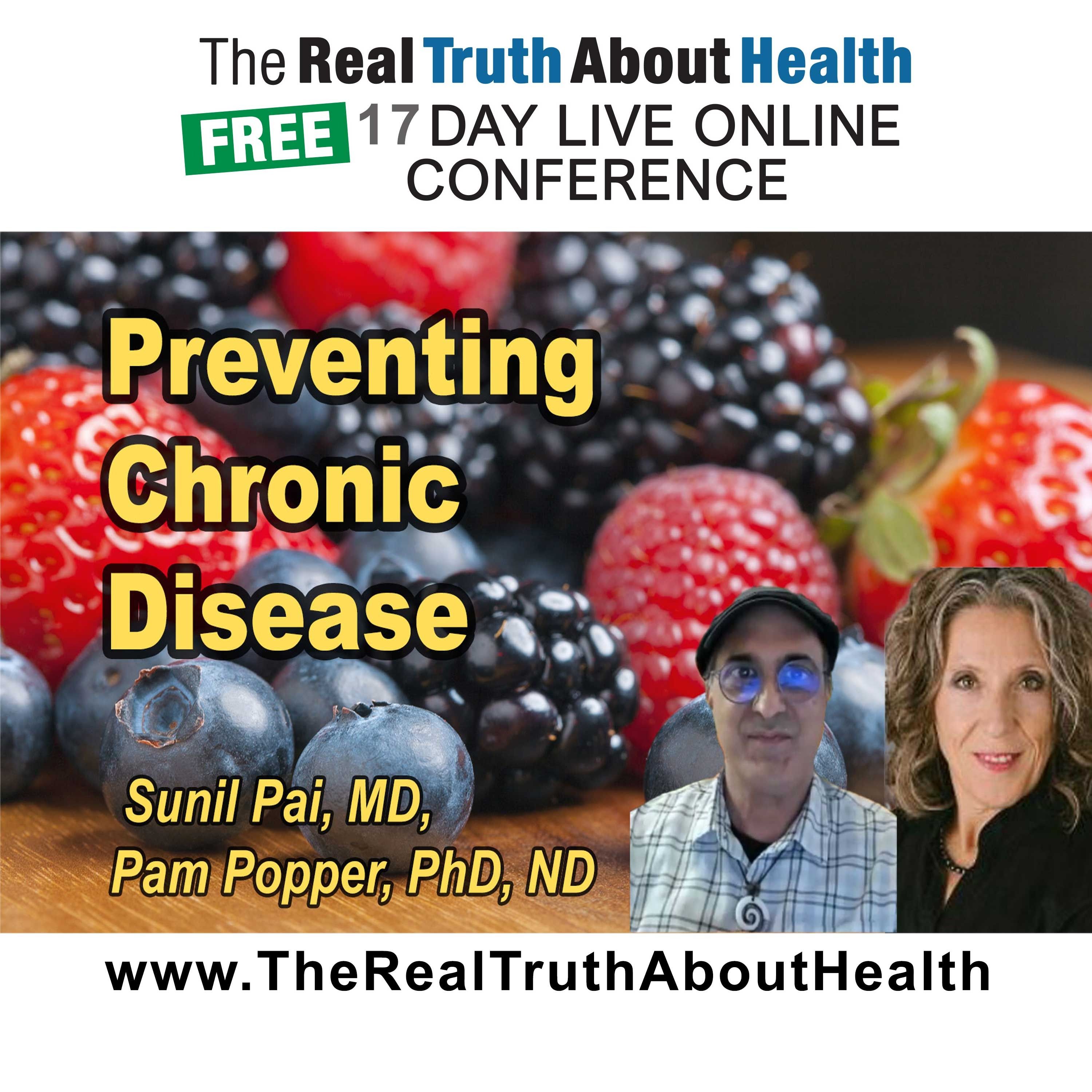
The Lifestyle Blueprint to Prevent Chronic Disease
About this episode
Get every episode summarized
Each time The Real Truth About Health Free 17 Day Live Online Conference Podcast publishes, we email you a written briefing from the transcript — the topics, who appeared, and any specific claims, with the ad reads skipped.
Email me new episodesFree for 3 shows. No card needed.
Hosts & guests
 Gerald PosnerHost
- JJohn McDougall M.D.Host
- WWilliam Li M.D.Host
- KKeith Block M.D.Host
- PPam Popper Ph.D.Host
- AAnna Maria Clement Ph.D.Host
- VVandana Shiva Ph.D.Host
- JJoel Kahn M.D.Host
- LLloyd BurrellHost
- JJeffrey SmithHost
- MMichael Klaper M.D.Host
- RRalph MossHost
- DDavid Katz M.D.Host
- SStephanie Seneff Ph.D.Host
- BBrenda Davis R.D.Host
- MMark SloanHost
- IIan Harris M.D.Host
- NNeil Barnard M.D.Host
- WWill Tuttle Ph.D.Host
- GGabriel Cousens M.D.Host
- BBrian Clement Ph.D.Host
 Marianne WilliamsonHost
- AAly Cohen M.D.Host
- MMilton Mills M.D.Host
- TTheodora ScaratoHost
- JJulieanna Hever M.S.Host
- HHope BohanecHost
- KKim Williams M.D.Host
- SSunil Pai M.D.Host
- CCaldwell Esselstyn M.D.Host
- JJoel Fuhrman M.D.Host
- CColin Campbell Ph.D.Host
- DDale Bredesen M.D.Host
- DDavid WolfeHost
- MMelanie Joy Ph.D.Host
- BBaxter Montgomery M.D.Host
- MMichelle Perro M.D.Host
- MMichael Greger M.D.Host
Transcript ready
176 searchable segments. Every word is indexed and playable.
Full transcript
The Real Truth About Health Free 17 Day Live Online Conference Podcast — The Lifestyle Blueprint to Prevent Chronic Disease. Machine-transcribed; use the interactive transcript above to jump the player to any line.
But a lot of times people don't understand the power of fit, right, because the doctors are usually in general. I mean, most of my cancer patients, they have, they go to the oncologist and the oncologist or any specialist and they'll say, whatever you want, we treat you and then if it comes back, we treat you again, right? Like there's no, there's a disconnect, I think, in just the conventional medical world in general of the understanding of like, no, patients can empower themselves with education with knowledge and with changing of their diet and lifestyle to improve and reduce their risk significantly, right? Because most of the conditions that we see in America, that is our lifestyle diseases, heart disease, diabetes, you know, blood pressure or obesity, these are all this lifestyle diseases. Now, it is easier said than done, right? And it's a challenge because this is why we're stuck in this realm of where we're at. So we have to take our patients and then work on all the epigenetic steps and it doesn't have to, but you don't have to be a perfectionist and one and I agree with Pam on that. Like a lot of people want to be hypervigilant and one thing like I got people like who crush the diet, they don't exercise or they run all day long and they eat, they, they, you
know, the weekend warriors kind of concept and good and bad and a variety of aspects. But it has to be a delicate balance. But for me, it's always putting it to the test because what we think and even as a physician or even what the science may say, I might say that you must be eating more of these foods, but if they come back and they have a sensitivity that's causing inflammation or they're micro, they're, or they think they're eating enough and they hear their diet diary, we really need to test that. And the reason why I do that because it really can give us some really like solid data on then shifting saying, hey, you know what, you think you're eating enough, but you're not. You need to eat more of these colorful compounds, you need to eat more of these antioxidant rich foods or, or maybe you're, you know, a lot of places patients that I see who are plant based, they think they're getting 30 grams or more fiber and when they actually count it out, they're not, right? Because a lot of people think like, oh, I tons of veggies, I, you know, even my, my, my middle of the road, Mediterranean diet patients or people who eat clean, oh, yeah, I'm eating my grass. Oh, I, I usually get that much. But when they actually calculate it out, they're not because the average person, if they're
still eating a lot of animal protein or even on a regular basis, there's no way that they're really getting to that 35 grams or more a day for supporting microbiome function and overall health. So there's a little bit of a miss, so if I can push them to say, hey, well, hey, if you still want this, then you need to maximize eating this as well. And as long as everything else is balanced, and again, all their laboratory parameters are great. That's great. Like that's fine for them. I've reduced their risk. They have lowered their overall risk. It's not just treating symptoms with medications or doing green pharmacy where people also treat symptoms with the natural therapies. Just to be more specific though, if someone said, tell me the exact things I should do, not how to think. What do you tell them? They're saying, like, what should we do? If we don't want cancer, Alzheimer's, heart disease, chronic kidney disease, and we're going to have the best attitude possible, specifically and succinctly as possible, what you've been dealing with cancer for a long time, what should we do?
What, you know, should we drink eight glasses of water a day? Should we eat a whole food plant-based diet? Should we exercise? Should we take sores? Should we do colonics? Should we do hyperbaric oxygen chambers? Like, what are the most effective things to prevent us? I understand we can't guarantee it, but from all your experience, is there specific things you would say are the number one, two, three, four, five things that you'd recommend someone does to minimize their risk of getting a disease? Well, that was good. Go ahead. Go ahead, go ahead. Well, I'll go back to the list that I gave before, and then we have a hundred and thirty-eight page textbook, and we teach a 12-hour course that our people take. I think you bring up an interesting point, which is that everybody wants a couple bullet points that will tell them what to do. And the first thing is, I'm clear when people come to Wellness Forum. I don't want you to do things that I tell you to do. I think the process is what's important, because if you don't know how to read the medical literature, and you do what I say, then you hear somebody else at this conference who
says something else, and I think that sounds good, that's what they're doing. They're going from this to that, to this to that, I'll try this, I'll do this, I'll do that. They have no idea what they're doing, and by the way, that's why they're in the medical mill, and that's why they get hit by the hurt by the medical mill, is doing what people tell them to do. The only way healthcare gets better in this country, one person at a time, is one person at a time learning enough to make decisions and making them based on intellect and logic, not because Pam Popper sure is convincing. I want to do whatever she tells me to do, until somebody sounds more convincing, and then they go off on that tangent. If people bought houses and cars the way they consume information about health, everybody would be homeless and walking to work, because people would take advantage of them not paying attention. It's only in healthcare that people have been to all reason and say, tell me what to do. I'm not trying to disagree with you that people need specifics, but they really need more than what we can put in bullet points. They need to be educated how to do it, and then they have to monitor themselves.
In other words, we have a food pyramid, we have a textbook, we have a 12-hour course, we take you through all this, then you have to keep food journals, and you have to keep an exercise journal and monitor yourself to see how you're doing, because I'm not moving into your house with you to get you up every morning and make sure you do the right things. I also think, and I think this is where Dr. Pie and I have a little bit of a great deal of agreement, is that it's important to teach people to have a normal relationship with diet and lifestyle. In other words, your whole life doesn't revolve around all the weeds. We call it the weeds. How much of this and how much of that, and did I have enough celery last week and all this kind of stuff? It revolves around adopting a pattern of living that becomes very natural, and that sustains life, right? The reason for doing it is so you can live your life, not so that you can focus on how many of this and that, and how much celery and carrots I ate last week, because that's really a myopic vision of health that doesn't leave a lot of mental space to read and enjoy
life and go on trips and have dinner with your friends and celebrate birthdays and do the things that we're here to do, which involve diet and lifestyle, but are not limited to that. I hope that made some sense. Yes. What I would recommend, if you want bullet points, so if you read my book and inflammation nation, you know, I have 10 steps, right? So I do that. If people want to be like, I want steps to go, like step one, step two, step three. But the idea is like, you go to be shifting more towards a plant-based diet, right? You have to be, these are all the epigenetic things, you have to look at environmental toxicities. When we look at inflammation, we look at inflammation not only from the food, but we're looking at like, you know, emotional inflammation, physical inflammation, even spiritual financial inflammation. I mean, not to show anything, but like right now, this is kind of what America is happening right now, right? Like there's a lot of stress going on. Stress is itself is an inflammatory trigger and reaction that occurs in the body. So when we look at like getting the person's inflammation down, their immune system stronger,
getting their microbiome kind of restored, looking at exercise, stress reduction, heart rate, variability, community relationships, and having, you know, sympathy and with the love, it's like 10 steps, right? Like how do we, you know, reduce certain things like cutting down the alcohol, cutting down, cutting off the cigarette? These are things that, you know, have become so commonplace now that are kind of creeping back into society due to a lot of stress, I would say. But again, it's not being perfect in any of these things. It's, in my opinion, and how I look at things is disease is the perfect storm of a lot of little failures or a lot of little upsets or a lot of what we call the stacking effects of inflammation. So if there's a threshold in your body, for example, say your joints, there's so much inflammation, this is normal wear and tear of life. But once it builds up and across that levy point, then you have joint pain, for example, right? And you're going to have fatigue and then you're going to have brain fog or you have other kind of dysfunctions. So it's a little bit of everything. And the way I look at it is you want to turn it all down as much as you can, like a sprinkler
system effect. We don't need to get a fire hose out and put out and call the fire truck to put out a kitchen fire. So we'll kind of destroy most of the kitchen. You want to have a little bit of a sprinkler effect and that's the best way to do it. You start turning it down. So when I have people read my book and they go start on step one, for example, which is moving towards a plant-based diet, they don't have to be completely plant-based before they go to number two, right? Like I agree with Pam, like we have to have people learn that it's steps, right? But it's not just like, well, what's the top three? I mean, I think even when we sometimes get these questions, it's so reductionist that people don't even think like, well, gosh, if that's easy, then why do we sell problems? Because you can still have problems. There's still 10,000 chemicals that we're going to get exposed to that we don't even know that we can't even test for. I mean, just last week they took out the clean water rack. How is that going to do for everybody in America, right? Terrible, right? So we have to look at, like we want a risk reduction of what we can. Let's drink some, you know, put our RO system if they're coming, you know, trying to be more, you know, as healthy organic as much as you can.
More episodes
More from The Real Truth About Health Free 17 Day Live Online Conference Podcast

Why the Right Supplements Can Boost Cancer Survival
The Real Truth About Health Free 17 Day Live Online Conference Podcast

Visceral Fat, Chronic Disease, and Dietary Root Causes
The Real Truth About Health Free 17 Day Live Online Conference Podcast

The Commercial Capture of Academic Research
The Real Truth About Health Free 17 Day Live Online Conference Podcast

21-4
The Real Truth About Health Free 17 Day Live Online Conference Podcast