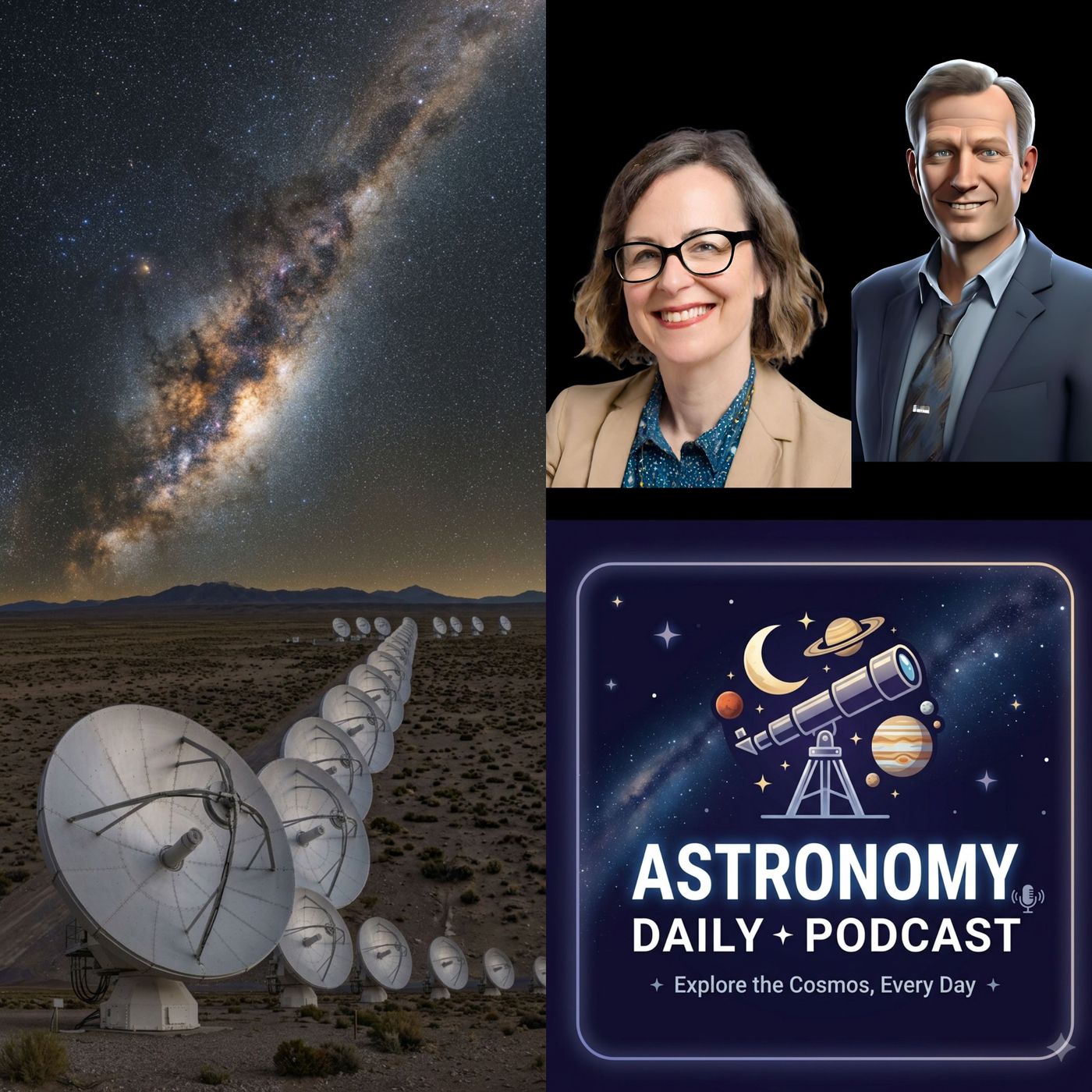
The Hydrogen Map: How a Radio Telescope Heard Half the Universe
About this episode
Links & sources · University of Manchester — Astronomers use MeerKAT to directly detect faint hydrogen signal from the distant Universe — https://www.manchester.ac.uk/about/news/astronomers-use-meerkat-to-directly-detect-faint-hydrogen-signal-from-the-distant-universe · The Astrophysical Journal Letters — Paul, Wolz, Santos, Chen et al. (paper DOI) — https://doi.org/10.3847/2041-8213/ae808f · American Astronomical Society — release listing — https://aas.org/node/730547 · Phys.org — MeerKAT directly detects faint hydrogen signal from the distant universe — https://phys.org/news/2026-09-meerkat-faint-hydrogen-distant-universe.html · Space.com — Scientists detect signals of hydrogen from billions of years ago — https://www.space.com/astronomy/galaxies/scientists-detect-signals-of-hydrogen-from-billions-of-years-ago-could-this-help-us-map-out-the-universe · Xinhua — MeerKAT in South Africa directly detects faint hydrogen signal from distant universe — https://english.news.cn/africa/20260905/3f6c7164a4404b0a9b79f879b1d31a59/c.html · SKA Observatory — the construction journey (SKA-Mid, Karoo; SKA-Low, Murchison) — https://www.skao.int/en/explore/construction-journey · NASA Science — Roman's planet imager has powered on (1 September 2026) — https://science.nasa.gov/blogs/roman/2026/09/01/nasa-romans-planet-imager-has-powered-on/ · NASA — NASA's dark universe-seeking Nancy Grace Roman Space Telescope launches — https://www.nasa.gov/news-release/nasas-dark-universe-seeking-nancy-grace-roman-space-telescope-launches/ · Next Spaceflight — Starship Flight 14 (NET 15 September 2026, Pad 2, Starbase) — https://nextspaceflight.com/launches/details/8346/ · Tesla Oracle — FCC filing points to Starship Flight 14 on 15 September; Booster 21 33-engine static fire — https://www.teslaoracle.com/2026/09/02/fcc-filing-reveals-starship-flight-14-launch-on-september-15-spacex-conducts-33-engine-static-fire-on-booster-21/ · Nature — Tidal tomography reveals a thermal anomaly beneath Mars's crustal dichotomy (27 August 2026) — https://www.nature.com/articles/s41586-026-10893-x · Phys.org — Thermal anomaly discovered below Mars' south pole — https://phys.org/news/2026-08-thermal-anomaly-mars-south-pole.html · ESA — Latest updates: BepiColombo's arrival at Mercury — https://www.esa.int/Science_Exploration/Space_Science/BepiColombo/Latest_updates_BepiColombo_s_arrival_at_Mercury · ESA — BepiColombo's Mercury arrival begins (full replay) — https://www.esa.int/ESA_Multimedia/Videos/2026/09/BepiColombo_s_Mercury_arrival_begins_-_full_replay · Brown University — LZ experiment sees surprising result in search for dark matter — https://www.brown.edu/news/2026-09-01/lz-dark-matter-results · The LZ Dark Matter Experiment — collaboration site — https://lz.lbl.gov/ · ARC Centre of Excellence for Dark Matter Particle Physics — Stawell Underground Physics Laboratory — https://www.centredarkmatter.org/supl · University of Central Florida — UCF researchers study a centaur transforming into a comet — https://www.ucf.edu/news/ucf-researchers-study-a-centaur-transforming-into-a-comet/ · Phys.org — Saturn encounter may have set distant centaur on path to becoming a comet — https://phys.org/news/2026-09-saturn-encounter-distant-centaur-path.html · Space.com — Scientists watch a comet being born 3 billion miles away — https://www.space.com/astronomy/comets/scientists-watch-a-comet-being-born-3-billion-miles-away · Star Walk — Astronomical events in September 2026 — https://starwalk.space/en/news/night-sky-tonight-september · EarthSky — Venus greatest brilliancy, 18 September 2026 (magnitude −4.8) — https://earthsky.org/astronomy-essentials/venus-brightest-greatest-brilliancy-greatest-illuminated-extent-2/ · EarthSky — Sun news: flares, CMEs and aurora updates — https://earthsky.org/sun/sun-news-activity-solar-flare-cme-aurora-updates/ · Space.com — Night sky September 2026: the best things to see this month — https://www.space.com/stargazing/what-to-see-night-sky-september-2026 Follow us: @AstroDailyPod · astronomydaily.io
Become a supporter of this podcast: https://www.spreaker.com/podcast/astronomy-daily-latest-space-news--5648921/support.
Sponsor Details:
Ensure your online privacy by using NordVPN. To get our special listener deal and save a lot of money, visit www.astronomydaily.io/nordvpn. You'll be glad you did!
Get the best secure and private email on the planet. Stop your Government, google and who knows who else spying on every email you write. Do what we did and use ProtonMail. They beleive in privacy and there are no ads in their business model...yet they still provide a free forever service. Check them out and get out special deal at www.astronomydaily.io/protonmail
Become a supporter of Astronomy Daily by joining our Supporters Club. Commercial free episodes daily are only a click way... Click Here
This episode includes AI-generated content.
Get every episode summarized
Each time Astronomy Daily: Space News Updates publishes, we email you a written briefing from the transcript — the topics, who appeared, and any specific claims, with the ad reads skipped.
Email me new episodesFree for 3 shows. No card needed.
Hosts & guests
Transcript ready
400 searchable segments. Every word is indexed and playable.
Full transcript
Astronomy Daily: Space News Updates — The Hydrogen Map: How a Radio Telescope Heard Half the Universe. Machine-transcribed; use the interactive transcript above to jump the player to any line.
If you've ever tried to hire someone in another country and immediately hit a wall of paperwork, compliance rules, and back and forth approvals, you know how fast that excitement can turn into a headache. That's exactly what Pebble is built to fix. Pebble is a global hiring platform that lets founders and HR leaders hire in over 185 countries in minutes, not months. Compliance isn't something you manage around with Pebble. It's built directly into the platform. A decade of expertise embedded into every workflow, so regulatory blind spots and costly mistakes don't slow you down. Contracts, payroll, benefits, it's all in one place, integrated with the tools your team already uses. And your new hire, onboarded by Monday. Pebble starts at $3.99 per month per employee, and right now there's a limited time offer just for podcast listeners that makes it even easier to get started. Go to highpebble.ai before it's gone. That's highpebl.ai, terms and conditions apply.
McDonald's is putting value back on the menu. Whether you're craving a Big Mac, McNuggets are sausage, egg, and cheese, McGrittle's, make it a meal, and save. Your favorite is now your wallet's favorite too. Extra value meals are back. Get a big something extra with a Big Mac or 10-piece McNuggets, fries, and a medium Coke all for just $9. Limited time only, promotion pricing may be lower than meal pricing. Hey everyone, welcome back to Astronomy Daily and it's Saturday. So you know what that means. The Weekend Raff, one brand new story, properly developed, and then we run back through the week's biggest news in case you missed any of it. It's Saturday, September 5th, 2026. I'm Anna, and this is Series 5, episode 186. And I'm Avery. Anna, today's fresh story is one I've been waiting years for somebody to pull off.
A radio telescope in the Caru Desert has heard hydrogen, not from one galaxy, from billions of them at once, four to five billion light years away, and it did it without any help from an optical telescope. Which sounds modest until you understand that this particular signal is buried under a foreground about 10,000 times brighter than it is. It's a technique people have been trying to make work for 15 years. This week, it worked. And it's a South African instrument that did it, with a strong Australian sequel coming. Then, the week that was, Roman opened its planet camera's eyes. Starship Flight 14 finally has a date on it. Mars turned out to be hotter underneath than anyone expected. Beppy Columbo let go of the ride that got it to Mercury. A dark matter detector recorded one flash it cannot explain. And brand new this week and genuinely lovely. Astronomers have watched a comet switch on. 3 billion miles away over five years in real time.
Plus the sky for the week ahead, both hemispheres, and it is a dark one in the good way. It's a big episode. Let's get into it. Right. Start me at the beginning. Who did what? A team led by Dr. Surab Paul. He's at the University of Manchester and the University of the Western Cape. Working with Laura Wolves at Jodrol Bank, Mario Santos at the Western Cape, and Zhao Ting Chen at Edinburgh. The paper is in the astrophysical journal letters, and Manchester put the release out on Tuesday. It has been rolling through the international wires all week. Xin Hua ran it yesterday. And the instrument is Mirkat. Mirkat. 64 radio dishes standing in the caroo in South Africa's northern Cape. One of the quietest patches of radio sky on earth, which turns out to be the whole point. And Mirkat is not just a fine telescope in its own right. It's a precursor. It gets absorbed into SKA mid, the mid-frequency half of the square kilometer array.
Okay. Now tell me what they detected because hydrogen on its own doesn't sound like news. It isn't on its own. Hydrogen is the most common thing in the universe. The news is how they detected it, and at what distance? Neutral hydrogen, a lone proton with a lone electron, emits at a very specific radio wavelength, 21 centimeters. The famous 21 centimeter line. The famous one. And it's famous because it's reliable. Hydrogen doesn't care whether it's in a bright galaxy or a dim one. If it's neutral, it glows at 21 centimeters. Which makes it, in principle, the perfect tracer for where matter actually is. In principle. In principle. In practice, the emission from any single distant galaxy is far too faint to pick out. So about 15 years ago, people proposed a workaround called intensity mapping. Stop trying to resolve galaxies. Point the telescope at a big patch of sky.
Deliberately blur it and measure the total 21 centimeter glow coming from that whole volume. So instead of a photograph of individual galaxies, you get what? A heat map? That's exactly the right image. A low resolution map of where the hydrogen is piled up and where it's thin. And because hydrogen sits inside galaxies and galaxies sit inside the cosmic web, that blurry map traces the large scale structure of the universe. Cheaply and over enormous volumes. Why does cheap matter? We have galaxy surveys. We do, and they're superb, but they're expensive in telescope time. To map structure optically, you have to identify each galaxy and measure its distance one at a time. Millions of them. Intensity mapping says, I don't need to know which galaxy is which. I only need to know how much hydrogen is in this cube of space versus that one. And if you can do that out to high redshift, you can measure how the universe has expanded.
Which is the dark energy question. So why hasn't anyone done it? Because of the foregrounds, and this is the part I want to be precise about, the 21 centimeter signal from those distant galaxies is extraordinarily faint. Sitting on top of it is radio emission from our own Milky Way, synchrotron radiation, electron spiraling in the galaxy's magnetic field. And that is roughly four orders of magnitude brighter than the thing you're trying to measure. 10,000 times. 10,000 times give or take. Then add human radio interference, satellites, aircraft, mobile networks, and then add the telescope's own quirks, which imprint themselves on the data in ways that look deceptively like signal. Paul's line in the release is the honest one. The signal is extremely faint and difficult to isolate from foreground emission. Human-made radio frequency interference and instrumental effects. So how have people got around that until now? By cheating slightly, and I mean that admiringly.
You take your radio map and you cross-correlate it with an optical galaxy survey of the same patch of sky. You already know where the galaxies are from the optical data. So you ask, does the radio map get brighter in the places the optical survey says galaxies live? And if it does, that's the hydrogen. That's the hydrogen. It's a legitimate detection, and Murecat and its predecessors have done it before. But it has a built-in limit. The foreground contamination and your instrumental noise don't know where the optical galaxies are, so they average away in the cross-correlation, which is wonderful for confidence and useless if what you actually want is a standalone survey. You're always tethered to an optical telescope. And this week they cut the tether. This week they cut the tether. This is the 21 centimeter signal measured in the radio data alone. No optical survey propping it up.
The foregrounds had to be genuinely removed rather than statistically dodged. And what's left is a real measurement of the hydrogen distribution. How much observing time did that take? Here's the part that made me sit up. About 96 hours. Four days of telescope time. That's nothing. And it gets better. Santos' quote is my favorite line in the whole release. It is particularly remarkable that the data used in this study were taken in 2018, when Murecat had only just started science operations. Wait, the data is eight years old? The data is eight years old. This is not a new observing campaign. This is a brand new analysis of some of the first science data Murecat ever took. And the advance is in the method. The foreground removal, the handling of the instruments' own systematics, the pipeline. The telescope was always capable. We weren't. How far back are we actually looking?
The emission has been traveling four to five billion years. So we're seeing the hydrogen as it was when the universe was around nine billion years old. Roughly a third of its present age ago. And well into the era when dark energy had taken over and the expansion was accelerating. That is exactly the epoch you want if you're trying to test how dark energy behaves over time. And the structures they're mapping are big. Enormous. The scales involved are comparable to the gap between us and Andromeda. Millions of light years, which is precisely the size range where the cosmic web's pattern lives. All right, Southern hemisphere angle because I know there is one and I know you're saving it. I am. And it's not a footnote. It's the entire future of this field. The square kilometer array observatory is being built in two halves, both of them in the south. SKA mid is going up in the caroo alongside and incorporating Murecat itself.
SKA low is going up at Inura Manna, Ilgari, Bundara. The CSIRO, Merchuson Radio Astronomy Observatory in Western Australia. On Wajari Yamaji country. So this techniques proving ground and its future home are both in the Southern hemisphere. Both. And that's not an accident of politics. It's radio quietness and its geography. You cannot do this from a populated continent. The signal is too faint. You need somewhere with legally protected radio silence. And both the caroo and the Merchuson have exactly that. Wolz's line is the forward looking one. Murecat continues to open new windows for cosmology. And the point of a precursor is that everything you learn on it, you carry across. So what does the SKA do with a working version of this? Surveys of a size that simply aren't available any other way. If 96 hours on 64 dishes gets you a detection, then thousands of hours on an array
with vastly more collecting area gets you a map. A three-dimensional hydrogen map running across billions of years of cosmic time, measuring the expansion history directly. That's a dark energy experiment done with radio waves from the southern half of the planet. And the honest caveat? Because you always have one. Two. First, this is a detection of the signal, not yet a precision cosmological measurement. The air bars are wide and turning this into competitive constraints on dark energy is a longer road. Second, foreground removal is the kind of problem that has embarrassed radio astronomy before. The 21 centimeter cosmology field has had claimed detections walked back. The reason this one is being taken seriously is the cross-correlation groundwork underneath it. They had already shown they could find the signal the safe way before they went looking for it the hard way. Which is the right order to do things in? It's exactly the right order, and it's why Paul's summary is the sentence to take away.
Detecting it directly with Miracat shows that this technique is becoming a practical tool for cosmology. Not a promising idea anymore. A tool. This summer, don't squeeze in, spread out, find homes big enough for your whole guest list on Verbo. That's vacation rentals done right. Look your stay now. Kitchen and bathroom professionals know what goes behind the tile matters. That's why trade pros trust fiber cement, party backer board to keep tile firmly in place, resist cracking, and help block moisture. Chosen in over 40 million kitchens and bathrooms, party backer board, what the best build on. Shop now at participating Home Depot, Lowe's, and floor into core stores. For more information, visit jameshardy.com slashhardybacker. Shop the Sherwin Williams Labor Day Sale and get 35% off paints and stains August 28th through September 9th.
Whether you're refreshing your interior or exterior, we've got the colors to bring your vision to life. And with delivery, getting everything to your door is easier than ever. Shop online to have it delivered or visit your neighborhood Sherwin Williams store. Click the banner to learn more. Retail sales only. Some exclusions apply. See store for details delivery available on qualifying orders. Right Monday to Friday, the six stories that mattered and three of them have moved since we covered them. We start where we ended last weekend. The Nancy Grace Roman Space Telescope launched on Sunday, August 30th on a Falcon Heavy out of launch complex 39A. And it was clean. No anomalies, straight up, right on the money. We led Monday's episode with it and that closed in arc we'd been building since the 25th of August. But it hasn't stopped being a story. It hasn't. On Tuesday, NASA powered on the Roman coronavirus instrument for the first time.
It came alive between 727 and 822 in the morning, Eastern time. That's the technology demonstration that blocks the light of a star so you can photograph the planets around it. Which is the hard part? Observedly hard. You're trying to see something a billion times fainter than the things sitting right next to it. The coronagraph does it with masks, sensors, and mirrors that flex themselves in real time to cancel out scattered starlight. And what it's after is a class of planet we've barely photographed. Worlds that are older, colder, and in closer orbits than the hot young super-dupaters that direct imaging has managed so far. How long before it produces anything? Months. It goes into a long calibration campaign. And it's observing is spread across roughly three months of time inside the missions first year and a half. So don't expect pictures soon. But the instrument is awake and that's the milestone. On Tuesday, we led on Starship Flight 14.
And the news then was that booster 21 had cleared its 33 engine static fire and ship 41 static fire was already done. What we could not give you was a date. And now there's one. There's one. With a caveat I want to put up front. An FCC filing points to launch no earlier than September 15. And the launch trackers have moved to that date. SpaceX itself has not stood up and confirmed it. So, net the 15th from pad 2 at starbase and treat it as a strong indication rather than a promise. And this is the big one. This is the big one on two counts. It's build as the first genuinely orbital flight of Starship. Previous test flights have flown trajectories that deliberately stopped short of orbit so the vehicle came down regardless. And it carries the first ever attempt to catch the ship itself. Not the booster, the upper stage, back at the tower into the arms.
They've caught boosters repeatedly now. They have and it stopped being astonishing faster than it should have. But the ship is a different animal. It comes back from orbital velocity through the worst of the heating and it has to arrive at a precise point with enough control authority left to be grabbed. If that works on the first try it will be one of the more remarkable things this vehicle has done. And if it doesn't? Then it's a test flight. And that's what test flights are for. 10 days out, weather and paperwork permitting. Wednesday's lead was the one I keep thinking about. A paper in nature, published on August 27th, led by burn and colleagues, built out of years of accumulated radio tracking of three NASA spacecraft, Mars Global Surveyor, Mars Odyssey, and the Mars Reconnaissance Orbiter. And the technique was the clever bit. Title tomography. The sun and foboce flex Mars very slightly. And how much a planet flexes depends on how stiff it is inside.
So if you track your orbiters precisely enough, for long enough, the wobble in their orbits tells you about the rigidity of the rock beneath them. It's seismology without a seismometer. And what did it find? That the interior beneath the southern highlands is somewhere between 200 and 400 degrees Celsius hotter than the north and partially molten. Which is not a small asymmetry. That's one planet with two different interiors. Does that explain anything we've been stuck on? Potentially three things at once, which is why it's such a satisfying result. The crustal dichotomy, why the southern highlands sit kilometers above the northern lowlands. The crustal magnetic anomalies, which are overwhelmingly a southern phenomenon. And a puzzle from insight, where seismic waves were damped more than the models predicted. A hotter, partly molten south is a candidate answer to all three. And what caused it? Open. A giant impact early on, lopsided convection in the mantle, or a layer down there trapping heat.
The paper doesn't pick one, and I respect that. Moving on to Thursday, and one of those quiet irreversible moments. Beppy Colombo, the joint European and Japanese mission to Mercury, separated from its Mercury transfer module on Wednesday the third. Eight years to get to that point. Eight years and nine planetary flybys, using gravity to shed speed, because falling toward the sun is the easy part, and arriving slowly enough to be captured is the hard part. The transfer module is the ion propulsion bus that did all that work, including working around a thruster power fault that forced the arrival to be redesigned. And once you let it go, you don't get it back. So what's the timeline now? Gravity capture at Mercury on November 21st. Then the two orbiters go their separate ways. Japan's Mio is released around the 9th or 10th of December. Europe's Mercury planetary orbiter reaches its final science orbit on the 10th of March next year,
and routine science begins on the 6th of April. So this is the start of the arrival, not the end of the cruise. Precisely, and there are follow-up beats all the way through. This is a story we'll be coming back to for the next seven months. And yesterday, the story with the biggest headlines and the smallest number attached to it. The LZ collaboration, Lux Zeppelin, 10 tons of liquid xenon, a mile under South Dakota, reported a single nuclear recoil event they cannot explain. In a place where dark matter could plausibly show up. In exactly that place, with essentially zero expected background, in 220 days of data from 2023 and 2024. It was announced at TEV Particle Astrophysics in Chiba. Brown University released it on Tuesday, and the paper has gone to physical review letters. And the number? 2.6 Sigma Globally, 3.4 locally.
Physics call something a discovery at 5. So this is an anomaly. And to LZ's enormous credit, they have published it as an anomaly. Rick Gates' line was that with only one event, they are not claiming to have seen dark matter. If people take one thing from yesterday's episode. Let it be the difference between local and global significance. Local asks how surprising the event is at one specific mass and energy. Global asks how surprising it is that you found something odd anywhere in the whole range you searched. Account for the size of the haystack and the surprise shrinks. That gap is the reason the honest number is 2.6. And the southern angle, briefly, because it's a good one. CUPL, the Stauwell Underground Physics Laboratory. A kilometer down a working gold mine in Western Victoria. And the only underground physics lab in the southern hemisphere. Its first experiment, Sabre South, installs late this year to test a 20-year-old Italian claim from reversed seasons,
which is a genuinely elegant piece of experimental design. And to finish, something new that we didn't get to during the week, and it's my favorite thing on the list. Astronomers have watched a comet switch on. Watched present tense? Over five years. The object is 450 p-slash loneos. It's a centaur, and centars are the in-between population. I see bodies out among the giant planets that used to live in the kuiper belt and are on their way over enormous time scales to becoming the short period comets we recognize. So they're comets in waiting? Comets in waiting, and normally we catch them at one end or the other. Catching one mid-transition is rare. The work is out of the University of Central Florida, Charles Chambo leading with Maria Womack, Jan Fernandez, and Aaron Beck. And it's been accepted by the Planetary Science Journal, released on Tuesday.
How far out is it? Over three billion miles, and using the James Webb Space Telescope, together with Gemini North, they detected carbon dioxide gas, icy dust, and thermal activity around it, and a coma that grows visibly across observations from 2019 to 2024. So what's turning it on? It's nowhere near the sun. It doesn't need to be, and this is the lovely bit of physics. Out in the cold, water ice freezes into an amorphous form, disordered, glassy, with other gases trapped inside the structure. Warm it gently, and it rearranges into proper crystalline ice. That transition releases the trapped gas, carbon dioxide in this case, and that's what's blowing the coma out. And they can see that the ice has changed? They found crystalline water ice in the coma, which is the fingerprint, and a Saturn encounter appears to be what nudged the object onto the path
that started warming it in the first place. So you get the whole causal chain, a gravitational nudge from a giant planet, a slow warming, a phase change in the ice, and a comet is born. Three billion miles away, and we watched it happen. We watched it happen. Let's move on to our Skywatch segment, and this is a good week to actually get outside, because the moon is getting out of the way. Last quarter was yesterday. Last quarter yesterday, and new moon on Friday the 11th. So every night this week, the moon rises later and thinner, and the evening sky is dark. If you have been putting off looking at something faint, this is the week. Southern hemisphere first. Southern hemisphere first, because September is our last really good month for it. From Sydney, the sun sets just before a quarter to six. And once it's properly dark, the center of the Milky Way is almost directly overhead. Sagittarius and Scorpius at the zenith.
That means you're looking through the least atmosphere possible at the richest part of our galaxy. What do people actually point at? Find the teapot of Sagittarius with the naked eye, and follow the steam up out of the spout. That's the Galactic Center. Binoculars turn it into star clouds and dark dust lanes, and the lagoon nebula and a whole run of globular clusters are sitting right there. Then, later in the evening, the Magellanic Clouds climb up in the southeast. And 47 Tukane is arguably the finest globular cluster in the sky. Planets down here. Venus low in the west after sunset. Brilliant, unmistakable, and building toward greatest brilliancy on the 18th at magnitude minus 4.8. Saturn is up most of the night in Aquarius, heading for opposition on October 4th. And from the south, it rides far higher than it does for northern observers. And Jupiter is the pre-don showpiece in the east. Anything to circle in the diary?
Tomorrow morning, Sunday the 6th, a thin, waning, crescent moon sits a few degrees from Mars in the pre-don sky. A nice one for a phone camera. Monday, the moon moves on to Pollix. And North America gets the proper event. Tuesday the 8th, the moon occults Jupiter. The planet passes behind the lunar disc. The footprint covers Canada, Greenland, the United States, Eastern Russia, and the North Pacific. And for much of Eastern North America, it happens after sunrise, in broad daylight. Daylight. Daylight. And that brings the standing reminder, which applies directly here. If you are observing anywhere near the sun, hunting Jupiter in a bright sky, or looking at the sunspots I'm about to mention, any filter you use for direct solar viewing must be certified to the ISO 12312-2 standard. Not sun glasses, not welding glass of unknown grade, not smoked glass, not a phone screen.
ISO 12312-2, and check the certification is genuine. Sweeping binoculars or a telescope across a daylight sky is exactly how people injure themselves permanently. And it takes a fraction of a second. Meteors. The September Epsilon Perseid's peak on Wednesday the 9th, a modest shower, about 8 an hour at best. And it's a Northern Hemisphere event with the radiant imperseas. But it falls two nights before New Moon. So if you're up North and you're out anyway, conditions are as good as that shower ever gets. And the sun itself? Bizzier than last weekend. Active Region 4524 has come back around the limb and fired an M1.2 flare at 745 universal time yesterday, with a brief radio blackout. Region 4523 is growing and throwing sea class flares. Nothing is aimed squarely at us. The strongest eruption went well away from Earth. Aurora chances?
Honest answer. Quiet tonight. Possibly unsettled Sunday into Monday. KP3 to 4 at best. That's a high latitude show only. Tasmania and Southern New Zealand down here. Scotland and Alaska up there. Watch the space weather feeds rather than the headlines. And one for Northern binoculars. The double cluster imperseas, while the Moon's away. Naked eye, it's a smudge. In binoculars, it's two open clusters side by side in one field. And it's one of the best sites in the sky. And that's the weekend wrap for Saturday, September 5th. A radio telescope in the Kuru has mapped hydrogen across 4 to 5 billion light years using nothing but radio waves. And proved out the technique the square kilometer array will use to measure dark energy from the Southern hemisphere. Romans' corona graph is awake. Starship Flight 14 is penciled in for the 15th, with the first attempt to catch a ship.
Mars is hotter underneath its southern half than anyone expected. Beppy Colombo has let go of its transfer module and is falling toward Mercury. A xenon detector under South Dakota has one flash it can't explain and is being admirably careful about it. And a centaur, 3 billion miles away, has spent five years quietly turning into a comet while we watched. Full show notes, links to every primary source and the whole back catalog are at astronomydaily.us. You'll find us on x, instagram and tiktok at astrodailypod. And if you've got a question or a correction, we want it. There's a contact form on the website. If today's episode was useful, the single most helpful thing you can do is send it to one person who'd enjoy it. We're back Monday with the regular weekday format. Until then, the moon's out of the way all week. Get outside. Clear skies. Clear skies. Clear skies. The sun may take, the star is the toll.
The star is the toll. The star is the toll. The star is the toll. Kitchen and bathroom professionals know what goes behind the tile matters. That's why TradePros trust Fiber-Sement Party Backer Board to keep tile firmly in place, resist cracking, and help block moisture. Chosen in over 40 million Kitchen's and bathrooms, Party Backer Board, what the best build on. Shop now at participating Home Depot, Lowe's, and floor into core stores. For more information, visit jameshardy.com slashhardybacker.
More episodes
More from Astronomy Daily: Space News Updates

A Hundred and Nine Flashes
Astronomy Daily: Space News Updates

The Smallest Things Remember
Astronomy Daily: Space News Updates

The Moon in Five Hours
Astronomy Daily: Space News Updates

Europe Launches From Europe — And Two White Dwarfs Six Minutes Apart
Astronomy Daily: Space News Updates