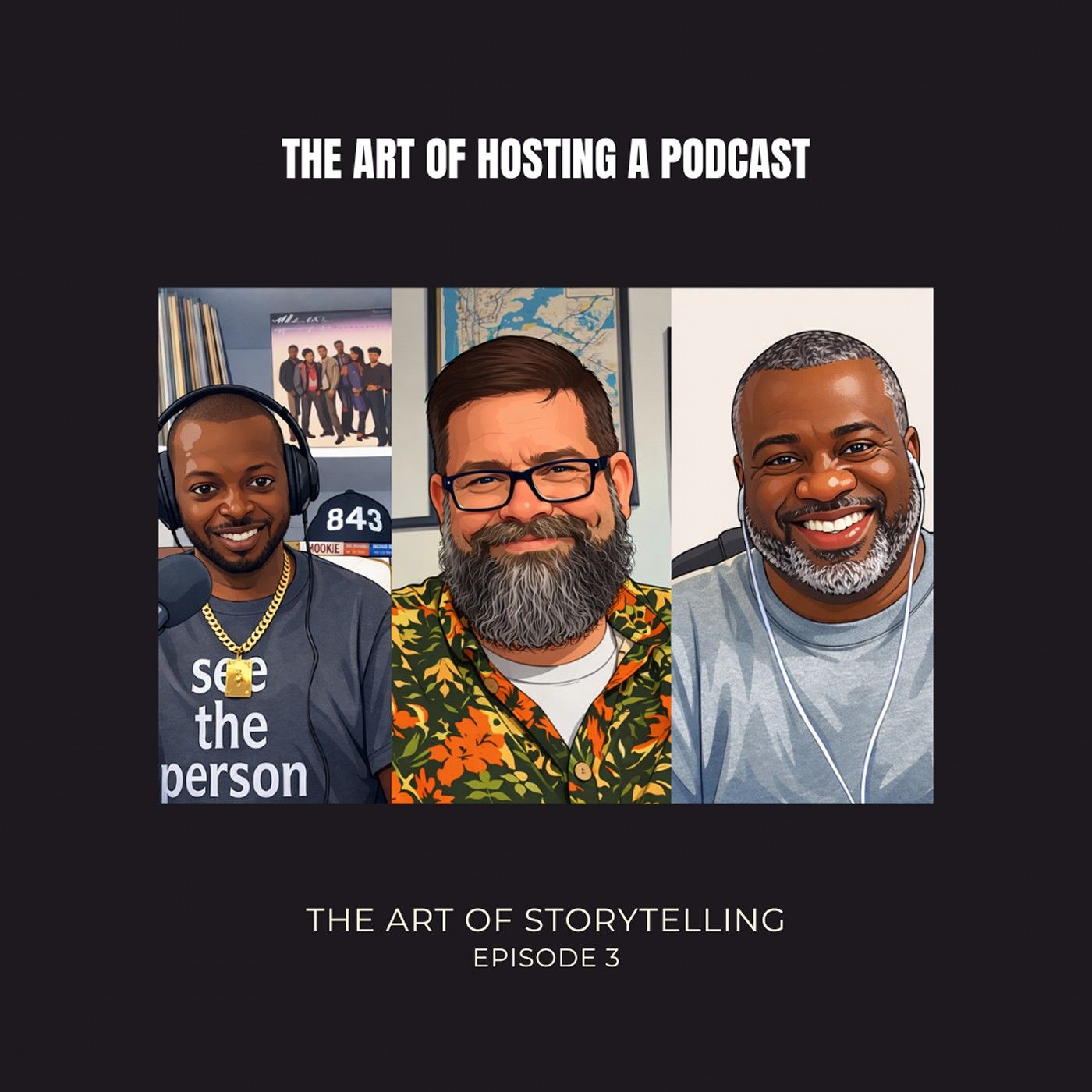
About this episode
The conversation covers the importance of preparation, active listening, and knowing when to guide the discussion versus when to get out of the way and let a guest shine. The trio also digs into hosting styles, building chemistry, handling co-host dynamics, managing nerves, and the difference between interviewing, presenting, and carrying a full show. Along the way, they share real-world lessons from radio, podcasting, live interviews, and media production.
They also discuss how hosts grow over time—working through imposter syndrome, learning to listen back, developing a voice, building a persona behind the microphone, and understanding the responsibility that comes with leading a conversation. Whether you’re launching your first podcast, improving your interview skills, or trying to find the right voice for your brand, this episode offers practical insight into podcast hosting, storytelling, and audience connection.
If you want to become a better podcast host, ask stronger questions, and create more engaging conversations, this episode is a must-listen.
Find more episodes and shows at pushplaypods.com
Learn more from Kin Lane at apievangelist.com
Get every episode summarized
Each time The Fourcast Media Podcast Network publishes, we email you a written briefing from the transcript — the topics, who appeared, and any specific claims, with the ad reads skipped.
Email me new episodesFree for 3 shows. No card needed.
Transcript ready
461 searchable segments. Every word is indexed and playable.
Full transcript
The Fourcast Media Podcast Network — The Art of Hosting a Podcast. Machine-transcribed; use the interactive transcript above to jump the player to any line.
I'll come back up pretty soon. At Amika Insurance, we know you'll always find ways to look out for the people you love. And with Amika Life Insurance, we'll help build a plan to make sure you always can. We're here to help protect the life you've built. Really? Oh, no. Amika. Empathy is our best policy. Visit Amika.com and get a quote today. I'm here with SpinQuest, where you can play and win from the comfort of your own home with hundreds of slot games and all of the table games you love with real cash prizes. Right now, $30 coin packs are on sale for $10 for new users. It's all at SpinQuest.com. That's S-P-I-N-H-U-E-S-T dot com. SpinQuest is a free to play social casino. Appoidware prohibited. Visit SpinQuest.com for more details.
Ladies and gentlemen, welcome to another edition of the Art of Storytelling. I'm LaTroy Gardner. Join once again with our brain trust, the Mario Washington and the API evangelist Ken Lane, where we continue to explore the Art of Storytelling in podcasting this week. We're going to focus on the mouthpiece, the person that's front and center, the host. So fellas, just tell us the art of conversation. Just walk us through, because you both hosted shows. Just tell us about the art of conversation. You could go in and start, Ken. All right. Bye. I was going to just stare you down and wave it out. Yeah. It's an interesting one. It's been an interesting journey as far as just in a world of video conferencing, but
then also the meetings, all the different workshops, digital things that I've conducted, but doing a podcast conversation and trying to get folks from different areas of walks of life to kind of share their story in a certain area. And I wouldn't say I was very good at it to begin with. I wouldn't say I'm great at it now. I've developed over time and I know what kind of works. I don't think it always reliably works to kind of get people to tell their story. I have bad days. I know other people have bad days. Sometimes you just never going to be able to get someone to tell a story, right? And my approach is really centered on them. Like I try to make it about who they are, what they're doing. I try to listen and not make it about what exactly I want. I usually try to go in with a line of questioning and series of questions and some research I've
done on the person. Hopefully, of conversation I've had with them prior to, but not always required. I actually like cold interviews too. Those are kind of fun. And just diving in and making it about them and listening, looking for cues, writing little notes as we're talking about what words they say, what's interesting, maybe what I know about them connecting the dots and trying to come up with something interesting. And then I would say a big part of what I try to do is make people feel at ease and feel more comfortable because I think some people get real nervous just doing podcasts in general, some for some reason see me in the space and get nervous or something talking around me. So you want to put them at ease and make them feel comfortable and try to center around them. But not all the time, sometimes, you know, depending on who it is, you know, it's good. You want to switch more towards interrogation mode and it depends on the topic, depends on the person, the industry, what you're looking to get out of it.
And so being a host for me is really about responding to who they are in the moment. And hopefully I have as much context as I can to respond intelligently, but it's an appropriate response. I think that there's two separate ways to look at it. I guess first talking about it from an interviewing standpoint, as Kim was just mentioning, one of the things that I see that really bothers me when I see interview programs is I hear the host talking way more than I hear the guest talking like somebody that I can point to that does this a lot is DJ Vlad, the popular host, but he talks all the time doing an interview whereas somebody like the art of dialogue, his channel, he will ask one question and
then like, he lets them go. But I think if you want to learn how to interview somebody go and look at old Larry King interviews and then and also about costus, they're excellent interviewing because, you know, they ask really good questions that are going to give a long thought out answer and then they ask really good follow up questions, which is also something that I think that as you mentioned, Ken, about like having a question is already pre-prepared and stuff like that. Sometimes that is a detriment to an interview because sometimes someone says something that is very interesting and then I'm waiting for the follow up question on what they just said, but the host is kind of following along with the pre-playing questions and that kind of kills the whole momentum of the interview to me. When it comes to just hosting a show in general, I think that the the one thing that I've always done and people who have worked with me will tell you that they've seen me do this because I do so much stuff outside of the show.
I used to stand up while I was hosting and I'd have a Red Bull and a cup of coffee and maybe even a soda. There was a lot of caffeine to get me through three to four hours because I felt like I needed to be quote unquote on the entire time that I was behind the microphone and caffeine would help me with that depending on the day. So like I think that what I like to say, get into character, you know, when when you get ready to hop on, like you kind of have to forget about everything that's happening in your life and just hop behind the mic and deliver what it is that the audience is expecting you to deliver on that particular day. And I think it's important to be flexible as a host. Like sometimes you're going to have a guest that, you know, is going through something in their personal lives and they're not in a good mood. So you're going to have to cheer them up. Sometimes, you know, they have people in the background that's got them, you know, a million
different places. So their mind is all over the place. You have to kind of get them to focus and zero in other times. You're talking to someone and they have a whole lot to say and you have to reel them in. And, you know, kind of cut them off a little bit to proceed with getting business handled. And sometimes there's people I don't have anything to say. It's like one or two word answers. And it's like, how can I pull information out of this person or at least like make as one of these podcasts, I listen to a wrestling podcast, make chicken salad out of chicken shit. So, like you just never know when when the red light comes on what you're going to get, but you just have to prepare for, you know, whatever comes across the screen. What's one trait that you look for in the great host Mario? You kind of already answered that, talking about Bob Costas and Larry King. But Ken, what do you look for?
The good questions. And I think that's, that's what I would like to hear from you too. It's like what goes into a good question. Is it, is it the preparation? Is it your overall knowledge of the space of the topic, the domain you're talking about? Is it waiting for that right moment? Like, I think all, you know, all those things feed into you. Like I just someone who can hit with a precise, just short, minimal response to a long winded something and then get at that, that next thing that Mario wanted to hear about, you know, that was like the follow up, like someone who can do that and remember that, you know, and, and, and hit hard with or hit precisely with it, I think is, is what I like the most. And I also think that like it's okay to have a host kind of derail your plan. I mean, not a guest kind of derail your plan because, you know, what, what, what the, what the guests is of saying may be more interesting than what you were planning on talking about in the first place.
I also like up, like, I know if somebody is prepared or not based on the questions that they ask, you know, typically if, if somebody has, has written a book or something like that and you're interviewing them, usually they will send you like some talking points so they can hit on, you know, stuff like that that you can work off of. But there's places where you can get interviews, like this magazine called the RTIR. I don't even know if it's still around, but I used to use it when I was a news talk. But, but it was always like bullet points that were always there that like so, so because you don't want to trip your guests up either with asking a question that they're not like totally prepared for as well. So preparation is definitely key. And, you know, and like I said, like you can always tell when there's a host that isn't quite prepared for, you know, the interview.
Yeah, and I think it's important to be able to blend all of that into one conversation. Like you can have the talking points, cover the business that they want to cover. But also use your instincts, like listening, listening to what they're saying and like this light bulb moment pops in your head and be like, let me ask this question. So I like to do that a lot. I also like to ask questions based on current events, like if there's something that's loosely related to, to, you know, what their expertise is in, then I want to get their opinion on it, because that can lead to lead us down another rabbit hole. And then, then I have ways of asking questions that will allow them to open up about their, about their personal lives, like what's something about you that people would find most surprising. And like they're open to talk about whatever I've heard someone say that I'm afraid of mascots. I've heard someone say that I am.
I've heard someone say like I watch HGTV religiously and I want to build a tiny home. So it's just like it allows you to go well beyond the predictability of, of the interview. So what, what does prep look like for you, let's try. And that was what I was going to get to next. So perfect. I think segue. Prep for me is if I have like a press kit from a guest, I will use that. And that will be the framework of the interview. But then if it's a musician, I'm going to listen to their music. I'm going to come up with questions based on the music. I'm going to dig into their background, dig in the who they're affiliated with, who, who their, who's their influences, things like that, figure out other questions. You know, where they're from.
And then we could have a conversation based on that. Maybe ask a few questions about their hometown or especially by visited their hometown. Something about that. But just the, just the well-rounded conversation. If I don't have that information, the process is, is probably like a two, three hour process of researching and really trying to figure out an angle. And that's the key. Finding an angle, finding a way to let, you know, put them in a position to shine. Because that's, that's my objective as a host is, how can I put this person in the best position, the score as a point guard. And once I find that angle, then it's smooth sailing, I feel. I will say that if you're, if you're bad at researching, make sure you have a decent producer that can kind of, you know, come up with the questions and the angles for you. Because nothing will make an interview worse than if you did not properly prepare and ask decent questions.
And then, you know, even, even if you have like an interview subject, that's, that's not as good at talking. It's, it's also like very helpful to have that person. You know, if you're, if you're, if you're prepared, you can kind of get more out of that person, even though they're not really good at talking and they could be a bad interview. So like preparation is, is everything. And I think that another thing that I want to add to preparation, because we talk about this a lot in prep for doing play by play for, for football, basketball games stuff. You should have more stuff than you can get. You know what I mean, like, and then you don't have to try to get to all of it. I know a guy, this guy named Dave Friedman, he used to be the voice of the Winter Beagles basketball. And he wrote really small. And he used one of those, those color pens that had like all the different colors and stuff.
And he had notes like really small about every single player on his sheet. And like it was amazing that he had all this research done. And he'd probably get to a quarter of it during a game, but he had it. You know what I mean? And I think that it's important to have it. But it's also important. You don't have to overkill trying to squeeze all of it in just because you did research. And that's very important. Like with stop looking, listen, a lot of times on one of the publicists I work with. He'll tell me you have 20 minutes with this, this artist. And I'll hop on more times or not. And the guest will be like, I love your work. I know you do quality interviews. You can have as much time as you want. Now, if I only prepared to ask them what was on the press sheet, then we would have 20 minute conversations. And we wouldn't get all of the gold, all of the great stuff. So I over prepare. Because you just never know if someone's going to hop on and be like, yeah, I know they told you 20 minutes.
Well, you can have as much time as you want. We can do this one hour if you want. And yeah, without the preparation, I would be lost in the weeds. Ken, like, do you prefer doing your own research? Oh, yeah. Oh, yeah. I would much rather wrap my head around what's going on. And I think, I don't know the, how you find out about someone, I think, I mean, a quick Google is one way a quick search on LinkedIn. But I think what you find on Google or what you don't find is interesting. I think there's, you know, people who don't have a large social media footprint. I don't always assume that they're like not good at the tech or they don't like they have other reasons. Why they don't, they don't have 38 different social media accounts and photo libraries and think, you know, is like they're probably being a lot more thoughtful of it. So how much information you have up there versus what you don't. And then which platforms you choose because there's a lot of, there's a lot of nuance in the technical details of what platforms.
I mean, you're still on Twitter full time, you know, I got a, we got to have a podcast and a conversation with you about why, you know, curious. If you're still on sub stack, you know, I get it. There's a network effect. There's, you know, but there's some, you know, so like there's, there's pros and cons to each of these platforms. And, you know, sub stack doesn't have an API. So you can't really automate things, but LinkedIn is all bots now. You're talking to human beings, you know, they're in a human being on the, on the platform. And so, you know, and so it's like what platforms people choose to use what they don't, whether they have their own calm is, is always telling. So there's a lot of signals in what you find or don't find. And so I like understanding those and I have my own biases and prejudices and, and beefs that I bring to the table when I do this research. And that's something I ain't going to get from a chat GPT prompt. So yeah. I totally agree with all of that. I think digging into the weeds of who a subject is, I think is super important.
And, you know, I like the, the Kobe Bryant approach to just being behind the microphone. And he said, and I'm paraphrasing the quote, but he always says something like, he would be nervous if he wasn't prepared. And, you know, I feel like you have to approach everything with with that, like, you know, doing the appropriate preparation. So you don't have to worry about being nervous because you know that you've done everything you've, you can do in order to get behind the microphone and have this conversation with this person. So I think that, you know, before, before people think about opening up a microphone, they have to always think about preparation. The amount of people in our industry that do not properly prepare is large. And it is noticeable to people like me. I don't know if like the general public can recognize it, but it is, it is very noticeable.
There's been, there's been people that you watch every day on television that I know don't prepare. I know they don't prepare and you hear it. And, and then like sometimes they get tripped up because a lot of people who have, especially on TV, you see that IFB. Well, somebody is talking to them in that IFB. And it's very like delicate skill to develop because, you know, like I've done it before, like having somebody talking in your hearing the entire time that you're talking is very difficult. But if that person is giving you some information, then you can like them make it sound like you're smart. Like anytime you watch a football game, anytime you watch a football game, they're talking into the play by playing a color guy's ear telling them who made a tackle and all this type of stuff. Anytime you hear it. So just know that they're not nearly as smart as you think they are. However, they definitely prepared a lot. They're still getting a little bit of help. So it's okay if you don't feel like you're at that level because you don't have all the tools that they're using to sound that way.
But you do have a tool to spend some time and research before you get in front of the microphone. Can we, can we shift the paradigm? I think a lot of what we're talking about. I was covered, I think his perspective is covering this, but is we're coming at this. Like if you want to do a podcast, what you do as a host and what you do, what recommendation do you have? Latroy for a company or an entity or group wanting to create a podcast and maybe they don't know what they don't have a host or a natural. Like what do you look for in a host? What do you need in a host? What's going to be ideal? Especially if you're going to be like training this person up or grooming them maybe or switching out. Maybe it's not a dedicated host. I think I think it's important that this person, as we've mentioned, has that work ethic. Researching, just the engaging personality, listens well, able to drive a conversation, but also know how to fall back and let it breathe.
I think that's an art form within itself is like we don't need, need you jumping in and cutting someone off in the middle of an amazing point. That's something that Nori on drink champs does a whole lot like he someone's telling an amazing story and then he'll jump in with a random off the wall question that just throws everything completely off guard. And you know, I think the person just has to relax and just understand a moment. They have to they have to be willing to accept constructive criticism. Like especially nowadays, the social media, like the critics are front and center, whatever you post someone's going to throw rocks at the throne. They're going to say something that could rattle your cage and make you now want to show up and do it again.
So just being able to either ignore it or take it on the chin, I think is is important. I think that in most instances, if you are trying to use a branded podcast to promote your business, I think it's always better to have it coming from your perspective and not having a host. Now, if you don't feel comfortable, then you want to make sure that the host is prepared in a way where they can ask you all the questions that you want answered by you. And that's pretty easy to do in terms of just getting that person to questions and somebody and then just having them kind of, you know, get out the way. Like ask the questions and then move on and that's okay to do it that way as well. But I think that, you know, it's always good having the expert, you know, do all the talking, so to speak, from my perspective.
But I think both works and the key is having someone who understands that they're hosting not to be the center of attention for a specific podcast though. They have to have that understanding that they're hosting more in a point guard rule. That is a distributor to set you up, be just like them and and you're a car ball, so to speak. Yeah, I think the domain expertise part is really critical because that's where I think the passion and curiosity and the things that you need to, I think, get you through episode episodes going to be key. And so knowing your stuff and being able to just just speak to it and go go off script if you need to. But I think it's also important to invest in that and cultivate that talent. If you can do it, if you're going to be a business, let's look into build something rather than just higher talent, because at a certain point, I mean, it might be worth it depending on what you're trying to accomplish.
But maybe getting your internal teams or finding who that potential knowledgeable person is and maybe doesn't have the speaking skills yet, maybe work on them and figure out how you can or find that person maybe doesn't have the domain as a speaking and then you can kind of cultivate them on the other part. But I'm really hitting that point, I would say, where I think looking for talent and understanding who could be the next kind of person to kind of talk on a topic. And it's not it's how they look, it's how they carry themselves, but there and how they speak to a topic and I'm always looking for that as I'm having various conversations and always looking for interesting people. And I would say industry-wide geographically, I think there's a lot of ways that you can bring interesting hosts to a topic by really looking outside of, you know, the normal cast characters, I think that you would you would think would be a podcast host.
And I think that's I would suspect that's what's next is in podcasting, I think it's been dominated and it's coming from, I think television radio, which I think there's a lot of proven things that work, but I don't think they always work, you know, like the six o'clock television newscaster face. I think it's different than what you want someone talking about, you know, LGBTQ or, you know, delivery driver issues, worker issues on the streets, like what are these, you know, you, I think you need, I think we need to get more creative and experimental. And that's going to be one of the next, next kind of faces of media or podcasting, I hope I could be wrong. I think it's actually something that is is is is done well in and other parts of the world, like the UK, for example, has a ton of what they call presenters. And, you know, these people, one second could be hosting a show about history in the next second and talking about astronomy, you know what I mean, it's just that they they have been trained in a way to be able to be a presenter and talk about a lot of different subject matter and stuff.
And that what we've done mostly in the United States is that we kind of box people in in a way where, you know, all. Steven Smith is a sports talk guy or you know what I mean, like it's I think I think it's a little bit different here where we we kind of like identify people for certain subjects. So I think you're right that is is is something that I think needs to be addressed in in in the field altogether where we can get more people to talk about subjects that they may not be completely well versed in, but you still believe their authority when they present. Don't get me wrong, I don't think influencers are always the answer to some of these conversation. So I think there's some, you know, I'm not just saying open up the playing field, I think there it takes training, it takes discipline, it takes people, it takes money to do it well, but I think we've we've got to get more diverse and creative when it comes to who the host is and older models aren't always going to work.
Right. So like Mario, you're broadcasting a Hall of Famer. Just share the story of how you were able to become better at the craft like you like you mentioned before you're from the smallest county, the poorest county in South Carolina, and you had an accent. Just talk about the steps you took to strengthen your your broadcasting skills. So my accent was really I can't even imitate what my what I sounded like. You know, before before my broadcast career began, but I met up our professor on the late great Haney Howell and Haney told me that I was never going to get in a radio with this voice. And I said, well, your voice is great. And he said, well, I grew up in the mountains of Tennessee. And my voice did not sound like this before. Well, how did you fix it?
Well, I read out loud every single day. So what I used to do, he, well, he told me to to get the Harold Rock Hill Harold newspaper delivered to my house. And he said, you played sports in high school. I said, yeah, shot 100 to 200 free throws every single day. And he said, well, you got to take that same type of work ethic and put it towards this. So read the Harold from front to back out loud every single day until the accent is gone. I did that. I took a class on speech. And I got a book. I can't remember the name of the book, but it was basically saying that you need to sound like the man from nowhere. And you know, so like you didn't want people to be able to figure out where you're from based on your accent. That was very, very difficult to do. But it took me about two years before it was completely gone. And I knew it was gone. The first time I went home and people started asking me, why do you sound like that?
I knew the accent was going at that point, but it's still, it's still something that I work on. Actually, like I don't, I, I haven't stopped working on improving my diction, so to speak, but, but, but it took work and, and effort. I was like anything else. Now, on top of that, I had to start trying to figure out how to be a host of a program. Luckily, I worked for two terrific guys behind the microphone in Raquel. So that's an Alan Miller and Manning Kimmel. Alan was famous for being a great country music radio host, and he has this wonderful set of pipes that he still does a lot of commercials and stuff like that. But Manning Kimmel was good at doing interview programs and stuff like that. And one thing that he taught me was when you open up a show, you pretty much want to say the same thing or something similar every single time. You signify it to the audience that, okay, this is the show. And this is how they identify with it. So it was like little stuff like that.
Learning how to do teases. I know a lot of people are opposed to writing stuff now. Well, I used to write teases out. If I'm doing a four hour show, I would write my tease. Now, I may not stick specifically to the script, but I had something that I could fall back on if I needed it until I got way more comfortable teasing. The next segment, stuff like that. So it was like a lot of like work went into like the basics of stuff. I don't think that people really work on now as much as they probably should. Some people are just gifted with the great voice. I know people who have like terrific voices that are bad at hosting. And you know, it's just because they haven't worked on the other parts of the craft. It's all encompassing. And you have got to do the work like you can't just, you know, wake up and crawl out of bed and then turn the microphone on and just doesn't work that way. It takes time to get to the point where you can get to a level where everybody can understand what you're saying and and they're entertained by what you're saying.
Can you listen to yourself, Mario? I do listen to myself. You know, like I used to, I used to hate it because I hated how much I didn't think I sounded like myself. You know, and then like. I will probably listen like maybe to everything that that I'm on now. Because I'm, I'm, I'm my worst critic. And I'm listening not for enjoyment most of the time. I'm listening because I'm trying to figure out what I did wrong. So I could get better and I try to get better with each each program. So yeah, I do. I know, I know a lot of people that don't listen to themselves. A lot of people. Yeah, it feels like an important part of the journey is being getting over hating yourself and learning to listen to yourself. And then I've found I've gone further where it's like, oh, I like listening to myself talk. And then now I'm getting back to where I don't really like listening. But what don't you like about listening to yourself?
I would say that my, the tone of my voice doesn't sound like what, what it sounds like in my head. It's higher pitched. And it's, I don't know, it, it's just kind of that, that gets to me. But it's the ums and the, those things too that, that when I listened to myself or I read the transcript mostly. I'm like, you got to work on that. You got to, you got to practice your transitions and coming in and, and, and work on those. But I like listening to it and doing that work now. I really much. And you don't know that you have that issue if you don't listen to them. So if you, if you, you have to like, you know, try to listen so you can figure out what it is that you have to work on. Umbs are very difficult to get rid of. I know a lot of people who get rid of umbs by having a crutch. And by a crutch, there's a word that are phrased that you can always tell that they're going to. Whenever they're thinking about saying, um, or trying to figure out what it is that they're thinking of next.
And I know, I know a couple of guys, if he listens to this, he's going to know I'm talking about him. But he will say, until your point, like, like, and I know he's figuring out what to say next, but he says it all the time. And, and I know it's a crutch so he could prevent us off from saying, um, I prefer hearing, um, then they hear the crutch words. So yeah. Right. Um, let's, let's transition into, guess hosting a show with cohost, like the good old boys, where there's like an A mic, per se. And then you have other talent and your job is to distribute the rock and put everyone in position to succeed. Um, everyone's hot. Some nights, someone's ice cold. Mario, just talk about, um, just finding a way to get the W regardless. So oftentimes is, is kind of determined by how we're communicating is four people on that show.
So it's always going to be difficult. I think that once you get beyond three people is very difficult for everybody to get their, their peace and so to speak. Um, in particular, when you're talking about, uh, four guys who are, uh, essentially kind of type A personality, uh, for lack of a better phrase. But, uh, one of the things that I'm sure that you've noticed this over the years, if I feel like somebody isn't getting to talk as much, we'll come back to the, to the next segment. And, you know, I'll introduce a segment and like yada yada yada. Wiz, what do you think about yada yada yada? And then it's forcing him to talk. But going into some of those shows, I know who's going to talk the most, depending on what the subject matter is. So it's kind of like set up that way. And, you know, and we kind of are, it's kind of free flowing. Uh, sometimes like, I think Wiz, in particular tries to jump in before everybody else to get his stuff off.
And sometimes I ends up derailing segments, uh, because he's, uh, the comedian and he's trying to make jokes and we're trying to be serious sometimes. So it's, it's very difficult to juggle that, but I have a plan and place mostly for myself. I, I like, I sometimes write down who I want to kind of go to on, on that particular segment and everybody kind of feeds off of that. I don't think you have to do that as much when you're talking about two, maybe three people on a, on a program. But before you definitely have to figure out how to manage all of that. I don't know how shows like, uh, like sometimes when Bill Simmons does the rewatchables podcast and it's like seven people. I don't know how to do that. Like that's just like, and everybody is getting their, their, their points across. Uh, it's got to be a producer kind of like leading the direction on that. So discrete. But it's, I think it's just gets very difficult. What should get beyond three people. Yeah, I think, I think so like within the dynamic of our show, like you're the point guard.
But a lot of times, especially when it comes to topics like politics, you're the most opinionated on that. So, um, my role a lot of times is to then be the quasi point guard to ask the questions to set him up or set, uh, cue or, or whiz up. And then we have whiz who's, who's like you said, the comedian and then cue who's kind of got such area takes and trillion takes. So it's, it's like having that dynamic of knowing where you fit in that space. Sometimes I'll have, um, takes that'll, you know, kind of raise some eyebrows as well. But I'm a little bit more of a realist and you got to have those different dynamics of realist. Someone that that is kind of contrarian. Then the one that'll bring levity to the situation and then the person that'll kind of real everyone in. So, um, I think that's, that's very important. But how do you deal with separating playing a character from being to being the real you?
Uh, the real me, uh, has probably rarely been on the radio. Uh, I, I, I step into character and then I step out door and, you know, and, and, and that's something that I have been, it, that's been in practice for 30 years. Um, you know, since my college days, like, uh, I'm a character and, and I have to be in character pretty much all the time in public. It's, it's hard for people to understand the differences. Uh, when they, when they, when they meet the real me versus the person that they, they know that it's on the radio. Um, but yeah, it's, it's, it's not, it's not hard for me to separate it. Um, because my personal life has always been separated from my public life. And, um, I don't know, I don't know how people do like all the posting on social media and stuff. Like, my family has never been posting on social media stuff like that. Like, I just have never done it because listeners have always been of my social media.
And I don't really want them to know who I actually am. Uh, but it's, it's not crazy differences, but it's a pretty vast difference. Like, uh, I, I come off as a, uh, extrovert. And I am not. I like solitude and be by myself for turning on the music and smoking a cigar, having a drink. That's, that's about it, man. I like being by myself. But the way that I come off on the mic, people think I'm the life of the party. And Ken, you have a lot of stands. Yeah. Yeah. I would say, I'm very similar. Um, in, in some ways, I, API vanteless is a theater production. It's a character and it's, uh, very tailored over over the years. And I mean, I personally, I, I mean, I'm pretty reclusive. I don't do a lot of, um, I'm definitely not next to work. I definitely have a lot of anxiety. Um, personally, like, just on day to day, getting up in the morning is hard for me.
You know, I was like, and going out and talking to people. But having a character, a persona, an outfit to put on is very helpful. I think for, for me, getting, getting beyond that and getting. And so early on, I had to develop kind of characters and, and masks to wear while talking and giving conference talks and things. And I just sort of kind of evolved that into API vanteless. And it's been the longest living persona. I would say that I've, I've, I've acted under. And it keeps me gone. It gives me feel like it. And giving it a little bit of ego actually helps me get out that, you know, get out the door with it and talk and. And so, and being opinionated helps. Um, even when I probably don't really give us care, you know, about the topic, you know, so, but actually like I do. Um, so it's definitely having a separation. I think it helped has helped me. I'm not sure if it's good advice for people. I just, um, just watched the P we herman documentary. And I was very, I see now, but like he's, he struggled, you know, like he really struggled that people didn't know who he was and they just thought he, you know, and so.
He like lived that for a while. So I think you got to, as a host, you got to find your own model that works for your life. Um, I wish I hadn't been so personal on social media. I wish I hadn't let my, my child either. Um, I wish, I would say it's some regrets I have. Um, on that front, I wish I'd kept it all theater, you know, 100% theater and I, you know, but I, I'll make it good going forward. Do you, do you think that developing character was birthed out of anxiety because I think that that's how it was for me. I didn't realize it was anxiety until much later in life. Yeah, yeah, the same for me. I wouldn't have called it anxiety early on, but it was like, I just didn't, I wasn't good at anything and I didn't want to do much. But then I like making money, you know, making money is nice and being able to do things and not to be broke, asked for all the time.
And so you got to kind of be able to put on a mask and go do that. And, and so I made a conscious switch in like 1996, 1997 to like stop being that loser version and kind of reinvented myself and it's accumulated into what's today. But it was very much that overcoming anxiety and still that that hasn't gone away. It's easier for me to flick the switch now and go from like laying on the couch in the morning and not wanting to do anything too. Hey, yeah, APIs and yeah, podcasts, yeah, good stuff, you know. Yeah, I mean, I think for me, like the character is in elevated persona of who I, who I really am. I'll say a lot of times on the show, like especially when the guys feel like I'm getting too much into my personal business. I'll always say like my responsibility is to never cheat the audience. And I feel like if I'm like, shine away from certain subject matter or not keeping it real with them that I'm cheating the audience.
But I still have to be comfortable with what I share. So as long as that's the case, then yeah, I'll, I'll, you know, open up the curtain and reveal whatever as long as I'm not cheating the audience or I'm not putting someone I love and jeopardy. That's, that's the different way to look at it, man. But, you know, for me, man, like the parts of me that definitely in everything that I do. But I think that what you just said about the exaggerated personality, that's basically what I think you all do. It's an exaggerated form, what's we come outside, so to speak. But, you know, I don't think that I think that the people close close to us deserve to have the only viewpoint of who we actually are. I don't think that's cheating the audience personally, but I do, I do know a lot of people who feel like they, they need to put it all out.
And sometimes I think that those people use the microphone as therapy, you know, which, you know, to each is old, but figure out what it is that works best for you for me is being proud. We'll come back at some point. I mean, you got to deal with depends on how popular, how big of an audience or, you know, and I've just gotten a little small taste of that and it can get weird, you know, like, I have a full blown stalker guy who's followed me around for a decade. The choice had a little bit of running, you know, and so like, you got to be, you know, he's gone through my life with a fine tooth comb and, and that's us, you know, he's done background checks on me and like published the original and stuff and it's like, so you got to be careful and think about it. So I think having negotiating that with the people around you and yourself and then being thoughtful about your character, but try, you know, do things and take risks, I think that within some healthy realm about what you put out there, but know that, you know, things do come back and things do get published and you've got to be, you know, you got to have a plan at some point.
So dealing with the highs and lows of hosting, you know, sometimes there's going to be interviews that, you know, it's just gold, the chemistry is clicking on all cylinders and you just, you're just on the high, but then there's moments where you know at this interview is terrible, I don't know if I want to do this again, like it's in your head. So like just how do you deal with the ebbs and flows of, of, you know, clicking on a microphone and doing what you do best. It feels like the back to the anxiety and mental health personal health is like that's just part for the course that's the rollercoaster that is Ken Lane and, and I just got to write it and roll with it. It's just amplified, I think, to a certain degree or amplified externally, as well as internally, like sometimes when it's a bad show, it's like, oh, this is me, I suck, maybe I'm done, you know, in that anxiety starts getting, but then sometimes when I'm getting too high and I'm like, oh, I'm really good at this and we just had the, you know, NBA and we just, you know, we just had like some amazing conversations, maybe I'm, you know, the next, you know, big, big time and then you're like, no, no, no.
It's like, so I, you know, I, I like that rollercoaster, I've come, come to terms with it and, but it doesn't mean, I mean, there's sometimes that you, it'll force you to walk away burnouts real, you can get too much exposure, you can get too much constraints, there's a lot of things that will kind of wittle you back down that you got a mind, you know, be mindful of. But that's why I want to figure out different formats and things that end, I like the, I like that this is a six episode series, you know, I know we have ideas for more and we might do, but I like finite things and it, and so it allows me to go, okay, this roller coaster has one big thing, but it comes around and then lets me out and I can go drink a beer and, you know, be safe and be fine, you know, and I don't have to like stay on the roller coaster all night or something. It's about finding balance, I, I definitely, I know you mentioned this on the previous episode, then poster syndrome, I have that like really bad sometimes, and, you know, like, I was just having this conversation with my brother yesterday, and we would somehow we got into this talk conversation about awards and stuff and he was talking about how, you know, like your, your work should like, you know,
reward you like, they should like recognize, you know, your achievements and accomplishments at times, and I said for what though, like, because I told him, I got like all your awards that I've won in my life there in a pal, like, they're not like, I don't have them posted up anywhere, you know, any of that type of stuff, because I don't want to ever get too high and think that I've accomplished anything. I also don't want to get too low thinking that I'm not, you know, accomplished anything and stuff, but sometimes I'll remind myself that, you know, somebody did think that I was pretty good at this at some point, but the poster syndrome is real, and I struggle with that at times, looking at the beer and seeing what I should see versus what I, what I start seeing sometimes, and then the thing that I do to correct that is I always take a step back and remind myself that I know what I'm doing. And I'm going back to what we talked about earlier in this episode about being prepared. Once you're prepared, it doesn't matter.
And it's hard to get through that at times. It doesn't pop up every day, but it definitely does pop up from time to time and just got to like, dug it out and get through it. All right. All right. So as we prepare to close, we can leave us with final thoughts. Oh, always be looking for the next host, even when you're happy, you know, always be keeping your out with talent, guests, under, you know, people that you can bring on to help in certain ways and maybe take over, but also listen to other other, I would say that's one area I got to get better and is listening to more. I'm listening to more podcasts and get out of my comfort zone with listening to podcasts and what people are offering. I think that's what I'm going to work on this year. Yeah, I was out to piggyback on that. I will add that. I don't think that is smart to start anything raw. I think that is always a good idea to get ideas from others who have proven to be successful in some way.
As you mentioned about listening to pods, I just listen to because we're trying to get into developing more narrative pods. So I've been listening to a lot of narrative pods, different styles of narrative pods and I just listen to one that was absolutely terrific. I called up, I think it was 30 for 30 podcasts and it was a six part episode and there's about the guy who discovered that everybody should be shooting threes, but it was way more than basketball. It was it was one of the most terrific pods that I ever heard. I've never heard anything done like it before. I got a lot of ideas from it because of it. Not to say that, you know, we're going to take their ideas, but it just inspire you to do something different and what you've all what you thought about things. So like if you, if you want to, like, you know, like when Ray Charles picked up the piano and started singing, he sounded like that can't call at times.
You know what I mean? Not a bad person to emulate, you know, and then eventually he found his own sound. So I think that you have to do the same thing with, with hosting, you know, like for every aspect of broadcasting that was somebody that that that I tried to emulate in some way. You know, rest in peace to Mike Patrick. That was the guy that I really liked that did play by play for football and basketball. DJ Hollywood from WDOG and Alan Dale is the person that inspired me to even do radio. I listened to a lot of stuff that he was doing all the catch phrases and all that type of stuff. There was a lot of people that I was able to borrow from to create my own style. So listening is very, very, very important to Kingsport. That was out. That's what I leave with. Okay. So I'm on the circle back to 2017. The good old boys, you know, we were known for doing the celebrity interviews. Mario was doing the bulk of them occasionally. I would hop on and join him. Sometimes Jasmine, you know, would help as well.
Mario had reached a point where he no longer wanted to do interviews. He was tired of it, burnt out, didn't really see the purpose of it anymore. I had formed a lot of relationships in the industry. One of the publicists reached out and said, look, I wanted to pitch Cassandra Lucas from changing faces. See if she can appear on your show. Mario didn't want to do the interview. So he forced me to do the interview. I was dealing with imposter syndrome myself. I didn't know if I could do an interview by myself. I hadn't done it in about 10 years. I'd always had Mario as a crutch. I did the interview. It was terrible. It was terrible. I didn't even want to listen to it. But I listened to it. It was tough. Kind of took some notes. Just continued to listen to other announcers like Ernie Johnson and Larry King, people on the view, Barbara Walters, just to figure out how I could hone my skills.
Two years later, the idea for Stop Looking Listen came about. I felt like, yeah, I'm going to do this show by myself. I don't want to just talk to musicians. I want to have conversations with Ernie and everybody that's making an impact in the world in our community, providing a voice to the voiceless. And five, six years later, Stop Looking Listen is continuing to push forward. There's been moments I wanted to quit. But there's been people that was like, no, you do an amazing job. And we need you. We need you. We need people like you supporting independent artists. We need people like you that provides a platform for black authors. We need people like you telling stories that impacts our community or providing insight into the trials and tribulations. We, we experience when it comes to health. So that's what keeps me pushing forward. So I'm just going to say everyone has a voice. Find yours.
And you know, with forecast media and API evangelists, we look forward to helping you find your voice. And you can reach us at API evangelists.com or pushplaypods.com. And for Ken Lane and Mario Washington, I'm La Troy Gardner. And this is the artist storytelling. See you next week. Peace and blessings. And Amika Insurance. We know it's not just about where you're going. But who you go with. That's why we work even harder to protect what matters most. And as a mutual insurance company, we're built for our customers and prioritize your needs.
Amika Empathy is our best policy. Visit amika.com and get a quote today. What's up, baby? It's Bretski. And I'm here to tell you that spinquist.com is giving out free sweet coins. All you got to do is purchase a $10 coin pack. And guess what? They're going to give you the coins from a $30 coin pack. That lets you play all your favorite games like Blackjack, Wanted Dead or Wild, and we're talking real cash prizes, baby. Spinquist.com. Spinquist is a free to play social casino. Boydware prohibited. Visit spinquist.com for more details.
More episodes
More from The Fourcast Media Podcast Network

LEGO Heists | Giant Robot Radio
The Fourcast Media Podcast Network

Navigating Professional and Personal Lives | Unemployment Line
The Fourcast Media Podcast Network

Accountability In Relationships | Good Ole Boys
The Fourcast Media Podcast Network

Yvette Michelle on ’90s R&B, Funkmaster Flex & Mr. DJ | Stop, Look & Listen
The Fourcast Media Podcast Network