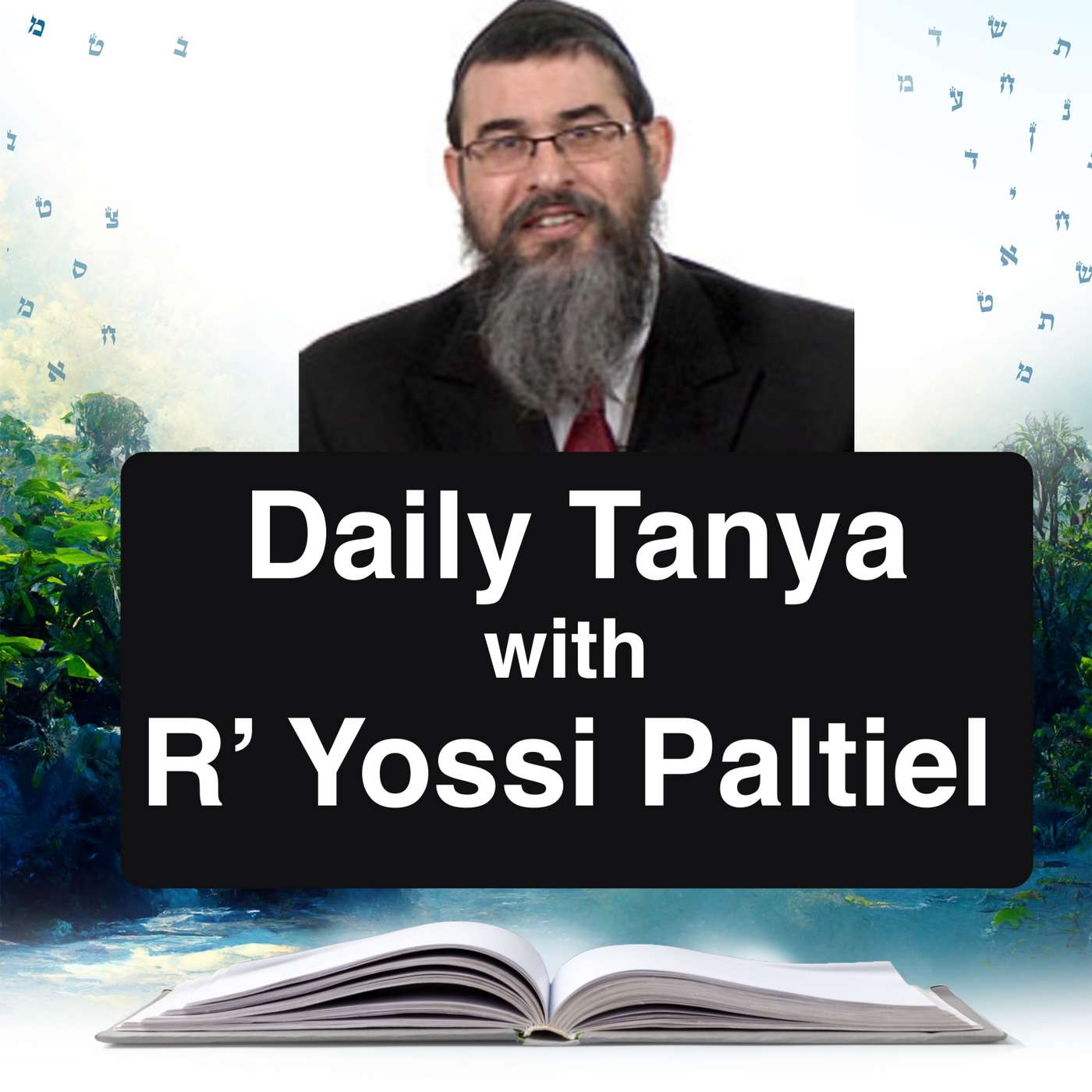
About this episode
No show notes were published with this episode.
Get every episode summarized
Each time Daily Tanya with R' Yossi Paltiel publishes, we email you a written briefing from the transcript — the topics, who appeared, and any specific claims, with the ad reads skipped.
Email me new episodesFree for 3 shows. No card needed.
Transcript ready
183 searchable segments. Every word is indexed and playable.
Full transcript
Daily Tanya with R' Yossi Paltiel — Tanya - 1 Nissan 5786. Machine-transcribed; use the interactive transcript above to jump the player to any line.
Now we're going to begin the new year. It's the beginning, eh? Habsha'a wa ha'adazu. Bringing down this idea and this light. Shaha'a wa ma'am shakumayah, that a posture person brings down and radiates. The other said in Sayyid Barakhoff, in the infant light of the Abish, that Arnafsh and his soul, as opposed to his body and the world. Arnafsh is callous thrall, modus are good friend, callous is thrall. Here he says callous is thrall, not just for Mitzvah's mice is, and for Avamsa Thedas, but for Thedas, well, when he didn't learn Thedas, they bring down light to the callous thrall, Shia-Shina, which is the Madriga of Shina called Thedas is thrall. Malka come to Shambhis is thrall, the world in Shambhis. When she goes to the Vlakaman, which we're going to be discussing later on, a.e. the Asek, a Therath of the Lening Therah, Nikras, Balaash and Kri, is called Kri. Now remember, we have mikra Mishne Talmud, right? mikra means Therash Baksaf. Mishne means halakh. Talmud means time, eh halakh, the reasons for the halakh. Mishne talmud are Therash Bap, eh, ah, kharayi. Mishne means Therash Baksaf. What does that mean? Mishne means Mishne means Therash Baksaf. Every word of Thedas is godliness.
The Mishne and the Gamarah is the Abish, the Khachma, the Abish, the Smartness. Pardon me for making up a word. The Khomish is Abish, the light. And it's there for called mikra. Why is it called mikra? Kri, the Thedas, one who's calling Thedas. The word Kri, the Mishne Talmud. Now, of course, talk about Shlaka Pratis. What's the key to this week? What's the key to this week? What's the key to this week? What's the key to this week? What's the key to this week? What's the key to this week? Kri, it's not just that he's giving him ideas. He's calling out godliness. Peter, this means the same. That's right. When a person learns Thedas, he's calling the Abish that they come to you. When you learn Thedas about Pair, you're trying to understand that Shem Khachma. When you are learning Thedas of Baksaf, you're trying to experience that Shem's light. This is the idea of Thedas of Baksaf, which is part of the reason incidentally that I'll be Allah. You'll become the midst of all Talmud Thedas. If you read mikra and you don't know what you say. Thedas about Pair, you don't understand it's a waste of time because the Holy is just about that sacred Latest. Thedas of Baksaf, that's called Latest, and all the months
will show you HD. It remains 1. 10. And that is the cost of the Pshat of the Pshat of the Pshat. You will see that everyone has the power and hope for them to even take it. What is the Pshat and hope for the Lord? In all of them, you can choose Maumis and all of them be Maumis and I'm sure that's the purpose of the ending. We're not going to go into this phase because Maumis and the first paragraph of the Because the Holy Spirit is trying to defend the infant field which is hiding in places with Archbishop Christ. But, Teethers call it clear because when you learn Teethers you are calling God. The whole idea of Teethers, specifically Micra, the silitation of the Magsav, is to rebeeing down Hashem's infinite light. The Ainu, in other words, the Kedla, the Chboda, the Atea, the Daphgoy. When you learn Teethers, the specific Atea, the Magsav, you are calling the Abysster. La Fukumish-keede, they say, Suleide is the Kedla, as opposed to somebody who is calling I'm not through that learning tater. Now boys, if a person is calling to Hashem and he's not learning tater, what is that
call? The difference in tater and filler is that learning tater means Hashem told me his name. I'm calling it. Right? What's tater? Hashem wrote the chumish. I'm simply reading it. So I'm calling the abish about the name he told me. He says to me, you want to get my attention? Call me gracious, but I'll like him. Call me, but I'll like it. I'll like it. Call me. I'll like it. Call me. I'll like it. I'll like it. Right? But when you're coded to the abish, tater, this is called tater, you're screaming abu, abu, father, father, this is the filler, which is higher tater or the filler. The filler has made it into a minus. And the biggest minus filler is that when you call Hashem and Davin, you know, you're in a show and was involved. I want to experience abish then. When you're saying words of chumish, maybe you're not even thinking what you're saying. It's the only dead that tater shabakshab is called mikro. And simply saying the word is kati, shmei shabakshabakshabakho, tater is much easier.
But it's not so pneumistic. It's filler is much harder, but pneumistic, but it's not the same, because it's not calling the abish as they're abish to told you how to call him. When you call the love of a novi, the novi says to this person who's screaming abu, abu, they're in kati, bishim, khava, gay med, nobody calls the abish to buy his proper name. But nobody calls abish by his proper name, means to call someone to make another word, you know, the mother says, right? Tvila and tater. Tvila is called khaye shab. And tater is called khaye yalim. Tvila is temporary life and tater is permanent life. What's the push? The pshad. Tvila may yashni Hashem for food, for health, for financials, for now. Tater is khaye yalim. How does Ghasidah say it? Tvila is called khaye shab. Khaye shab means to say, I want to bring God and it's into this minute. But in my own personal form, my own personal way, tater is called khaye yalim, tater lives forever. Hashem gave us a tater. He wrote himself into the tater. And when I'm calling tater, it's not me right now, creating a relationship with the abish. This is the khaye yalim, the internal life, the khaye yalim, not abish, the khaye yalim,
the abish. The gave us that I am calling. So the novice kubul, the in khaye yalim is shab, now understand, we have to have sight, tater and sight, Tvila. We have to scream abu, we have to learn tater. The myelin aba aba is the primiest, the myelin tater, is that we are khaye yalim, shab shab shab, akhada shbal akhwa yaman shakhad insaf, aghav, I must tell you, that there's a mushroom from the balshamt of in these words aba aba, which is probably the source of these taniyas, this is the shikl taniyat. The balshamt of give a famous mushroom, there's two mushrooms of a tikias, from the badi chivam from the balshamt of which you brought them vakokha or from the ramarash, and they have a sikhis on it. But the mushroom mushroom is that prince is sent away and he forgets the language of the king. So when his father comes to the region, he screams father, father, but he speaks it in the language of the slaves. The father recognizes his voice and he's macadafin. So the ramarash once came out before Ashishana, and it was time when he said the vakokha, even if Messiah. And he said that in the most of the balshamt of, where the prince screams aba aba, is nish the ikir aba aba, the ikir is the qishre. The important thing is not that he's screaming father, it's that he's shouting.
So the vakokha, right, that rashashana on the bavich was one of the most famous, what happened by ceding, because the ramarash said his words. So the say akh aba aba, it's also Yiddish guy, but it's not the channel of Tehra that's called Kehri Bishimkhah. And when you learn Tehra, it's so much easier, because the ebish that is telling you how you can approach God in us, there is Bainin Hamaskel, which allow a smart person to understand or an intuitive person to understand the hamjah of Yiddah, to appreciate how awesome the opportunity of learning Tehra is. Bishas is a Tehra, but once the aesthetic mission is by al-Apennikh of Giml, that is the madrega of Yiddah, law, because when you learn Tehra, you're experiencing aingsaw. The point is we may not feel it, but you should know that with much less effort, you can get much closer to God through Tehra, than through its filah. But Rasidah says that in order for us to feel the light of the Tehra, we have to have the kehri kehri kehri kehra baabah, and I want to remind you again that the ekeh of this sheet has been against Tehra Shab mikro, because that's the pond of the Tehra.
Tehra is both myelus, yes, yes, yes, yes, it's in my love, in the gombo, all this, and the right, right. I mean, Meske told me once, but the rebe told him when you hit this, oh yeah, I wrote it down, and I remember, I'm happy, I wrote it down. But about two swatham, Tehra, and another safe fit. One of them, the rebe told him is Tehra Shaba Tehra, and the other is Tehra Shaba Tehra. Oi, my memory, but I wrote it down, I have it down, but the rebe told him that Tehra is Tehra Shaba Tehra, and about something else, the rebe told him it's Tehra Shaba Tehra, I forgot what, but I'll look, I'll look, and it has the myelus of Tehra Shaba Tehra. Abah, Abah, kehri kehra, Abah, Abah, but the ekeh of Tehra Shaba Tehra is not the words. In other words, it's hard to have an ekeh of Tehra anyway, in a dynamic. But the ekeh of Tehra is not the words, I have it in Shaba Tehra, but on the other hand, the whole union of Tehra is, you know, a person says tatanu, Abah, Abah, kehri, you know, the personal aspect, that's a very good point, which deserves further analysis.
So this ends the Karachi.
More episodes
More from Daily Tanya with R' Yossi Paltiel

Tanya - 2 Iyar 5786
Daily Tanya with R' Yossi Paltiel
Tanya - 30 Nissan 5786
Daily Tanya with R' Yossi Paltiel
Tanya (Shabbos) - 1 Iyar 5786
Daily Tanya with R' Yossi Paltiel
Tanya - 29 Nissan 5786
Daily Tanya with R' Yossi Paltiel