newsApr 25, 202618:55pending
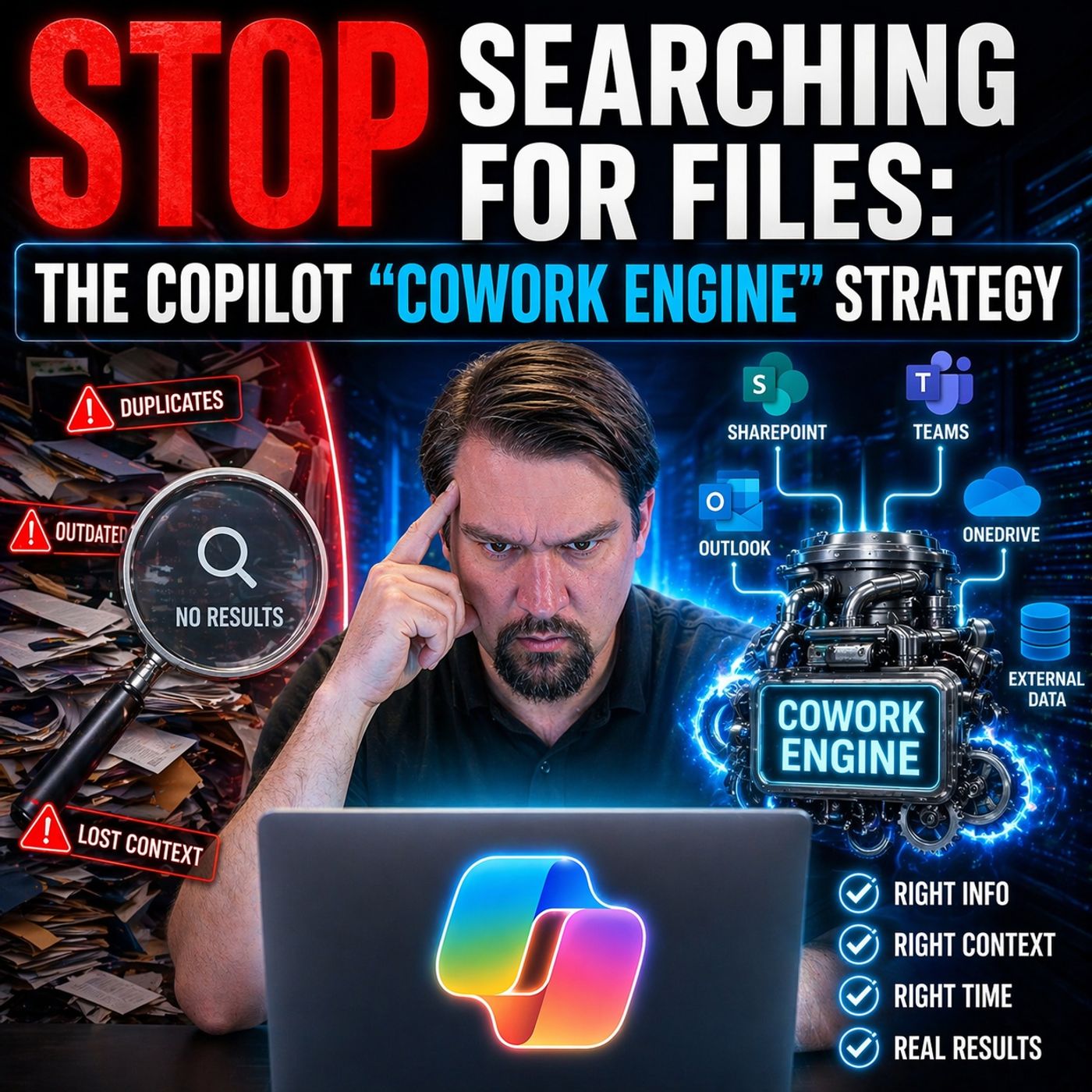
Stop Searching for Files: The Copilot "Cowork Engine" Strategy
About this episode
Search is not a feature.
It is a failure signal. If your day starts with a search bar, your system is already working against you. What most organizations call “document management” is, in reality, a high-density storage system for dead data. Files are stored, duplicated, renamed, and forgotten—while the burden of finding meaning is pushed entirely onto the human. You are expected to remember:
FROM ASSISTANT TO ARCHITECT: THE COWORK ENGINE SHIFT
Most companies are still using Copilot like an assistant—reactive, prompt-driven, and dependent on human direction. That model doesn’t remove the Search Tax.
It just speeds up the wrong process. To actually eliminate search, you need a different paradigm: the Cowork Engine. This is not a chatbot. It’s an execution layer. Instead of waiting for instructions, the engine:
STRUCTURED CONTEXT: FROM DATA GRAVEYARD TO SIGNAL LAYER
The biggest mistake organizations make is giving AI access to everything and expecting clarity. That approach creates noise—not intelligence. If your system contains thousands of outdated or duplicate files, the model doesn’t magically filter them. It gets confused by them. The result is inconsistent outputs, outdated insights, and a growing lack of trust. The solution is not more data. It’s better context. A Cowork Engine requires a curated layer where:
It starts with ready-made understanding.
GOVERNANCE-BY-DESIGN: TRUST AS INFRASTRUCTURE
Speed without control is risk. That’s why governance in this model isn’t an afterthought—it’s built directly into how the system operates. Permissions define visibility. Identity shapes context. Sensitivity travels with the data. This means:
FROM SEARCH RESULTS TO EXECUTION: THE AUDIT PACK EXAMPLE
The difference between old and new architecture becomes obvious in high-pressure scenarios. Take a compliance audit. In the traditional model, this triggers a manual process:
MEMORY AND RAG: HOW THE SYSTEM GETS SMARTER
What makes this model scalable is not just retrieval—it’s learning. Traditional AI resets with every interaction. The Cowork Engine does not. It builds a persistent memory layer that:
MEASURING SUCCESS: FROM SEARCH TIME TO DECISION SPEED
You can’t measure this transformation by counting prompts or outputs. The real metric is:
TIME-TO-DECISION
How long does it take to go from request → to trusted action? Supporting this are two critical indicators:
FINAL TAKEAWAY
Search was designed for a slower world. A world where:
Become a supporter of this podcast: https://www.spreaker.com/podcast/m365-fm-a-microsoft-mvp-podcast-by-mirko-peters--6704921/support.
It is a failure signal. If your day starts with a search bar, your system is already working against you. What most organizations call “document management” is, in reality, a high-density storage system for dead data. Files are stored, duplicated, renamed, and forgotten—while the burden of finding meaning is pushed entirely onto the human. You are expected to remember:
- where something was saved
- which version is correct
- whether “Final_v2” is actually final
FROM ASSISTANT TO ARCHITECT: THE COWORK ENGINE SHIFT
Most companies are still using Copilot like an assistant—reactive, prompt-driven, and dependent on human direction. That model doesn’t remove the Search Tax.
It just speeds up the wrong process. To actually eliminate search, you need a different paradigm: the Cowork Engine. This is not a chatbot. It’s an execution layer. Instead of waiting for instructions, the engine:
- understands relationships between data
- assembles context automatically
- executes tasks in the background
- how emails relate to documents
- how meetings influence decisions
- how timelines connect across systems
STRUCTURED CONTEXT: FROM DATA GRAVEYARD TO SIGNAL LAYER
The biggest mistake organizations make is giving AI access to everything and expecting clarity. That approach creates noise—not intelligence. If your system contains thousands of outdated or duplicate files, the model doesn’t magically filter them. It gets confused by them. The result is inconsistent outputs, outdated insights, and a growing lack of trust. The solution is not more data. It’s better context. A Cowork Engine requires a curated layer where:
- authoritative sources are defined
- duplicates are removed
- external systems are connected intentionally
- live operational data
- verified documents
- relevant communication threads
It starts with ready-made understanding.
GOVERNANCE-BY-DESIGN: TRUST AS INFRASTRUCTURE
Speed without control is risk. That’s why governance in this model isn’t an afterthought—it’s built directly into how the system operates. Permissions define visibility. Identity shapes context. Sensitivity travels with the data. This means:
- the system only sees what the user is allowed to see
- outputs inherit classification automatically
- compliance is enforced during execution—not after
FROM SEARCH RESULTS TO EXECUTION: THE AUDIT PACK EXAMPLE
The difference between old and new architecture becomes obvious in high-pressure scenarios. Take a compliance audit. In the traditional model, this triggers a manual process:
- searching multiple systems
- downloading files
- reconciling versions
- building reports manually
- retrieves authoritative contracts
- scans relevant email threads
- extracts decisions from Teams conversations
- compiles a structured, validated output
MEMORY AND RAG: HOW THE SYSTEM GETS SMARTER
What makes this model scalable is not just retrieval—it’s learning. Traditional AI resets with every interaction. The Cowork Engine does not. It builds a persistent memory layer that:
- captures corrections
- stores preferred formats
- learns decision patterns
- fewer errors
- less rework
- more alignment with business expectations
MEASURING SUCCESS: FROM SEARCH TIME TO DECISION SPEED
You can’t measure this transformation by counting prompts or outputs. The real metric is:
TIME-TO-DECISION
How long does it take to go from request → to trusted action? Supporting this are two critical indicators:
- Rework Rate
How often outputs need correction - Search Dependency
How often humans still need to “look things up”
- decision cycles shrink dramatically
- rework approaches zero
- search becomes irrelevant
FINAL TAKEAWAY
Search was designed for a slower world. A world where:
- data was smaller
- decisions were slower
- navigation was acceptable
Become a supporter of this podcast: https://www.spreaker.com/podcast/m365-fm-a-microsoft-mvp-podcast-by-mirko-peters--6704921/support.
Get every episode summarized
Each time M365.FM - Modern work, security, and productivity with Microsoft 365 publishes, we email you a written briefing from the transcript — the topics, who appeared, and any specific claims, with the ad reads skipped.
Email me new episodesFree for 3 shows. No card needed.
Hosts & guests
No transcript yet
This episode has not been transcribed. Request it and it moves to the front of the queue.
More episodes
More from M365.FM - Modern work, security, and productivity with Microsoft 365

Constraint-Based Scheduling: The Architecture That Makes Production Plans Real
M365.FM - Modern work, security, and productivity with Microsoft 365
Sep 15, 20261:51:40completed

A Machine Goes Down. How Should Your Production Plan React?
M365.FM - Modern work, security, and productivity with Microsoft 365
Sep 15, 20261:41:43completed

Can Value Stream Mapping Become a Live Data Model?
M365.FM - Modern work, security, and productivity with Microsoft 365
Sep 15, 20261:48:32completed

How Finite Capacity Scheduling Actually Works in Manufacturing
M365.FM - Modern work, security, and productivity with Microsoft 365
Sep 14, 20261:54:54completed