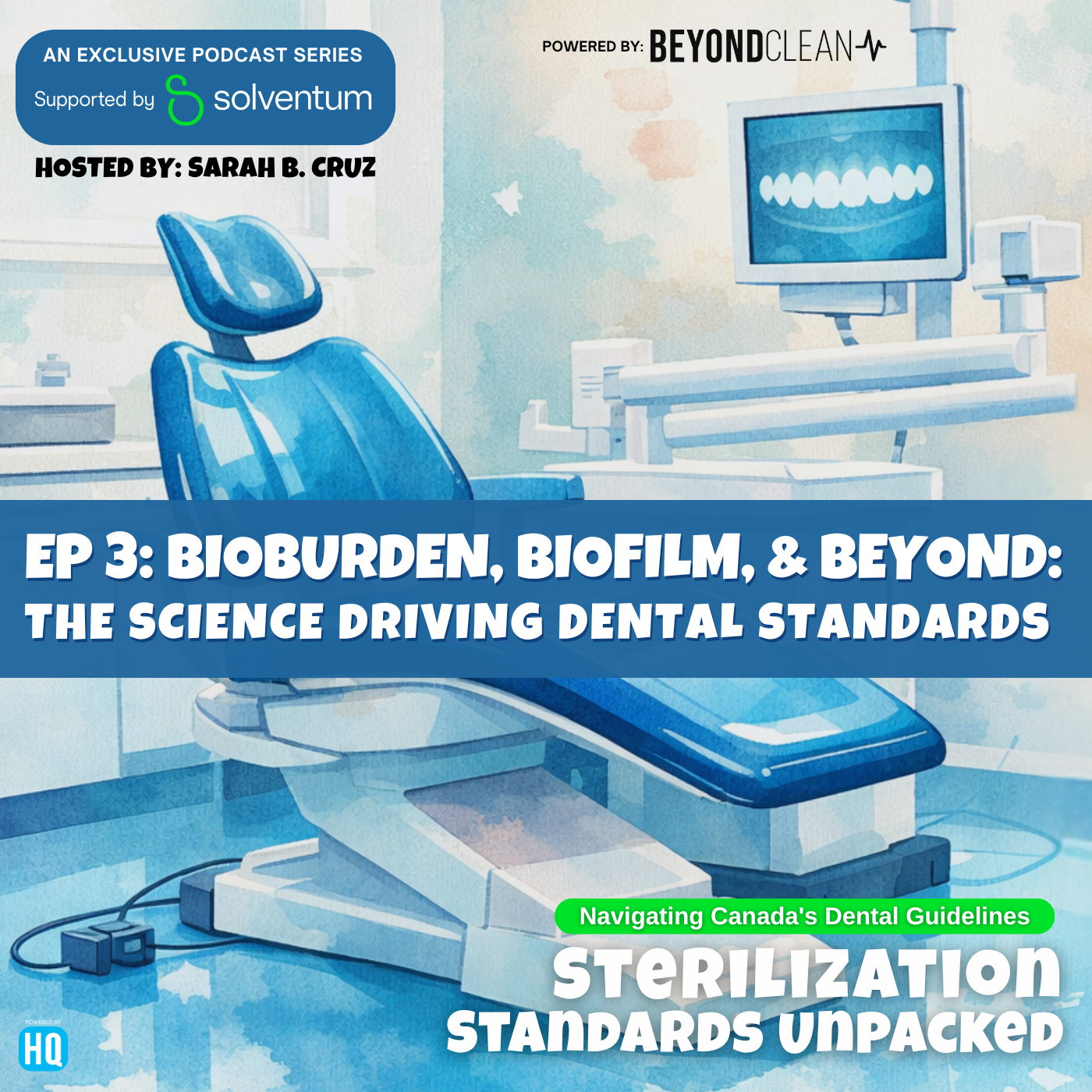
Sterilization Standards Unpacked - Bioburden, Biofilm, & Beyond: The Science Driving Dental Standards
About this episode
What really happens at the microscopic level when we talk about "clean" in dental sterilization? In this episode of "Sterilization Standards Unpacked," host Sarah B. Cruz is joined by Dr. Atila Nozari, Senior Medical Liaison at Solventum, to connect the science of microbiology with the day-to-day realities of instrument reprocessing in dental practices. From bioburden and biofilm to the evidence behind modern sterilization standards, Dr. Nozari helps demystify the "why" behind the guidelines teams are being asked to follow. Whether you're brushing up on CSA standards or trying to connect policy with practice, this conversation bridges the gap between following a guideline "just because" and understanding the science that stands behind it.
This 5-part series pulls back the curtain on how Canadian dental teams are translating sterilization standards into real-world practice—one guideline, one cycle, one patient at a time. With each episode, we'll explore the people, processes, and evolving expectations driving dental sterilization forward. It's not about compliance checklists—it's about connection, clarity, and conversations that make the technical feel personal.
A special thanks to our sponsor, Solventum Medical, for supporting this podcast series!
#BeyondClean #Solventum #SterilizationStandardsUnpacked #DentalSterilization #SterileProcessing #Bioburden #Biofilm #Standards #InstrumentReprocessing
Get every episode summarized
Each time Beyond Clean Podcast publishes, we email you a written briefing from the transcript — the topics, who appeared, and any specific claims, with the ad reads skipped.
Email me new episodesFree for 3 shows. No card needed.
Transcript ready
315 searchable segments. Every word is indexed and playable.
Full transcript
Beyond Clean Podcast — Sterilization Standards Unpacked - Bioburden, Biofilm, & Beyond: The Science Driving Dental Standards. Machine-transcribed; use the interactive transcript above to jump the player to any line.
Hello and welcome to Sterilization Standards Unpacked, Navigating Canada's Dental Guidelines. Where we'll talk about the evolution of dental sterilization, the people shaping it and the standards guiding it forward. I'm your host, Sarah B. Cruz, and in every episode we'll connect innovation to intention because progress in dentistry doesn't just happen. It's built through consistency, clarity, and care. Here we'll explore the practices that protect patients, the standards that impact process and the professionals who set the tone for excellence. Whether you're in the operator, the sterilization room, or leading a team. This space is for those who believe that quality isn't a check box, it's a mindset. Sterilization Standards Unpacked, Navigating Canada's Dental Guidelines is supported by Sylventum, creating smarter, safer ways to deliver health care and advancing the future
of dentistry through innovation and education. So let's get ready to get dirty and go dental. Hello and welcome to Sterilization Standards Unpacked, Navigating Canada's Dental Guidelines, presented by Sylventum and hosted on the Amazing Beyond Clean Network. Hello, my fellow medical device reprocessing technicians, sterile processing technicians if you're joining us from the Americas. And of course, let's not forget the focus of this podcast series, all of our dental assistants, dental hygienists, and hopefully a few dentists hanging out with us today. Because this podcast series is all about the evolution of dental standards currently happening right now, all across the nation of Canada. We'll see in this podcast series that we have representatives, technicians, professionals, all checking in and sharing their experience with the new CSAZ314 2023 updates.
And in this episode, we are going to be sharing the stage with our very own Dr. Tila Nozare about how we even got to this point, right, because standards aren't born overnight. Thankfully, they're not, because with the way that they roll out, things take a little time. And as you'll learn throughout this podcast series, even provinces have different takes on all the different updates. But we are happy to say that I believe personally, as someone who has been studying the significant changes happening in Canada, I personally as an American am overwhelmingly impressed with how much impact this is having in the dental industry. Being as how I am participating in our very own Amy, which is very similar to the CSAZ314 and all of the other Canadian agencies working together on standards, I'm appreciating the insight and the background workings that are happening to make these huge updates a reality. Now before I get too far ahead of myself, let me bring our special guest, Dr. Tila Nozare,
to the stage. He is the Senior Medical Liaison Forcel Ventum and has a major part in global standards and activity on their behalf as well. Attila, how are you? Hello, Sarah. Thank you for having me. I'm really looking forward to this conversation. And I want to just say hello to all of your listeners, all people who are listening to this podcast series. Ah, well, I think if they could, they would be saying it all back because we are about to demonstrate why people should start bragging about their autoclaves because there's obviously this glamorous side to dentistry that's all about the veneers and the billboards and the whitening, but we're about to get into the nitty gritty of dentistry standards. Attila, just share with our audience what we're about to get into with this. Yes, so standards are, you know, just one of the most favorite topics in the word for
me. So standards and guidelines. So it's very, I'm happy that I'm talking about this actually. I want to start by, you know, the purpose of the standards like CSAZ314 is to create a common evidence-based framework that protects patients and supports healthcare professionals. So they translate the signs and best practices into clear actionable requirements, insuring that whether you are in hospital or a dental clinic or any community health sitting, you receive the same level of health and safety and quality applies. So today, we want to actually start by what does it 314 is composed of and how we have developed or where we are today, how all these steps we've rolled away, all the past that we've gone through to reach this level that we have these standards, not only is it 314, but also the dental standards from different provinces that we have in Canada.
So we'll just go, we'll go a little bit back and then walk through and come to the state that we are in today. Yes, and it's going to be a great, well, it's going to be a good, trip down memory lane, a little bit of a history class and that's going to be really important for the foundations for the rest of our podcast series like Attila was referencing the national framework for reprocessing reusable medical devices across all healthcare settings, including dental, right? So as we get going, please keep in mind that we are going to start with the 2018 version of the CSA Z314 and we're going to see how just based on the 18, then the impact of all the provinces and doing their best application of best practice, right? And how it's led us to the 2023 that I personally think puts everything together with a nice bow. What do you say, Attila?
Yeah, I agree. So of course, certainly we should start by foundation, right? So the standard Z31418 is actually, and when I, it is, this is standard alone, it integrated back then, it updated and replaced several other set of standards basically to one document. So we had Z314-0-3-8-10.1, 10.2, but the dash 14, dash 15, dash 22 and 23. So they were several documents actually that they all basically combined and the part that they were, some part that were repetitive in those documents, they were eliminated. So the committee back then decided that we want to have one document. We want to have one reference document to make it easier for people that they are looking for information standards, instead of referring to nine separate standard documents that I mentioned just the numbers for them, just having one document.
So actually that was one we had with Z314-18 is a combination of nine documents and those documents are, of course, they were gender requirements, effective sterilization in the esteemed processes, in the atilloxide processes, in reusable medical devices, what about the gowns and drapes and how they are used in facilities, about laundering, about maintenance, about preparation, about disposable devices as well, about single use or unusable devices. So all these documents they gathered together and then we had this Z314-18 that it was the, and that means that in 2018 it got published, but that was not just the only difference. So, and that was basically a very huge accept that then we had all this documented as one, but then we changed to a 2023 version of it. So then another update, but this time is one document, it's not like previous time that we are having nine, it's still one document, making it easier for us, but what changes
happened was, we can start by title. The title for Z314-18 was, Canadian medical device reprocessing, we realize as a committee that everyone who participates in this, as you know, it is just a good participation of the old stake holders in the standard setting. So in users, definitely because they are using this document, are a very important critical part of that, industries, the parts of that, regulatorys, the parts of that, genderless it's a part of that, non-profit and auto organizations are parts of this document. So all together, basically people, this committee sits together to come to this consensus when having this document. The idea was that we should make it more comprehensive. Then we have Canadian medical device reprocessing title. It wasn't as comprehensive as it should be, as at least it sounds when someone's seeing the title. In 2023, actually, it changed to Canadian medical device reprocessing in all healthcare facilities.
So all healthcare settings, even having that title, it want to highlight that this document is not for hospitals, is for all the healthcare settings that they are having healthcare provided. And so the definition got updated. The definition is that any location where healthcare is provided, including emergency care, a pre-hospital care, hospitals, long-term care, home care, ambulatory care, and facilities and location in the community, where the care is provided. So that's include dental offices. You know, and I like how by making it more inclusive and thinking of the patient as this holistic view, this close, everyone is a patient, no matter where they're getting serviced in any type of facility, really made a big call to action to these healthcare providers, these healthcare spaces, but also to the individuals writing the standards.
So huge kudos to the 2023 group that worked so tirelessly to work on that. But I do think it is important to take a small moment of recognition and recognize Quebec, in 2009, they were one of the first provincial documents to outline the dental expectations, you know, as I was learning, and so it seemed like Quebec had started that conversation and really got that 2018 ball rolling, and that's that huge break with the provinces, you know, and as someone who lives in the states, I guess we can view provinces as different hospitals, because you know, we're here just trying to apply our best practices in the way that we're interpreting the standards and the way that regulatory bodies expect us to, right? So having entire areas of provinces really taking the reins and implementing this is very, well, it's frankly, it's impressive.
So Attila, as someone who's in that space, can you tell us a little bit more about provinces and how they're taking it and running with it? Maybe you can help us understand that a bit. We're going to acknowledge it, right? So how the states are different in, you know, United States, right? The states they can have their own separate guidelines and best practices. Provinces in Canada can do the same, and standards, almost of the time, but they refer to that. They say that follow your local laws and regulation, and that's the one that it's kind of, you know, emphasizes that each province is because we have to be mindful of the different provinces, the different level of the practice being happening, and also resources available, and the number of the, you know, processing happening. So there are lots of factors need to be considered. That's why we have these provincial guidelines. And different provinces, they, just, you know, you started with the example of Quebec. So they were, yes, they had this, really, you know, we started that. They had this 2009 guideline. And again, the best practices
that was in that document is get updated, you know, host standards are not dead documents. They're alive. So by more evidence we get, by more evidence-based knowledge we get, and then we need, we feel they need that, okay, we need to update because of technologies also evolving, right? All of these things happening. That's what they made that, you know, these things happen, and then Quebec started their prevention and control infections, and reprocessing medical devices, and Quebec, they tried to have a document. I think initially in 2022, but then they realized that they wanted to do some more updates until in 2024, basically, they got the document out. So, and that's in, you know, in different provinces is different. For example, in Ontario, I want to give an Ontario where I reside in. So in Ontario, what is that, is basically the standards, is the infection prevention and control in dental offices, is developed by Royal College of Dental Surgeon in Ontario. Sometimes it's just one college is actually developing the dental standards, like what we have in Ontario. But sometimes,
in like other places, there are several organizations. So, several, I can give example of like Saskatchewan. So, civil organization together, they develop this one. So in case of a Saskatchewan, I can say, like infection prevention control standards in oral care, oral health care facility, college of dental surgeons, Saskatchewan dental therapist association, Saskatchewan dental hygienic association, Saskatchewan dental assistant association, and other assistants as well. So, I want to just, again, it's not a comprehensive list. I'm just mentioning some of them, but I want to just highlight that in some places, one college is overseeing all of that. In some places, there are different associations, because it's important that everyone worst get hurt. So, and then that, of course, again, we have a very important document, as we mentioned, Z314, and then this, okay, how much can we align to that one? Yeah, and first of all, I love the word Saskatchewan, that is awesome. You know, and then we think of Alberta, who in 2021 was really using that
2018 update as the primary technical source, and that includes small facility examples, which was really exciting, right? Now you're getting into that nitty-gritty, hey, Alberta's like, look, even these small facilities have to gain and buy into this, well, level of accountability, right? Because I almost feel like, because I truly believe that the 2023 update really said, when a practice commits to standards, it's not just following the rules, it's providing accountability, traceability, and dare I say, even a quality management system? Well, I mean, you know how I feel about quality management systems, so. I do know that. So, no, I totally agree with that. That's a very good point that you mentioned, right? It's important that we want to have the same level of quality and care for everyone. It depends, regardless of the facility happening. I will say this one, microorganisms, they do not differentiate, right? We have to, we have to
be mindful, microorganisms, they do not differentiate if you are in a hospital or if you are in a dental office, they are not going to say, oh, because you are in dental office, I'm not going to make you sick. No, if microorganisms are there on the devices, if devices are not properly reprocessed, they are going to do what they do. So, that's why I do agree with this one that every small place in the community, any healthcare setting offices everywhere that is possible. As much as possible, we have to be, you know, follow the guidelines, but also that's why we have these dental associations helping that because in dental clinics, we do not have the resources or the size of the facility or the area that we do the reprocessing happening and likely one that's happening in the hospital. So, that's why we have to be mindful of that, but the Vonwe workflow is a must, regardless. So, that's why we have these differences. Oh, and this is going to be a perfect space in this
first episode. We're going to put a little pen in it. We're going to take a break and hear a word from our sponsors and you all are actually going to listen to our first mid-session break called Practice Defined. So, if at any point you want to keep re-listening to this first episode over and over again, keep in mind that every episode will have a practice defined and will keep you up to date with all of the terms that Atilla is referring to. We'll be right back. It's time for Practice Defined, a quick pause to unpack a key term shaping dental sterilization and safety. Today, we'll talk about air removal and steam penetration tests. Commonly known as the Bowie Dick Test, this procedure confirms that pre-vacuum sterilizers can remove air efficiently and allow steam to fully penetrate porous loads. According to the CSA, Z314, reprocessing of reusable medical devices in healthcare settings, these tests must be
performed at the start of each day the sterilizer is used. Whether completed with traditional test packs or electronic systems that record and store results, air removal verification is a daily baseline for safety and performance in every dental clinic. That's Practice Defined. Now that we're one term closer to excellence, let's jump back into today's episode. Hey everyone and welcome back. If you are just joining this episode, please stop and go back to the beginning because Dr. Tillin-Nazari is really giving us a great foundation setting, history lesson. Thank you again for being with us Dr. Till. I really appreciate your time today. Of course it's a pleasure to be here. Thank you. Now before we went on break, we started to allude to well the oppositions and even when you were giving that amazing microorganism analogy,
it almost kind of fell overwhelming for me just hearing it because I remember when I started in sterile processing. It's not that the medical device reprocessing industry was going through this but I had learned how the traditional medical device reprocessing industry was applying this and seeing the updates to their standards and really starting to get into what microbial protection infection prevention actually looks like. It's almost like I'm watching well history repeat itself because now it's being applied to the dental space, ambulatory spaces where I am. So what have you experienced and what type of advice can we give dental facilities to well aid them in this application because it's really changing how they do cleanings there I say. A perfect question. I would maybe again just you know we are talking about
the foundations right. I will refer to the foundation. This document that we have also the part of the reprocessing and the level of reprocessing happening is going back to the spouting classification right. We have critical devices in semi-critical device or non-critical devices. Of course now in during years now we have had some let's say updated spouting classification and that's why it's not that an update means that some of devices have changed. So for example some devices that in the past they had semi-critical application now they are being used as critical application. So basically spouting classification is still available. I mean it still is valid. So now we have to be mindful of that. So why we are doing this certain level of processing for different items if we have to just check that okay is it a critical application does it have critical application then it requires sterilization does it have semi-critical application or is it just non-critical and this part is the same. This part is going to be the same either wherever you are. So if you
are in dental setting or if you are in ambulatory or a big hospital setting. So this this part is going to be important. We need to be mindful of that and I think that some dentists need to be maybe oversee about their activities okay the application of the instrumentary using is what and based on that they decide okay what is needed if something needs adjusting again critical cases critical use devices reusable devices then it needs sterilization and if we need a sterilization sterilization is defining the standards and what are steps are necessary to basically to reach there. If you know that sterilization itself we cannot see it we cannot touch it we cannot test it as soon as you touch a device which was a serial or open a packet was a sterilized it's not it is honestly anymore right that's why we need to have some quality control quality check so basically use the quality control to make sure that it has happened. Yes and you hit the nail on the head like and not quality management systems aside right the
structure and framework that ensures consistent documented and auditable processes right for reprocessing but even just going back to the chemical indicators you know if you're using a type 4 verification is that enough if it's going to be something that comes in contact with a sterile environment right if so it needs to have a type 5 integrator and we need to be doing biological indicators really testing for those fours in our sterilizers and then even using a variety of process challenge devices right those test packs designed to challenge the sterilization process you know and and I think it just speaks volumes to how the industry keeps growing because there's the traditional test pack and now you even have rapid readout test packs that take the human guessing out completely so just with this small explanation that Dr. Taylor is referring to is a slew of new education application and frankly how you've done things and not doing it the way
you've always done them that's absolutely right again it's actually you know it's one of the differences right one of the differences that we have between dental clinics and dental settings with the health care with bigger health care facilities is even their sterilizers and again sometimes some of these dental clinics are part of bigger organization like for example they're dental clinic inside a big hospital so they may have access to bigger sterilizers and some places they have a smaller what we call them tabletops so how we are going to okay we now I have a tabletop sterilizer and then I have a bigger sterilizer should should I just because it's tabletop because the smaller I just maybe I'll meet some of the steps no no I cannot do that it does not mean because even the standards that you want to mention that if okay if it's if it's the process happening if this sterilization process happening then we need to have the checks to make sure that it happens but very good point you talk talk talk you touched on upon that is the process Chinese devices
and now actually is that even for 23 has more information about how to make you know even even how to you know about this process Chinese devices that it is suitable sometimes the the process of Chinese devices are too much challenging for a smaller one so really here we have to highlight that follow instruction for use and then okay then that's what before a smaller one we might have or tabletop but the size of that and based on standards defines that okay does the size at the volume of inside the sterilizer classifies as a tabletop or classifies as a regular bigger sterilizers so that one will define that maybe the type maybe the part or the cross-change device that uses different but process regardless a process trying to device needs to be used and very important point was about type five or type six chemical indicators yet if it is they are implantable parts and mostly that's happening is actually in the dental side then a type five and six is required so what type of information we get type four gives us limited information type
type five is actually is the one that mimic in the bio training here to response on type six is defined for only one specific cycle so we we have to basically revisit what we are doing if we are using a type six for this specific cycle if our cycle changes then you have to go and use another type six that is defined for that specific cycle if you are using type five type five response to all three critical process variables and then you can use for all of the cycles but the other ones like type four yes is allowed but if you are it again in the cases that it's not going to be implantable inside the inside that tray or load so we have to really revisit what the guidelines telling us that our provincial guidelines are requiring us and sometimes you know we can just go above above beyond standards the standards they do not stop you there the standards they tell you the minimum but you can go above beyond yes and I know that standards tell the minimum but I still can't stop myself from thinking that
the 2023 really set that bar high enough you know and the key takeaway is that provincial interpretations vary but standards unify outcomes and it went even further to say patience unify outcomes right like you said it doesn't matter where we are or what's happening in that space it's how we're making sure what's happening is having the highest quality impact and the greatest patient safety outcome and I can't wait to use the rest of this podcast series to really demonstrate and get into that technical nitty gritty with our guests to show them just how profound and these huge steps that dental is taking and really the big call to action to the frontline professionals in them and until you did a great job on this history trip I am so grateful it was you that did it because I couldn't imagine being the one to even
try and explain this as someone who doesn't even live in the country you know it's it's just I don't think I would have done it justice like you did today so thank you again for being our special guest thank you so much again for having me and this I want to maybe say a word here ultimately I see standard notice you know rigid rules but they're as also as educational tools that they can empower health care professionals to understand why behind it best practices and as you you very beautifully summarize that that the ZZ314 is trying to that have a one harmonized standards for Canada and old provinces are basically moving towards that so we have integrity for our health care system thank you excellent and well said let's continue to contribute to a culture of safety that really defines Canadian dentistry and just how much Canadians can impact the overall outcome of patient safety you know remember folks progress isn't perfection
it's participation and like Attila said these are living breathing documents that change and frankly they only live in breathe because you live and breathe them in your best practices where you are join me next time as we explore what makes dental sterilization unique and how these differences shape the way we define safe consistent care across Canada um therapy crews and keep fighting dirty and solving with momentum bye thanks for listening to sterilization standards unpacked navigating Canada's dental guidelines where we connect innovation to intention and recognize the progress driving dentistry forward every conversation here is a reminder that progress doesn't just live in policies and products it lives in people the professional choices we make the standards we uphold and the care we deliver every day if today's discussion inspired and motivated you
share it with your team and keep the conversation going sterilization standards unpacked navigating Canada's dental guidelines is supported by Sylventom creating smarter safer ways to deliver health care and advancing the future of dentistry through innovation and education I'm Sarah B. Cruz thanks for joining me and until next time keep fighting dirty and solving with momentum
More episodes
More from Beyond Clean Podcast
On Pathogens & PPE: The Challenge of Robotic Instrument Reprocessing
Beyond Clean Podcast

Season 20 Rewind - Not In Our House: A Team Approach to Decon Protection
Beyond Clean Podcast

Beyond Clean Canada: More Than Instruments: Supporting Canada's MDR Community
Beyond Clean Podcast
On Pathogens & PPE: Hand Hygiene in SPD
Beyond Clean Podcast