Spectator Out Loud: Noa Hoffman, Robert Hardman, Patrick Galbraith, & Matthew Reisz
About this episode
On this week’s Spectator Out Loud: Noa Hoffman explains why Keir Starmer’s empty seat could become a Green Party battleground; Robert Hardman tells us how the death of Norway’s King Harald could reshape the royal family; Patrick Galbraith says it has been a disastrous year for British farming; and Matthew Reisz explores the unique relationship between artist Paula Rego and her model, Anthony Rudolf.
Produced and presented by Abigail Brierley.
Hosted on Acast. See acast.com/privacy for more information.
Get every episode summarized
Each time Best of the Spectator publishes, we email you a written briefing from the transcript — the topics, who appeared, and any specific claims, with the ad reads skipped.
Email me new episodesFree for 3 shows. No card needed.
Hosts & guests

Transcript ready
342 searchable segments. Every word is indexed and playable.
Full transcript
Best of the Spectator — Spectator Out Loud: Noa Hoffman, Robert Hardman, Patrick Galbraith, & Matthew Reisz. Machine-transcribed; use the interactive transcript above to jump the player to any line.
Granger knows if you're a procurement manager at an industrial manufacturing facility, you're balancing inventory and budget while sourcing critical supplies across the operation. Too much inventory? Cost climb. Too little? Production slows. Grangers, $2 billion in on-hand inventory helps you get what you need when you need it, so you can help keep budgets balanced in lines moving. Call 1-800-Granjer. Click ranger.com or just stop by. Granger, for the once, who get it done. Hello and welcome to Spectator Out Loud. The podcast were each week we choose some of our favorite pieces from the magazine and ask their writers to read them aloud. I'm Abigail Riley, the Spectator's new producer. On this week's episode, Noah Hoffman delves into why Kirstaamers vacant London seat, could become a battleground, not just for the Green Party, but within the party itself. We hear from Robert Hardman, who explains how the death of King
Harold Abnawe could revolutionise their royal family. Patrick Galbraith tells us why this has been a disastrous year for British farming, and finally Matthew Rice talks about the unique relationship between artist Paula Rago and her subject Anthony Rudolph. First up, his de-spectators political correspondent Noah Hoffman on the Green Party's bid to gain a Westminster seat. When Sir Kirstaamers announced that he was standing down as an MP on Tuesday, dubolation erupted among green activists. Zach Polanski's party has already proven it can take on Labour's campaign machine in ethnically diverse parts of Manchester. Stamers resignation now presents the perfect opportunity to do the same in London. At the time of the 2021 census, the constituency of Holbin and St Pancras was 21 per cent Muslim and 45 per cent non-white. At the 2024 general election, Starma received almost 50 per cent of the vote, while the Green Party and independent pro-Garza candidate Andrew Feinstein secured a combined 29 per cent.
Andy Burnham has taken some of the wind out of the Greens' assails, but Holbin and St Pancras present a comeback opportunity for the far left, who think Burnham is just a less robotic sounding Zionist capitalist shill than his predecessor. The central London constituency is fertile ground for the Greens to take the fight to Labour on their favourite subject, Gaza. In the Greens for Palestine WhatsApp Group, excitement about the impending contest was accompanied by an awareness of the consequences of failure. Green members agreed that while Deputy Leader Mothin Ali would be a strong candidate in any by-election, he would be too great a loss to the North and better place to fight a seat near his home city of Leeds. What was most striking was the apparent lack of enthusiasm for Polanski. Former Green Council candidate Zach Khan, who is adored by members for his role aboard the Gaza Global Samud Flotilla, remarked. The seat has a 50 per cent bane population. It should be represented by someone who understands
those communities concerns. Mental health and social care work is stiff-responded. It had been nice to have a global majority rep for once and also a true anti-signist. In Green Parliance, global majority refers to people who are Black, Asian, brown, dual heritage, Indigenous or from the Global South. Preempting the horror of a white man standing for the seat, another member, Ash responded. Terrible the way selections in our party are often run. It's often a passive process, rather than proactive. We know women and people of colour generally need encouragement and support to put themselves forwards. Also, in terms of values, I'd like to see us as the left, organise and support candidates with the right values, like being anti-signist, which doesn't seem to be happening. Jacqueline, an academic, trade unionist and trans-activist, chimed in. Lots of room for unconscious bias and structural injustice to come into play. Moe from Birmingham suggested that his comrades should be mindful when discussing their preference for an outsider over Polanski,
lest their conversations end up in an article by Noah Huffman in the spectator. Green members wield huge power through the party's governance, rules and democratic structures, as well as exercising influence over its leadership. Greens for Palestine maintains a particularly close relationship with Ali, who quietly left the chat after conversations berating Polanski and the party leadership were repeatedly exposed. Earlier this year, Polanski professed that he would almost certainly be running if Star must have stood down. On Tuesday evening, he was outcandising in the constituency. Polanski said, we will announce our candidate in due course and they will set out an exciting agenda for the deep change our country needs. I am proud of what I have achieved in the first year of my leadership of the Green Party, but it is just the start. Polanski will undoubtedly feel pressure to stand, but the stakes are high and the safe option would be to wait and see whether Diane Abbott retires before making a run for her hackney seat. As Ash remarked in the Greens for Palestine chat, the party's shocking third place result in the Manchester Meryl election really
has given the impression we have run out of steam, given how bad we did, and if we don't do reasonably well in this by-election, that will seal that impression. One potential headache for the Greens appears to have been avoided. Splitting the vote with the pro-Garza independent fine steam, who came second to Starmer in 2024, he announced on X. We must ensure that all progressive forces in Holben and St. Pancras unite. Among the former candidates views is the claim that Starmer's government was directed by Israel. Excitement over his potential candidacy was palpable in green chats. He's an incredible person, one member gushed. Whether fine steam formally joins the Greens, or whether Polanski or someone else stands, the campaign looks set to promote an increasingly extreme agenda. On Gaza, Defence, the economy and immigration. In recent months, Labour has shown that whether Greens lead, it will often follow, even if only halfway up the garden path. The by-election will place huge pressure on Burnham to move further to the left. Labour HQ, however, is determined to attack the Greens as hard as possible. This is relatively
easy, given that the party's membership provides almost endless material for ridicule. Ahead of its conference in October, Member-submitted motions range from giving people who menstruate an additional 36 days of paid annual leave to disbanding the Prevent Programme and forging close ties with the IRGC. The question for Labour is how far Burnham and his eventual candidate should go to chase those votes. Some senior MPs believe it should refrain from launching negative attacks on its rival party, focusing instead on Burnham's positive agenda. Others believe that even in an area as progressive as Holman and St. Congress, highlighting Polanski's extreme positions will deter potential Green voters and push them towards Labour. The party of government gave prospective candidates until Friday to put their names forward, with the winner to be selected by 9th September. So far, David Miller-Band has ruled himself out, while the party is taking an interest in several local community bigwigs. In the days ahead, those willing to make a go of it will begin the process of self-primation.
Starma, Trutorform, has left his party in another fine mess. King Harold's death could change the future of Norway and their royal family. Crowning glory after Harold, what's the future for Norway's royal family? By Robert Hardman. Affable, unflappable and imposing, he was a six foot two-inch ex-Elimbian, the late King Harold of Norway was also blessed with good luck for much of his life. The first notable dose of good fortune occurred at the age of three, when his mother managed to spirit him and his sisters out of their home country, hours before the Nazi invasion, and a way to safety in the US. He returned to a nation so devoted to its monarchy, that the children of post-war Norway pulled their pocket money to help by his grandfather, King Harkin, a royal yacht. The Norg remains in service to this day, funded by an uncomplaining
nation. Compare that with Britain's royal family, who had to waive farewell to their yacht, Britannia, back in 1997, after a long and toxic political swobble. It is a reminder of the many ways in which of all the world's monarchies, Norway perhaps most closely resembles our own. And, of why the House of Windsor has so often cast an envious glance across the North Sea. Following the death of King Harold at the age of 89 last week, however, it is royalists in Norway, who now look wistfully across at the UK. Harold V set midway between Elizabeth II and Charles III. Like our late Queen, he was a great grandchild of Edward VII, like her, his worldview was shaped by war. Like King Charles, who hailed Harold as a dear cousin and towering figure, he had strong Danish lineage.
Both could claim direct basent from King Christian IX. Like King Charles, Harold reigned in an age when monarchy had to earn the respect it could once take for granted. Both men would have to overcome traditionalist opposition when it came to marriage. In the absence of an Norwegian nobility, young Harold had been expected to wed a European princess, yet fate introduced him to Sonia Haraldson, daughter of an Oslo textile dealer. His father, who became King Olaf V in 1957, disapproved, but Harold was not for turning. Three years at Oxford, where he rode for Baleol College, had instilled a sense of independence. Sonia was similarly strong-willed, as I learned when I interviewed the couple in Oslo shortly before their 1994 state visit to the UK. She had traveled
to Britain as a language student in the 1950s and told me she enjoyed it so much that she got a job as a barmaid at the Eagle in Cambridge, where Crick and Watson had just announced the discovery of DNA. I remember celebrating my 21st birthday there, Queen Sonia told me. I didn't want to go home because I wanted to learn the language. There I was sitting with a lamb chop all by myself. A year later, she did return home and met Harold at a party. Their romance endured ten years of opposition before Harold got his way. Having warned his father that he would remain a bachelor unless he was allowed to marry Sonia, that would have meant the end of the monarchy. Their Norway had been a kingdom from the 9th to the 19th centuries. It fell under the Swedish crown until a referendum was held in 1905, and the people of Norway demanded a new monarchy of their own. They had turned to the Danish House of
Gluckstburg to furnish them with a monarch, and Prince Karl of Denmark stepped up as King Harkin VII. It meant that Harold was the only heir to a young monarchy. Under the male only law of succession, his sisters were private citizens. It was a case of letting Harold follow his heart or face a republic. The crown prince and the ex-barmaid were finally married in 1968. I wondered whether Norway's relative classlessness had been another piece of good fortune for Harold. Absolutely, he told me, there is an economic class structure but nothing more. He was the first to admit that being monarch of a small nation is much easier than raining over a large one, let alone 14 other realms like King Charles. Each individual has more of a feeling of knowing you personally, he told me. I think we have an
easier task in coming into contact with the people because our population is half the size of London. We mulled over what it was that made the region so predisposed to the system of constitutional monarchy. King Harold was modest in this regard. Usually people say stability is created by the monarchy, but I think it's a two-way system, he said. Stability creates a base for the monarchy, and the monarchy creates a base for stability, that may be one of the reasons for so many northern European monarchies. These countries are fairly stable. Harold came to the throne in 1991. Just as his second cousin Elizabeth was about to experience her anus-heribalus and the misery of the 1990s. Norway's king continued his run of luck. Three years into the job, he was welcoming the world to his small nation as he opened the Lillahama Olympics. Another strike of good fortune had been
the discovery of vast reserves of oil and gas in the Norwegian North Sea. Whereas Britain swiftly chumped its way through its oil money, Norway decided to invest its dividends just as Harold was taking charge. Its national wealth fund is now the world's largest, a nest egg worth two trillion dollars which covers over 20% of all annual government expenditure without touching the capital. It meant that Harold's subjects were never exposed to serious hardship during his reign. Nor, unlike Lillabot, would he have to preside over an EU entry or exit since Norway has chosen neither. He was also blessed with an easy charm. Having first met him at his palace in Oslo, my next encounter with him was an abay tent during Kausweak, yet luck is not hereditary. Norway's new king, Haak and the Eighth, comes to the throne with some serious challenges.
His wife, the new queen Metamarrit, has suffered severe health problems and had a lung transplant just ten weeks ago. Her past friendship with Jeffrey Epstein has exploded into the public domain, with the publication of hundreds of cosily intimate email exchanges long after Epstein's 2008 conviction for sex offenses. She has since claimed she was manipulated by the pedophile financier. And her son, by a previous partner, a convicted gangster, has been convicted of multiple counts of rape. He remains under house arrest while he appeals. It is a scandal to dwarf even that of Andrew Mountbatten-Winzer, given its proximity to the throne. And if Britain thinks it has a slim down monarchy, Norway's is almost skeletal. The new king's only sibling, Princess Martholuees,
could hardly be less like our own Princess Anne. Having had three children by her first husband, who died by suicide in 2019, she is now married to Doric Verrett, a bisexual American shaman, who claims to be a reptilian reincarnation of a Pharaoh. The couple attribute all criticism to racism because Verrett is black. It helps to put the Windsor's own problems with American spouses and claims of racism into some sort of perspective. For now, the new king has vowed to reign like his father, and has chosen, Norwegian monarchs have a choice, the same motto, all for Norway. Whether the sentiment is reciprocated remains to be seen, but support for the monarchy has actually risen since Harold's death, up from 54% in February to 72% this week. Whatever doubts people
may have about their new queen, there is a deep affection for the couple's daughter, Crown Princess, Ingrid Alexandra 22. She has already completed her military service, and is now studying international relations in Australia. As we saw in 2022, the death of a constitutional monarch is a moment when people suddenly dwell on a system to which they might have given little thought from one week to the next, and the alternative then quickly comes into focus. If King Harcun is not to enjoy his father's good luck, he can at least call upon cousin Charles for wise advice. Robert Hardman writes for the Daily Mail, he is the author of Elizabeth II in private in public, the Inside Story. That was Robert Hardman. Now we'll hear from Patrick Galbraith on how British farming is becoming increasingly under threat.
Granger knows if you're a procurement manager at an industrial manufacturing facility, you're balancing inventory and budget while sourcing critical supplies across the operation. Too much inventory? Cost climb? Too little? Production slows. Grangers, two billion dollars in on-hand inventory helps you get what you need when you need it, so you can help keep budgets balanced in lines moving. Call 1-800-GRANJER. Click ranger.com or just stop by. Granger for the once who get it done. Lately, for reasons that are far too baroque to go into, my wife and I have been looking at farm tenancy agreements from 1983. In a way they're deeply dull, all those drains and all those clauses about fence maintenance, but they're also fascinating in that they reveal how farming has changed. If you were after a few fields for your sheep or cattle, back when culture clubs Carma Communium was riding higher at number one, you had to really fork out. Ten pounds an acre for pretty marginal land was the going rate and red risers year on year were the order of the day.
Fast forward 40 years and a lot of grazing is worth almost nothing. The most recent tenant on the patch of land who were researching was paying one pounds an acre in 2017 and 10 bob in the 1980s went a lot further than it does now, needless to say. So what changed? Well in a way everything back then you were paid money by Brussels just for having livestock and the beef and sheep price was solid, not least because supermarkets hadn't yet become the price setting monsters they are today. For those in cereals things were also rosy in the early 1980s. Prices were high and because of post-war modernisation including fertiliser and pesticide use, harvests were plentiful. Last month the tenant farmers association urged its members to demand lower rents from their landlords. Grazias paying just a couple of quid and acre are set to call for things to go lower still. That's a kick in the balls for those lucky few with bigger states but tenant farmers are just trying to stay afloat. This year's harvest has been chronic. Barley, wheat and oil seed rape are expected
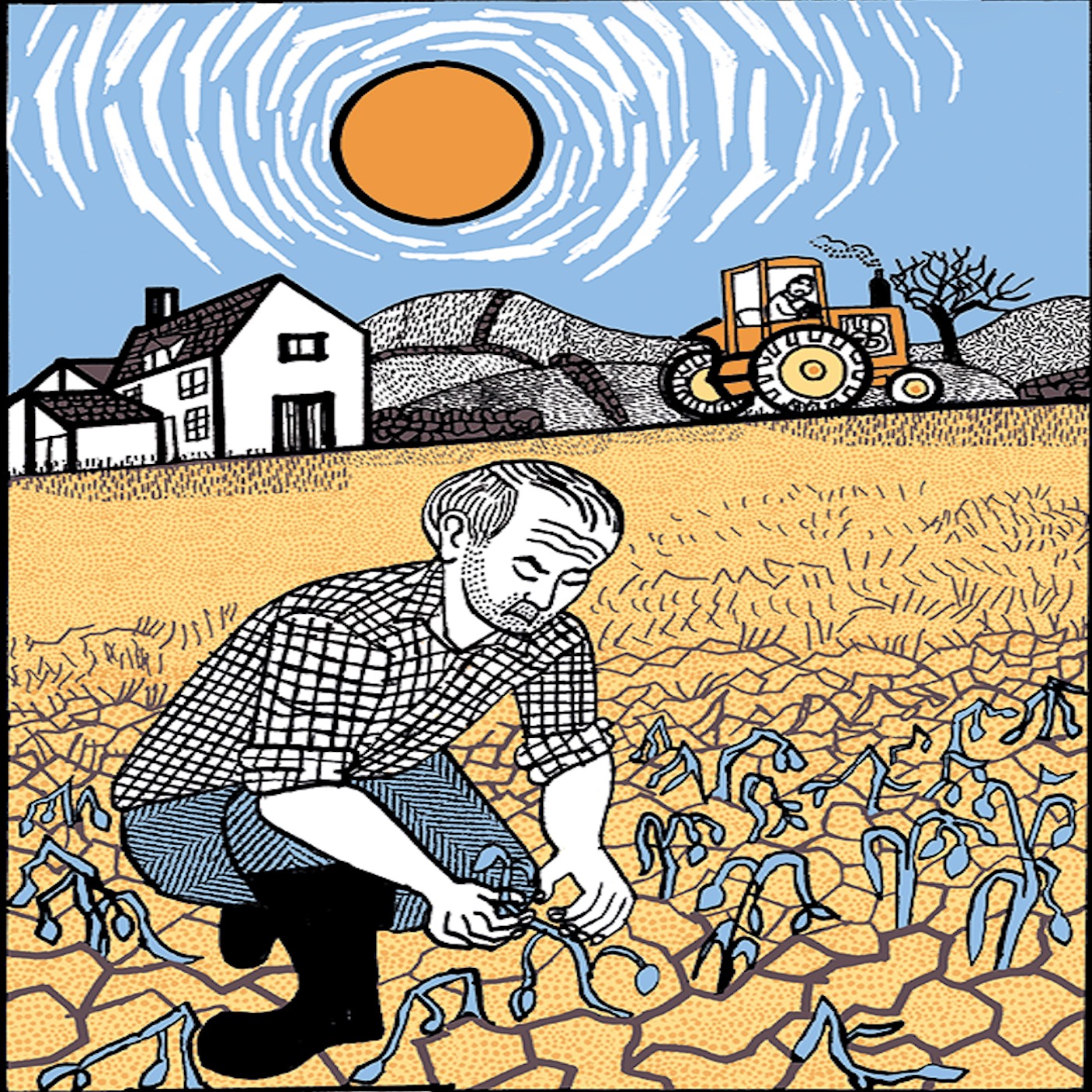
to amount to a total yield of 18.5 million tonnes, the most meagre since records began in 1984. Tom Bradshaw, president of the National Farmers Union, told the spectator that things are woeful. We're suffering a huge crisis of cash flow and confidence he said. The summer we've had followed inflation driven by the Iran crisis and the relentless heat and drought resulted in a brutal harvest. On the ground the picture has been both fascinating and deeply worrying. Potatoes which stop growing when it gets to 30 degrees have been tiny and peas, according to my Norfolk neighbour Jimmy Goodley, are as hard as bullets. In a normal year peas can be a big earner but this year rather than being hoovered up by birds eye, lots of them are only fit for animal feed. At the moment there is a dark irony in that lots of farmers like Clive Bailey and Staffordshire who organised the tractor protests last year outside Westminster are wondering whether they should bother planting crops in the coming weeks. He's lost money this year and he doesn't fancy doing so again. That said, Bailey notes that it feels are still so dry that he can't actually plow up his land ahead of
sowing next year's crop anyway. There used to be a joke, beef and sheep farmers like telling it went, what's a classic arable farmer's rotation? The response goes one year of barley, one year of wheat and a year in the south of France. Doubtless there was a time when the going was good for grain barons but at the moment there on their knees it's not just that the harvest was poor as Tom Bradshaw alluded to, the price of fertiliser most of which comes through the straight of her moves has gone up by some 30%. The cost of farming have soared, the harvest was dire and to top it off the price is being paid for cereal are on exciting. Wheat is now around £200 per tonne. In recent memory it was almost £265. The paradox is that lots of other farming regions around the world are having a fine time of it or we flounder. America and South American arable farmers are sitting pretty and the cereal market is a global one. For once it seemed that the tables had turned and those paulpers with their sheep were in a comparatively favourable position. The land price, due to a declining national herd, hit a record high of almost £10 per
kilogram in the summer but then Blue Tung a potentially fatal ovine disease broke out across the country. Blue Tung is spread by midges which have done well because of the heat. This agri-economic shit show is set against the backdrop of Labour's family farm tax. It's not just that the former Secretary of State for Environment, Food and Rural Affairs Steve Reed promised when Labour was on the campaign trail in 2024 that they wouldn't whack IHT on land, it's also that it's only set to raise £200 million. This is a rounding error for the treasury but it's catastrophic for farmers. The latest madness is that people aren't building the reservoirs they need for irrigation because they don't want to increase the value of their farm businesses and therefore the tax liability for their kids. As Gavin Lane, the president of the country land and business group puts it, the sensible thing to do would be to charge people capital gains on selling farmland but then again that wouldn't make landowners sweat, clearly for Labour that's no fun. One consequence of farming being in the doldrums and the need to generate cash to pay treasury invoices is the proliferation of diversification.
My neighbour Jimmy of Hardpeace Sorrow has built three paddle courts. Just down the road at Walsingham my father-in-law has turned to drink. Seven years ago when he planted nine acres of vines people suggested that his pino and wild grapes wouldn't get enough sun and Norfolk. No such worries this year. Elsewhere chicken farming is going great guns. Every year our poultry consumption increases by 3%. That said, guided broiler unit visits probably aren't going to work quite as well as those vineyard tours everyone seems to be doing. Michael Landel, a young farmer who lives near me has started doing picture-owned sunflowers. He is a tenant farmer so in theory he could just hand back his 358 as if he wanted to but he's reflective about why he won't be doing that. You come off the back of a year like this and part of you think sports the point he says, but I get to live where I live on the north north at coast five miles from the sea and there's a huge chance of pride in producing food. That's why I farm. Landel makes no bones about it because of the drought his barley was down 50% this year and the quality was so poor that it couldn't go for beer. The mulsters wouldn't take it. It's a sucker punch he says, but he adds, perhaps
optimistically next year I could have a bumper harvest it could be completely different. Farming is brutal now but it's been brutal before. Some of my wise family went to the wall after taking a wrong turn with cattle in the 1880s and post-war you couldn't give farm tendencies away. People kept at it though, in part because as Landel suggests there's a lot of love for the game. Perhaps that's why the last government took so much issue with farmers, too much pride, too much passion and far too much entrepreneurial grit. Patrick Galbraith is the telegraphs environment correspondent. That was Patrick Galbraith and last but by no means least is Matthew Rice on the unique companionship that artist Paul Aurego and her subject Anthony Rudolph had for over 26 years. The truth about modelling for a great artist. I was Paul Aurego's willing slave for 26 years. Anthony Rudolph interviewed. Artist models seldom get a chance to tell their side of the story. Yet one model, Anthony Rudolph, believes they deserve to be remembered for their work and their devotion. His dazzling new book Office Hours in the studio Paul Aurego celebrates one of
the most remarkable artists of our time from this unique perspective. Rudolph is a poet literary translator and the founder of the Menard Press. He had reggae partners for the last 26 years of her life, though she preferred the less business like French terms, compagnon and compane. About three months in, he realised you could never get near Paul Aurego office hours, which she worked strictly. A tendency to be asked if I could become a model and she'd flug her arms around me saying, I never dared ask you, so it was a win-win situation. It allowed him to spend much more time with her and her to give male protagonists a larger role in her pictures. Though they never co-habited, he was her official plus one. They ate together, went to the cinema and traveled to European cities. When the President of Portugal awarded her the grand cross of St James of the Sword, even appeared in Hello. Particularly towards the end of Aurego's life, he spent hours on the phone every evening reading her favourite poetry to her. This led to a special intimacy,
here, of course, because that was what I could do for her at that stage of her life, though she was also sketching me in her flat-up two or three weeks before her death. She was stuck in in prison in bed, and the way she could escape was through books and poetry. Yet the centre of gravity of their relationship, and so of the book, was the studio, which also had a flat attach, known through it off. Though she was a sweet, generous, and loving person at other times, there, Rego became a control freak and optional. The creativity and fun bit of modelling is when you are setting up the pose, he says. When Paula finally decided on the pose, it stands in for the story. Essentially, you sit still in this uncomfortable and eagled, though you learnt a few tricks. He would later impress a literary gathering by demonstrating how easy he found it, don'ten is still, for five minutes. I meet Rudolph, a vigorous and exceptionally
eloquent 84-year-old that is flattered, eventually. The door opens onto what looks like a store room below a library, a long narrow corridor crammed with books dating back decades. There are hundreds more books, letters and papers scattered right every room. Yet I'll prominent display a two extraordinary images of him, as Kafka's beetal and as the lecturer's penitent priest Father Amaro, who appears in a celebrated 19th century Portuguese novel. Rudolph estimates that he features in at least 12 series of paintings and drawings and about 180 images in all. These include some very loving sketches of me and some too erotic to ever be shown. Every artist has him erotic. Yet most of the time he appears in character, playing everyone from the wolf in Little Red Riding Hood to clear patria across dressed as Anthony. He certainly makes it sound like hard and sometimes humiliating work. In the last feed, 2012, he has dressed an appearer outfit and
represents corruption incarnated the old Portugal. Holding my crotch and my mouth on the breast of the mannequin, my character is in the words of Paula sucking Portugal dry. Another time he was a perverted woman sporting a little black dress which I had to wear back to front in order to squeeze in. Images inspired my Kafka's metamorphosis required him to slide in naked in one version deckerus, in the other less so, keeping a straight back with arms and legs supported by police and stirrups. He also quotes diary entries from the time, rufal comments such as, saw arses are given and I shall send Paula the austere path spill. He fell off a fiberglass horse while posing as Mr. Rochester from J. Nair. In some of the poses, Rudolph was able to take a quick glance at Rago working as she turned away from him to look back at the canvas. Such snatch glimpses over many years have enabled him to give
a varied sense of how she struggled to manage the constant tension between the pictorial and marital. This sometimes led to decisions about whether to move away from the imagined story, often derived from a book or another source, or change the design. The picture is finished when the story and design have become one. Since the book is rooted in personal experience, it isn't in competition with the vast literature on Rago's influences, art historical references, and the meanings of her powerful but often aiming-matting narratives. Nonetheless, Rudolph makes clear that what she said about her art in public was often playpore perverse and contradictory, and agrees that critics sometimes attach too much significance to such, off the cuff from marks. There have been some fierce debates about the role of models in Western art. One familiar argument is that male painters have been happy to project their own feelings onto often nude female models and portray them as a luring, mysterious, or dangerous,
but without much individuality or in their life. What does Rudolph feel about such claims? Whatever was good for Paula was good for me, he replies. It was as simple as that. Outside, when she wasn't working, we were equal. When she was working, I was a willing slave. The model is like the man a kid I sometimes sat with. You were just there. Since he was generally playing characters, the issue of doing justice to his appearance was largely irrelevant. Finding the best lightness is a default position. Paula could do it in her sleep and draw me even if I wasn't there, and she would then deviate from it to get the character from the story. In the sale 1997, she got a fabulous lightness and then realized it was the wrong face for the story. So she said, I've got to spoil your face. Sorry. She twisted it and made it more tormented. She tormented the paper with her pastors until she got the psychological torment of the wicked priest, Father Amaro. It is clear that much of Raydo's work expresses her feelings
about patriarchal power as represented by clerics, fathers, dictators, and characters' conviction. This meant the root of often had to pose either as what he got alpha, marcher characters, or as defeated and feminilist men. She projected onto me these different kinds of male figures that she was interested in. When he was required to take painful abject or whom humiliating poses, did he ever feel she was also working through complex feelings about him? He has little time for this suggestion. When we weren't working, we were compatible. I don't think she would have put up with a defeated or feminized man or his opposite, an ultra-matcher man, whereas I am just a normal bloke. But I may be the wrong person to ask. Instead, he argues Raydo was able to address the tangled and bivalent and file the despics of relationships between men and women, knowing that life is full of such complexities and contradictions. She embraces all that because she's a grown-up, but she does the work almost
like a child. Key to this was the fact that the studio is a place of total freedom and total routine. It's quite vital that everything is routineized, the breaks, the music, the food, and within that strict routine she was completely free to confront her demons. Although the whole book is a tribute to a beloved compane, perhaps the most poignant moment captures the fierce but magical complicity Rudolf sometimes experiences with Raydo in the studio. Best friends and lovers, we were like two criminals and conspirators, like children in the playground or actors in the theatre prop store. These images convey the atmosphere of the crime scene which is the studio, a grown-up version of a childhood player or where, in vengeful and contrary mood, she snapped the fingers off her dull, a precursor to her cutting up items for collage. Anthony Rudolf's office hours in the studio Paul Raydo is published by Art Publishing Inc on 30th of October.
This is the story of the one. As a shipping manager, he's running the dock, stocking supplies, and making sure every order goes out on time. And Granger helps him stay prepared. From shipping supplies to PPE to hand tools, he counts on Granger to keep products moving and trucks rolling. So his operation runs smoothly, no matter the shift. Call 1-800-GRAGENGER, click ranger.com or just out by Granger for the ones who get it done. Forward slash voucher to claim this offer now.
More episodes
More from Best of the Spectator

Quite right!: Danny Kruger interview | LIVE at Reform Conference
Best of the Spectator

Coffee House Shots: Malcolm Rifkind on Farage, Kemi and Burnham's gift to the To...
Best of the Spectator

Quite right!: Francis Fukuyama interview
Best of the Spectator

The Edition: has Reform UK lost its magic? | with Quentin Letts
Best of the Spectator