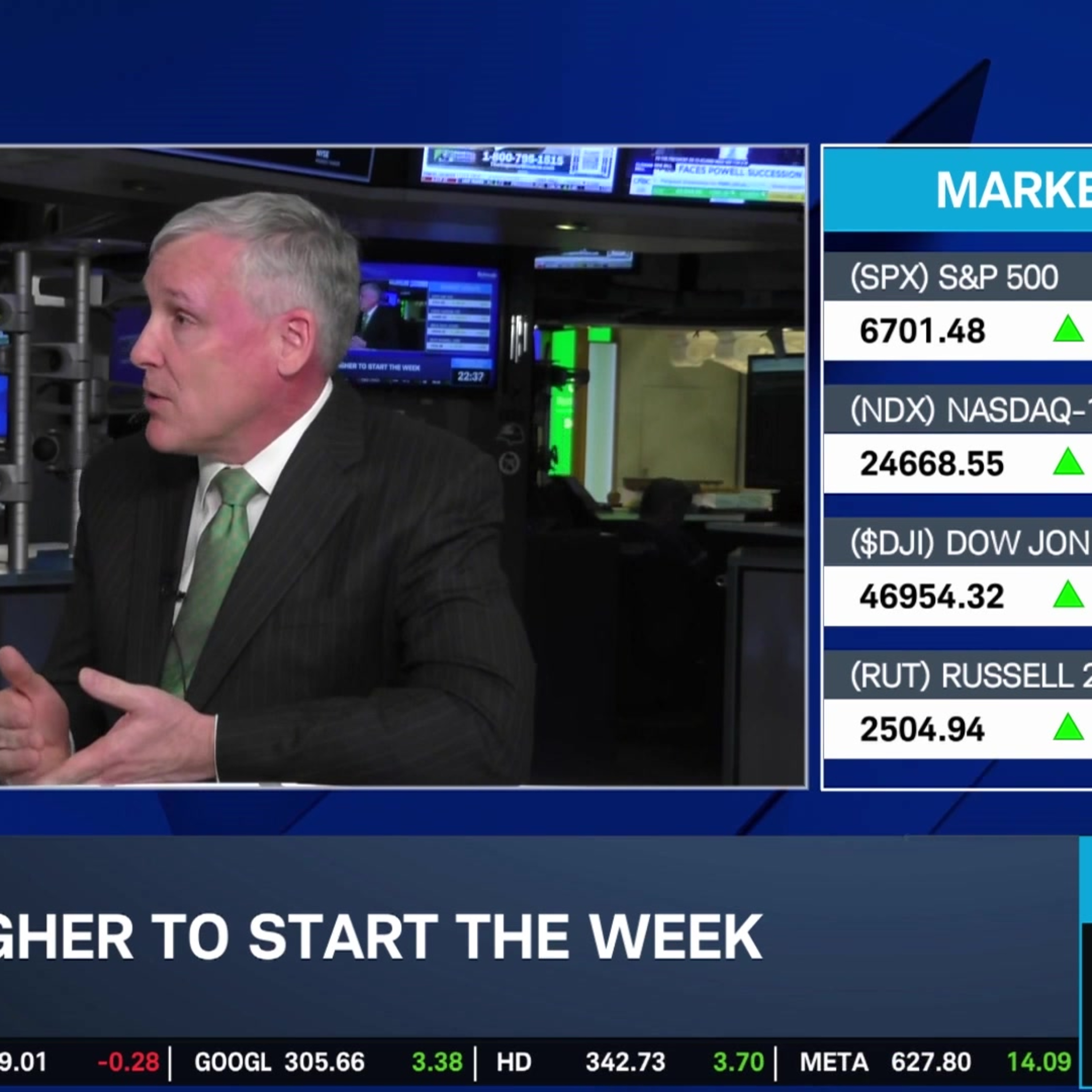
Smaller Tech IPOs Can Gain ‘Thousands’ of Times After Going Public
About this episode
Jeffrey Stewart brings his new book, The Great Rewiring of Capital Markets, which covers how capital has gone global and sharpened its interest in high-growth tech companies. Regulations are moving to allow access – and it’s important for these companies to go public. He thinks it’s a “golden era” for IPOs where companies won’t wait as long to go public, vs the “mega” IPOs we’ve been seeing over the past few years. He sees gains in “the thousands” ahead for some of these companies.
======== Schwab Network ========
Empowering every investor and trader, every market day.
Subscribe to the Market Minute newsletter - https://schwabnetwork.com/subscribe
Download the iOS app - https://apps.apple.com/us/app/schwab-network/id1460719185
Download the Amazon Fire Tv App - https://www.amazon.com/TD-Ameritrade-Network/dp/B07KRD76C7
Watch on Sling - https://watch.sling.com/1/asset/191928615bd8d47686f94682aefaa007/watch
Watch on Vizio - https://www.vizio.com/en/watchfreeplus-explore
Watch on DistroTV - https://www.distro.tv/live/schwab-network/
Follow us on X – / schwabnetwork
Follow us on Facebook – / schwabnetwork
Follow us on LinkedIn - / schwab-network
About Schwab Network - https://schwabnetwork.com/about
Get every episode summarized
Each time Schwab Network publishes, we email you a written briefing from the transcript — the topics, who appeared, and any specific claims, with the ad reads skipped.
Email me new episodesFree for 3 shows. No card needed.
Transcript ready
150 searchable segments. Every word is indexed and playable.
Full transcript
Schwab Network — Smaller Tech IPOs Can Gain ‘Thousands’ of Times After Going Public. Machine-transcribed; use the interactive transcript above to jump the player to any line.
Welcome back to Market on Clothes, Ensemble. It's joining me on the floor of the New York Stock Exchange. Very now is the Managing Director of GPO Fund and Altruv at Global IPO, the great rewriting of Capital Market. Jeffrey Stewart, thank you so much for your time. Thank you for having me. I really appreciate it. Here is a copy of your book that's coming out this week, I believe. End of the month. End of the month. Okay, very good. So, just talk us through exactly why you wrote this. You call it the great rewiring of capital markets. What is being rewired and what's so great about it? Well, when I started as a tech entrepreneur, companies went public all the time, hundreds every year. And then companies stopped going public and what I saw was the destructive nature of staying private forever. At the same time, those starting companies all over the world and investors were asking me, how do we get to these great, high growth companies? And I realized that the markets were changing and that most capital is now global and most capital wants direct access to these high growth companies. And luckily, technology and regulation is falling into place, so that's going to happen.
Is that globally that regulation is falling into place? And what is that? I mean, what has changed fundamentally? Well, I think what's changed is people have realized that if they have bad regulation, investors go elsewhere and founders go elsewhere. Right. So, you've moved to a world where hundreds of millions of people around the world are moving into the middle class and they have direct access to the markets through their smartphone. But more important is every payroll cycle, billions of dollars are showing up into their passive funds and into their active funds. And those funds are looking for a place to invest and it's going to find its way to the IPOs. Okay. So, you're calling it the golden era. Obviously, we've got a pretty good looking IPO outlook this year with some big names. Just before we went to the break, we named a couple of those that we're expecting to go public this year. Why do you believe that now is a good time? Well, I think over the last 20 years, you've seen mega IPOs. It was really about staying private and then using the public markets as an exit once most of the juice had been squeezed out.
But we're moving now into an era where you can go public earlier with less friction and tap into that credibility of the public market. And that means that investors, once again, will be able to get into companies like NVIDIA. NVIDIA was under a billion dollars when it went public. It went up thousands of times. So it's these smaller companies that still have lots and lots of growth ahead of them. Those are the ones that we're excited about. And we think we're going to see hundreds and hundreds of them in the coming years. When you say small companies, I mean, which sectors are looking to take advantage of this change in regulation and this kind of environment that we're seeing? I mean, has that changed a lot since the beginning of your career when you started thinking about global IPOs and from what we've seen in history? Well, I'm a tech guy. I used to write software and I think a lot of the focus right now is on IT and AI. But really, the excitement is in every industry. I'm a pharmaceutical discovery about to be rewritten because of AI.
Real estate about to be rewritten because of AI. Construction, manufacturing, material science. Every industry is about to be re-structured kind of in the way that steam did the turn of the century. You have a huge industrial renaissance and the public markets are the right place to sort that out and direct the capital to where it needs. But at the same time, I was just saying a fascinating chat with my previous guest about that is AI creating a tougher entry point for companies because I mean, you're a software guy. You have seen the decimation in that multiple compression we've seen in software. Is it everyone's just freaking out throwing babies out with barforder to figure out who's going to be the winners or the losers here? Is that not scary for those who are wanting to get into the public market? Well, I think it's very scary for the incumbents. I mean, if I was an insurance right now, I counted on regulation and things being the way that I'm used to. Yeah. As my defensive mode, I'd be worried because startups are using AI to rip through that
and enter new markets. Right. You're seeing it in medicine. You're seeing it in professional services as professional services move from human based to AI based. It's going to be really, really exciting. And I think that as an investor, there's never been a good, better time to understand an industry and see how technology is going to change that industry. Interesting. So how are we thinking about some of the big guys? I mean, I know you mentioned some of the small companies and that's really exciting for them. But as we went into the breaker, we talked about SpaceX and anthropic, these are all who meant to be sort of the blockbusters. Everyone's really excited about how are you thinking about some of those names and timelines and just the impact that they're likely to have on the market's psychology. Well, they have a huge impact, I mean, but the biggest impact is for the bankers and they've got huge fees. Look at Facebook or now Matt, when it went public, that was a $100 billion company. It went up 17 times. I mean, that's exciting. I mean, I'd love to have all my investments go up 17 fold. But if instead you look back at companies like Adobe or Oracle, companies that went public
before they were a billion dollar companies. They went up thousands of times. That's really, really exciting. And I think for investors who can spot those trends, who use those products, who understand those industries, who have friends who work at these companies, they're going to be able to get in on these companies before the giant funds act on it. So it's a great time to be an active investor, even a small investor, or a small fund, because there's so much changing. I'm sure you've seen a fair share of conflicts throughout the time in your career and working in public capital markets as well, and just wondering what you're thinking about with respect to the energy shock and this Iran war with so much uncertainty in these markets. I mean, you wouldn't tell on a day like today, but I'm just wondering if that pushes back or gives companies cold feet about their plans or thoughts about entering the public market. Well, I think a big part of what's going on is around electrification and digitization. That moves at the speed of electrons. So as certain jurisdictions, their cost of energy is higher.
Just means you're going to put your data centers elsewhere, you're going to build your software, you're going to build your products elsewhere. So I think energy is driving the entire economy, especially as we're increasingly digital. So I think that what it does is creates opportunity, which is good for investors. And you said in order to write this book, I mean, it's called Global IPO. I mean, you obviously had to zip around the world to get a sense of what is happening and something I've noticed is that more and more companies are actually choosing to list. Locally, our home, I've been watching the Chinese market for many, many years. I mean, some of the IPOs that are coming out of Hong Kong and Shanghai in recent months are just bonkers. I mean, 400, 700% on the day view days, just talk us through what you're seeing as far as some of that trend. Well, I think years ago, where you listed mattered a lot and where you treated matter. Now things treat everywhere. In some cases, 24 hours a day. So I think the important thing is to figure out what's the right exchange to list for your company. And then more important is attract investors from around the world.
Because they're just one click away from owning. And if you find the right investors, they can support your vision and you can build a great, important company. So what we encourage our portfolio companies to do is to start building those relationships long before you go public so that you can execute, you can show that you're building something. And then those investors can support you in the public market. And even after you're included in indexes. Makes sense. Jeffrey, we have to wrap it up there. A bit of fantastic chat. Thanks so much for joining me here on The Fourth New York Stock Exchange. Really appreciate it. And good luck with all your sales for your book. Thank you. Really appreciate the chat. Jeffrey Stewart, their GPO fund. Thanks so much for joining me here on The Fourth New York Stock Exchange.
More episodes
More from Schwab Network

Stock Market Today: ORCL & ADBE Earnings, AEO Plunges Near 52-Week Low
Schwab Network

Thursday's Final Takeaways: Crude Taps $103 & PPI Hotter than Expected
Schwab Network

Balancing High-Conviction AI With High-Dividend Diversification
Schwab Network

EARNINGS PANEL: ORCL, ADBE
Schwab Network