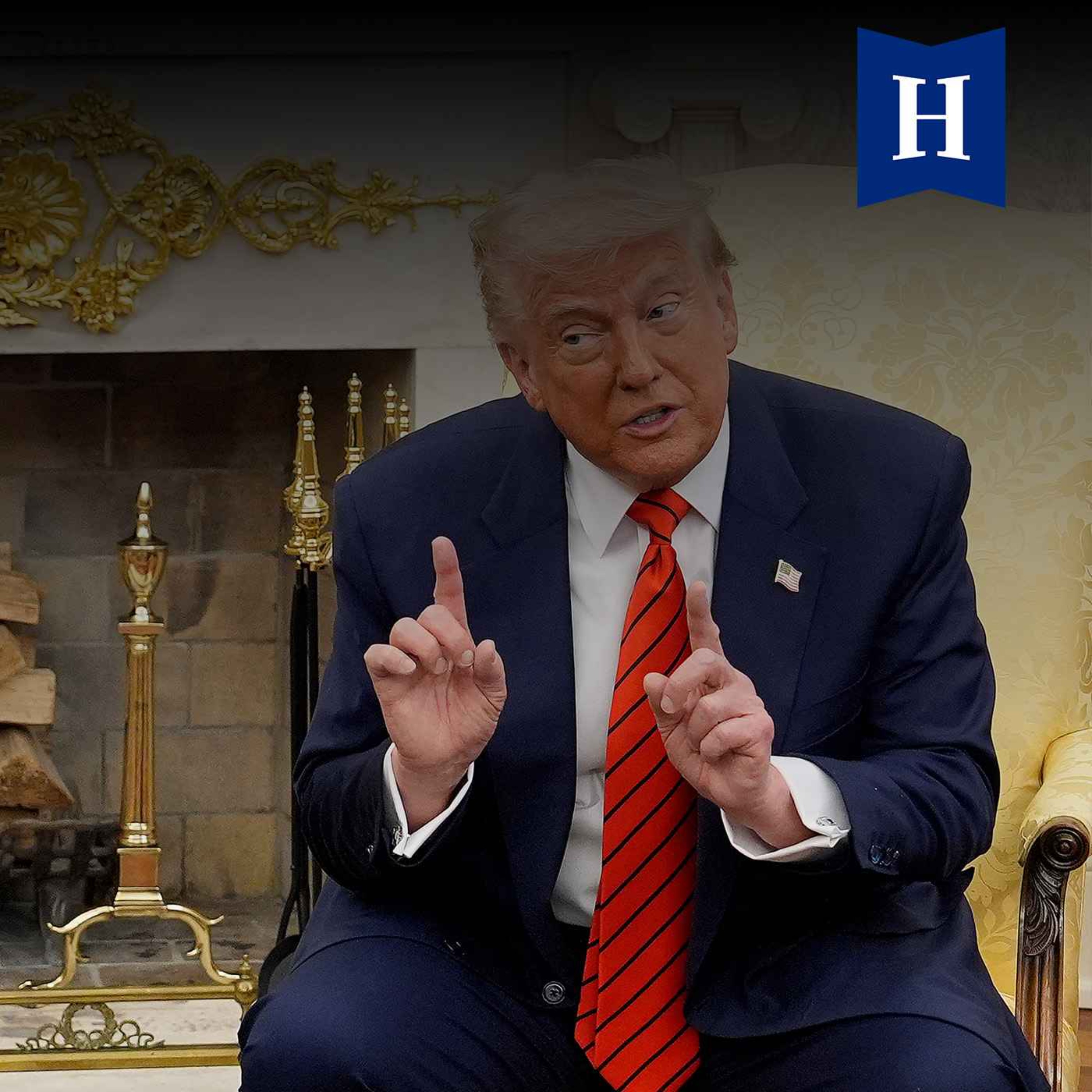
About this episode
Hub Podcasts is made possible by:
Rudyard Griffiths and Sean Speer analyze the Trump administration's latest tariff escalation against Canada, examining the shift from broad tariffs to targeted sectoral measures and procurement restrictions. They debate whether Canada should continue retaliating or seek an off-ramp, discussing the asymmetry between the two economies and the risks of prolonged conflict. They explore how Canada's industrial structure could be fundamentally reshaped if the Carney government plans to wait until after the 2028 presidential election for another president more inclined to improving economic relationships, and question why domestic economic reforms remain absent from the national conversation.
The Hub is Canada’s fastest growing independent digital news outlet.
Subscribe to The Hub’s podcast feed to get our best content when you are on the go:
https://tinyurl.com/3a7zpd7e (Apple)
https://tinyurl.com/y8akmfn7 (Spotify)
Follow The Hub on X: https://x.com/thehubcanada?lang=en
CREDITS:
Daphne Liang - Producer and Editor
Rudyard Griffiths and Sean Speer - Hosts
Adrian Wyld/The Canadian Press - Photo Credit
Hosted on Acast. See acast.com/privacy for more information.
Get every episode summarized
Each time Hub Podcasts publishes, we email you a written briefing from the transcript — the topics, who appeared, and any specific claims, with the ad reads skipped.
Email me new episodesFree for 3 shows. No card needed.
Transcript ready
298 searchable segments. Every word is indexed and playable.
Full transcript
Hub Podcasts — Should Canada keep fighting Trump’s tariffs?. Machine-transcribed; use the interactive transcript above to jump the player to any line.
In a world where AI is changing every role and every industry, knowing who actually has deep expertise matters more than ever. Upwork connects you with the highly skilled freelance professionals with proven track records, so you can hire with confidence. Upwork gives your business fast access to highly skilled specialists with deep expertise, so you can fill critical skill gaps, launch projects faster, and scale support up or down without committing to full-time headcount. With Business Plus, you can access the top 1% of talent on Upwork. AI-powered shortlisting delivers a curated shortlist of top freelancers match to your goals, in under 6 hours. No endless searching required. Thousands of growing businesses already trust Upwork to hire highly skilled freelance professionals for everything from one-off projects to ongoing support. It's free to sign up and posting a job is easy. Visit Upwork.com right now and post your job for free. That is Upwork.com to connect with top talent ready to help your business grow. That's UPWORK.com. Upwork.com.
Hi, I'm Jack Ravic, your Kramer host of the best one yet. At T-Boy, we're always talking about small decisions that can have an outsized impact. One of the simplest is staying hydrated. Whether I'm traveling, getting a workout in, or heading into a busy day, I keep liquid IV on hand. It's clinically demonstrated to hydrate faster than water alone and contains three times of the electrolytes of the leading sports drink, plus eight vitamins and nutrients. It's an easy addition to your daily routine and helps support hydration when you need it most. Shop now at liquidiv.com. Liquid IV hydration that goes wherever life takes you. New Trump tariffs announced today hitting Canadian suppliers to the U.S. government along with people making motorcycles selling alcohol and a bunch of other things in Canada to the U.S. to help break down this latest escalation in Canada's fast evolving trade war with Donald Trump. I've got Sean Spear, co-founder and editor at large at the hub on the line. Well Sean, picking up on our conversation yesterday where we predicted escalation, here
we have it. What do you make of the particular announcements of the last 12 to 18 hours? Do they allow us just begin to start calibrating how the U.S. administration is responding to our retaliatory tariffs enacted on Tuesday? Yeah, I think some of the tariffs on Canadian exports in the U.S. are pretty marginal. They'll affect those industries and suppliers and consumers and I don't want to diminish that. But in the grand scheme of the thing, they are not the nuclear option if I can put it that way. And the direction from the administration to the GSA, basically the entity within the U.S. government responsible for procurement, think of the Canadian equivalent of public works is a bigger deal. It's an example of the administration expanding the remit of prospective responses from tariffs on particular exports and thinking more broadly about using the awesome power of the U.S.
government to punish Canadian industries and firms. We talked yesterday, Roger, about the risk that the administration pursues this path that expands its response beyond tariffs. And so in that sense, I think it is notable and worrying. And I would just say this before I turn it back to you, even if one thinks that this is an administration in shambles, that it is the kind of that best C or D team, don't underestimate that the U.S. government itself is sophisticated. And so if the administration reaches into the government and says, you know, produce 5, 10, 15 ideas that we can sign through executive order or execute without legislation that would do real harm to Canada, the system will do that. And so I think it is a sign, Roger, that we should be prepared for similar kinds of responses, possibly targeting visas or taxation or other non-terriff means that could do real harm to Canada and real harm to Canada's economy.
And so I think that is where we need to kind of keep our eye on the ball. Yeah, great analysis. And I agree with you Sean. It seems maybe unfortunately that the United States has learned from its trade fights, particularly with China where it tried to get into these very kind of almost simplistic, and a ratcheting up of a gross terra freight on the entire Chinese economy. And eventually, as we discussed yesterday, prompted the kind of rare earths threat from China that caused that all to kind of unravel, at least the credibility of America to fall through with those tariffs. This does feel different the last 12 to 18 hours. It feels asymmetrical in a way. It feels as if the United States is now going to look at its full panoplay of pain and pressure points on the Canadian economy. Via tariffs, it's now seeming to do this with a kind of sniper rifle, taking out motorcycles, alcohol.
It's not in substantial. I mean, if you think of Canadian liquor and booze sales into the United States, but nonetheless, US officials telegraphed yesterday that the total annual goods covered in those new, let's call them, I don't know what you call them, sectoral product-based tariffs, was we're only roughly a billion dollars. Whereas you're right, they're alleging that locking Canadian suppliers out of the ordering system that not only the US federal government uses, but states use to avoid having to get into kind of third-party bidding, it's a procurement system that allows them to skip over that. So there's a lot of incentive for them to use that to quickly access. I don't know. Highway signs. You name it. Trash cans for state parks. All of that, Sean, $50 billion a year alleged by the US administration in terms of the value
of Canadian contracts currently in the system. We'll have to see that number proven out, but that's not a small number, is it? Yeah. And I, Roger, you've raised this point with me, both on the show, but also offline, that even the threat of executive action in certain sectors or affecting certain parts of Canada's economy may be enough to induce a reaction in the US amongst industries and consumers that could do real harm to Canada. We've talked, for instance, about the prospect of the President even threatening to study Canadian banking licenses in the US. You could see a world where that led to almost like a run on the US operation of those banks, which would put pressure on their share prices in Canada, possibly their capital ratios. So, this is going to be a response from the administration that can't count on Congress.
You know, I think in fact, Canada has a lot of allies in Congress. And so it's going to require the President and those around him to think kind of creatively, if I could put it that way, on the tools at their disposal that they can use unilaterally to do harm to Canada and make no mistake. As I said earlier, the US government has awesome power across a range of areas. We've seen the extent to which this President is not afraid to use delegated authority from Congress, even if that authority is contested. And the point is, even if those issues are ultimately resolved in the courts, the threat or the specter of the administration leaning on parts of Canada's economy is enough to do harm. And it comes back to our point. This is, I don't think anyone can underestimate the harm and the risks associated with an escalating trade war with the United States.
So if we're starting to see, in a sense, a drip, drip, drip, a kind of form of Chinese water torture that the Trump administration will now perpetuate on Canada. Maybe we'll be seeing these types of targeted actions, you know, on a regular basis. Maybe every few days, maybe as long as this goes on a weekly or out of the blue moment again, destabilize, create a perception of uncertainty vis-a-vis the Canadian economy, its future, your ability to invest there. How does the Carney government respond to this? Because we chose on Tuesday night at 12 o' 1 a.m. to retaliate vis-a-vis what was a, I don't know, I think a somewhat, I guess, efficacious to the extent that matching the previous tariffs with our own tariffs sends a message that we're willing to walk up the escalatory
ladder that we have the courage and the conviction to do that. But if the United States is moving off that playbook and they're going to go for these targeted, specific product-based or, as you say, licensing visas, I mean, it's terrifying to think of the 1,000-in-one ways that they can torture Canada and Canadians through the regulatory power of the U.S. federal state. How does the Carney government respond to that? Do we now shift our strategy to a similarly asymmetrical approach and pull out our version of a sniper rifle? But then, hey, Sean, as we've discussed before, you get into the bigger asymmetry, which is just the sheer size of the U.S. economy and the extent to which as accurate as that Canadian sniper rifle might be, it's kind of a pea shooter, isn't it? And the context of the damage that it can ring to a $30 trillion economy.
Yeah, I think that's exactly the type of conversation happening around the Prime Minister's Office right now. We're using the metaphor of war. Let me, you're interested in history. Let me kind of extend the historical analogy a bit, Roger, on one hand, I think that has to be on the table the type of thing that they're discussing internally and what tools are at their disposal up to, including possibly export taxes on Canadian energy. But there's another scenario, another historical analogy, and that may be the Cuban missile crisis. You'll recall in that episode, the administration of JFK decided not to respond to what appeared to be a kind of hostile message from the Soviets and instead decided to wait it out and were rewarded for that. And I wonder, Roger, if the notwithstanding of the potential threat represented by these
procurement restrictions, that the extent to which the retaliatory terrorist themselves are relatively modest, isn't an opportunity for the current government to try to off-ramp from ongoing escalation. So I think both of those scenarios are probably being discussed right now and have to be seriously considered. And I hope that that latter one, that we, instead of responding to the tariffs on motorcycles and other goods with our own round of tariffs, we use this as an opportunity to try to let cooler heads prevail. Yeah, I think there's a case for that, Sean. I mean, the Chinese did much the same thing at one point, you know, when US tariffs succeeded 100% on Chinese exports, they called them meaningless and they stopped matching the US kind of escalations. That ultimately worked for them again for other reasons related to rare earths and the dependency
of the US industrial complex and military on those unique specific Chinese exports. I guess my question for you as we wrap up today's hub hit those, Sean, is that strategy, which might be the more, let's say, level-headed strategy, which is not to respond to, acknowledge possibly, in fact, that Trump's reaction to our retaliatory tariffs on Tuesday might have been much more outsized than what we've actually seen in the last 12 to 18 hours. So maybe this is the administration sending a signal saying we don't want to kind of run off a cliff with Canada. Maybe the midterms are constraining them a little bit in that regard. But the problem remains, Sean, going back to your early comment, the uncertainty is there. As long as this trade war goes on, there are 1,000, 10,000, 100,000 business decisions being made across Canada about where the future of investment and capital is deployed.
And companies have to, probably out of necessity, either begin to shift as many companies had said that they had pre-staged, worrying companies, reporting that they were pre-staging the possibility of operations in the United States so that they could flip on factories and distribution hubs in a sense overnight, or if they haven't gone that far, begin planning for that eventuality. So I just don't... My question, Sean, I look, it's not a $64,000 question. It's a $64 billion question or more. Being doesn't seem like a sustainable strategy for Canada. And that's why almost perversely, like certainly against my inclinations or desires, I wonder if we don't have to escalate in order to bring this to some kind of crescendo sooner or not later and understand that the midterms, at least in the short term, are a pain point
for this president and for this administration. What do you make of that? I know there's no right or wrong answer, but it's interesting to speculate what we do next, because I think that there could be an equally pervasive argument that, you know, sitting on our heels and accepting this status quo from now to November opens up the possibility that this becomes a status quo from now until 2028 when this president hopefully leaves the White House. Yeah, just a few things in response. First of all, I agree with you fundamentally that waiting itself is a consequential choice that comes with a series of consequences and try to oss, and we ought to be clear about those. Secondly, as you say, maybe there's a way to kind of try to induce a faster returns and negotiations. And maybe that involves having to go even further than we've gone to date.
That may be right on the other hands. The asymmetry, which is really at the heart of this trade war, something we've underscored in all of our conversations, just hands so much power over to the administration and the president who we would both concede is kind of erratic at best. The last thing I just want to underscore though, because you raised an important point, the cost of waiting, if the real plan on the part of the Carnegie government and those championing its course thus far, is that this is going to get better after the 2028 presidential election that come January 2029, an incoming president is going to be more inclined to some kind of normal economic relationship with the United States. Man, Roger, that is a serious bet with a lot of consequences in the intervening time.
I worry a lot that whatever we're left negotiating in 2029 is an economy and industrial structure that looks a lot different than it is today. I think that's something that the Carnegie government needs to reckon with and those encouraging it to dig in and turn this into the Western Front. Similarly, you need to reckon with the cost of waiting, the cost of an action, maybe that the industrial footprint at the heart of Canada's economy looks fundamentally different to 1.5, 3, 4 years from now. It's a debate for another day, Sean, but if your policy preferences are in fact for more of a state planned economy, for a greater role for public capital and political decision-making in so-called major projects and other large-scale capital investments, boy, this trade war is kind of mana for heaven. It gives you a proverbial blank check to start writing ones with lots of zeros behind
them to do precisely what you said, which is refashion, remake the Canadian economy, kind of back to the future, back to the 1970s, more crown corporations. I would argue less consumer choice, less dynamism in the Canadian economy would be the cost for that. Let's pick that conversation up at another time because it is a significant one and I think it, you and I share a concern about the extent to which the range of public debate now in terms of how we're responding to these tariffs. I've noticed, unfortunately, in the last two weeks we've had very little or any conversation about why we truly have free trade within Canada between the provinces. Why isn't that number one on our premier's agendas as opposed to the status of you as booze on the shelves of their liquor retailers? I digress, Sean, but the issues here, the stakes are not small simply for the trade war.
It really is the kind of the future of the Canadian economy, the role of the state and the economy that agree to which we do or don't do, the things that we can actually act on right now to liberalize this economy, to make it more dynamic, to make it in a attractive place to invest capital, to build businesses. Those seem like to me job number one and I'm just surprised, Sean, they seem completely missing from the conversation, MIA, for the last two weeks. Let me give you the last word. Yeah, me on. What a salvage. I couldn't agree more. I mean, think about it. If the plan is to sustain an escalating trade war between now and say 2029 and the hopes that things look better on the other side of the Trump administration, we have to take for granted that that involves just a huge set of subsidies from the federal government and provincial governments to sustain Canadian businesses in the mean times to sustain Canadian
workers in a way that would frankly extend beyond what we saw during the pandemic, which was shorter in duration. So I mean, that I think we really aren't, there's just so much focus on the understandable aversion to the president and all the rest and I get all of that. But we need to kind of think through this systematically. Is the plan on our end to escalate a trade war? Is the plan to wait until after the midterms of the presidential election to hope that things get better? If the answer is yes to those questions, then the next questions are what are we doing in the meantime? And it just seems to me, Roger, a lot of people who are counseling waiting are failing to kind of reckon with a series of secondary and third questions, which Canadians own and oh, answers to. Yeah, yeah. The silence is conspicuous at least in terms of where we go, where we go next next week, next month, next year. I feel like I don't really understand.
Maybe it's just me what the what the economic plan is for the country. Sean, great hub hit. I'm enjoying doing these weekly, these daily hits with you on hub hits focused on the trade war. We're going to keep at it for our podcast listeners and the over 80,000 people subscribing to our YouTube channel. Yeah, thanks for tuning in. Thanks for listening and watching back at you tomorrow with our next hub hit on the trade war. Hi, I'm Jack Ravitch, a Kramer host of the best one yet. At T-Boy, we're always talking about small decisions that can have an outsized impact. One of the simplest is staying hydrated. Whether I'm traveling, getting a workout in or heading into a busy day, I keep liquid IV on hand. It's clinically demonstrated to hydrate faster than water alone and contains three times the electrolytes of the leading sports drink, plus eight vitamins and nutrients.
It's an easy addition to your daily routine and helps support hydration when you need it most. Shop now at liquidiv.com. Liquid IV hydration that goes wherever life takes you. Real talent is defined by what people can do, not where they learn to do it. So by stopping at the education section of a resume, you might throw away the perfect chiro. Skills first hiring helps you see talent others miss. Like more than 70 million stars, skilled through alternative routes. Let their story unfold and gain a competitive advantage because hiring managers who start with skills are 60% more likely to find a successful hire. Hire skills first. Learn why at tetherpapercealing.org. Brought to you by Opportunity at Work and the Ad Council.
More episodes
More from Hub Podcasts

9/11, Europe, and the fight over immigration
Hub Podcasts

How much slack is left in the global oil market?
Hub Podcasts

Canada’s low-quality trade war debate
Hub Podcasts

Andrew Coyne says we are at war, but is that true?
Hub Podcasts