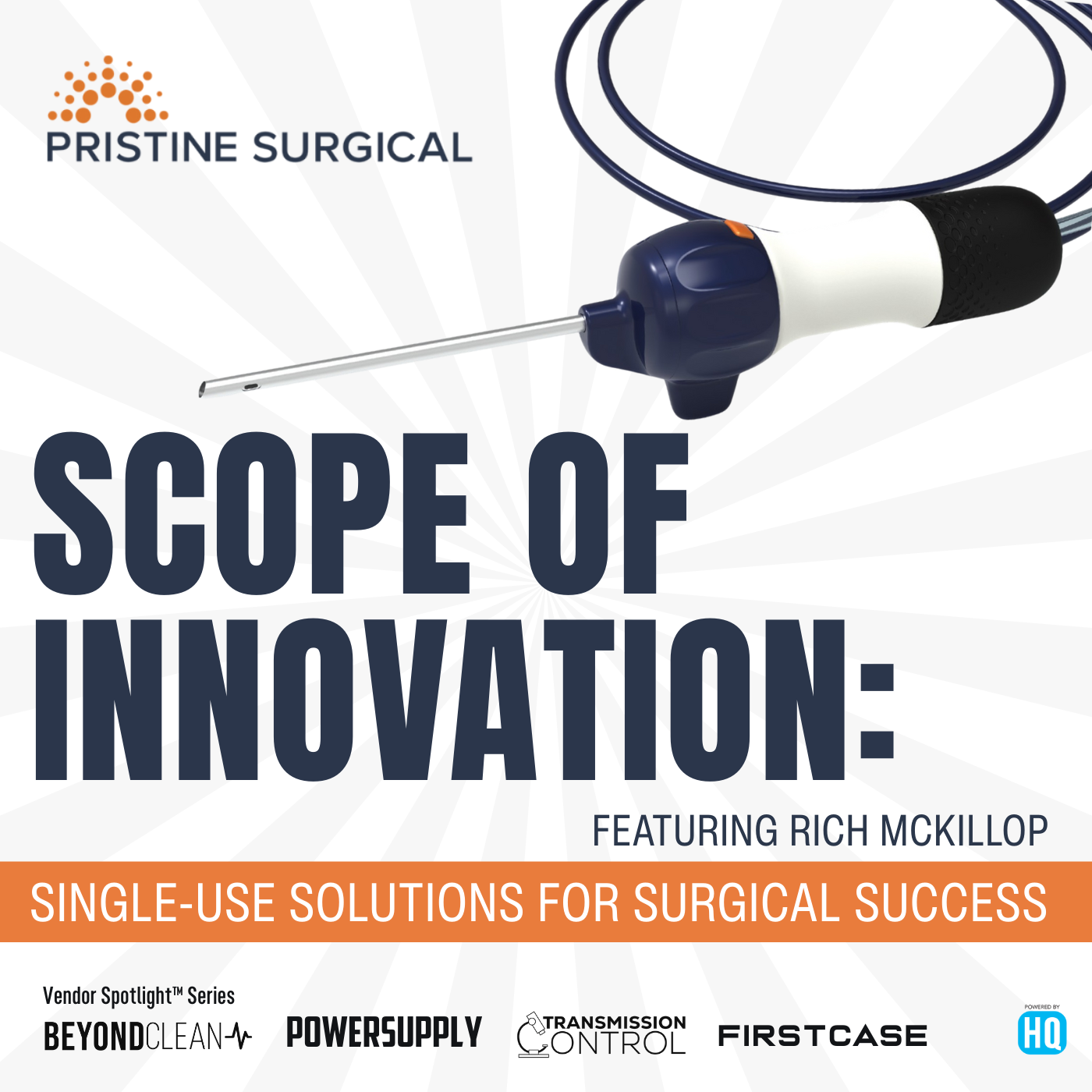
Scope of Innovation: Single-Use Solutions for Surgical Success
About this episode
Perfect imaging every time. No repairs. No reprocessing. Could single-use arthroscopes be the answer? On this special Beyond Clean, First Case, Power Supply, and Transmission Control Vendor Spotlight™ co-release episode, we're joined by Rich McKillop, CEO of Pristine Surgical, to explore how their Summit™ 4K Single-Use Arthroscope is redefining what efficiency looks like in the OR. Learn how this single-use solution delivers consistent 4K image clarity while eliminating the time, labor, and costs associated with scope reprocessing and repairs. Through smart, cloud-connected technology that delivers real-time data and case analytics, discover how Pristine Surgical can help your department optimize workflows, reduce costs, and improve patient outcomes!
Learn more about Pristine Surgical's single-use arthroscopy solutions by visiting pristinesurgical.com. To access the cost savings calculator, schedule a demonstration, or learn more about Pristine Connect®, email [email protected] or follow them on LinkedIn.
Get every episode summarized
Each time Beyond Clean Podcast publishes, we email you a written briefing from the transcript — the topics, who appeared, and any specific claims, with the ad reads skipped.
Email me new episodesFree for 3 shows. No card needed.
Transcript ready
942 searchable segments. Every word is indexed and playable.
Full transcript
Beyond Clean Podcast — Scope of Innovation: Single-Use Solutions for Surgical Success. Machine-transcribed; use the interactive transcript above to jump the player to any line.
Obviously, a savings from an SPD perspective, it's a savings from a reprocessing and repair perspective, we eliminate all service contracts that exist out there with companies besides the capital expense up front, which can be significant. A typical video tower you're going to spend probably in the range of $100,000. So that all goes away, reprocessing goes away, efficiency gains are incurred by all of the ASCs so that it can actually become a revenue generator for them. Rising above the buzz of ultrasonic cleaners and the clanking of stainless steel are the ideas and voices that are changing in industry. You're listening to the Beyond Clean podcast, the central nexus for the people, processes, and products that are improving our sterile processing world. Each week, we speak with frontline technicians, CEOs, engineers, and entrepreneurs with a common goal to help you fight dirty, every instrument, every time.
Whether you are tuning in for education or inspiration, you're glad you did. Now, turn on those washers and turn up the volume. It's time to go Beyond Clean. On this vendor spotlight, we will speak with Rich McKillip Chief Executive Officer at Pristine's Surgical. It's a paradigm shift in arthroscopy. We're going to be talking about the Summit 4K single use arthroscope, a safer, smarter, and more efficient alternative to reusable scopes. Gone are the repair budgets. Gone is managing loners and inventory or getting charged for lost loners, no more capital costs, no service contracts, just a great deal of flexibility and because of no reprocessing, no infection risk. But at the same time, you're going to get a Pristine 4K quality image. And so really looking forward to talking to Rich today. And also, I think you'll be very interested
to hear his background and how he wound up in his current role with Pristine Surgical versus where he was when he was coming out of college and his original professional career. So stay with us after a short break. We're going to hear all about it from Rich McKillip. From the studios at Healthcare HQ, you're listening to Beyond Clean, the global voice of Stereo Processing. The executive officer with Pristine Surgical, we've got a great interview for you today. And Rich, I want to welcome you to Beyond Clean, podcast, thanks so much for coming on. Thank you, Justin. Pleasure to be here. Really looking forward to this excited about this podcast. So when we weren't getting ready, you and I were just talking about your background. And I was curious how you got into not only
being an entrepreneur, but even just how did you get into healthcare and healthcare sales? And I learned a lot of really interesting things about you in that conversation. And so I thought maybe we could start there and tell us about your unique path to where you are today. Yeah, it's highly unusual and probably not recommended for the average person out there and how to get into the medical device world. But a quick overview, I started my career actually in medical devices and I probably all at all a golf, which is kind of a weird thing. I played professional golf for a living for five years. And I was sponsored by a company called How Medical Back Then before a striker bought them. And on the Canadian tour, we used to stop in various cities across the country. And the company would line up orthopedic surgeons to play in the programs. And I would work internally with the tour to make sure I played in those groups. And then in my off days on Monday, Tuesdays, I would do clinics and things like that. So I had an opportunity to meet probably 300 or so orthopedic surgeons,
fellows, residents throughout my five-year career on the tour. And then when I was finished playing golf, it sort of became an obvious that I would be hired internally by How Medical, which is that's how I started. And I actually started as a land supervisor. I have a computer background of all things. I'm not health sciences or anything like that. And then I worked my way into product management and then into executive management with various companies. So I went from How Medical to Right Medical, I was in sales. And then went to a company called Lim Detek, which got acquired by ConMed. And I was a general manager up there in Canada for 12 years. And then moved down to the US. I reside in Florida now and looked after their North America sales, South America, et cetera. So kind of worked my way up on a very unusual way to get into the industry. But to this day, I still have some fantastic relationships with surgeons throughout the world, really, but strong and obviously North America. Well, we haven't even talked about what pristine surgical does, or why you started it.
But I can tell that you've got enormous experience working with the physicians and the surgeons that are using your technology today. And you also know a lot about how to manage a sales org and how to build a business. And what's interesting is I think a lot of our listeners are going to enjoy this conversation around single use arthroscopy. And that's really kind of the starting point. But I'm interested also in your experience in talking with surgeons and working in the industry. Can you tell us about pristine surgical and how this whole concept was born for you and why you knew it was going to be well received in the market? Yeah, again, so I've worked through product management, really the total joint side of the business is where I started my career. So total knees, total hips, spine, trauma, procedures, et cetera. And then in the ConMed days, where I was probably 20 years or so at ConMed, they focused on arthroscopy. So your typical video towers with your cameras,
your light sources, your image capture units, your lights cables, and then the scopes. So I'm very familiar with scoping all the joints. And then the concept I was probably introduced a few years ago to the disposable aspect of it. And I thought that's interesting because if you look at the video tower itself, it really hasn't changed that much in the last 40 years. Scopes have been around a long time, introduced by the Japanese on the whole history there and brought its way to North America. And now the concept of making basically a video tower a disposable was intriguing to me. And I thought, well, why hasn't it changed? What's holding us back here? So we've got a typical video tower, the component tree within each shelf of the tower, the cameras have obviously improved with technology from EP to TP to HD to now 4K. As our phones, for instance, have drastically increased on the commercial side of the world, when the both brick phones, and now we've got wonderful
iPhones here now that we can do all kinds of things with and take pictures. You no longer have to have cameras around your neck with the long rod lenses and camera lenses on them. People can even make movies now with their phones. So why can't we do that in surgery? Why not take advantage of CMOS technology in the whole digital world to see if we can't make component tree more feasible in the surgical environment? And that's essentially what attracted me to this company was the fact that if we could apply the aspects that are available today, which are small sensors, a very good quality 4K, how can we help expedite and bring that whole older technology to light in a different way? So pristine surgical was born many years ago, but now we've got it to a point where we can do 4K images in a very small scope. So 1.9, 2.7, 4 millimeter, and 5.5, we can get a 4K quality image out of that.
And because of technology, we can get the price point down low enough that it makes sense and not deal with all the headaches that are part of the typical video tower, which is a big headache for a lot of companies, including the represents representation of the sales people that look after it on a daily basis. It's kind of a necessary evil that's used to help them sell their implants. And really that's what the surgeon is there for. To conduct a surgery, we provide a pathway and a view into that world, into that portion, that cavity of the body, for them to perform the operation to actually fix the patient. And that's all we do. We're focused on visualization. We have no other implants or shavers or RF wands or anything like that. So that's kind of our mission. I'm just thinking about how much space is saved in the room on thinking about not having, as you mentioned, like cables to trip over and some risks to the environment that way that have to be thought about.
I'm thinking about the reprocessing and the contamination risks. This is really a transformative approach to arthroscopy. How do the surgeons respond to it? I'm just sort of curious. We've got a lot of different listeners with different roles listening to this podcast today. But from the surgeon's perspective, I mean, that's got to be a benefit to them. But I mean, you tell me. The surgeon's care about one thing from a video perspective. And that's that the pictures, pristine, sort of used upon there. But a perfect image every time they come into surgery, that's what they care about. Give me a great view. The case and probably the start of their day goes really bad. If the very first scope they pick up has got a big scratch on the objective lens, give me another scope or the scope breaks or it has a previous rod lens that got broken in SPD. And they run out of scopes. They can't finish cases at the end of the day. So we're there to provide a perfect image every single time. And we try to make it as simple as possible. So we have one cord that comes out of the back
of the camera slash scope. So everything is disposable. Plug's in basically USB into a monitor. And that's it. After the case, you want to plug that and you're done. So if you needed another one, you just peel another pouch open like you would any other implant or disposable that was sterile, they come wrapped sterile. So you really have an opportunity where you never run out of scopes and able to do as many cases as you want. So it could be obviously a savings from an SPD perspective. It's a savings from a reprocessing and repair perspective. We eliminate all service contracts that exist out there with companies besides the capital expense upfront, which can be significant. A typical video tower you're going to spend probably in the range of $100,000. So that all goes away. Reprocessing goes away. Efficiency gains are incurred by all of the ASCs so that it can actually become a revenue generator for them, especially in busy times like December where it becomes very busy where people have already
exhausted their deductibles for the year and it's a very busy time. If most ASCs and hospitals don't have enough equipment, so we provide that solution so that you just keep opening them up as many cases as you have. So we can actually be a revenue generator for the hospital as well. I think that just the ability to scale on add-on cases, like if your, I mean, money's hard to come by right now. So investing and expanding your inventory might be limited by just your ability to access funds. And so like in this case, every time you're using one of the Summit 4K single-use arthroscopes, it's tied to patient billing. And so it's already baked into it instead of having to figure out, well, we're know that we're going to have a 20 or 25% increase in caseload volume this time of year to your point for all those reasons the deductibles being used up, we might be throttled by the inventory that we have, but not in this case.
And I know we're going to dive a little bit deeper into it, but I also wanted to bring up something we've talking very specifically about the arthroscope, but you also have a cloud-based software platform called Pristine Connect. And I thought, let's talk about both of those before we take a real deep dive into the features and benefits. Yeah, so Pristine Connect. So we obviously needed to have a back end solution for not just having an arthroscope, but what do you do with those images? We need to be able to interface with DICOM to a pack solution of the hospital so that they're able to be stored somewhere. So we have the ability to print them out. If you just use to the routine of, hey, I do my scopes, I want to copy for the patient, I want to copy for the records, I'm done, I move on, or you have the ability to connect to the URL of their choice and store the images out there. And then again, as things advance in technology, what we do with that data becomes potentially very valuable. And so the world is moving towards data solutions so we needed to have a back end solution for that as well.
Talk about the inventory management aspects of that if you don't mind. Yeah, so in addition to what I just described, we also put a QR code on our boxes. So we have the ability to just zap the QR code as the case is getting started. We add in the patient information on a keyboard and boom, the two marry together. And then we can hook that up to the inventory management system of a hospital or ASC such that we set par levels so that when they drop down to a certain par level and they know how many scopes based on how many QR codes they've scanned, it will automatically reorder for us for them. And we would get an order cut to us and we would replenish. So it's one less thing that somebody in materials management has to manage. Yeah, I'm just thinking about like the par management, right? And how much can you automate that? Because you're bringing up a really good point in materials too. And it can be OR materials, you know,
it can be a function of supply chain, but at the end of the day, you know, staffing's at a premium there as well. And in a lot of cases, we're looking at like where can technology, you know, help automate what you just talked about, reordering. And so if you can set some par levels and you're able to manage that inventory and replenishment, you know, in an automated way, then you'd also don't have to worry about having stockouts. And this is a constant conversation in supply chain these days. It's like, oh, we have too much inventory, we have too little inventory. And I think, you know, by you taking kind of control over that and responsibility for that as it relates to caseload volumes, just knowing when one's used and knowing that you need to order the replacement or the replenishment and keeping their inventory at optimum levels, like what a great advantage for the health system to just know that they're always going to be mission ready when a surgery is scheduled for an arthroscopy. Yeah, in addition to the inventory manager, that's one small piece.
Like I said, it offloads of maybe 10,000 items they have to maintain in their database in their inventory warehouse. So we help there. But in addition to that, it's really, there's a lot of soft sell and soft good advantages here as well. As far as just time management, you know, no longer do OR managers or SPD managers have to worry about loners. You know, all of this capital intensive, you know, video tower, you've got scopes that go down, you send them out for repair. When are they coming in? Is it back yet? I've got a time my case is accordingly with the number of scopes I have available. And then you've got materials management, cutting peos for those repairs, et cetera. The whole management of the OR manager to the SPD manager is significant and a lot of times stressful. I would imagine that a lot of people spend a lot of their time every day worrying about, do I have enough equipment to satisfy the surgeon base that I have in my facility so that everybody's happy
and conduct the cases that are required to be done in a given day, week or month. So it just provides a very nice piece of mind that you don't want. No longer have to worry about that. I used to work in the repair industry. So when I left nursing, I went to work for a third party manufacturer. Well, there was a manufacturer and a third party repair entity. And I can tell you, like I remember this one time, it wasn't arthroscopy I don't think, but the issue was the SPD manager called me and said, I've got seven scopes that are down. I need seven loners, I need them right away. And like that kind of situation is really, you know, tough to respond to, you know, even as a repair vendor. You know, that's a pretty big volume. I said, okay, you know, I'm gonna head up there and I'm gonna take a look at things and we wound up ordering the loners and everything, but you know, they wound up opening a number of scopes and then having to reprocess them. And so it had a big impact on their surgical operations for that day.
I don't know if they had a delay or cancel any cases, but what wound up happening is once we got up there and we started inspecting the scopes, it actually turned out that the culprit was the light cord. And so it was a dark image, not a fuzzy image, but it was just one scope after another and nobody thought to get rid of, like to try a different light cord. And I guess the point that I'm making here is, you know, with the reusable scopes, one of the challenges often is education. You know, there can be chemical residue from reprocessing that gets on the lens and they think that there's something wrong with the rod lenses. Nobody can really inspect a rod lens without sending it out for repair. And so, you know, the volatility, I would say, of that inventory can be significant and especially when you have staff turnover, lots of education that needs to happen or maybe a surgeon who is, you know, just inappropriately using the scope for whatever reason another to pry. These things have consequences that just don't exist in the single use environment.
Well, there's a complete video chain and some of the best reps out there that represent the products throughout various companies, the best ones have the ability to go and diagnose exactly what you're talking about. And I lived at first hand for 20 years. I ran a actual scope repair company for 12 of those years. So I understand it very well. And it could be anything from the objective lens that you mentioned earlier and have a built up biofilm or residue on there. And there's various cleaners that are available to buff them off and clean them to the actual rod lens spacer chain within the actual lumen shaft to the camera head itself could be bad, to the light cable, as you mentioned, could be bad, to the cord that plugs into the camera box. The paddles tend to get worn down over time. And then the camera box itself are typically pretty reliable. You've got a light source that provides light that could be bad or faulty, might need a new bulb. And then the monitor itself,
the monitor itself is very tricky. You've got settings, you've got saturation levels, contrast levels, et cetera. So that all has to be optimized and critiqued as far as what's the culprit. So it could be anything along that daisy video chain that could be wrong. And to your point, you might open up five scopes and go, my image is still bad because it's not the scope today. It's something else. So we eliminate all of that outside of the one box. So the light cable is gone. The paddle that continues to get reused and worn down is gone. It's only used once now. There is no reusable camera heads, which are very expensive. Those are gone. Those are in the handle of the scope itself. And then of course the scope end, the lumen and the objective lens. So that whole chain goes away. So now you only have to worry about really your monitor settings. Set it up once. Some surgeons like more reddish look to it for saturation and contrast. Another surgeon, depending on what surgery,
maybe general surgery likes less red and they want more blues or whites. So you can adjust it to surgeon preferences as well, but it's a one time event. And then it just eliminates all the peace of mind. Yeah, I'm also thinking about room turnover time. There's just so much pressure to get the room turned over and get on to the next case. This has to save a lot of time in that regard. Yes, so to that extent, there's typically two trays that are designated for a scope. So you're going to put your scope in there, your light cable, a few instruments, et cetera, your camera head that's been sterilized. So there's a cost to that. There's roughly $50 per tray. So there's $100 savings right there alone. And then the efficiency time. So all you need to do is peel a pouch, open it up, plug it in. Typically on a normal scope, a reusable scope, you would be taking it out of the blue wrap, opening up the tray, connecting the light pose, connecting the light cable, connecting the camera cable
to the camera box. And then after the case, you're wiping it down, making sure it goes into the tray, making sure you don't put another tray on top of the scope because that's going to break the rod lenses for sure. And then that all goes back down to SPD. So our turnaround easily saves if in our value proposition cost calculator, we put in there one minute. I think that's probably very conservative. If we could save five minutes a case, I think that's probably even conservative. The numbers for our value proposition go way up. So we're at parity basically right now. If you look at the depreciation cost of all your CapEx expenses, compared to using a disposable scope. If you add in the time savings, and you add in just one extra case a week, not even one per day, but add in one case per week that you'd be able to do an extra case because you have an unlimited supply of them, the value proposition kind of goes through the roof. It becomes a no-brainer that this is the way to go. And again, it's only due to the technology side of it
has come down in cost and size that we're able to do this. I want to read a quote from one surgeon who had some good thoughts. I know you shared a few with us, but one really stands out to me is Dr. Sean McMillan, the chief of orthopedics and director of orthopedic sports medicine at virtual Our Lady of Lawrence Hospital and virtual Willingborough Hospital in New Jersey. And he says, I think the value proposition for pristine is simple. Thanks to Summit in a busy surgery center like this, we are no longer waiting for instrumentation. We have 4K single use scopes ready to go. We're able to turn things over and move through the day more efficiently, which leaves us a better turnover time, happier patients, and happier staff. I mean, that really covers the gamut, I think, maybe not imperfect, like every little detail, but if you want to think about how this is going to transform, how surgery is done in your surgery center or in your orthopedic practice in the hospital,
that pretty much sums it up really nicely, Rich. Yeah, and I think we've seen this in the past and there's a movement already in the urology space and some of the other flexible scopes and for good reason, they're probably more difficult to clean than some of the traditional arthroscopes, but we're the first company that's really making an aggressive movement towards orthopedics and specifically arthroscopy. For the value proposition that Dr. McMillan just commented on there. It becomes to the point of, you know, if it works as prescribed, this really becomes a no-brainer, then it comes down to, does the money work, you know, do the economics work? And we've got it at a point now where it definitely works, and it actually to the point where it becomes a no-brainer. And then put the soft costs of the peace of mind, what's that worth to everybody to know? They no longer have to worry about that whole video chain, breaking down, repairing, loaning, blah, blah, blah, or then budgeting for the next cycle. So these only last typically three to five years in any given company before they have to start worrying about,
okay, I've got to find another two, three, $400,000 to get me four more towers and et cetera, et cetera. So it really simplifies things. I also think, think about upgrades and how you have to budget when the latest and greatest tech comes out. It's like in this model, as soon as the latest, greatest tech is out, you have it. It's immediately available. You don't have to deal with the capital budgeting of that. Well, that's another beautiful thing that we have. And these are, I would call future scope features that we're looking at developing. We can do things to a scope that's digital now, with CMOS technology that you can't do with a typical Rod Linz reusable scope. Not gonna go into all the proprietary things we're working on, but there's some very interesting ones that people would go, wow, I want that. And I want that and I want that because I can do things that I couldn't do and I can't do with my traditional scope. So those are coming very shortly. But some very exciting things that we can do with it. That's good to say. Obviously can't tell us some of the proprietary things
that are in development, but one thing you did tell me is that you're looking to expand the product line as well. So I mean, maybe you can speak to that somewhat. Yeah, I think we've, we've been focused on probably piloting it in the knee and shoulder arena for now with four millimeter 30 and 70 degree scopes. If we look at, really satisfy the needs of an ASC, we need to have the 1.9, the 2.7 in the various sizes, the fours in the extended length where we could do hip arthroscopy and then the 5.5. So basically anything that's a rigid scope. So, you know, the lap colis that are done in ASCs with a typical 5.5 configuration. They don't require a sheath. We can have that as well. We're gonna have that very shortly as well. So we'll be able to address the ENT cases, the orthopedic cases and the general surgery cases that are done in a typical ASC. In the same exact configuration. And then again, have the ability to do some unique things to those scopes and have the continual evolution
of technology built into them. So, for instance, jumping from RK to 8K, or 60 frames per second to 80 frames per second, or 100 frames per second. We don't need to go back and do another 5, 10K for that. We've got the technology's continual improvement thing versus we don't have to worry about being backwards compatible and all that kind of stuff that the typical system does, which is kind of a dinosaur in technology. When you think about it, what else do we have in this world that we're still using the similar configuration for the last 40 years? There's nothing. Yeah, you know, a lot of times we talk about things like speed to revenue in the business world. But what I love about this is speed to innovation. You know, just the rate with which and anybody who's watched, who's old enough to know what it was like to have your very first smartphone in your hand and how quickly that took off and now with the rate of adoption in AI, you know, just technology, the rate of technology, innovation and advancement is just going to keep speeding up.
So having a business model that can keep up with that rate of change, how phenomenal. And I want to get into the cost calculator that you talked about, you know, before we wrap up, but the one thing I do want to make sure we discuss before we get to that and wrap up is sustainability, which means a lot of different things. The traditional sense of sustainability has been environmental. But now, especially with the supply chain disruption that came about from the pandemic, we start to see sustainability also talking about, you know, just supply chain resiliency. So there's almost two facets to what sustainability means to a lot of people now. And I know, you know, this particular paradigm shift addresses both of those. I don't know if you want to kind of touch on sustainability from your perspective, Rich. Yeah, for sure. I think we definitely simplify things from a sustainability of just having the ability to make sure that we don't run out of parts in inventory around the world.
That's, you know, we're PCB boards. We're in the electronic world. We're in small sensors. We have ribbons that carry the information from the objective lens to the handle where the processing takes place. We then send it to the IPO or additional processing takes place. So that's an easy space because it's so available today. We're not going to run out of glass like rod lenses. When I was in that space, it was like, there's two manufacturers really at the end of the day that make rod lenses in the world and they're at a Germany. That's where they start. So imagine if they run out for whatever reason. Like, that's a problem because ours is so simplistic and it's mimicking the commercial world with phones that that doesn't become a big problem from that perspective of sustainability. And as far as environmental sustainability, there's a very big value proposition there as well. I was speaking to a surgeon last month, actually, and he was telling me his typical case and doing a standard rotator cuff. He looked in the corner after the case and he had two clear bags filled with blue wrap
and various components that were used, et cetera, from that surgery, ours is no more than a single anchor where you're opening a peel pouch and you've got your scope. That's it. We do have an agreement in place with sharps so we can recycle them. But we've done analysis of the amount of water that's used to actually be down an SPD to sterilize for autoclaveability and the amount of blue wrap that's used on all the trays, all that's being eliminated. So we feel we're in a very comfortable position that we actually have less waste to the environment than previous, which is a common pushback we get is like, well, you're disposable, what's going on with them. We can put them in a blue sharps container and recycle them. Let's also talk about just the flexibility with contracting because like a lot of agreements get bundled, and then all of a sudden you bring out a new surgeon and they wanna go a different direction, but you've got these contracts. I think for supply chain, the contracting piece
of this can be so difficult. Can you just tell them about the freedom that can be gained from switching to pristine? Well, this one is huge, and this is again, a soft sell byproduct of this, but it unbundles all these contracts. And I know them firsthand because I wrote a lot of the contracts in my days to basically not hide the peanut under the shell, but we would consign it or not consign it or put the cost somewhere else or put it into a service contract or charge more on the repair costs for the scopes themselves. Now we have the ability, let's clean that up. You no longer have to bundle the surgeon's compliance to use a certain number of implants, shaver blades, pump tubing, et cetera, based on the video tower vendor that you ended up choosing. So completely freeze that up so that you can RFP just your shaver blades and burrs and just your implants and get down to true cost and no longer worry about the bundling aspect that typical companies do.
So make it very clean. And the surgeons feel better that they don't have an obligation to use 80, 90% of implants in a given month. And if they don't hit that threshold, they get a bill in the mail that says, you owe us another 10, 15% because you didn't hit the right number. Well, that all goes away now. Well, so not only are your scopes always clean and sterile, so are your contracts. Yes. Which is how you come with prestige. It's not just the imaging, but we're painting a beautiful picture here, I think, for the audience to really, that will really resonate no matter what their role is. Like if you're working in SPD, if you work in the OR, if you work in supply chain, if you work in infection prevention, I think you touch on just about every one of those elements in your value prop, and speaking of the value prop, we talked about the cost calculator. And so I'm just going to have you walk through this in a minute here for the audience, but they can reach out to you at armakillup at pristinesurgical.com.
We're going to have a QR code in the right up for this episode, so you can scan that to reach out and kind of walk through this cost calculator, help you make a business case. You could also schedule a demo of the Summit Single Use Arthrascope and Pristine Connect Platform, so you can see it in action. Their website is pristinesurgical.com, so you can get more information around product details, videos, clinical insights, and then connect with their team in general, just to see how you can streamline your facilities, arthroscopy, workflow. So if you don't reach out to Rich directly, you can also email info at pristinesurgical.com, and of course follow them on LinkedIn for the latest news, case studies, and thought leadership, and single use endoscopy, and so Rich. All they need for this cost calculator is number of cases per year, number of ORs, how many towers and scopes they have today, and their service contract costs, and then you can help them paint the financial picture for what the impact would be.
Yeah, we have a simple one-page Excel sheet with all the variables on top. Give it to the customer and say, you fill it in. You tell me what you typically pay for a video tower. Tell me what you typically pay for a scoper pair, or a service contract. We have put in a couple assumptions in there, like the cost of a tray for reprocessing SPD, as typically. Which was a lot. You said you were conservative. There's a lot of people that are gonna argue. It's a lot more than $50. So I mean, keep going. But I think after you walked me through this, I feel like you were heavily on the conservative side with your cost estimates. We purposely were. Then if we look at efficiencies, we were purposely low there as well. Like I said earlier, if you added in one more case, and we put in there, okay, what is one case generated revenue with an assumption of a 30% gross margin for the ASC? Now we start adding dollars on the positive revenue side instead of subtracting from a cost perspective, becomes a no-brainer.
So yeah, it's a very simplistic cost calculator. It's a one-sheeter. Happy to share it with the audience here. And let you guys do the numbers and we'll come back and we'll show you probably parity with what you're doing or slightly better. But when you start adding in the time savings of what's a typical ASC or a hospital, the hospitals are typically $60 to $100 per minute. NASC's typically $38 to $50 per minute. So we put in $42 in our cost calculator per minute for an ASC. Again, conservative. We saved one minute per case. You can do the math and it becomes again, kind of a no-brainer. So if you added all of that up, and again, the peace of mind and the soft side of it is pretty significant. And the one thing I will also mention, we didn't touch on was the infection rates. You had mentioned it just prior to the cost calculator. So we eliminate that completely. Although I would argue that our throscopy in general is pretty low infections. I think it's 0.015 in comparison
to other surgeries out there. But again, if I'm a patient, do I want the scope that was used in another human four, five hundred times? Or do I want a brand new pristine scope? That's the very first time and I have a zero chance of infection. I think I know what I would go for. In fact, I'd probably pay for it. Rich, you said it best. I think you know what you'd go for. If you were the patient, really fantastic job. Not only with the development of this technology and kind of making the business case, but also really detailing out all the nuances in today's conversation, I thought you were wonderful. Thanks for coming on the show. Appreciate it very much. Justin, you're fantastic. Again, the audience, if you want to reach out to me directly, feel free. I've got a team behind me as well that will take your call and we'll come in and do demos and prove out our value proposition. It's got to work on all aspects that we mentioned. There's probably at least five or six people that are involved in the decision of this. It's not just the surgeon.
It's not just the materials management. It's not just SPD, but we help all aspects of it. And especially in busy times, like I mentioned in December, but the other factor that's going on, especially in ASCs, is the additional pressure that's being put on them that now and now more and more total joints are being done in ambulatory surgery centers. So you're now doing them in less than 24 hours because of technology again, whether that be robotics or whatever, but they're not equipped from a processing perspective to turn those volume of trays over. So one total knee or hip is five or six additional trays of instruments. And if they're doing a couple of day, that means 12, 18 trays of instruments. So again, we never enter SPD. So we completely eliminate that burden from them. But again, I appreciate being on your show. Hopefully this was helpful to everybody. So
Rich McKillip, everybody, Chief Executive Officer of Pristine, Surgical made a great point at the end there. I mean, just the amount of volumes for all of these procedures that is getting shifted into surgery centers is really enormous. And like, how do you scale that? How do you make sure you have enough staff, enough inventory with more and more demands being placed? Very difficult. It often takes some sort of transformative technology and evasion to be able to keep up with advancement in that way. And I just love how Rich has this cost calculator. I do want to remind everybody that you can really work with them very quickly, a one-pager and get a sense of what the business impact would be for your organization. Let alone the positives in terms of infection prevention, not having to manage aloners and repairs and the video towers, just all of that extra work that goes into arthroscopy gets very much simplified in this model and it's cost-effective.
And I love that he brought up environmental eliminating blue wrap, reducing and eliminating the water waste that's used for reprocessing and now having an agreement with sharps for recycling. And then as far as supply chain, having flexibility with your contracting and not being married to bundled agreements that lock you in and allow you to be much more flexible. And again, one of the things that I think is most incredible with this paradigm shift is the fact that you can have the latest and greatest technology as soon as it's available on the market without having to unwind equipment and capital equipment or budget for replacement capital equipment in the future. So just a fantastic model. We're seeing a lot more movement in this single use space and I expect this to get continued head of steam and adoption along with movement into the ambulatory surgery center market for a lot of these orthopedic procedures.
So again, you can reach out to Rich, our McKillip, that's MCKILOP at pristinesurgical.com. Visit their website pristinesurgical.com. You can also email their general email line info at pristinesurgical.com. And I want to thank you for listening to this vendor spotlight on Beyond Clean, first case, transmission control and power supply, the entire family of brands with healthcare, HQ, media, every single one of you is a stakeholder in this technology. Thank you for listening to this week's episode of Beyond Clean. As a reminder, you can help support us by subscribing to Beyond Clean on your favorite podcast app or by downloading the smartphone app on iPhone or Android. Simply search for Beyond Clean in the App Store or Google Play. The best thing about downloading the smartphone app is that you can access bonus content for certain episodes and view episodes in certain categories, like articles on the go and vendor spotlights.
Are you following us on LinkedIn or Facebook yet? If you are in the 11 episode or post, then let your social network know about it. Like, comment, or share our posts along with your thoughts and keep the conversation going. If you have any topics or guests that you would like to recommend for a future episode, just send us an email to infoatbeyondclean.net. We look forward to hearing from you.
More episodes
More from Beyond Clean Podcast

On Pathogens & PPE: The Challenge of Robotic Instrument Reprocessing
Beyond Clean Podcast

Season 20 Rewind - Not In Our House: A Team Approach to Decon Protection
Beyond Clean Podcast

Beyond Clean Canada: More Than Instruments: Supporting Canada's MDR Community
Beyond Clean Podcast

On Pathogens & PPE: Hand Hygiene in SPD
Beyond Clean Podcast