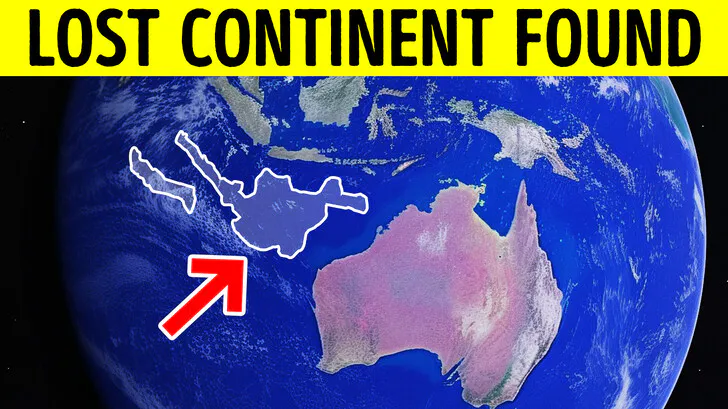
Scientists Discovered Continent That Vanished 115 Million Years Ago
About this episode
Get every episode summarized
Each time Bright Side publishes, we email you a written briefing from the transcript — the topics, who appeared, and any specific claims, with the ad reads skipped.
Email me new episodesFree for 3 shows. No card needed.
Hosts & guests
Transcript ready
146 searchable segments. Every word is indexed and playable.
Full transcript
Bright Side — Scientists Discovered Continent That Vanished 115 Million Years Ago. Machine-transcribed; use the interactive transcript above to jump the player to any line.
Protein is now at Starbucks, and it's never tasted so good. You can add protein, cold foam to your favorite drink or try one of our new protein lattes or matcha. Try it today at Starbucks. This episode is brought to you by Redfin. You're listening to a podcast, which means you're probably multitasking. Maybe even scrolling home listings on Redfin, saving homes without expecting to get them. But Redfin isn't just built for endless browsing. It's built to help you find and own a home. With agents who close twice as many deals, when you find the one, you've got a real shot at getting it. Get started at Redfin.com. Own the dream. Surprise! There's more than seven continents on our planet. Our Go land, a hidden continent, may help us understand how our planet will look in the future. To find out how it hit from us and what secrets it holds, well, you'll just have to keep watching.
Ready for a mystery? Scientists have been looking for a piece of land that's been missing for over 100 million years. Not exactly newsworthy, since people search for information about our planet's history all the time. You'd think it was probably this minuscule island somewhere in the middle of an ocean. Well, you'd be wrong, because this continent used to be as big as the entire U.S. territory. For a long time, geologists have been wondering whether a massive chunk of contemporary Australia vanished into thin air. Some believed it was simply hiding somewhere on the ocean floor, but thanks to some Dutch specialists and seven years of investigating, we now know there are bits and pieces of this lost land mixed underneath the lush jungles of Southeast Asia. The continents we see in our geography manuals these days are like scattered pieces of a puzzle. There's even a nice experiment you can conduct to see for yourself. Find a world map online and print it out. Cut out all of the continents and play around with them for a while.
You'll see they all fit together. Probably the most striking thing you'll see is how South America perfectly fits near Africa. If you close up the oceans that were formed in the last 200 million years, the continents look like they form a giant letter C. And that C is what scientists call the supercontinent Pangaea. It was swimming in an ocean called pantholocin, and the interportion of that letter C had a smaller stretch of water called the teeth of the ocean. It is in this small ocean where things get interesting. Back in the Jurassic period, this vanished continent, which scientists started calling Argo land, vanished and left a hole in Australia, now known as the Argo Abyssal Plane. Geologists initially believed this was all due to a process called subduction. It's when one piece of the Earth's crust... This episode is brought to you by Peloton. Break through the busiest time of year with the brand new Peloton Cross-Training Tread Plus, powered by Peloton IQ.
With real-time guidance and endless ways to move, you can personalize your workouts and train with confidence, helping you reach your goals in less time. Let yourself run, lift, sculpt, push and go. Explore the new Peloton Cross-Training Tread Plus at OnePeloton.com. Sierra has all the best active and outdoor brands you need. From athletic stuff, like a full-court pickup game, swish to athletic-ish stuff, like a half-mile stroll, get those steps in! And for morning hikes up the mountain trail, good pace! Tonight time goastries from the camping chair. What a twist! Whatever level of active, Sierra loves it all. Head to Sierra or Sierra.com for the brands you want at the prices that let you do it all. From athletic to athletic-ish, Sierra's got it! Us dives under another and recycles it into the planet's mantle. Usually specialists track this continental vanishing through off-scraping. That's how they figured out, for instance, that India bumped into Asia and gave us the majestic Himalayan mountains.
But for Argo land, things were a bit more complicated. Bits and pieces were popping up in places like Myanmar and Indonesia. But they behaved like these time-traveling relics, looking way older than when Argo land supposedly separated from Australia. It immediately raised the question, if one continent can behave so weirdly, how many others are out there doing the same? Thankfully, scientists have now put together the entire timeline of Argo land, and figured out its mystery. It didn't sink or get swallowed up. It simply transformed into an Argo pelagop, breaking into smaller pieces, called microcontinents and floating away from Australia. These mini-continents then took a little journey before settling down in Southeast Asian jungles. This discovery fits right into the whole Pangaea puzzle. It helps us better understand how continents break up and make up, all in one discovery, revealing secrets of biodiversity and climate back from in the day.
If you'd like to find out more secrets about history, civilization, or random day-to-day objects, be sure to like this video and subscribe to the channel. Like, for instance, the mystery behind this invisible species line in Indonesia. It's called the Wallace Line, named after the British explorer Alfred Russell Wallace. Over 150 years ago, Wallace was on a journey around the melee archipelago, visiting thousands of islands. What he found was that animals on one side of this invisible line were considerably different from ones on the other side. This invisible line is like a wall between marsupials and tigers, for instance, or honey eaters and trogans. But now we know that around 35 million years ago, Australia broke up with Antarctica and collided with Asia. And this continental love triangle triggered significant changes. It didn't just change the way the length looked. It also messed with the species of animals on each side of the Wallace Line.
In more recent times, a bunch of specialists published a study saying this collision and climate chaos made Asian species comfy living in the melee archipelago. Meanwhile, the Aussie animals weren't as happy with the new environment. It was too hot and wet for some, and others just couldn't handle the tropical island lifestyle. The discovery of this continental shift towards Asia might also explain a recent finding of a human species that didn't seem to make any sense either. You see, in this hidden cave in the Philippines, archaeologists stumbled upon a new human ancestor. It seems that about 50,000 years ago, on the island of Luzon, there was this ancient human-like species. The lead researcher believed this finding was crucial for understanding human evolution in Asia. And it named this new species after the island, Homo Luzanesis. Now here's where it gets a bit confusing. The bones found by archaeologists had one small problem.
They had a weird mix of traits that hadn't been found. This episode is brought to you by State Farm. Listening to this podcast, Smart Move. Being financially savvy, Smart Move. Another Smart Move. Having State Farm help you create a competitive price when you choose to bundle home and auto. Bundling. Just another way to save with the personal price plan. Like a good neighbor, State Farm is there. Prices are based on rating plans that vary by state. Covered options are selected by the customer. Availability, amount of discounts and savings and eligibility vary by state. Been seen together in any other homited species. Smaller teeth, similar to ours, yet hands and feet that were more like our ancient humanoid ancestors. It was those throwback lends in particular that connected this human species with a long-lost southern territory. That's because they have this primitive look, like these hard to pronounce guides, for instance. Only these two species are separated by two to three million years of time and evolution.
Many have wondered. Is homo-luzonisis really a new species? Not everyone is convinced. But it may also explain why living creatures are also affected by the constant shifting of the land underneath us. Now, just because they haven't changed much during our lifetime, it doesn't mean our continents will look like this forever. They evolve from this large mega-continent, and, though most likely, end up in a similar position in the future. On that note, a geologist from a European university tried to predict the future of Earth's supercontinent. As a starting point, he used an earthquake that occurred in Portugal back in 1755, when tectonic plates behaved a bit differently than they should have. After years of research, he came up with a theory in 2016. He believed that the stitches between these tectonic plates might be coming apart, setting the stage for a bigger rupture. It's like when glass cracks between two holes in a car windshield.
If this happens, a subduction zone could stretch from the Mediterranean all the way up past Ireland, bringing volcanoes, earthquakes, and new mountains to these areas. If all goes according to this plan, the Atlantic Ocean will disappear and so will the Pacific, turning into one large stretch of water. Instead of the seven continents we know today, we'll get a new supercontinent, which he called Arricot, because it would have Australia and the Americas at its heart. Now, it's not the only possible scenario, though. Novo Pangia might be another, and it's easy to foresee. The Atlantic stays open and the Pacific closes. Then there's Amasia. For this one, you'd have to imagine the Arctic Ocean closing, and the Atlantic and Pacific staying open. Everything shifts to the north around the north hole, except Antarctica. One final scenario would be called Pangia Ultima. Slow down the spreading in the Atlantic, and a new subduction plate pops up on the Americas East Coast.
Well, either way, if all the continents collide in the future once more, some say it won't be fun to experience. It's believed that in around 250 million years, we'll feel like we're being trapped in a sweltering, soggy plastic bag. Weirdly, that bag will be the best place to live on Earth, the coastal areas. As for the inland spots, they'll be sizzling, like a desert on fire. Many of the species of animals we know today might not make it. As for as humans, we'll need to be creative if we want to withstand the heat. We should be thankful, though. These digital models are still great, because we can use them to test all sorts of interesting ideas. For example, how these super continents would mess with tides, taking future space travels into consideration. These models can help us understand the climates of exoplanets, too. Those are located outside our solar system. This episode is brought to you by Athletic Brewing Company.
No matter how you do game day, on the couch, in the crowd, or manning the snack table, Athletic Brewing fits right in. With a full lineup of non-alcoholic beer styles, you can enjoy bold flavors all game long. No hangovers, no buzz, no subbing out for water in the second half. Stuck the fridge for tip off with a variety of non-alcoholic craft styles available at your local grocery store or online at AthleticBrewing.com. Near beer, fit for all times.
More episodes
More from Bright Side

Archaeologists Stumbled Upon Breathtaking Find Near King Tut
Bright Side
Megalodon Once Ruled the Oceans, But Not Antarctica
Bright Side
Divers Discovered a 2000-Year-Old Tech Secret by Accident
Bright Side
This Ocean Disaster Could Shut Down the Entire World
Bright Side