newsJul 19, 20261:14:12pending
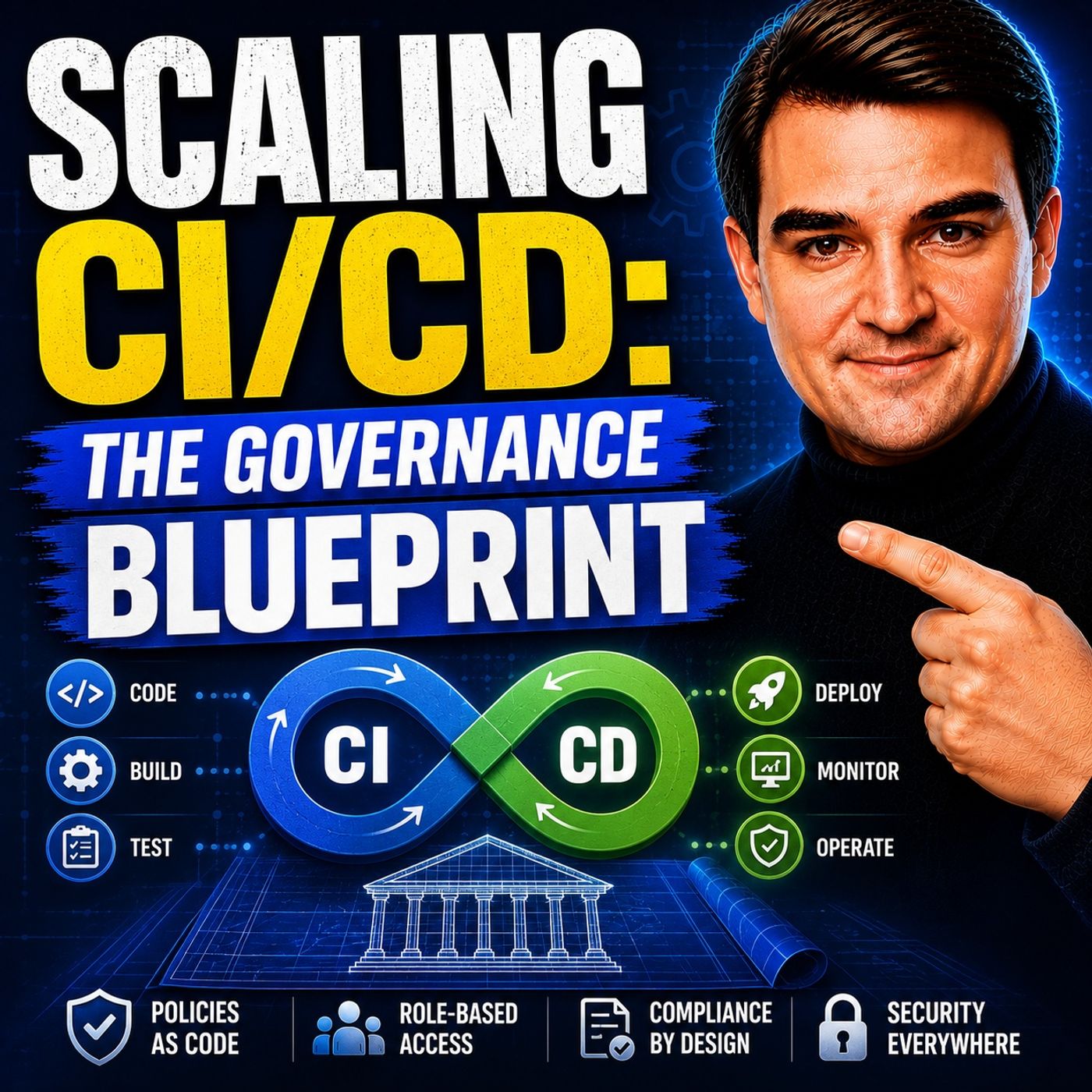
Scaling CI-CD: The Governance Blueprint
About this episode
modern platform governance works differently. Rather than enforcing compliance through documentation and manual reviews, governance is embedded directly into templates. These templates automatically include:
GOLDEN PATHS
A major concept introduced in this episode is the Golden Path. Instead of giving developers blank pipeline templates, organizations provide opinionated deployment paths that already include best practices. Golden Paths define standard approaches for:
RING-BASED DEPLOYMENTS
Safe deployment at scale requires limiting the blast radius of every release. The episode introduces Microsoft's Ring Deployment model. Instead of deploying directly to every user, releases move progressively through increasingly larger audiences. Typical deployment rings include:
CANARY RELEASES
While ring deployments target groups of users, Canary Releases gradually increase traffic to a new application version. Instead of exposing everyone immediately, perhaps only 1% of requests use the new version. Observability platforms continuously compare:
OBSERVABILITY AND AUTOMATED PROMOTION
Deployment governance depends on reliable measurement. Observability provides:
PLATFORM AS A PRODUCT
One of the strongest messages throughout the episode is that internal platforms should be treated like products. Platform teams should measure:
IMPLEMENTING THE BLUEPRINT
Successful platform transformations happen gradually. Organizations typically begin by identifying the largest deployment pain point before introducing a single Golden Path and a small platform team. As adoption grows, reusable templates, automated governance, observability, ring deployments, and policy-driven promotion gradually become the standard operating model. Leadership support is critical because platform engineering requires cultural change as much as technical implementation. Teams move from owning individual pipelines to participating in a shared delivery ecosystem that improves reliability, security, and developer productivity.
KEY TAKEAWAYS
Scaling CI/CD isn't about choosing a better pipeline tool. It's about designing a repeatable operating model. Organizations that standardize deployment through reusable templates, Golden Paths, platform governance, ring-based deployments, automated promotion gates, and strong observability can dramatically reduce cognitive load, improve developer productivity, lower operational costs, and strengthen security. The most successful platform teams don't build infrastructure that developers are forced to use—they build products that developers genuinely want to use. By making governance invisible, embedding best practices into templates, and continuously improving the developer experience, organizations create delivery platforms that scale from a handful of teams to hundreds without sacrificing speed, quality, or compliance.
Become a supporter of this podcast: https://www.spreaker.com/podcast/m365-fm-a-microsoft-mvp-podcast-by-mirko-peters--6704921/support.
- Security scanning
- Dependency validation
- Approval gates
- Secrets management
- Naming standards
- Audit logging
GOLDEN PATHS
A major concept introduced in this episode is the Golden Path. Instead of giving developers blank pipeline templates, organizations provide opinionated deployment paths that already include best practices. Golden Paths define standard approaches for:
- Building applications
- Running automated tests
- Performing security validation
- Deploying through environments
- Rolling back failed releases
RING-BASED DEPLOYMENTS
Safe deployment at scale requires limiting the blast radius of every release. The episode introduces Microsoft's Ring Deployment model. Instead of deploying directly to every user, releases move progressively through increasingly larger audiences. Typical deployment rings include:
- Ring 0 – Internal engineering teams
- Ring 1 – Pilot users
- Ring 2 – Broad production
CANARY RELEASES
While ring deployments target groups of users, Canary Releases gradually increase traffic to a new application version. Instead of exposing everyone immediately, perhaps only 1% of requests use the new version. Observability platforms continuously compare:
- Error rates
- Response times
- Business KPIs
- User behavior
OBSERVABILITY AND AUTOMATED PROMOTION
Deployment governance depends on reliable measurement. Observability provides:
- Distributed tracing
- Centralized logging
- Performance metrics
- Health dashboards
PLATFORM AS A PRODUCT
One of the strongest messages throughout the episode is that internal platforms should be treated like products. Platform teams should measure:
- Developer satisfaction
- Adoption rates
- Time to first deployment
- Self-service success
- Golden Path usage
IMPLEMENTING THE BLUEPRINT
Successful platform transformations happen gradually. Organizations typically begin by identifying the largest deployment pain point before introducing a single Golden Path and a small platform team. As adoption grows, reusable templates, automated governance, observability, ring deployments, and policy-driven promotion gradually become the standard operating model. Leadership support is critical because platform engineering requires cultural change as much as technical implementation. Teams move from owning individual pipelines to participating in a shared delivery ecosystem that improves reliability, security, and developer productivity.
KEY TAKEAWAYS
Scaling CI/CD isn't about choosing a better pipeline tool. It's about designing a repeatable operating model. Organizations that standardize deployment through reusable templates, Golden Paths, platform governance, ring-based deployments, automated promotion gates, and strong observability can dramatically reduce cognitive load, improve developer productivity, lower operational costs, and strengthen security. The most successful platform teams don't build infrastructure that developers are forced to use—they build products that developers genuinely want to use. By making governance invisible, embedding best practices into templates, and continuously improving the developer experience, organizations create delivery platforms that scale from a handful of teams to hundreds without sacrificing speed, quality, or compliance.
Become a supporter of this podcast: https://www.spreaker.com/podcast/m365-fm-a-microsoft-mvp-podcast-by-mirko-peters--6704921/support.
Get every episode summarized
Each time M365.FM - Modern work, security, and productivity with Microsoft 365 publishes, we email you a written briefing from the transcript — the topics, who appeared, and any specific claims, with the ad reads skipped.
Email me new episodesFree for 3 shows. No card needed.
Hosts & guests
No transcript yet
This episode has not been transcribed. Request it and it moves to the front of the queue.
More episodes
More from M365.FM - Modern work, security, and productivity with Microsoft 365

How Finite Capacity Scheduling Actually Works in Manufacturing
M365.FM - Modern work, security, and productivity with Microsoft 365
Sep 14, 20261:54:54completed

Why Your Critical Path Changes When Production Changes
M365.FM - Modern work, security, and productivity with Microsoft 365
Sep 14, 20261:51:17pending

How AI Changed Software Development Forever — Building the Agentic Future with A...
M365.FM - Modern work, security, and productivity with Microsoft 365
Sep 3, 20261:11:37completed

Architecting Power Platform for Complex Enterprise Solutions with Ian Tweedie [M...
M365.FM - Modern work, security, and productivity with Microsoft 365
Sep 2, 20261:01:31completed