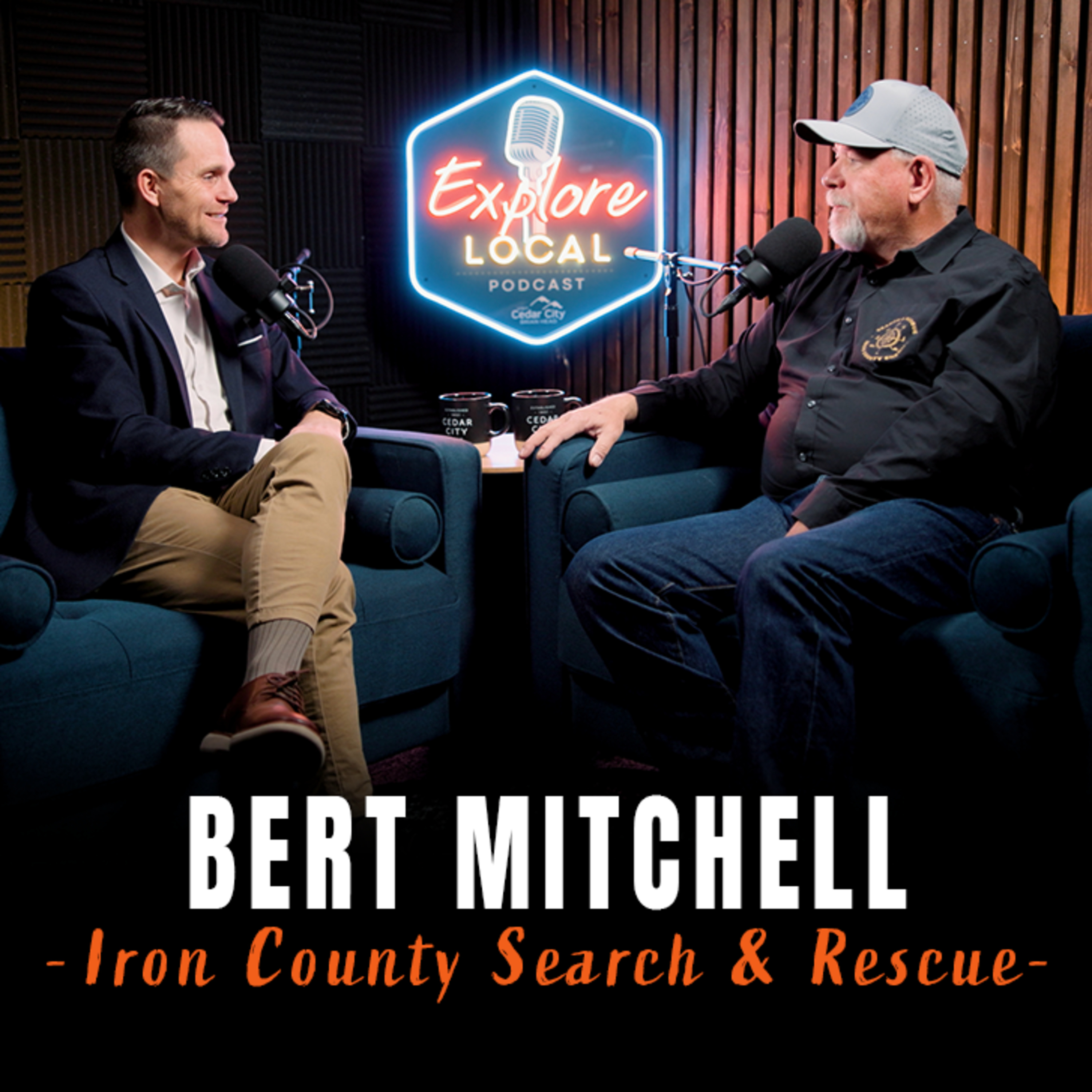
S2 E25 Bert Mitchell | Iron County Sherrif's Search and Rescue
About this episode
Bert Mitchell is the commander for the Iron County Sherrif’s Search and Rescue, a fully voluntary extension of law enforcement that is trained to handle lost persons and help anyone in need. The team has donated thousands of dollars and hundreds of hours to provide services to the local community and visitors. To learn more go to ICSSAR.net.
The Explore Local Podcast is presented by Visit Cedar City Brian Head and hosted by David Johnson, Cedar City Economic Development Director.This episode is sponsored by The Cedar City Business and Innovation Center. Dedicated to supporting local businesses and entrepreneurs, it provides resources and services aimed at fostering business creation, growth, and retention. The center features the “Makerspace” where entrepreneurs and small businesses can have access to 3D printers, video production and photography equipment, t-shirt printing and more! Whether you’re starting a new venture or looking to expand an existing one, the Cedar City Business and Innovation Center offers the tools and guidance to help you succeed. To learn more and get involved, visit innovationcenter.cc
Get every episode summarized
Each time Explore Local Podcast publishes, we email you a written briefing from the transcript — the topics, who appeared, and any specific claims, with the ad reads skipped.
Email me new episodesFree for 3 shows. No card needed.
Hosts & guests
Transcript ready
1,347 searchable segments. Every word is indexed and playable.
Full transcript
Explore Local Podcast — S2 E25 Bert Mitchell | Iron County Sherrif's Search and Rescue. Machine-transcribed; use the interactive transcript above to jump the player to any line.
This episode is presented by Visit Cedar City Brinehead Tourism Bureau. Discover the art of adventure at Utah's Gateway to the Parks. Cedar City is within a few hours drive from six different national parks and monuments, and only 30 minutes from fresh snow at Brinehead Resort. Check out VisitCedarCity.com to plan your next trip. This episode is sponsored by The Cedar City Business and Innovation Center. Dedicated to supporting local businesses and entrepreneurs, it provides resources and services aimed at fostering business creation, growth, and retention. To learn more and get involved, visit innovationcenter.cc. Hello and welcome to the Explore Local Podcast presented by Visit Cedar City Brinehead in partnership with Cedar City Iron County Economic Development, produced by Dallas Smith Media, and I'm your host, David Johnson. Okay, today we have Bert Mitchell, who is the commander of the Iron County Sheriff's Search and Rescue, joining us on the podcast, Bert, thanks for coming on.
Yeah, I appreciate your invitation. It's good to be here. Yeah, so we were just talking before we started about how Iron County Sheriff's Search and Rescue is all volunteer. Can you talk a little bit about that? Sure, so everybody on the team is a volunteer. Nobody gets paid for it. It's, well, the organization itself is where we're under the direction of the Iron County Sheriff. Now let our equipment, so the county will provide equipment to us, our big, durable stuff trucks and stuff like that. But we are completely responsible for all of our personal equipment. Just, yeah, anything that we have to do for ourselves is, is, is, is quickly up to us to do, so. How, you know, how many volunteers do you have, Charles? Right now on our, we have a, what we call our member, roster, which is our, our roster of people who are actually full members, and right now it's sitting at about 40, I think. Total on our roster, we've got about 60 people. So we bring people will come in as, you know, on a kind of a probationary period.
And we get them through training and see if that's what they want to do. You know, you tell people you're going to be paying for all your stuff yourself. And sometimes people will bark at that. But it, that's, is what it is. But anyway, so we've got about 60 something people on our roster right now. Wow. Now, do they have to have some sort of baseline background or experienced? Not necessarily. I mean, it helps, you know, anybody, because we've got people that are where EMTs. We have a lot of former military, not a lot, but we have former military. We have former, former Eleo law enforcement. People that have done like wilderness, first aid or wilderness survival stuff. But for the most part, it's just, you know, just people of the community. It's, it's, mostly it's people in the community that want to serve the community. And most of our, we have a fairly in-depth rigorous training program that we put people through that's all, most of it's done in-house. Wow. We do require everybody, excuse me, we do require everybody in the unit to have at least a CPR
or a basic life-saving training, you know, carry a car. Yeah, yeah. Other than that, it's just, you know, we try to do most of the stuff in-house, but it's, it's helpful to have some background, but not necessary. Yeah. So how long have you been doing this? Oh, we were talking about that the other day. I think this is my eighth year. I'd have to take back, I'm pretty sure it's eight years. And what motivated you to get involved yourself? Well, kind of a long story. Several years ago, I ended up getting a German Shepherd and I wanted him to do something. I had an acquaintance that's a dog trainer in town and I was talking to her. And she was part of a private canine search group. And so I kind of try to get involved in that. My dog didn't work out, he actually turned out to be a little bit aggressive, but good dog, I could do anything to have him back. Anyway, about nine years ago, he passed. We got another dog, I talked to her again. And between that time, she had joined the Iron County Sheriff's Search and Rescue and said, well, if we do that, you've got to join the unit because the canine unit
now is attached to that. Oh, really? Because of a dog, I mean, I'm where I'm at now. So is the canine unit for, is that, is it a separate canine unit for just search and rescue or is it the same canine unit that the sheriff's office has? No, it's completely separate. It is. Yeah, so what the deputies and anybody else has in law enforcement, they're they're actually owned by that organization. Right. Our dogs are house pets, basically, we do mostly do most of our own training. And of course, it's a different thing. The law enforcement dogs are trained to do different things with apprehension and stuff like that. Our dogs are strictly just go find people. And then we also have some of our dogs are trained in human remains. Is there certain breed, is it like German shepherds? Are there a variety of breeds or about any breed? I mean, there's there's specific breeds that are more prone to be able to do this kind of workload. There's sort of shepherds of any kind, labs, especially labs are really good.
You know, those type of breeds, hunting and herding breeds are kind of the better ones. But I will say, I have been to trainings, went to a really good training salt lake about, I think about five or six years ago, and some of the people that are involved in that, they had rescue dogs that were just muts. Uh-huh. And they actually did really good. Now, the base of that dog was one that already had some herding or sort of skill like that. Again, I mean, it's just, it all comes down to the drive that the dog has and, you know, just a few minor things like that. But yeah, that goes into actually a little bit of my next push about the dogs specifically. I'm going to quiz you about that. I mean, thinking about the canines, does it, does it matter the age of the dog? I mean, obviously you don't want like a 12 year old dog, but I mean, do you want them within like the first four years or something? Yeah, I mean, uh, you can teach an old dog new tricks. I've learned that because my dogs are getting older and I can, I've been teaching them new things. However, to get started the training process, you know, they have to be very well well-behaved
because we're dealing with a public in a different, different scenarios. Right. You know, we get a lot of kids. There's going to be a lot of kids and they're going to be scared. Yeah. People get scared too. I know, uh, I'll tell you another story about that in a while, but, um, so that it's, you know, that we have to get them through that part of it and make sure that that's, and then it takes at least a year to get them up to a point to where you're getting into where there'll actually be deployable and sometimes longer, sometimes two years, because we, we try to train at least once a week, um, together as a group, and then we train on our own, you know, at home and do whatever. But, you know, we haven't done it. It's just you've got to where we represent the sheriff and we represent the unit. We have to make sure that our dogs are ready to go. You know, it's, it's, we've got to have, we have a specific standard that we actually train to and. Oh, wow. But yeah, it's a lot of fun. What kind of a dog do you have? I have two German, I actually got three German shepherds now. I, I got two older ones there. Um, my little female, she's getting a little older and it's getting harder. So I'm brought another one on so I can start training her and that's been, uh,
it's been a long time since we've had a puppy. Interesting. Yeah. That's, yeah. They are high energy. They are puppies are and make you everything up. How many, how many of your, you said there was like 60 plus, there you have, how, how many of them have canines? Uh, right now we've got eight handlers and, uh, let's see, we've got 10, I gotta think, 10 dogs and then we've got three of us that have brought new puppies on. Oh, wow. And so as they kind of rotate out, which I hate to say that because it makes me sad to think I'm going to retire my female. I'm probably my male too. He's getting older too. But, uh, yeah. So right now as our unit stands, we've got eight handlers and 10, I think 10 dogs. And now, um, kind of going back to what we were talking about or what I asked you about in the beginning about, um, qualifications. Tell me about the, um, you mentioned, you have some veterans, EMTs, are there other types of backgrounds like, for example, a buddy of mine, um, and his brother, um, if you familiar
several years ago with the, with the young man that got stuck in the nutty putty caves forever ago, a buddy of mine and his brother. Um, uh, they weren't on search and rescue, but they were cavers and they're rock climbers and repellers. And so they brought in some people with that expertise and they, they kind of helped in that situation the best they could. Um, so tell me about, do you have others with some of those unique kind of backgrounds as well? Well, um, in fact, we have a, we have a, I wouldn't call it a separate team. Um, we have a high angle rescue team. We actually have a separate, like you need almost. Yeah, they're their own little group because they're, they're training and everything is so much more technical. I mean, it's, um, uh, at least one of the guys from what we call the ropes team is on search and rescue as well. They're, uh, they're all part of the share of search and rescue. We're all the same thing. Yeah. Um, but they are kind of their own separate thing because they do different trainings. They have, you know, a lot of different things that they do and exceptional people.
I mean, they're, it's, it's a lot of fun to watch them work. It's, but they are. Do you have like five different types of teams with specialties? What are those types of specialties? Yes, we do, um, their facts. So we've got, um, well, the ropes team is their own thing. We've got the canine team. We have what we call a winter rescue team. Um, and so these are people that have a lot of skills, like on snowmobiles and just being in snow in general. Yeah. Um, I hate snow with passion. So that's not your team. That's not my, that's not my, that's not my Bailey Wick. Um, but yeah, so we've got a big, uh, snow cat, um, the county's providers with a snow cat. And that's a very, it wouldn't say it's very technical. But driving that, you have to have, you know, a certain amount of training on that because it's completely different than, right? You know, it's not just a piece of heavy equipment. There's a lot of different things that do belong with that. Um, so yeah, and they're the ones, you know, they're the ones that are getting up three o'clock in the morning and a blizzard to go get somebody out. Oh, yeah. And, uh, so yeah, and let's see what else we got the drone. We've got a drone team. Okay. Um, we can get into it later, but we got a grant to get some drones.
And we've got, let's see, I don't know how many people are on that team right now. Four or five, um, they, they do exceptional work. And it's just, it's, it's a lot of fun to watch these different teams. We have an equine team, which I think is two people right now. And then we, we have a mountain bike team, um, but to couple those people moved. And left the unit. Um, so they're kind of trying to build that back up to them. But that's been very helpful for all the new trails they put up here on the mountain. And so, you know, trying to get more than anything getting equipment up there. That still takes a little bit because of the terrain itself. But it's nice to have the, like the bike team. They can just jump on the bikes and head up to where they are. And then they can give us an assessment of what's going on. So that's been really helpful. And same thing with the drones. You know, we, if they can't find a person, if we do find somebody, we can get them overhead and have them assess the situation. And they've got night vision and flare and stuff on too. So they can really kind of get an idea of what's going on that way. Is that some of the equipment that you've got individuals have to buy themselves, like with the drones or obviously mountain bikes?
Um, the mountain bikes they have to buy on their own. Um, everything else is provided by it. Like I say, we got, um, we've got a grant a while ago. Yeah, why don't you tell it? Go ahead and tell him about that grant. Well, we've got actually several grants. Um, we're, we have a budget with the county, but it's, it's very limited. Just like, you know, the, there's just like anything else. It's for a lot of the bigger stuff. Well, we get some of the smaller stuff that we feel like we need. And, uh, the, uh, Utah's at the Utah outdoor recreation department. Have some really good grants that they do. I've noticed, uh, there's other places around town like for trail maintenance and trail building and all that. They've gotten these grants and it's, they're really good to work with. I've been really pleased with it. So through the outdoor recreation, we've been able to get, we got two drones through a grant. Um, we've gotten, I think two trailers. We've gotten two ATVs, one side by side and one six wheel thing. Um, we got some ice rescue gear last year. Uh, that's another story I didn't get into on that.
Yeah. And then, uh, let's see, right now we are putting in for another grant to replace one of our old side by sides with a new one. And they've just been exceptional to work with. Uh, but yeah, so that's, we've been able to outfit our team with some, you know, very specialized and very new, well new equipment. Oh, uh, now we didn't get those through the grants, but we, we've, uh, through just different things we've been able to replace our entire snow will be a fleet to him. So we were, when I came in as commander three years ago, I mean, we had some that were one of them back in like 1999. That was the age of it a couple of them that way. And just through finagling a little bit. Yeah, yeah. Yeah, so we were able to replace all those. So now we've, we've done a, our group has done a really good job of getting the equipment we have to, to a point to where, well, we're in the new millennium. Yeah. You know, and so what we feel a lot more comfortable about book deploying, because our biggest, my biggest concern in my position is it's just,
you know, you send people out on stuff like that. And if you worry about the equipment, then that's always, that gives me all kinds of anxiety, because not only are we putting the, putting our group in, because we have a, or in a possible peril, you know, we were, we were a couple of team first attitude. The team always comes first. Yeah. And then so if we get out, we don't want our team to have to become a victim. But then again, when we get out, we want to make sure that the people we are trying to get home safe are going to get home safe. And so that's been a real priority of mine. Well, mine and my command staff, the people that I work within the group in general, that's something we've, we've really strived to do. Yeah. Is get to a point to where we know that if we go somewhere, we can depend on our equipment and that doesn't become a factor in, is everything going to be okay? Yeah, I like what you said too, about making sure you're searching rescue team doesn't become the victim, meaning somebody that needs to be safe. Unfortunately, occasionally that does happen. But I, this is a little bit of random digression.
But I always chuckle at movies when in the premise of a movie or a portion of a movie is to rescue someone so that they don't die. And there's like 10 people that die on their way to rescue them. That's right. Are you guys are kind of missing the point of rescuing the one person? Yeah. If everybody on the rescue team is getting picked off like, you got to make sure your team is good enough not only to rescue, but to maintain your own safety along the way. Anyways, the pitfalls of Hollywood's presentation on those sites. I know exactly what you're talking about. I call it the Indiana Jones Syndrome. Yeah. Because he goes out and destroys all this historical stuff to find one little thing. Yeah. And so that's kind of that same premise on that is, you know, you don't want to put all these other people in danger in your city home. But yeah, it's funny. Well, you know a search and rescue, you know, I've, some of my background is, I've been a PIO for police and fire for different communities.
And something about search and rescue is it's not a lot of people know a lot about it. And I think that's part of why we wanted to have you come on is to talk about, hey, this is a volunteer based organization that's under the Sheriff's Office. But we could use help of a lot of different people. And there's a lot of different skill sets. It's not just a background in police and fire necessarily that going out during search and rescue. I mean, the fact that you talk about, there's a mountain bike team. I know we have dozens of mountain bikers. We have mountain bike club teams here. We have mountain bike trail building clubs here. We've had some of them on the podcast. You need to talk about you have two people doing a question right now. Well, I know there's a heck of a lot more horse riding going on in Iron County than two people ride it. And so, you know, it's good for people to be able to hear and learn and see that maybe there's something they can do to contribute to search and rescue.
And getting first aid is not hard, especially if you're in Utah and you, you've ever, for, for guys out there, if you've ever been involved in Boy Scouts, you've probably done the majority of what's required to get, you know, CPR and first aid training. But one of the things that I wanted to highlight is this year the Cedar City Chamber is recognizing Iron County Sheriff Search and Rescue as volunteer of the year. Do you want to talk a little bit about that and what that means to you guys as an organization? Well, I mean, it's, I mean, it's, it's a very humbling to get something like that, you know, coming from the chamber because we kind of work a little bit under the radar. We do, we do a lot of stuff for the community. I mean, I don't get me wrong on that, but it's just one of those where, you know, when they say that we got that, I'm just like, they're sure. But, you know, that all goes to the group. Our unit is just, it's an exceptional bunch of people back in my wife's even mentioned that a couple of times that she talks about how it feeling, feeling like a family, you know, and I guess when you get in this position where you, you feel like you're, you're putting yourself out there and having to do,
like you say, we're responsible for our own things and all that. You know, it's a, it's a, it's a really, it's a very high commitment. Yeah. And that's one thing I can't emphasize when we talk about, you know, people that can help with the, yes, they are. But the, the award itself, like I say, I was just, I was really thrilled. I just, it made me feel, as a commander, I, I'm really happy that it went to the team because it wouldn't happen to us. None of this would happen without them. I mean, it's, the unit themselves, I just, I can't emphasize enough what a, what a great bunch of people they are. And for this kind of recognition to come from, you know, the chamber and the community and everything, just it was very, it was very, it was very happy about it. Yeah. So yeah, I just, it, it, I don't know, it's just one of those is kind of hard to say because I don't well when I don't really like talking about certain things. But it was, we're not, again, if you're dealing with a blonde terror organization, I guess, we're not really looking for anything other than a thank you. Yeah. You know, and so when that came in and that's kind of what it felt like was just a,
it was a big thank you from the community. Yeah. It's very, it's very happy to see it. Well, very well. The unit really deserves it. Yeah. Yeah, very well deserved. And in your right, and that's kind of why I wanted to acknowledge that is, search and rescue is kind of under the radar. People that are involved in search and rescue, they're there just because they want to help somebody that, that's in a dire situation and get them out. And when you have certain skill set to be able to assist with that, I mean, it can make all the difference, right? Absolutely. My wife's a nurse. And so we know the difference, not only when she is at work, but, you know, in family circumstances, her skill sets come in handy all the time for family members. And so to be able to contribute those types of skill sets, in a variety of skill sets that people may have to the community, it can make all the difference between life and life and limb, I guess, life and death for some individuals.
So talk to me if somebody wants to, and then after this, I kind of want to dive into maybe some interesting stories and talk about some of the rescues you've done, memorable rescues. Talk to me if somebody wants to get on search and rescue. What are the, you know, just high level steps that they have to take? How do they get ahold of you and et cetera? How do they move forward? Sure. Well, first, first to start with is we, our team meets the first and third Monday of every month at the search and rescue's bound, search and rescue buildings down on Kitty Hot Drive. Okay. And we ask people to come to a meeting because first and foremost, we want to meet them and have them meet us and kind of go over the particulars. We do have a website if I can shamelessly plug that. Yeah, please. It's it's icssar.net. Some of the information on there, it's kind of going through, we need some more updating right now. But anyway, under the contact tab, there's a item that says new volunteer information.
And there's a quick synopsis of kind of what we ask of them. And then there's the application packages on there too, and they can download that. It's several pages. So we can hand them out if they come to the meeting, but it's better if they download it because then they have the information. And then there's several things they have to fill out. They require a criminal background check, a drug screening, and then just anything else. There are a lot of other things that come up with that. And then that goes to the Sheriff's Office, and they run the background check and look things over. And if they approve that, it moves on to human resources in the county. And they will send information to them to have the drug screening and of all that comes back, then we bring them on to our roster. And then we have, it starts out as what we call our prospects. So it's a minimum of six months, I guess, probationary period. And during that six months, we make sure they get their application in. There's some training that's required before they really move up. Right. Some of it's online, a lot of it's in-house with us.
It's CPR card. We do a CPR training for the unit every year. But if they can go someplace else, Southwest Tech, I think has a really good program for that. And as long as they get that, so that's kind of the beginning of it. We find a lot of people are... There's a lot of people moving into the area that they want to help. But then when they realize the commitment part of that, they just say, okay, this isn't for me, and that's fine. We can't expect everybody to do that. And then from there, they move up to what we call a rider status, which gives them kind of brings more into the fold, and then they're able to do a few more things. And then from there, after another six months, they might be eligible to move up as a full member. So it's a process. And again, I will emphasize that it is a commitment. We talked about these individual teams, and these people that might want to help. Even the people on the individual teams have to join the unit and be part of the full team.
It's not, well, we're calling the bike team out or the snow team out or whatever. So it's all year long. We expect attendance and participation throughout the entire year. And so again, you go back to people like the K-19 team, and the snow team, they're doing trainings on their own, same with the drone team. So we have unit trainings. We have unit meetings. And then our individual teams do their own trainings. And then if they get called out, because there will be times when just the drone team will have the drone team go out. They need somebody to insist it's trying to find something or somebody. We get the same thing from the K-19 every once in a while. Of course, the mountain bike team kind of does their thing too. But during the winter, the snow team gets the majority of the calls, because again, we don't want 30 or 40 people to stand around freezing up in the parking lot somewhere. So you get the people who know how to run the equipment. But we do need support people too. I need to make, I need to emphasize that too, even if we have some people that are a little bit long in the tooth
and really can't hike a lot or do whatever, but they make a good support team. So we find something for everybody to do. That's awesome. So I guess now it's kind of maybe dive into some of the rescues that you've done. And maybe we can talk about some of the specific unit type rescues that have happened. But for you, some of those successful rescues, what are some of your more memorable successful rescues? Yeah, I've got a few of them. Some of them are... Well, it's very diverse. Let's put it that way. Sure, yeah. Before Kener Falls made some of those improvements on the ladder. We were getting down there, called down there quite a bit. We still do. We still get calls down there. But nothing like... There was one time I know for sure we got called down twice in the same day. Oh wow. But those are always very memorable, because we normally have members of the ropes team there to our hangable team. So that gives us a chance to all be together. And it's not about hike either when you really think about it.
But yeah, we've had some... I've got a telefunny story about that while I'm thinking about it. So Kener Falls, you've got the first falls. That's where they put that new ladder in. And then you walk up the ways. And there's the second fall. And there's really no way to get up there except they've got a tree limb there, a log. And you get up there and then you get to the third fall. Well, between the first and second fall is where a lot of people get hurt. Just because the rocks are slick, it looks deeper than it really is. And they'll slide on those rocks. They mess up their ankle, their feet, their knees, whatever. And Mariss, they'll fall and break their wrists. But right there, kind of the middle of that, there's this kind of fairly good sized tree. Well, we'll talk, we'll be talking as we're on our way down to help these people and we'll say where are they? And we get a lot of people say, well, they're at the screaming tree. It's because normally we get up there if they're above the first fall. They're sitting under that tree screaming. Because they're in pain. Yeah, so that's happened a few times.
We had some pretty serious ones. We had a gentleman up there that fell and he was alone. And hit his head and that was a bad one. We had one where we had a, I will just say it's a person that was rather larger. And we couldn't get them down. We couldn't get them down. I think she was above the second fall. I was trying to keep more information out of this. But anyway, this person was above the, I already said that, but this person was above the second fall. And we could not get them down with the equipment they had. So they called in the DPS helicopter. The outer patrol has the, which they're a great bunch of group to work with also. And also the lifelike people. We've had so many good interactions with them anyway. So the decision was made that we were going to have to hoist this person up the cliffside so they could take them out on the helicopter. And it turned out to be about 80 feet high.
Wow. And that was, that was very interesting. But boy, it was really, it was very, I'll say it was cool to watch how the helicopter would come in over that. And just, you know, basically hover right there while they got that person up and into the helicopter. And we had quite a few of those. One of the first ones I went on was right after I joined. There was a child out in kind of the Bible Springs area. I am in Valley area, Pine Valley, whatever, wherever it was out there. And he was on the spectrum. And he'd walked away from campus. Him, he was out there with his family. And because of his, because of his condition, he couldn't, he couldn't feel cold. And it was really cold. It was kind of the end of October, I think. And we're out there pretty much all night. Wow. We had our teams out there. We have, we do a lot of man tracking training. And we tracked him. We found him about a mile from camp. But we tracked him for over eight miles.
Oh, wow. So just, he was just wandering through the hills. Yeah. And when the helicopter had come over, he would dive under a rock. Oh, really? And then there was one thing he said that he was mad because the helicopter kept him awake. Oh. But that was one of those that was, it was very, that was a really good one to be on. Because to see that where they're reunited with the parents. And to home safe young child like that, especially in that situation. And out in that area, you never know what's out there. That was a real good one. Yeah. Just, there's been a lot of, a lot of them. And oh, personally, I've had a couple of real good ones with my dogs. I don't know, there's just, it's hard to kind of pinpoint. When you get anything on the bad side, the bad ones are paying, playing crashes. I hate going on playing crashes. They're just, they're just, it's, you know, I'll be blunt about this and just say they're very violent. Yeah. And we have to really be careful about, you know, what we do in the hills.
Yeah. Yeah. Yeah. Yeah. Yeah. Yeah. When you talk about the dog rescues too, I actually, I'm always impressed at some of the stories with how intuitive some dogs are. In fact, I think it was just this morning in my newsfeed, somewhere else in the country they were looking for a little boy. You made me think of this. And they couldn't find him for a long time. And some random dog came up, kept barking at the officer. And his body cam recorded it all. And the dog would go, stop barking at the officer and have him come. And the little boy had trapped himself in like a neighbor's car or something. And this dog, nobody even knew who owned the dog or anything, led the officers right to the little boy. And I was just crazy to me. Sometimes these animals, how intuitive they can be. Yeah. And then you add training on top of that and what they can know. I mean, I don't know with your dogs if you've had some cool experiences like that where your dogs just surprised at what they were able to uncover.
I actually have. There's a couple of people in our team have some really good stories. But a personal story for me is, I can't remember, it was probably about four or five years ago. There was a group of people had gone deer hunting. It was during, I think it was during the bow hunt. I can't remember. Yeah, it was the bow hunt. But it was, whatever it was, it was up by Hancock Peak, which is right there by, you know, Highway 143 over to Penguin. And we got this call. And one of the guys, I think if memory serves, memory serves, it was a couple of people. Some people that brought some friends in and wanted to take them hunting. And so the guy was kind of unfamiliar with the area. And sometime during all that, he'd walked away from him. And I don't know if you've ever been up that area up around Hancock Peak, but the timber up there is so thick. Really? And if you get in there, it's very disorienting. It's really, you can't see a landmark. And this was at night. So I really couldn't see the stars. And luckily, we have a, the application that we use on our phones that we've used for a long time.
And without that, I'd probably still be up there. Anyway, it's, it had been drizzling, it had been raining all day. And then we got into the night. This was quite late. It was probably afternoon at night. I want to clock in the morning. And I had my dog with me. And we also told the deputy, because we always have a sheriff's deputy either there or available. Because he's there as a liaison with the sheriff's office. Because we can't get called out unless the sheriff's office calls us. So we, you know, you can't just call us out and say, hey, somebody's missing. Now you got to go to dispatch. And we have to get the deputy's involved in anybody from the sheriff's office. So anyway, so we, I grabbed my dog. We took off across. It was kind of this open flat and then got into the timber. And like I said, it was drizzling. It was cold. It was wet. And as we got into there, I got to realize, and I'm looking around going, man, I hope I haven't gotten turned around. Yeah. So my dog was, you know, he was, he was going through the timber. He was doing pretty good. And they had other people looking for him. And I could hear somebody whistling to the south.
Uh-huh. And I didn't know if it was him. So I was whistling to see if I can get a return. And I kind of did. And I was thinking, well, maybe that's him. So I'm kind of trying to pull my dog off. And he wouldn't. He kept wanting to go a little bit north. I was like, oh, man, you know what to do. But anyway, we pressed on and I was going to look up. And I'm standing in front of this guy from about, I don't know, 20 feet away or something. Yeah. He's in full camel. And my dog is standing in front of me. And he's just frozen. And so he'd, he'd send it this guy and, and founding. Yeah. That's the guy. He says, you who we're looking for? And he says, yeah, I think so. And anyway, so he started walking toward us. And my dog started to growl. Uh-huh. And I'm like, you know, I couldn't understand what was going on. Well, the guy had started a fire. So we smelled like smoke, really bad. Covered in camel. Yeah. And I don't think my dog knew what it was. Because this guy's talking to a tree is talking to my dude. But he sent it to something. He sent it to the person. Yeah, he found it. And he got to the guy. So that was, that was really good one. That's cool. Yeah.
So just stories like that. And you know, we have other members of our team that, you know, they get into stories of, you know, when they've done, when we've got out looking for people, when you first find that person, it's just, yeah, you can't imagine the feeling. It is the most incredible thing in the world. Yeah, that's awesome. So aside from the dogs, even the people in the group, when they do stuff like that, then, I don't know, that's, that's the best payment anybody can get. Yeah. When that happens, when you know that you have brought somebody back to safety, and it's incredible. Yeah, like a treasure hunt on tenfold. Yeah, that's right. It's a relief that somebody's okay. Yeah, it is. It's really true. So how long is the, I, I guess I'm just fascinated. I had no, I didn't even think about having like a mountain bike team. How long has that been going on? We've had it for probably about three years. Okay. It just, we were having calls, we get calls up here on, you know, below the sea and those, that trail system, the trail right here.
And for the most part of the calls we get are not real serious, but we've had some very, what could be potentially very serious calls. Right. Some of those steeper hill trails and stuff, somebody gets off on that. You know, we've had, you know, broken shoulders, we've had, just very, there could be a lot, but it could be a lot worse. Yeah. And that kind of went up. We were getting more and more of them. And now it's, it hasn't been so bad the last little while. But I think it's because you got more people up there and, and something happens there. Anyway, it doesn't matter. But, um, so that came into play where I remember exactly which part of the trail system was on. But anyway, some guy had had missed the turn and went off. And it broke his shoulder and, and hurt other places. Well, he was on in an area that was quite steep. And there's some access to some of those trails down below, you know, with small ATVs where, but there was no way to get to this guy. And our first concern was, is we need to get an assessment on him.
Do we need to get, because we've actually worked a little bit with the BLM and others to try to get landing zones up there too. Yeah. Um, so our first thought was, is, well, we've got to get up and find out what's going on. You know, do, do we need to get some sort of air support in to come get him out? Do whatever. And it so happened that one of our, uh, members was riding his bike in the area when he heard the call and met us there. So he took off the trail, went up, you know, just a few minutes. Yeah. And was able to, uh, talk to the guy and get a good assessment. And from there, we were able to know, okay, we need medical here. We need to take this up. We need to take that up. Had we tried to hike that or whatever, you know, we'd have been probably 20 minutes getting to him. And instead it took five. Yeah, that's awesome. So when we, when we've developed these teams and stuff like that, first we go with the need. And we're, the need, of course, is increased with the trail system and some of the stuff. And more trails around the area too that they're putting in. So we're seeing, well, this is something that's really going to become a factor
sometime down the road. So, you know, um, you're aiming to think of a couple things, um, and actually two things that kind of go together. Um, so I, I am run and I do trail running and things like that. And when I was living up north, my wife and I, we have this tradition to go and run when we have, sounds, some people think that is the weirdest tradition. But we will go for a run on our birthdays, for anniversaries, wherever we're at. And so we decided to go on this really long trail run. Um, we were up north and we mapped it all out on what we thought were clear, you know, and marked trails on, on the maps and everything. And so, uh, we took, and we were just doing this giant loop. And we got to this one part and we're like, uh, the trail doesn't seem very clear. What, uh, kept going this way. And I'm like, yeah, but if we go that way, I'm pretty sure the map says that goes clear up and around. I'm like, it, it looks like it's supposed to go this way.
So we followed the way that it looked like it was supposed to go. In the end, it turned out that, that was the right way. But, and I'll tell you what, what, what I discovered later was, um, but as we went down that trail, we get to like kind of like this rock cliff face. And I'm like, the end of our run should just be like a mile just right there. But there is no clear trail. And we tried bush-wacking little. And I'm like, I don't want to get lost. And I don't want to be one of those stories because it was starting to get dark. We had timed it just right. So we'd be done a little bit before sunset and everything. And I'm up on this like rock cliff face trying to find a round and everything. And, um, and it dawned on me because only, I can't remember the exact timing. Mine's a little blurry because it was several years ago. There had been a pretty prominent trail runner in that area that went missing. And everybody was looking for him. And the whole kind of like search and rescue was out.
The trail running community was kind of out searching. And I realized the rock, the area that we were at was where he had been found. And, um, Lisa, I assumed it was based on everything that I'd read and kind of looked at. And, um, in the end, we decided it's better to know our way back. So we ran, well, I can't remember what we were only supposed to run like seven miles and we ended up running. Or we were only supposed to run like eight miles and we ended up running 14 because that last mile we couldn't figure out. So we ran back the other way. And what I had realized, and I started paying closer attention on the way back, I had realized there had been a wildfire there just the year before. Um, and or maybe maybe a year or two before. And so the mark, the marked trails were missing. The trails had been, they, they just hadn't been redone since, since that wildfire. And, um, and so what I'm kind of getting at with this is, um, as you guys are up there, are you, do you guys coordinate with maybe some of those trail groups or the county or the local authorities?
To say, hey, this is a trail that the, the mark, somebody's going to get lost because it's not properly marked or what is there kind of coordination that because that's always resonated with me. I thought my wife and I could have got really lost in a tough situation because all the maps said it was marked. But when we got there, it was no longer marked because of that wildfire and I understand funding and time and volunteers to go do that stuff. But I don't know if there's kind of coordination with some of that. But we have, we have done that, um, we find something that's kind of glaring like, you know, we'll, we'll talk to somebody and say, yeah, I know so and so from the whatever organization and they'll talk to them. I mean, we don't necessarily go out looking for that. I shouldn't say that. Um, but one thing about this area that I will say in that same vein is, you know, there's a lot of groups in this area that do a really good job of taking care of those type of things. Some of the, uh, the, uh, ATV clubs and they go out and are really good about making sure that the little posts that show the trail things. And the same thing with these trails up here, a lot of the trails around here.
Like to say the bike, the biking groups or running groups. They've done a really good job with that. I've noticed we go out and, and we'll go out one time and you can see somebody shot one of those posts completely full of bullet holes so you can barely read it and you go out a few months later and it's fixed. So, so that's, uh, you got to really hand it to the community with their involvement with stuff like that too. Um, you know, kind of in that, like I say, kind of talking about things like that, we don't necessarily go out looking for specific. When you're on a rescue, do you notice things like that? Sometimes on the rescue, they're like, hey, this definitely contributed to why this person got lost. Yeah, we've, we've noticed that a couple of times, you know, a sign has gotten knocked down or something like that. And, and kind of to your point, you know, you get out some of those areas and the map looks like it's supposed to do this. And you're kind of looking at things like, well, that looks like that's more of a turn than this really should be in. Yeah. And, you know, without proper markings and that that happens. It makes a difference. That's becoming kind of another thing too with, you know, people coming into the area.
There's, um, we've got people that have been our, our group in our group for 20 and 30 years and we've got one guy that's been involved in this and for 48 years. So we get into this reminiscing thing about, you know, back in the day, you know, back when, you know, Moses was the commander or whatever. And they talk about how, if, when people got lost and we didn't have the technology we have now, you know, we don't have the phones we didn't have ever. So they would just like scatter throughout the county to try to figure out direction. But back then, you think about you didn't have the access roads and the trails like you have now. And so that's becoming, it's becoming kind of a, I wouldn't call it an issue, but something we all need to be cognizant of. And so people come into the area. We try to, anybody we talk to or we, we give any sort of a deal with the public. You know, hey, make sure your trail makes this. And the one thing we tell them is it would be very careful about your mapping software.
They're using Google or anything like that. Yeah. Because the fair majority of, especially our winter calls are up here on like cedar breaks and those roads up there. Because somebody will be trying to go from highway 14 from cedar to get the brine head. And it'll take them through the red desert. Well, in the middle of the winter, there's four or five feet of snow up there. Right. Or even, yeah, in the cedar break road, you know, 148 through cedar breaks is closed. Or should be closed because, you know, DOT has a lot of, they, they can't just run up and shut the gate. If something happens, they have to make sure that the road is cleared. Nobody's in there because you don't want to shut the gate and leave somebody in. Right. Well, in the meantime, there's always somebody that comes up there and goes in. Classic. I know. I think you got, I think there's already been a couple when we haven't had as much snow this year, but like there's already, I think I saw something or maybe it was a previous year's video of somebody going and mean pulled out of one of these roads getting stuck in the snow. Yeah. Well, so Christmas morning, this last Christmas morning, six o'clock, we got a call.
There was some people from Florida in Brazil. And they were, that's what they were trying to do. They were trying to get from brine head over. And they, it, it snowed. The wind, when the, when our group was up there, it was sustained winds of 30 miles an hour plus. Yeah. But they got up there and got just almost to where they were almost out of cedar breaks and got hung up in a, in some snow. Yeah. And by the time I, our people got there, they were in about three or four feet of snow. They were fine. They had plenty of stuff where people got them out and everything was good, but we just find that a lot. They, they get off on these side roads. It's, you know, said, hey, take this next ride where you get down there and you get to a point where you can't turn around anymore. And then there you are. Yeah. So, you know, that, that's a good topic. So we, in Iron County, one of our economic drivers is tourism. Like we, it's something that creates a lot of jobs. And people have their, their businesses based on tourism.
And it brings in tourism dollars that then we get to reinvest back into the community for our city events and, and community, community events and things that we have that can be reinvested in these things and our quality of life. And so it's a balance with tourism sometimes. But search and rescue, what percentage would you say are out of towners versus locals? It's about 50, 50. That's what I think. Yeah. I mean, it kind of depends on what you mean by local too, because, you know, the multi-generational people here know, not, you know, the area and kind of know their search and do you get people that live here that are off exploring and kind of get, whatever they sometimes get in trouble. But yeah, for the most part, it's, well, people that come from areas that there's very little or no snow. And they think, well, hey, let's go play in the snow. And then they just, you know, you don't realize, we always joke about the TV commercials. For the vehicles, you know, the cars. They're not going through the snow.
Yeah. They're going through this snow. Push this away. Push this away. Push this away. Push this away. They're having a grand old time. And now we've got four-wheel drive. We can go through it. Yeah. That's not true. That's not true. Yeah. That's why you have YouTube channels like Matt's off-road recovery. Exactly. That's right. Exactly right. And it's funny, because even those, those rescues aren't always necessarily just tourists a lot of times. They're locals. They know my truck. Can you do this or whatever you know? And it's knowing your limits. Yeah. Kind of a thing. Yeah. That's interesting. So, with those kind of going back to your team again, and you talked a lot about the time commitment involved, would you say a large majority of your members are people who are retired, have more flexible jobs? I just keep going back to somebody that might be listening to me, and that's something I would like to do. And don't necessarily want to scare them off about the time commitment until they can maybe look at it.
So, talk about the dynamic of those who are volunteering in like our half of them retired guys. Or... Yeah, there's a... I don't know if it's half. But yeah, there's an amount of people that are retired. And then do you have a lot of working professionals too? We do. There's a... Yeah, I mean, again, it's a very diverse group. We try to make sure that our trainings and stuff are on like weekends. We do it. We try to do a quarterly training, and we get the information out. So, if there's any conflict that way, our meetings are in the evenings. Your first and third Monday. Monday and their evenings. Except for December and sometimes whatever. So, yeah, I mean, again, it's... We try to do as much as we can. Well, we've got a lot of students too. Oh. Not a lot. We have a few students. Yeah. From SUU, maybe in the outdoor rack, or... Or just whatever. Yeah, whatever they're doing, but...
Yeah. We try to accommodate that as much as we can, because we make it real clear. We're here to support our people as much as we can. We try not to put, you know, very strict guidelines on them to where... If you're doing that, you can't be here sort of thing. We do have, you know, minimum requirements for attendance, because if you're not coming to the trainings or stuff like that, then... You don't want your volunteers to be at risk. Correct. That's a good way to put it. But yeah, we have... All age groups, I mean, we try to do everything we can to, like I say, to give people an opportunity to come out. It's like I say, we're not doing it at eight o'clock in the morning on a Wednesday, because we do have a lot of working people. We have students. We do have a lot of retired people, but even our retired people have commitments, too, that we have to deal with. So, again, that kind of becomes part of it. And that's what we kind of put bottom of the people that want to join,
is, you know, you've got to understand there is this commitment. And it's, you know, it's not like you just come and go with your police sort of thing, because, but again, we don't want to scare anybody off, because somebody does have something valuable to give to our group. And if they're willing to do that, you know, again, for free. Because, yeah, we try to do everything we can to accommodate that. And we've done a pretty good job over the last little while. That's awesome. So, let's go into a couple different things. Maybe I'll highlight them now, and then we can pick them off one by one. But one, I kind of want to talk about the fun places for people to go sort, you know, adventure in the area that are safe based on kind of maybe skill level. I also want to talk about maybe tips if you find your, or tips to prepare so that if you find yourself in a precarious situation, you can get help. And I want, I definitely want to talk about your why and why you love to do it.
And maybe some of the specific teams and things that you enjoy doing, because you said earlier, I'm not the winner team, you know. But let's start off talking about first, what are some of the, what are some of the kind of outdoor adventures that people can do around here that you'd recommend based on maybe skill level or interest? Well, that's a good question about this area, because there's, you know, there's things out there that people of all skill levels can do. You've got, you know, some really nice hiking trails that are just very, you know, they're a half day, you just nice and easy hikes. And then you've got some, you know, some other things that are a little more advanced. Of course, the mountain biking part, the trail system around here is excellent. Yeah. Things that go in the same thing with the hiking trails. You know, you get down, there's just, it's funny because there's not, you know, one single destination sort of thing. Cedar Breaks has always been a great place because you do have, you know, the nice little things you can do there. If you want to, I know there's people that are developing,
I shouldn't say developing, they are working on, they're putting in like rock climbing areas around here. Yeah. In fact, we had a rescue, it was not last summer. I think it was last summer. It's kind of off highway 56. There's an outcropping of rocks and people are talking about it. A guy fell and short distance and broke his ankle. And so it's just, the thing about it as you can't say, well, you know, you could go to Zion or you could go whatever, you know, Cedar Breaks is kind of a destination. But it's just funny how you just get out of the, the improved areas, you know, the urban areas. And there's always something. You know, there's, you can go, I mean rock counting. There's a lot of places around here where people go out, you know, out toward the mine and you can find trollabytes and some of those places out there. And I don't know, that's a tough question. No, it's good. You've got, you know, the ATV trails, it's just like the same thing about this county. We're 3300 square miles. Yeah. And I don't have the statistics in front of me.
I had to find out how many miles of ATV trails were in this county. And it's thousands of miles between the county for a service in BLM. Yeah. And I'm like, those numbers like, yeah, this has got to be statewide. And I get to do some more research and share it off. You know, so they, what they're recognized as ATV trails. Yeah, that's just a really tough question. So you just can't really put your finger on one thing. Let's put it this way. If you had a friend that came to you, I mean, they enjoyed hiking, but they weren't this overly athletic person. They said, hey, what's, what's a pretty hike I could go do or I can, where I'm confident that I'll be okay if I just kind of go on a, on a hike on my own or just with my spouse. What's cool. Yeah, I recommend. Yeah, I mean, Cedar Breaks, of course. Anything up around that area. If you get down like the Colobb fingers, I think there's some, those nice little trails that kind of go along the base. Yeah. Down to Colobb Canyon. Canerap Falls always a really nice hike. And the lesser known one to the south is that spring creek.
I don't know if you've, no much about that, but that's another hike up a, you know, where a little creek has come out of there. If you want to get really adventurous on that one, if you get to the end of spring creek and I haven't done it, but I've heard people talk about that you go up as far as you can and you kind of get up on top of the hill there. You actually kind of look down toward Colobb fingers, the Colobb Canyon there. I think you have to walk away from there, but I'm just... I have to look that up. That sounds good. Yeah, I'm not exactly sure. I just had somebody kind of been passing, tell me that one time, because this doesn't really hike. That's why I run dogs. There you go. But yeah, that's what I recommend. I always tell people go to Bryce, even though it's not in the county. But I think everybody needs to see Bryce Canyon. That's just such a beautiful area up there. You've got all the trails that are up on, you know, up toward the tipets and all that, and the red desert. So when you get up in the higher elevations like that, you've just got those open areas
that are all forest service, so you're not worried about private property and things. So when you get into this area, it's just really hard to say, here's this one little thing that everybody in the county should see. There's all this stuff. And that's what's awesome about being here. That's why we love living here. There's so much outdoor opportunity. In a variety of outdoor opportunities, whether you're trail running, dirt biking, mountain biking, hiking, hunting, ATVing, you name it. There's so many outdoor opportunities here, and I think what's really important as people are going out is that they're planning and preparing adequately, right? Yes, absolutely. Getting into that, what are some things that you recommend basic things no matter what your outdoor activity is? If you're going on an outdoor adventure, what are some basic precautions or preparatory things you can do to make sure you're safe or that you can get help if, for some reason, you roll your ankle and you can't
I can pass where you're at. The very first thing about being any sort of preparedness is let somebody know where you're at. Tell them where you're going, what time you're leaving, what time you're expecting to come back. At least give that time frame. If you decide to move to a different area, message somebody and let them know hey, we're not here anymore. Once we get up, once you get out there, there's always plenty of water. Snacks, you know, protein snacks to kind of keep you going. The weather patterns around here can change so fast. So you've really got to be aware of if you get stuck or you're going to be later and you're going to be, you know, you get that huge temperature drop when the sun goes down. And, you know, be prepared to at least keep yourself warm. Carry a flashlight, always carry a flashlight. And one of the biggest things I tell people is when you're out walking around don't use your phone because, you know, hey, I need to check my, whatever, you know, on this thing on TikTok. I've got to check this, I've got to check that. And I can tell you how many times we have gotten calls.
And Dispatch says, it's given us an idea where they're at. And then it's, and then their phone died. Yes, I knew what you were going to say. And so it's just like, oh, so we actually have on this, on the application I was telling you about there's, it's probably going to be antique here pretty quick because of all the fast technologies moving. But we have a way is if you have phone service, we can actually send a text message to you. It'll catch the GPS on your phone and it'll put a dot right where you're standing. Oh, really? And that has come in handy several times for us. Because when you're dealing with through the, because it actually goes through the GPS on your phone, when you're trying to get information off people's phones through the phone service because the geography, geography around here, the signal's kind of bounce and they can be quite a ways off. Right. We had one that was an elderly woman that supposedly was stuck. The coordinates showed she was right off Highway 14 at the Zion Overlook.
And I mean, like right off Highway 14, we could have pulled up a truck grabbed her and thrown her in according to where the mark was. Well, we were able to call her, got the information, send her this message and come to find out she was almost 22 miles due south on Highway 9. Oh, wow. Or just off Highway 9 on the North Fork Road. So she wasn't even in our county, she was in Kane County. That came in real handy because it was dark. She didn't know exactly where she was. Yeah. So I tell people make sure your phone is charged. If not, at least carry one of those power banks with you. Yeah. And because you know, that's going to be, that could be quite a lifeline. Yep. You know, actually that trail run I was telling you about with my wife and I, because we were planning on only running eight. It got stopped up at seven and had to run back. My set of home was actually watching our kids. And we told her where we were, you know, how long we would be. And our both our phones died. Because we had just been taking pictures the whole time of our trail run.
Oh, this will be a quick little run, you know. Anyways, and luckily we were fine. And we kind of knew we were trying to be smart about it. You know, and just go back the way we came. But we didn't have a flashlight. Like you're talking about in our phones were dead. So we couldn't use that as flashlights. And, but my mother or my step, my stepmother, she knew, okay, there's, there's something wrong. If we don't hear from them, you know, in the next hour or two, we probably should try to figure something out. But luckily we were able to get back in a timely manner. But that was a lesson for us too, about like what you're saying with the phones. You just got to be wise and the power being smart thing too. One thing that a lot of people don't know about. And I know it's on my watch. I have a garment running watch. But there's a lot of watches that track your GPS. And they are actually setting similar to what you're talking about with the text message in the phone on your watch,
where there's an emergency setting. And it'll ping and it'll send an SOS and it'll send it to search and rescue or emergency services. And so I always have my watch on that. So like it's even set. So sometimes it can be annoying because if I like hit my wrist or or something, it'll start going off. And I'll be like, no, I'm fine. But I always have it on and it's on that setting for when I'm when I'm doing an activity. Because if I fell and hit my head and call somebody, it'll send a signal out for me after it'll do like a countdown before it sends the signal out. Because there was an accidental bump and things. But there's a lot of resources out there. In fact, I have a it's like a hiking vest, but it's made for like trail running and stuff. It's really light vest. It's got a ton of pockets. But in all of those, they they always sow in a little whistle as well. And so there's just there's lots of options out there for people to think ahead. You don't have to you don't have to put together a whole hiking bag to go on, you know, a two mile hike.
But there's little things you can still do per cautionary that can help you be safe. And I love what you said just the simplest thing is tell people where you're going. What time you leave and about when you expect to be back. Yeah. And when we tell people, I tell people, you know, is before you go anywhere, just just think what if? Yeah. Okay. If I'm going to this place, I'm going to go this higher elevation. What if it starts to rain or snow? Yep. You know, do I have what I need? If what if I hurt myself or whatever, do I, you know, it's just, it's, it's, it does a lot of good to just ask yourself, okay, what if? Yeah. And like you say, you don't need to carry a 70 pound rucksack or anything. Just make sure you have just the essentials, you know, something, something to drink, something to eat, make sure you have a flashlight, make sure you've got whatever you need. Yeah. Carry something a little bit warmer, you know, if you can throw even a pair of just light, like sweatpants or something, where if it starts to get cold, you can throw them on. Right. You know, a lot of people don't, don't really think about the fact that you can get hypothermia,
even in like 40 and 50 degree weather. And so it's like, oh, no, it's, it's not going to get that cold. Well, if you're sweating a lot, you've been moving a lot, it starts to cool off. Also, that cools your body down. You, you can get mild hypothermia. Oh, yeah. We can vouch for that when you're, when you're running or hiking, and like just like you said, you're sweating a lot and, you know, 40, 50 degrees, sometimes can be shorts and a t-shirt weather to run and hiking. If, you know, when you're working, it doesn't feel that cold. But as soon as you stop all that sweat, you just freeze. And that's how you get in the car and head home. Yeah, it's, it's one thing that was ingrained in me in my youth, just growing up, being a boy scout in Eagle Scout was just always the motto, be prepared. And maybe I've over, maybe I overdo it sometimes, because sometimes I'll be loaded up with way more things than I need. But I'm like, my God, I just want to be prepared. Based on the what if that you're talking about, because that's kind of how I think you don't want it to make you paranoid
or, you know, like you, like we were saying, you don't have to carry a 70 pound pack, but just be wise, you know, in what you're doing. Okay, well, kind of wrapping up a little bit. One thing that I wanted to talk about right, right before we wrap up and then any parting thoughts that you may have as well, why do you do, you told your story about how you got into it. But why do you do this? Why do you enjoy it? Why are you invested so much that you're the commander of this large volunteer group? What's your why? Well, for me, and I know there's a lot of people in our group who kind of feel the same way. It's just, it's, I personally had a point in my life where I realized I wanted to do something more for the community. I wouldn't say that prior to that, I did a lot of stuff with other organizations and stuff, and I realized it was kind of a, it almost felt selfish because I was doing it for me.
It was for my own enjoyment and all this other stuff. And then I just got to a point where, you know, I really want to get into something where I can feel like I'm giving back, you know, because the people around here, I'm originally from this area, and I just, I wanted to make sure that I was giving something back to the area. And you hear that a lot from other people is, is just the fact that when you can go out and help somebody else, and we touched on this earlier was, unless you've done it, you don't understand the feeling of what it's like to, you know, find somebody that's in peril and, you know, hurt or whatever, and be able to get them out safely. It is, sorry. You're right. You just, unless you've done it, you'll never know. But that's why I do it. That's why a lot of our people do it. And again, we've got an amazing group of people, very amazing group people.
The sheriff, he has been such a great support for us. I mean, a lot of people, a lot of people talk about the sheriff, oh, he's just a politician, no, he's not. He is very, very in touch with this community, and making sure that the people of this community are safe, and doing everything he can for that. So, you know, it's kind of a shameless plug, to contribute my boss, but, you know, he has been so, so good to us, the things he's supported us with and everything else. And I can say he's, you know, he's one of our bigger proponents of what we do, and just, I can't say enough about the guy. I really appreciate you sharing that, because just seeing kind of your emotion, not having been in your shoes, trying to rescue someone, but I can imagine, there's one word that came to my mind, as I was listening to you and kind of watching your expression, was hope.
I can only imagine when you're out there searching for someone, trying to make sure that they're safe, that search and rescue, just you're hoping to find the best outcome. Absolutely, yeah, that's a good way of putting them. And the same way with the family members of those that are lost or friends or whatever, and the person that needs rescue, everybody has this hope that we're going to find the best outcome in this situation. When you're talking about that story with the little boys, I just thought of every parent who's ever had their child missing, even for a moment, you go through this panic of, where's my kid? I just hope that they're safe and taking care of him. I can't imagine. I guess I should say, I can only imagine how much further that would be when you're out there trying to rescue someone with that hope that you're going to find the best outcome. Yes, and it's awesome. And in my position, where I'm kind of in charge of that whole thing,
that gets amplified a little bit too, because you've got to make sure, are there people where they need to be? Do we have what we need? Again, it's really an amazing feeling. Yeah, I appreciate you sharing that. Well, kind of to wrap us up, tell us, I'm going to have you tell us a couple things. One, what are some of the needs you guys have right now in search and rescue that those in the community listening might be able to help you with? Well, we're always, like I said, we do get a budget from the county. We try to get some of the bigger stuff from grants and all that, but we do rely heavily on donations. Last couple of years, we've kind of done a fundraiser drive, and we've been able to raise some good money for that. So it's a lot of little things. We try to keep specific things in a lot of our vehicles, so we need shovels and blankets. And just, you know, little ancillary stuff.
And because of what we do and all that, they always, not always, but the replacement for just some of the smaller stuff. So, you know, donations go a long ways. This last fundraiser we did, we were shooting for, well, it wasn't that one, it was, anyway, it doesn't matter. We've got one of our ATVs that needs some updates. We wanted to put a cab on it because, you know, you can get out there in the dirt and the cold and everything else. And you've got people that are trying to, you're trying to take back. And you don't want to exacerbate that by, you know, making colder and dirtier. Especially if they got hypothermia. Anyway, the community was good enough that they donated enough that the grant I was talking about, about trying to get a new ATV, we actually got enough that, with the grant money, we're going to be able to use a portion of that in kind, because the state requires, the recreation requires an in kind amount. And we got enough that we're going to actually be able to buy a brand new one. That's awesome. It's got heating and the cab, I mean, it's going to be really nice.
But yeah, we rely on donations, little small donations here. And there's a few of the local businesses that donate quite regularly to us. And again, it's just a lot of small stuff that just, you know, don't fall underline of what the budget is. And if we can just get stuff like that, we can say, hey, we need this right now. Instead of having to go through the channels of, you know, let it take some time to get the budget for something. Yeah. Yep, I know exactly how that goes. Again, we've done really good on people that have been, you know, and our social media has also taken off pretty good too. And that's really helped people. That's really gave us some really good exposure. Well, that goes right into kind of how I want to wrap things up. Tell people the various ways, remind them of the website, the social media, tell them the various ways that they can find you, get in touch with you, get more information, and then any parting words you want to leave us with. Miller, again, our website is ICSSAR.net.
So Iron County Sheriff's Search and Rescue. Just the letters for that. There's a way on there. I think there's a way on there still to donate. If not, they can call the Sheriff's Office and get information from them. We have a unit phone, but it's not monitored. When we go out on big searches and stuff, that's the phone number we give out to people to call us. So we're not giving out personal numbers. Yeah, I mean, just the support of the community, just absolutely amazing. We do a lot of community work. We work pretty close with the Iron County Fair. We help with the parking and setting up their parking lots, stuff like that, the Heritage Festival. We help with the sheep parade. There's a lot of things. We participate in a lot of the parades. Yeah. Yeah. So we're doing everything we can to be a valuable member to the community as well as being what we do, what we're being paid to. Yeah. As volunteers. That's awesome. Well, great. Bert Mitchell, commander of the Iron County Sheriff's Search and Rescue.
Thank you so much for your time. Thanks for being on here. Glad to be here. It's been a fun. I appreciate it very much. It's been great chat with you. Yeah, you too. Thank you.
More episodes
More from Explore Local Podcast

S2 E24 Chip Deutschlander | Brian Head Sports
Explore Local Podcast

S2 E23 Christian Morales | Rosales Mexican Food
Explore Local Podcast

S2 E22 Bill Heyborne | Southern Utah University
Explore Local Podcast

S2 E21 Derek Bryan | SUU Outdoors
Explore Local Podcast