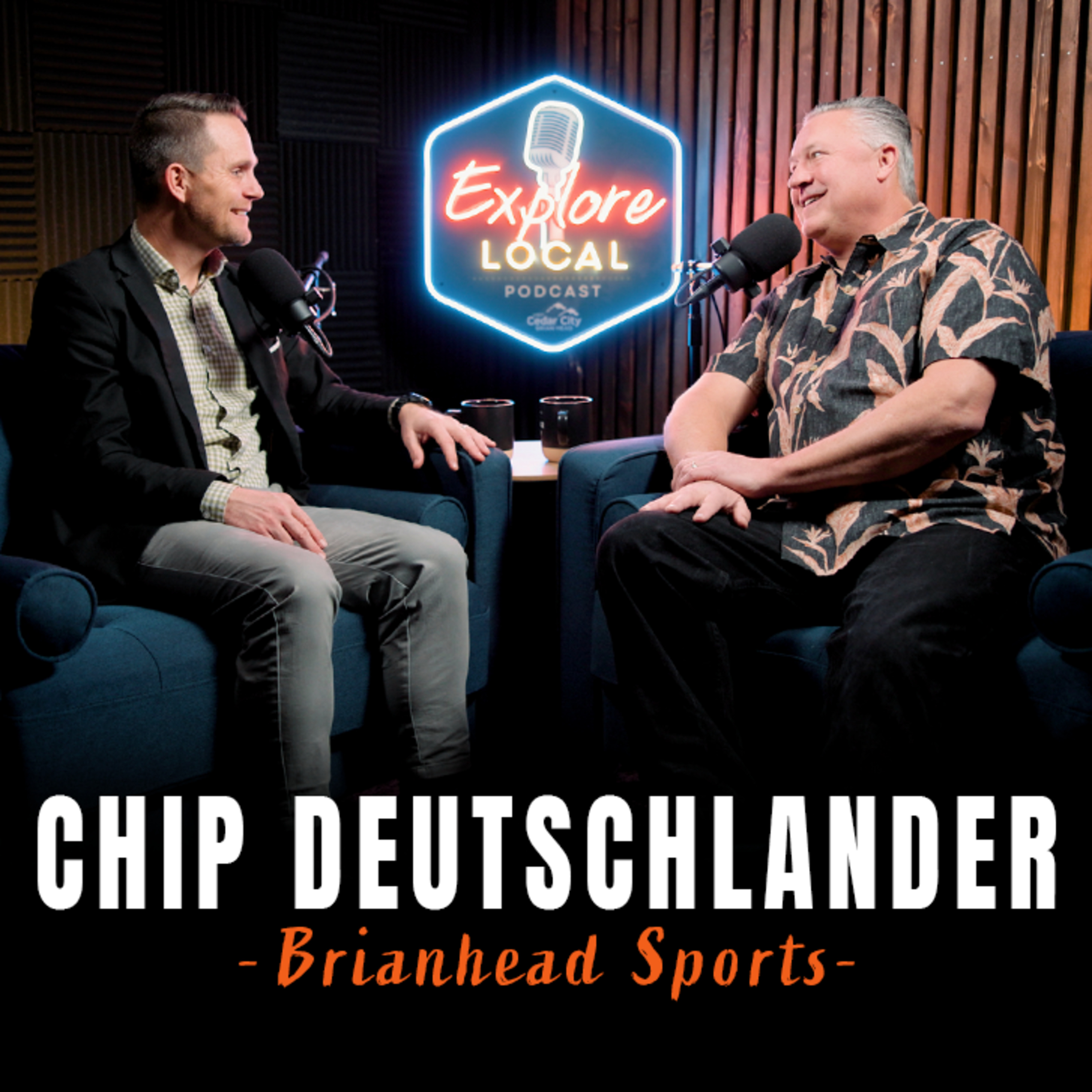
About this episode
Chip Deutschlander is the owner of Brian Head Sports, located at the base of Brian Head Ski Resort. Brianhead Sports offers a wide variety of outdoor gear and equipment, including ski and snowboard rentals, hiking gear, camping gear, and more.
The Explore Local Podcast is presented by Visit Cedar City Brian Head and hosted by David Johnson, Cedar City Economic Development Director.
This episode is sponsored by The Cedar City Business and Innovation Center. Dedicated to supporting local businesses and entrepreneurs, it provides resources and services aimed at fostering business creation, growth, and retention. The center features the “Makerspace” where entrepreneurs and small businesses can have access to 3D printers, video production and photography equipment, t-shirt printing and more! Whether you’re starting a new venture or looking to expand an existing one, the Cedar City Business and Innovation Center offers the tools and guidance to help you succeed. To learn more and get involved, visit innovationcenter.cc
Get every episode summarized
Each time Explore Local Podcast publishes, we email you a written briefing from the transcript — the topics, who appeared, and any specific claims, with the ad reads skipped.
Email me new episodesFree for 3 shows. No card needed.
Hosts & guests
Transcript ready
1,354 searchable segments. Every word is indexed and playable.
Full transcript
Explore Local Podcast — S2 E24 Chip Deutschlander | Brian Head Sports. Machine-transcribed; use the interactive transcript above to jump the player to any line.
This episode is presented by Visit Cedar City Brinehead Tourism Bureau. Discover the art of adventure at Utah's Gateway to the Parks. Cedar City is within a few hours drive from six different national parks and monuments, and only 30 minutes from fresh snow at Brinehead Resort. Check out VisitCedarCity.com to plan your next trip. This episode is sponsored by the Cedar City Business and Innovation Center. Dedicated to supporting local businesses and entrepreneurs, it provides resources and services aimed at fostering business creation, growth, and retention. To learn more and get involved, visit innovationcenter.cc. Hello and welcome to the Explore Local Podcast presented by Visit Cedar City Brinehead in partnership with Cedar City Iron County Economic Development, produced by Dallas Smith Media, and I'm your host, David Johnson. Today we are here with Chip Deutsch Lender who is the owner and manager of Brinehead Sports. Chip, welcome so much to the show.
Thank you, it's great to be here. So tell us, Brinehead Sports, what is it that you guys do there? We're full service ski and snowboard shop, even in the middle of August. We still consider ourselves a ski and snowboard shop. In the summer we'll dabble into stuff like fishing, hiking, mountain bike riding, all that, but primarily we are ski and snowboard. Oh, that's awesome. Sorry, I had this picture when you said primarily, we're still primarily skiing snowboard shop, even in the middle of summer. I just had this picture of people trying to wax their boards and just slide down the mountain. And then I had this vision of, you know, I don't think it's really popular anymore, but there was this stint for a while where there were mountain boards. Do you remember those? They'd put like these big hunker wheels. They were like kind of like skateboard kind of things. Those are still out there. Really? Yeah, and things like the unowields where they've got one wheel and skateboard. Those things are huge. People ride them around Brinehead all the time. Really on the trails?
They're, well, they're not supposed to be out on the Forest Service Trails, just like an e-bike isn't allowed on a Forest Service Trail, but it is allowed out in, you know, the pathways, the trails. The Brinehead has a town, has lots of interconnecting trails that you can walk on and ride a bike on. So, you know, without going out into the true mountain biking. Yeah. Then when you get out into the true mountain biking, it's world class. We've got trails up there. They started as old cow trails. They probably started at as old Indian trails where they went through the mountains. Then they became cow trails. And then mountain biking came up and the Forest Service didn't want to spend a lot of money on trails. So, it was like, hey, follow that one cow trail down through Dark Hollow. Or, you know, go over to the other side and follow it down through Bunker Creek. And then those over time developed into world class trails. That's awesome. Yeah. So, you seem to know the area pretty well. How long have you, as Brinehead Sports, been in business?
We opened Brinehead Sports in 1979. Really? We opened it as it was in the Brinehead Resorts Rental Shop. And all we had was a, like, six-foot-long cabinet full of T-shirts. Really? And then we sold Brinehead T-shirts. Really? And I was just a little kid then. I was involved, but I certainly didn't care much about it. I was more like, hey, I want to go skiing. Yeah, yeah. But from there, it evolved into a little strip of a shop on the side of Minis Mansion. If any of your viewers remember that, it was just an old, like, a night spot up in Brinehead. And then we moved to Brinehead Resorts main building at the bottom of Chair 2. For a while, we had a big shop over at the Navajo side. Oh, really? And then back, let's see, in 1997, we built our current location. Okay. And so we've been there ever since. So, who, if you were little when it started, who officially started?
My two older brothers. Oh, really? Yeah, my dad was involved quite a bit, but really the gears and the running of it and all was my two older brothers. Were they adults? Or did they kind of started as teenagers? Oh, no, they were adults. Oh, okay. Well, yeah, they were in their 20s, and they just started it from little tiny, and just grew a little tiny bit at a time. They didn't go out with grand design and, like, take on a lot of debt. Yeah. They just grew slowly as the resort grew. So, and to make sure I understood you clearly, they started off just selling t-shirts, not ski equipment. Yeah, it was just, like I say, a six-foot counter full of Brianhead t-shirts. Really? And then evolved from there into a full-service ski shop. So, would they just screen print the shirts themselves originally, or they would order them, or design them, or whatever? Yep, design them, order them, get them in, and hope to sell them all. That's awesome. So, how did it transition into what it is today?
Walk me through kind of the chronology of how that evolved. You talked a bit about the changing the different locations kind of in the area, but how did it evolve into what it is today? Mostly, there was always a desire to have a full-service ski shop up there. For a long time, it was hard to get ski equipment for a lot of our customers. Most of our customers are from Southern California and Las Vegas. Yeah. And back in the, in the 19s, 1900s, sure, that's all we had. You know, St. George wasn't big enough that it was a major contributor. Yeah. Cedar City, they didn't ski a lot, you know? So, it was Vegas and Southern California that were most of our customers, and there weren't a lot of ski shops down there. Yeah. Imagine if you lived up in Salt Lake City, you could go around the corner and buy a pair of skis. But somebody living down in Anaheim, they had nowhere to go. And so, when they came up to us, they needed equipment. And we just started carrying what we could.
In the, when we started, we were a ski shop. There was no such thing as snowboarding. Yeah. Nobody, you know? Nobody even known what snowboarding was. Yeah. So, then when the 90s came around and the snowboarding started, I guess late 80s, early 90s, snowboarding got started. We started delving into that as well. Let's see, Vinnie Fava, a local snowboarder here from Cedar. We have one of his original Burton Boards. And it's like the beginning of the whole sport. And we have it stuck up on our wall. Yeah, actually, when I went in your shop, this was a year or two ago. And when I first noticed, as what I'm saying, that Burton Board, I thought, oh my goodness, where did they get that board? Yeah. Now, there's a local family here named the Fava's. They've been into the snowboarding sports since it began. Some of the kids are pro riders right now. And they still frequent the Brianhead area.
You know, it's great snowboarding up there. It's great skiing up there. So, you know, it's a smaller resort. It's not one of the big ones where people come from Europe to go skiing. But shoot, we get international customers all the time. Yeah. And they know where we are. It's easy to fly into Las Vegas and get to us. Yeah. So... So, any fact checkers that are listening can correct me or you can correct me too, but from what I recall, Burton started snowboarding, right? They were the first like one of the first... I thought they were the first snowboarding company. I would need a fact checker for myself for that. I know, we have a fact check in. I mean, Sims was definitely there right in the beginning. There was lots of surfboard shapers that thought, oh, I can make this transition very easily. Yeah. And so, a lot of companies got into it in the beginning. Yeah. And we're fortunate enough right now. We're carrying the major, you know, like 32. 32 has been in the game forever. They've introduced new bindings and new snowboards in the last few years
that we're carrying. And, you know, it's just the sport is still evolving in such a way that the riders are just getting better and better performance out of their equipment every year. Yeah. So, it looks like, Jeff, you might know better, but it says, winter stick, 1970-72, Sims snowboard 76, and Burton in 1977. Oh, okay. Dallas. They're right. They're right in the back. Fact checkin' for us, yeah. And I think back then, they didn't really call it snowboarding. They called it snow surfing. They didn't have bindings. Uh-huh. They had a little rope that they're holding onto the front. When they did start strapping in, they weren't using snowboard boots. They're using snowmobile or, you know, like the cerells that you'd use to shovel snow. Uh-huh. They're strapping into the boards with those. You know, it's funny that you say that about the rope in the front because I've, well, I haven't seen one in a long time, but I remember as a kid, and even since then, I've seen, occasionally, you, I mean,
that's the one I first learned on with no bindings. Yeah. And I just remember my friend's backyard. I was a little bit up in Washington State at the time. And we had a snowboard with a rope on the front, and you just kind of stayed on the board by holding onto that rope. You're like unlocking these random memories I totally forgot about. Yeah. And those boards are still out there. K2 makes one called the tree splitter. Oh, right. And it's an old throwback board. And it's got the rope on it. And it's, you know, the little kids come in, and they're all over it. Yeah. But it's not designed strictly for the little kids. It's designed for me. Yeah. I'm six to 280 pounds, and I can get out there and slide on this surf board with the rope on it, type of thing. The interesting thing is it is, it does seem a little more like surfing because you, with the rope, you can't really ride the edge quite in the same way that you do with the board with bindings. Right. Yeah. You are more relying on the back pressure of the snow. Yeah. So that's interesting. Well, thanks for indulging me in that digression.
It's just, when you brought up that board, I actually was planning on bringing that up because it's so cool to see that on display in the shop. And I don't think people, now it's just so common place. And snowboarding for a long time. And I think it's starting to balance out a little bit more. But I think there's still, like snowboarding seems, people think, is the cool. You know, you snowboarder your ski, but you're cool, you're, you're a bro if you snowboard kind of a thing. Yeah, I suffer through that all the day because I'm a skier. I love skiing, I've always been skier. When, when the sport of snowboarding first came out, I learned how to do it. I got to where I could go right and I could go left. I could have a decent time anywhere I'm riding head. Yeah. I think the biggest mistake I made in trying to take over snowboarding was that one day I plumped out my chest and said, I'm a pretty good snowboarder. Yeah. I proceeded to go out and break a board. Then a week later, I broke a binding. And then a couple of weeks after that, I went out one more time and I broke my wrist.
Oh my gosh. So when I got up from that, I just said, ah, you know what? I'm a skier, so. Hey, three strikes you're out. For those that have listened to some of the past ones, I'm obviously a little biased to skiing because I started snowboarding and then I got into skiing and realized that was so much easier. I mean, maybe I just not cut out for snow. But the funny part is I've been going to Brian and quite a bit this season and every time I'm there, I'm like, gosh, I want to try snowboarding again because it's been so long. I'm like, I just want to do it. Maybe I'm just a glutton for abuse and hurting myself but I'm wanting to get out there and snowboard. There's early generations of families where, you know, mom and dad only skied. Yeah. And then the kids are like, oh, mom and dad ski, I want to be cool. I want to snowboard. Right, right. Well, then we finally got to the point where mom and dads were all grown up and they were the snowboarders and now the kids want to ski. Yeah, that's what I, that's what I was talking about. It's almost kind of balancing out.
It used to be like, yeah, just like you said, like it was cooler to snowboard, but now it's, as a, as a shop owner, it's great because you know, a guy comes in, well, it just happened last week. A gentleman came in, bought a full ski package, bought, you know, skis, boots, poles, everything he needed. And then came in yesterday and bought a snowboard package, bought everything he needed for snowboarding. Really? Yeah, he just, he needed to update all of his equipment and he does both. That's awesome. In conditions where, you know, like he comes up spring skiing most of the time. But he loves to go out and ski all morning when it's nice and hard and fast. And then take a break for lunch, throw on a snowboard equipment and, you know, as the sun comes out and conditions soften up a bit, he starts snowboarding. Really? And it's just, man. There, these, there, there's a lot of really good athletes coming through Brianhead. The, the caliber of skiers, the caliber of snowboarders are, are top notch.
You know, everybody thinks of Brianhead as this tiny little resort. But man, we've got great terrain and we've got good athletes that come through from all over California and Nevada. And even, you know, now St. George and Cedar are big enough. They contribute quite a few customers up there. And I meet people all the time that are just locals come up and ski. Well, in this season with Brianhead as the first resort to open in the state, I keep running into people down from Salt Lake. They're like, oh yeah, I'm down from Salt Lake, you know. But every time I run into people, just like you said, from California and Vegas and all over the place. And it's cool to see, you know, there was a CEO that I was meeting with, I don't know, year or two ago. And we were talking about how many more ski days Brianhead Resort has now and what they're trying to achieve. And his, off the cuff response was, our little ski resort is, is, is having that many ski days
and ski days for those that don't know, or just, it's like the count of skiers that, you know, essentially come through or whatever. But yeah, it's crazy what they're doing out out there. So, yeah. Well, the base of Brianhead is at 9,600 feet. That's the lowest kind of a, like the bottom of the bottom chair. Yeah, it's the highest resort in the state. Yes, yeah. And so, you know, once we get snow, it holds on really well. Spring skiing and Brianhead is the best in the state. Yeah. We've, you know, great coverage. The snow will extend, you know, I've been there, like it says, since 76. And I cannot remember a year where we closed for lack of snow. Really? And we've had some snow years that were pretty, like, pretty lean. Right. But even then, we didn't close for lack of snow. We closed because people had moved on to their jet skis and their tennis rackets and they'd pulled out their golf clubs.
And just quit coming to us. But the current management up at Brianhead is trying to extend that season. They want to open early. They get that out there. They've invested a lot in making snow. Yeah. And once they make that snow, when I grew up, the groomers were farmers in the summer. And then they came up and groomed in the winter. And they groomed like that. You know, they was like they were grooming a field. And it was awful. Now with professional groomers, like these people really know what they're doing. And the equipment, GPS lead, all that, is just making for optimum conditions, just about every morning when you show up at that resort. Yeah. It is perfect. It is, it's corderoid that just looks beautiful. Yeah, the corderoid. I know what you're talking about. Yeah. We just, excuse me.
What's cool about it too is, I think it was last year or the year before when we were talking about the spring skiing. I think there was like a 19 dollar day in May or something. And I called my brothers up north. And I'm like, you guys have got to come down. It's cheaper in gas and the lift tickets than just one lift ticket up north. And so yeah, my brothers, a bunch of them came down and we went skiing. And yeah, we do have a lot of customers. One family in particular, they live at the bottom of the cottonwoods, which is premier-scaring skiing area up north. You know, they've got all kinds of resources. It's actually where some of my family lives, yeah. They figure by the time they get in the car, get on the freeway, get down here, ski, and wait and Brian has really long lift lines, which are like four minutes, seven minutes, is a long lift line for Brian. Yeah, tops. They get way more skiing time, even with that little bit longer drive to get down here.
And so we are starting to get a lot of customers from up north that just love the sport and don't want to be stuck in traffic or don't want to be standing in a lift line for 45 minutes. Yeah, no, that's true. There's been several times just this season where I've gone up for just a half a day and I get in a dozen plus runs, you know. Yeah. And I'm the guy, you'll see the memes on social media where the person gets to the top and then they ski down trying to make it at the last minute to get on the lift before they close the lift. That's always me. I can make it, I can make it, I can make it, I can get one more. And that in Brian head, that used to be so easy to do. You get out there, your first chair, your ski all day long and you just work it so you can get that last chair. And so that's good solid ski in all day. Well, early on, it took 13 minutes
to get up to the top of the lift. If you got on at the bottom, it was about 13 to get to the top. And so that was plenty of rest throughout the day. Now we've got the detachable quads both over at the Navajo side and on the giant step side. It's six and a half minutes to get to the top. I can't ski all day anymore. That's just, you know, you're doing lap after lap in the six and a half minutes. Your legs don't recover. You're like, just go and fast all day. So most people, if they get four or five hours of good skiing with maybe a break or two in there somewhere, that's a full day. They've had enough. So it's, it's, there's, like I said earlier, we've got some true athletes out there. And that's what it takes to get first chair, ski hard all day and still be on last chair. Yeah. You know, you mentioned the detachable quads. That's something I learned about not too long ago is those lifts when you see the giant spring and the quads are the ones that, you know, seat four people.
But apparently when it comes through, it detaches from the cable, right? Yeah. And so it kind of slows it down, but it keeps the the cord going at the same pace and then it reattaches with that spring. Am I, am I mis-explaining that? I don't know. No, that's exactly what it does. It comes down the mountain into that wheelhouse, detaches and just comes around nice and slow. So anybody from an expert to a beginner has time to get up there and sit down comfortably. And then once you're all loaded, it shoots you out there and gets you out of safe distance, hooks back up to that cable and scoots you up that hill at a, at a pretty quick pace. Increasing. And so both, yeah, the Navajo lift is our, you know, it's our beginner chair. It's got really nice general terrain. And so first timers are taking that all the way to the top. And again, it loads them up so nice and slow that it's easy to get on. But man, once it hits that cable and reattaches,
yeah, sure, you're off. Yeah, it's true. So and then the giant steps one is, you know, that's, that's a lot of vertical in six and a half minutes. Yeah. So what, now trying to remember what's the, what's the top elevation at the peak of the, so our peak is 11,307. Yeah. And so we are considered the highest ski resort. So not only like our base is higher than a lot of ski resort's top. Yeah. But then because our exact mountain goes all the way up to 11,000, we're, we're one of the higher ski resorts. That's awesome. The town of Brianhead for years was the highest town in the United States. Really? And I think some guy over in Colorado incorporated his one house town in order for him to become the highest town in the United States. We'll have to, we'll have to research that. Yeah, you know, we could say the highest largest town in America. There you go. Yeah, so Brianhead is, as much as it's a ski resort,
it's also a community. Yeah, there's, there's plenty of families up there, plenty of people up there that just live there because that's the town they love. They don't necessarily ski. They may not even snowboard. You know, maybe they snowmobile or maybe they just love the summer up there. Like my wife in particular, she likes the summer more than the winter months. I'm all about the winter. I love the snow. I want a ski. I want a snowmobile. Any of that kind of stuff. Yeah. Once the snow melts, I want to go on vacation somewhere. Let's see, you know, and change it up. Yeah, and there are all kinds of people that are the exact opposite of me. They don't ever come up in the winter. They come to Brianhead to vacation in the summer. Yeah. The hiking is amazing. Not only does the Dixie National Forest and the Cedar Brakes National Monument have lots of really nice trails, but because we are such an open land up there of public lands,
a lot of people just go up there, spin around in a circle, and point, and go, okay, let's hike that way today. And they just go cross country out and check out the trees and the hills. It's a beautiful area, summer or winter. So did you, could you say you were a little when your brothers started it? Did you grow up in like Parawan or Cedar City or where did you grow up or were you guys living in Brianhead? I lived in Brianhead. I grew up in Brianhead. I had to take the bus every day to go down to Parawan to go to school. Oh wow. And so it, yeah, I went all of my middle school and high school in Parawan. Before that, I was a military brat and it moved around quite a bit. You know, 29-plomb San Diego. Me too. I lived in 29-plomb. So I was born in San Diego. Really? Yeah, was it Navy or was it? No, it's Marine. Oh, Marine, see, my dad was a medical corpsman which Marines is the division of the Navy. So anyways, yeah, keep going, sorry, I interrupted you. No, no, that's a, it's a,
so yeah, I had moved around quite a bit before I landed in, in Brianhead. And no choice of my own. Like, by the time I moved to Brianhead, I was 10. Yeah. And so I had just followed my mom and dad around as he got deployed to different places. And then he retired from the Marines in 29-poms. Oh, okay. And then moved to Brianhead. He quoted himself once of saying, you know, I quit the Marines because I hated having so many bosses. And then he took over managing a condominium complex over there with 84 units. And so then he all of a sudden had 84 bosses. He's like, what am I doing? Why, why? I was going to ask what led you there. So yeah, so was he was managing or did he buy the condominium? Well, what led us there really, my family would always been a ski family. Loved the sport. We're totally into skiing. And from San Diego, mammoth was our early choice. We'd always gone to mammoth.
One day we're driving up, and I don't remember this from remembering it. I was like, say, a little kid. But the story's been told enough times. For you dad. Now I know, yeah, okay, this is what happened. But we were driving up to mammoth one time. And in one of those notorious traffic jams on the road getting to and from mammoth. Back then it was truly one lane going one way, one lane going the other. So any accident was just multiplied. And there was a couple arguing a couple cars away that were yelling and they said, see, I told you we should have gone to Brian Ed. So then, you know, no internet, no nothing like that. My dad got back to Camp Pendleton and Quantico and just started, Camp Pendleton and just started asking, hey, anybody here, Brian Ed? Anybody here, Brian Ed? And then finally met a Navy pilot that had not only heard of Brian Ed, but had been there quite often. Wow. So told us what it was about, where it was. And the next time we're heading up to mammoth
and something happened on the road and my older brothers were like, hey, why don't we just try Brian Ed this time instead? Yeah. And so instead of taking a left and going up to mammoth they took a right and went to Brian Ed. Wow. And I can honestly say I've only been back to mammoth once since then. And so, yeah, we've been sold on Brian Ed ever since the first time we went there. That is awesome. That's such a fun story. Yeah. So skiing truly led you to Brian Ed. Yes. Yep. And then we, you know, my parents bought a condo up there and then when my dad did retire from the Marines this opportunity to manage that condominium complex came up. So he just, ah, what the heck, I'm going to move there. Yeah. My two older brothers had already moved there. They had decided, hey, what a better place to live. My parents own a condo there. Let's go there. Yeah. And so then it just evolved. And once we got the ski shop up and rolling then it just, it was a natural place to live. And, you know, I didn't get to raise my family here.
When I came of age because, yes, I was involved in Brian Ed sports at that time. Yeah. But I was 10 years younger than my next oldest brother. Oh, okay. So I would not have been working with them like I should have been. I'd have been working for them. Yeah. And no chance I was going to do that. And I said, ah, I'm out. Yeah. And then finally after I had my career in Southern California they, they got old enough that they wanted out. And I was like, all right. Well, I'll come back if I can have some sort of autonomy. Yeah, yeah. And they're like, yep, it'll be yours. It's all you run it. They're, they're still highly involved. And, you know, if one of them tells me something, I don't necessarily have to listen. If the other one tells me something, I don't necessarily have to listen. But if they both gang up on me, not only do I have to listen, they're most likely right. They ran it so well for so long that if they're willing to gang up on me, they're right. And so I better listen to them. I thought you were going to say something like,
but if they both gang up on me, then I find myself in a headlock. Or something like that, you know. Yeah, exactly. No, no, the business model that they had established and a very simple business model of just doing it right and keeping it small and conservative has worked really well. And so we're, you know, we're always striving to grow. But with the community in mind and with sustainability, you know, we're not, like I say, we've been here since 79. We're not going anywhere any time soon. We don't need to grow exponentially this week. We'll take a little tiny bit of the time and continue to grow. So I'm trying, in my mind, I'm trying to picture the store down. There's an upstairs and downstairs, right? Yes. And the downstairs is more just like a shop and then like like clothing, things like that. And then upstairs is the actual ski shop, correct? Am I remember these? Absolutely.
Yeah. So downstairs we have all of our soft goods. The jackets, the pants, the bibs, netgators and goggles, helmets, all that kind of stuff is downstairs. A huge selection of still that, what we started with, Brianhead T-shirts. We carry hundreds of Brianhead T-shirts and sweatshirts and they're all downstairs. Then when we go upstairs, that's when we get into the, what I think is the fun stuff. You know, we've got close to 300 snowboards. Still, we're halfway through the season. And I bet on our sales floor right now, we've got almost 300 snowboards. And then off to the right is a whole bunch of skis. We've got poles, ski boots, snowboard boots. As you move through that, we get into the tech shop where we've got all the pieces and parts that you need for anybody that like say breaks a snowboard buckle. Or you know how they always say snowboarders have a screw loose? Well, yeah, it's not in their head.
It's down on their bindings. And so we've always got all the screws, the pieces. We may not have, you know, if they've got an off brand binding, we may not have that specific part, but we'll have a part that we can put in there and get it going, or you know, at least we try. Yeah. And then as you move past that again, you get into our rental department. And so upstairs is full service rentals, everything from, we rent the ski bikes to then on down to yes, snowboards and skis. People come up to rent snowshoes all the time. They rent snowshoes from us, take them up to cedar breaks, tool around up there, and Brian had doesn't have any groomed cross-country skiing, but there's still plenty of places out there you can go and cross-country ski. So we rent those out as well. Yeah. Okay, you've just filled my mind with like a half a dozen questions. So I'll see if I can like go through them all.
Well, first let's start off with, what is, when you're out skiing, and maybe there's a couple questions in this, what's your personal favorite setup? Like brand of skis, boots, bindings, things like that? Do you personally have a preference of some brands over another or different fittings, yes, and that creates, not a fight, not even an argument, there's a huge difference in my family alone. So of preferences? Yeah, I like a ski that's narrower underfoot, wide at the tip and tail, that's made to carve, and made to make lots of turns carving pretty much on piece, or on the trails that the resort has. I don't get off into the backcountry very much anymore. So personally right now, my favorite ski is the head V10. Oh, okay. And then there's also a head super-shape. Both of those are my favorites.
They're really fun, quick from edge to edge, nice turning skis, but then my son, he does not want those narrow underfoot, he's looking at something more like 99 to 100 underfoot. So he likes the K2 mind benders, or even the Scott makes a ski called the sea, and he's loving that ski right now. Totally different style of skiing between the two of us. What's more the intent of the ones that your son has preference for? His or more all-mountain, go anywhere, do anything, and it doesn't matter if he's in the moguls, or all of a sudden somebody says, hey, let's cruise off into the trees and go down through that field over there. Those skis are more aligned into doing that. If somebody wants to hike up to Brianhead's peak and ski the shoots, his skis are more suited for that. I'm not hiking anywhere anymore. God invented chair-list for a reason.
So I get on the chair lift and I come right back down there. That's awesome. What about preferences and boots, bindings on skis? So you've got to get the right boot. Right. I don't care if you put me out there on the best ski ever made. If I'm in a horrible boot, I'm probably going to have a horrible time. And is that dependent on like your fit? Or yeah, absolutely on your fit, where I think head makes the best boot out there right now. It's the best out of the box. It fits everybody. It just feels good. They do have all the way from a recreational fit where hey, you take this thing out of the box, it's going to fit. Then they go all the way up into their race models. And then their race models, you may have to do some work to make it fit your foot. But then you're demanding the most out of the performance from that boot.
And so I'm kind of right there in the middle. I've got a boot that I can demand performance out of, but it's still really comfortable, really easy fit. And then again, while Tyrolia has their newest binding right now, that not only releases side to side on the toe piece, like everybody's used to, but it'll release side to side on the heel piece. And so you can release vertically or side to side on the heel piece, it's called the protector. And it's the next step up in binding safety for the industry. I think that a lot of the companies are going to end up copying it or coming up with their own versions. But this is the first step to a new level of safety in bindings in a long time. Interesting. And it's backed by, I don't know what you'd call it, clinical studies, but doctors and needs and the lawyers
are actually behind it saying, yeah, okay, you can call it another level of safety because it is a safer binding. I always found that interesting about skis. And obviously it's because of the way you move and steer, but skis, you can pop out if you crash. But snowboard, you're in it. You know, you're closed lining if you're in it. But let's maybe talk about, I know you're prefer to ski. Let's talk about like if somebody comes in and they're really in the snowboarding, what your preferred recommendations are for people that are maybe renting or bought. Probably let's say buying. Got it. It's that you really have to have a full conversation with the customer and not tell them, hey, this is the best board, but ask them, what kind of riding are you doing? What level are you? Where are you going to be when you're out there? The technology and the snowboards is so high right now that,
yeah, if you're going into the park and you're playing on the little metal tubes and you just want to get up in the air and throw a 360 or do a Hemi or do, I don't even know half the names they used for these tricks, right? But they're doing a lot of tricks out in the park. You need a particular board for that. Like the lip tech skate banana is actually, it's got a reverse camber on it so that it doesn't catch edges. It's free to go out in the park and play around. But then I say the black snowboard of death. That's a heck of a name for this snowboard. But the black snowboard of death is that just intense carving board. It's got a lot of camber in it. But you can't put a beginner on the black snowboard of death. Because those catch edges too much. They just won't have fun. It'll be like, wow, this is a lot of work. Yeah. So there are boards out there for every level of snowboarder.
And you've got to try and match them with the right one. There's Solomon makes one called the Huckknife. And the Huckknife Pro. And it's just a super fun board that kids are riding all the time. The Huckknife Pro, a little bit stiffer, maybe somebody more like my size. And then, yes, speaking of the Lib Tech makes one called the Huckknife. The Huckknife is, when you walk up to it, most people are going, man, that's a massive board. But what it's made for is that guy that's six, two, six, three, it's made for me. Six to 280 pounds. I can't just hop out there on a little 155 with a narrow waist. I got to have a big board under me because I got a lot of weight that's bearing down on it. And then the bindings, kind of the same thing with the snowboard bindings. Yeah, they don't release. You want those things locked on. Mostly because then both of your legs on up to your hips
are doing the same when you crash. If you did have one released, and so the way to that snowboard is taking one of your legs away, that's when injuries could happen. But we've got the whole line of step-in bindings. So traditionally you bend over and you clip yourself in. Yeah, right. And then now the technology is coming along. There's been some form of a step in binding forever. But this year it seems to have exploded. Yeah. Clue is a big one, right? Clue right now I think is the best one. That one is a true click-in with no loss of performance. You're locked in like a traditional one. And it comes in two pieces. So when you say, go to get a snack at the snack bar, you just click from your board, but half of your binding stays on your boot. And you're walking around like that. Then under that we've got the, well, the supermatics, the supermatics
have been around for a long time. And they used to be just made by nightecker. But now bent metal and solamin are making them as well. And they are kind of a step-in system, real quick, real easy and very comfortable. 32 has a binding now called the phase. And it is another one of the bindings where it's not like true click-in. You still have to bend over and do a little bit of adjusting once you get in it. But you don't have to sit down and get in and completely buckle. You can do it as you slide off. I couldn't. A good snowboarder can do it as they're getting off the lift. Just stick their foot in, reach down, slap it a couple of times and boom, they're good to go. And again, with no loss of performance, it's as good as a traditional binding as far as locking you into the board and getting you that performance idea. But it's just so nice and easy to slide in and out of that customers are loving it.
Yeah. I remember most of my ski and board equipment, either somebody gave me or I got it at thrift store because I was just cheap and when I was younger, obviously I couldn't afford to go buy stuff. And so I remember my first snowboard, somebody gave me with the boots, were a step in and it had a little notch in the toe. And you like clicked in the toe and then you snapped down the hill or whatever. Anyways, they didn't last very long because they were used and everything. And as a matter of fact, I grabbed those. They were still at my parents' house. And I grabbed those the other day and the rubber because they're like 25 years old or 20 years old or whatever. And the rubber just like peeled off off. I'm like, okay, I got to throw these boots away, I guess. You know, because I was going through my parents' house garage saying, I got to find some of that old snowboard stuff because I want to go snowboard and test it out. And I was trying to piece together stuff that I had from Forever Ground. I'm like, yeah, I don't know if this is going to work.
Yeah, the step in the clue, the clues have been so interesting to me because that was one of my put-offs when I was snowboarding was always having to sit down and click in every time I got up. And I loved just, you know, skiing, just jump off the lift and go, you know, that's one of the things that I loved about it. But anyways, I'm kind of blabbing. But it was interesting to hear you kind of talk about the different types of snowboards and no surprise to me all the unique names that each of these snowboards have. It just cracks me up. Yeah. Now, where they come up with some of these names is like, holy cow, you know, what were you on when you named Rowan? But the snowboard companies have always been a little more playful, a little more leaning with, you know, where it had in particular, as a brand, they are so prevalent and so driven in the World Cup series that their technology, they want to make
the best ski ever. And they want every pro rider, every pro skier to be on their skis. Yeah. And you see it right now. Right now we're leading up to the Olympics. Yeah. And it's amazing to me how much coverage we're getting in the ski industry right now. And yeah, all these guys, they come up, they go like this and they're holding the brand of skis that I like. It's like, oh yeah, that's not what I mean, you know. And so it's, and that trickles down into the snowboard technology. The, you know, companies like Head and Solomon, they've been making ski equipment for so long that they know what they're doing. They know, sure, it's a different shape. Sure, it's a, you know, a different kind of a process for a board that's this wide, rather than a ski that's this wide. Right. But the basic technology and the engineers that are doing it are super good at what they're doing. And so it's, it's fun to watch the, the industry evolve.
Yeah. Just materials. There's a material in our skis right now. It was developed probably by the military somehow, you know, because it seems like a lot of these are, you know. But when it's docile, when it's just relaxed, it's a, it's almost as flexible as my t-shirt, right? Maybe not quite that much, but, you know, it's got band, it's got flex to it. But as you start going fast and the vibration starts hitting this material, it generates its own kinetic energy, electrifies itself and stiffens up to where it's, it's like, you know, it's a hard piece of material that just changed within your ski or within your snowboard. Interesting. And so, you know, again, nice and slow, it's playful, it's fun, it's all that. But you start bombing down the hill and you're going really fast. Then all of a sudden, this is a performance magnet and it is sticking to every turn you want to put on it.
That's awesome. And it's the materials, the material stories in these boards right now and skis is almost incomprehensible for a layman like me. I'm like, I don't get it. How does that even work? Yeah. But they're doing it. It's interesting that they can figure out those little tweaks in some of those things. So tell me about like, in addition to the ski and the snowboards themselves, tell me about like gear, like the outfits gear. What are things you generally recommend to people? And I know it might vary depending on what they're trying to do. But talk to me about gear as somebody's coming in, they want to get, there's everything from the beginner to the experience to someone like me who's always kind of gone cheap skate, but I'm a really experienced skier. What's some of the gear that you recommend to people on why? Well, there's waterproof is gotta be the biggest story.
But along with waterproof, it also needs to be breathable. Like you want it waterproof, wear a trash bag. That is waterproof. No water's getting through there. But then again, no vapor will get through there either. And so you're going to sweat like crazy inside it. And you're still going to be soaking wet. And so there's a rating and ski clothing that's basically its amount of waterproofness. And they measure it in how many millimeters of water column the material will hold up before the pressure will permeate through the material. Interesting. And there's kind of like a line drawn in the sand where 15K waterproof garment is about what somebody you're an eye size would need to be able to put our knee down in some fairly wet snow and still anticipate staying dry. So 15K, Gore-Tex, a very good material that's been in the industry forever.
Yeah, they've been around forever, yeah. They say they come in at around 37K. And so Utah in general, and Brian had for sure, because we're at such high elevation, have generally got pretty dry conditions. Even in a blizzard, it's so cold that you don't really have to be that waterproof. Yeah, and we're in a, I mean, we're a high desert. And that's why they call us the greatest snow on earth is our snow's more powdery and dry. It's not wet and slushy. Yeah, it's the, it is. The best snow on earth. I mean, it's not just Brian, or not just Utah's logo, it's real. You know, I grew up up here and I could never make a snowball. You scoop it up and go like this and you just go, I had to wait until I came to Paramount or Seater to make a decent snowball. Yeah, I wanted to kind of melt them down, yeah. But you know, the material stories, we have garments that are made for, like say, the guy from San Diego that's going to ski one weekend
out of the entire year. He doesn't want to go out and buy a $600 Gore-Tex jacket. He just wants something to get him through. And so we've got, you know, some that are 5K or 8K. And that's just a pair of insulated bibs. They know they're going to maybe get a little bit damp, you know, soaking through after several out there hours out on the hill, but they're OK to do that. And then it's the more performance, you know, the guy that's going to be riding four or five weeks total out of the year, he's going to get a little bit better equipment or a ski instructor or a ski controller. That's literally out there. Five days a week, all season long. They need something like Simtech or Dursamax. I can never even say that word. But those are materials that can be woven into these products that really make them that windproof and waterproof layer and still allow the vapors or the sweat and everything to come out of them.
We carry a lot of brands, the fun ones, you know, like Roxy and DC, Quicksilver, those kind, Vulcom. A lot of Vulcom. They're just so fun and playful, but they still use the good material stories. So it's still a performance idea. And then we're fashionable. Yeah. Yeah. And then we carry some other brands like Ice Peak or North, well, we don't carry North Face, but those other brands that are more associated with a high-end idea. And so it's hard to make that balance of, hey, I want all ski clothing or hey, I want all snowboard clothing. Because there is still a difference. It's mostly in the mindset and in how it looks. The material stories are the same. But a snowboard jacket, you probably do want it to come under your butt a little more.
Because you spend a lot more time on your butt. Yeah. Right. Huh, interesting. It's cool to kind of hear you really dive into some of the, not just about what you need, but like why the story, when you've said the word stories several times, like the material stories and what their purpose is and what degree you need. One of the things that I bought recently this year, because I noticed a lot of people out there, because I've always just used snow gloves, but whatever cheap snow glove I could find, and they've done me fine. But then I noticed a ton of people out with two different types of gloves, one, mittens, and two, leather. And I thought, I wonder if that helps with the wind, because sometimes we can get some pretty mean wind, or if it's just a really frigid day. But then I found the crab claw, and that's what I ended up getting. I got a leather crab claw because I'm like, oh, I can still use my finger to point,
you know, to do whatever and everything. But I don't know if, what's the benefits or differences of maybe having a mittens versus a stand as typical glove versus a crab claw if people are curious which one they should get? For the most part, it is personal preference. Like for me, I had to have a glove. I was always give me a glove, I'm not skiing in a mitt, and I want my glove, because I want my fingers. I want to be able to do something. Yeah. But then when I really started paying attention, I realized that every time I needed my fingers, I was taking my glove off anyway. Right, yeah. And so then I'd do it and put my glove back on. So then I said, well, I'm just gonna get a mittens. That way my hands will be warmer, and if I'm gonna take it off anyway, what's the difference? And so having that trigger finger available for a snowboarder to do is buckles. A novice probably still has to take their gloves or mittens off to get the buckles to work, but a good snowboarder, they don't even look down,
they're talking to their buddies. B have done all right, let's go. That's true. And so it has more to do with what you need from your hands. your hands, but yeah, mittens are definitely warmer, and then a lot of them now are coming with, with like say a five finger glove liner that goes in the mittens. Yeah, that's how mine is, yeah. And you kind of get the best of both worlds. Yeah, I was actually surprised by that, because I bought them, and obviously, well, Crab claw, lobster claw, or whatever you want to call them. But the mitt and portion of it, I'm like, there's slots for my fingers, because I was just expecting them to be free inside the mittens, but it's nice, it's so much warmer. And if anything, my pointer fingers, maybe a little colder than my other friends there, because they're all bundled together and stuff, but I still kind of like the pointer finger, because like when I'm skiing with my kids, or a buddy, or someone I can, I don't know, I feel weird just like,
hand out like this, I can still like point, hey, go that way, or whatever. You know, when we were talking about the material in the skis, and how, yeah, it was probably developed by the military, right? Well, that goes back to what you're talking, that Crab claw, that finger like this, that's actually, it was a military idea. Oh, really? In that, they needed the trigger finger. So their official call term, is it's a trigger finger glove. Oh, really? And that way you've got the trigger finger exposed, you don't have to take off your mitt and your glove to fire your weapon. Oh, interesting. So it's, again, back to the military. You know, silly putty started with like the military or NASS, or something like that too. It's like, who knows if they really developed it, or if they just went into the patent office and stole it? Yeah, there you go. Who knows? Who knows? All the conspiracies. Yeah, exactly. So that's funny. Well, tell us more to, you know, as we're kind of wrapping up here, tell us why you love doing what you do,
why you love brinehead sports, why you love brinehead, why you love the resort. I mean, you've talked a little bit about that, but give us your why. Well, I mean, why I love brinehead sports, that it's a family business, and I've been in some sort of retail my whole life. Well, you know, I taught skiing in order to pay for me to go to SUU. So that was right out in the public. I wasn't selling a product, but I was selling a service. I was selling myself. I was selling brinehead, and so I just sort of naturally, that's where I like to be. And then when I left brinehead, after I got out of college, I went down to Southern California. I managed some big fives. They're a sporting goods chain that's probably mostly from down there. And then, but again, there was all sales and retail. In brinehead at this job,
every day I meet somebody new. On a good day, I may meet 50, 200 new people, you know? And it's not like I'm selling a lot of stuff that people really, really need. You know, people come into my store all the time, and I don't say what do you need, it's like, you know, because look around, it's a big store, and there's nothing in there that anybody needs, you know? It's stuff they want, it's stuff. And so in general, the customer's on vacation, they're in a great mood, they're having a good time, and they're, you know, they're just happy and jovial, it's fun, you get to interact with them. You do occasionally have to sell a pair of chains, to some poor guy that's got to go out and lay in the mud and put them on, and I tell you, he's not happy. So those guys are not happy at all. But in general, the vibe up in Brianhead is so much fun.
We get customers all the time, that come in and go, how come everybody from Utah is so nice? Or how come everybody from Utah is so friendly? Yeah. Because we say hi to everybody, and everybody, they just walk into Walmart, down here before they come up the mountain. They're like, I was walking in Walmart, and I'd say 10 people said hi to me. You know, at home, I can walk around all day, and nobody says hi to me. He's like, well, yeah, we're generally friendly, nice, you know, it's a pretty easygoing community, you know. And then, yeah, the community up and around Brianhead is also second to none. The people up there, the community, the, you know, from the police force, the firemen, down to public works, all that, just in the community that rallies around them, is just a lot of really good, hardworking people. You know, you can't just hang out out there.
If you're up there, you're working. Yeah. Whether you're retired, you're still working because you're shoveling your, you know, you're working around your house. There's a lot to do to live on a mountain. Yeah, that's right, I'm sure. There's a lot of people move up there to retire, and realize, holy cow, it's work to live up here. And they move back down here somewhere, you know, but, but no, it's just the whole vibe of meeting new people every day in that retail environment, where they're not there because they have to be there, they're there because they want to be. It's a lot of fun. That's awesome. Yeah. Well, great. Well, Chip, thank you so much for coming on the show, talking about Brianhead Sports, talking about the skiers or giving us the background. It's really, it's really cool to hear your stories and to just kind of get to know you more. So, Chip Deutsch Lander with Brianhead Sports, we hope to talk to you more soon. All right. Well, thanks for having me, and yeah, I'll come down anytime. Awesome. Have a great day. You too. All right. Yeah. Yeah.
Yeah. Yeah. Yeah. Yeah. Yeah. Yeah.
More episodes
More from Explore Local Podcast

S2 E25 Bert Mitchell | Iron County Sherrif's Search and Rescue
Explore Local Podcast

S2 E23 Christian Morales | Rosales Mexican Food
Explore Local Podcast

S2 E22 Bill Heyborne | Southern Utah University
Explore Local Podcast

S2 E21 Derek Bryan | SUU Outdoors
Explore Local Podcast