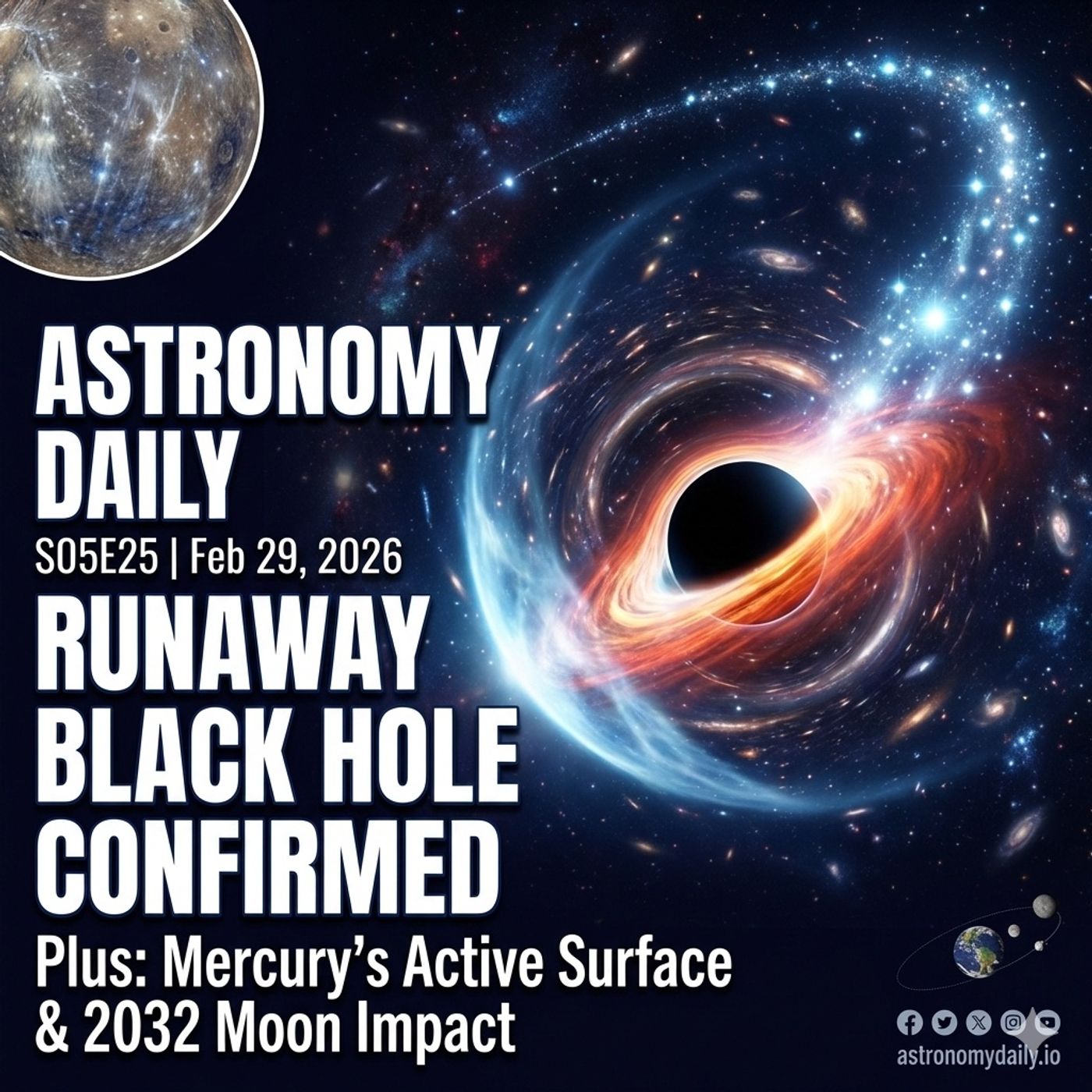
Runaway Black Hole Confirmed, Mercury Still Active & 2032 Moon Impact Risk
About this episode
### Episode Highlights
**Mercury's Hidden Activity**
New research reveals that Mercury, long considered geologically dead, is still actively losing volatile materials from its interior. Using AI analysis of 100,000 MESSENGER images, scientists have mapped 400 bright slope streaks that indicate ongoing geological processes. The BepiColombo mission will provide unprecedented new data when it arrives at Mercury.
**TESS Satellite Recovery**
NASA's planet-hunting TESS satellite recently entered safe mode after a command error caused solar panel misalignment. The spacecraft successfully recovered, demonstrating the importance of built-in safeguards. NASA is reviewing procedures to prevent future incidents.
**Ice-Cold Earth Twin**
Astronomers have discovered HD 137010 b, an Earth-like exoplanet 146 light-years away that could be as cold as minus 90°F. Despite frigid temperatures, it orbits within its star's habitable zone, offering insights into the diversity of potentially habitable worlds.
**Crew-12 Launch Advanced**
SpaceX and NASA have moved up the Crew-12 launch to February 11, four days earlier than planned, to provide relief for the three-person skeleton crew managing the ISS after the first-ever medical evacuation from the station.
**Runaway Black Holes Confirmed**
The James Webb Space Telescope has confirmed the first runaway supermassive black hole, ejected from its galaxy and leaving a 200,000 light-year trail of newborn stars. Traveling at 1,600 km/s, this discovery validates 50-year-old theoretical predictions.
**Moon Impact Opportunity**
Asteroid 2024 YR4 has a 4% chance of striking the Moon on December 22, 2032. While posing risks to satellites and Earth, such an impact would provide unprecedented scientific data on lunar geology, create spectacular meteor displays, and deliver free lunar samples to Earth.
### Featured Stories
1. **Mercury Still Geologically Active** - University of Bern researchers discover 400 bright streaks indicating ongoing volatile loss (Source: Space Daily)
2. **TESS Satellite Command Error** - NASA's exoplanet hunter recovers from safe mode after solar panel misalignment (Source: Daily Galaxy)
3. **Frigid Earth-Like Planet Discovery** - HD 137010 b joins the search for Earth's twin despite extreme cold (Source: Daily Galaxy)
4. **ISS Crew-12 Launch Moved Up** - February 11 launch provides relief after historic medical evacuation (Source: Space.com)
5. **First Confirmed Runaway Black Hole** - JWST observations validate theoretical predictions with stunning stellar trail (Source: Phys.org/Science Sources)
6. **Asteroid 2024 YR4 Lunar Impact** - 4% chance creates scientific opportunity and satellite risk in 2032 (Source: Universe Today)
### Hosts
Anna and Avery
### Links & Resources
- Website: astronomydaily.io
- Social Media: @AstroDailyPod (X, Facebook, Instagram, YouTube)
- Subscribe for daily space news and updates
Become a supporter of this podcast: https://www.spreaker.com/podcast/astronomy-daily-latest-space-news--5648921/support.
Sponsor Details:
Ensure your online privacy by using NordVPN. To get our special listener deal and save a lot of money, visit www.astronomydaily.io/nordvpn. You'll be glad you did!
Get the best secure and private email on the planet. Stop your Government, google and who knows who else spying on every email you write. Do what we did and use ProtonMail. They beleive in privacy and there are no ads in their business model...yet they still provide a free forever service. Check them out and get out special deal at www.astronomydaily.io/protonmail
Become a supporter of Astronomy Daily by joining our Supporters Club. Commercial free episodes daily are only a click way... Click Here
This episode includes AI-generated content.
Get every episode summarized
Each time Astronomy Daily: Space News Updates publishes, we email you a written briefing from the transcript — the topics, who appeared, and any specific claims, with the ad reads skipped.
Email me new episodesFree for 3 shows. No card needed.
Hosts & guests
Transcript ready
486 searchable segments. Every word is indexed and playable.
Full transcript
Astronomy Daily: Space News Updates — Runaway Black Hole Confirmed, Mercury Still Active & 2032 Moon Impact Risk. Machine-transcribed; use the interactive transcript above to jump the player to any line.
How to have fun, anytime, anywhere. Step one, go to chumbacacino.com. Chumbacacino.com. Got it. Step two, collect your welcome bonus. Come to Papa, welcome bonus. Step three, play hundreds of casino-style games for free. That's a lot of games, all for free. Step four, unleash your excitement. Chumbacacino has been delivering thrills for over a decade, so claim your free welcome bonus now and live the Chumbalife. Visit chumbacacino.com. No purchase necessary VGW group void for prohibited by law, 21 plus terms and conditions apply. You know what, I can really go for right now. Literally anything that comes in a McDonald's carton, wrapper, or bag, or a McDonald's cup. Yes, any of those items you do it. We've got your cravings covered. Now, stop in for the flaky filet of fish, the crispy snack wrap, or a large fries for just $2.99. Limited time only, price and participation may vary, cannot be combined with any other offer.
Welcome to Astronomy Daily, your source for the latest space and astronomy news. I'm Anna. And I'm Avery. Thanks for joining us on this Thursday, February 29th, 2026. We've got a fascinating lineup today, covering everything from Mercury's surprising geological activity to a possible asteroid impact on the moon. That's right. We're going to explore bright streaks on Mercury that suggest our smallest planet is still geologically active. Check in on NASA's test satellite after a command error, temporarily sideline it, and discuss the discovery of an intriguing Earth-like exoplanet that's much colder than you might expect. Plus, we'll bring you updates on NASA and SpaceX moving up the crew 12 launch to help out the skeleton crew currently on the International Space Station. Then we'll dive into the wild world of runaway black holes tearing through space, and wrap up with what could be a once-in-a-lifetime scientific opportunity
if an asteroid hits the moon in 2032. It's quite a ride today. Let's get started with some surprising news from the innermost planet in our solar system. Mercury has long been viewed as a small, geologically dead world, but new research is challenging that assumption in a big way. The team led by researchers at the University of Bern has uncovered hundreds of bright linear streaks on crater slopes that point to ongoing volcanic activity and volatile laws from Mercury's interior. This is really fascinating work, Avery. The team applied deep learning techniques to analyze about 100,000 high-resolution images taken by NASA's messenger spacecraft during its orbital mission from 2011 to 2015. Using this automated approach, they mapped the global distribution of roughly 400 bright streaks that had previously escaped comprehensive cataloging. And what they found was pretty telling,
these features, known as slope linear, occur preferentially on sun-facing slopes inside relatively young impact craters that cut through thick volcanic deposits. The concentration of streaks in these thermally-stressed environments indicates that solar heating is an important trigger for volatile escape from near-surface layers. Much of these streaks originate in small, bright depressions called hollows that dot crater floors and walls. These hollows have long been interpreted as products of volatile loss and their close association with the linear supports the view that both structures form when volatile components like sulfur or other light elements escape from the subsurface. According to the research team, fracture networks created by the original impact events likely provide pathways that allow volatile-rich material from deeper levels to reach the surface. As solar radiation warms these exposed zones, volatiles can escape into space,
driving the development or modification of the bright streaks down slope. What's particularly exciting is the timing. This research arrives just as the joint ESA and Jaxa Becky Colombo mission is en route to Mercury. The mission carries an advanced payload that includes several key contributions from the University of Bern. Absolutely. The Becky Colombo laser altimeter, or Bella, was designed and built in part at the University of Bern. It will use laser pulses from an orbit roughly 1,000 kilometers above the surface to measure elevations with about 10 centimeter precision, enabling a detailed reconstruction of Mercury's topography. The Bern team also contributed the ion optical system for Strophio and NASA mass spectrometer on Becky Colombo that will measure the composition of Mercury's extremely thin atmosphere, connecting present-day volatile escape at the surface to the surrounding exosphere. The research team plans to use the current inventory of slope streaks
as a baseline for future comparisons once a Becky Colombo begins returning data. By imaging key regions again, they aim to determine whether new streaks have formed or existing ones have changed since the messenger era. Any such changes would provide strong evidence that volatile driven processes are still reshaping Mercury's surface on human time scales. It's a great reminder that even our smallest, closest planetary neighbor still has secrets to reveal. Mercury is far more dynamic than we thought. Gifting from Mercury to our planet hunting efforts, NASA's transiting exoplanet survey satellite, or Tess, recently had a bit of a scare when a command error temporarily knocked it offline. Right, the spacecraft was forced into safe mode after an unexpected command error caused its solar panels to misalign with the sun. This misalignment had serious consequences because the panels were unable to charge Tess' batteries, leading to a low power condition that triggered the automatic transition to safe mode.
In safe mode, all non-essential systems are turned off to conserve power, and the spacecraft awaits further instructions from ground controllers. NASA engineers quickly worked to resolve the issue, and fortunately, Tess' safe mode performed as intended, protecting the spacecraft from permanent damage. This incident is actually reminiscent of past missing failures. Remember Viking I back in 1982? A faulty command caused the loss of communication, and there was that catastrophic series of events that nearly destroyed the Soho probe in 1998. But unlike those cases, Tess was fortunate to have safeguards in place. Exactly, the spacecraft's automatic safe mode kicked in when the power situation became critical. The safe mode is designed to preserve the spacecraft's core functions, such as attitude control, and ensure it can be reactivated once engineers identify and address the issue. According to NASA, the mission team is now reviewing and updating procedures to prevent this command error from happening in the future.
It's a good reminder that even with advanced technology, human error remains a significant challenge in space operations. Absolutely. While Tess' recovery was successful and demonstrates how far space mission technology has come, this incident emphasizes the need for continued vigilance in mission planning. The risk of human error is always there, and the consequences can be costly in terms of both time and resources. Tyler Reddick here from 2311 Racing. The rush of racing? Nothing beats it. But Chumba Casino comes close. Chumba's got fast spins, fun games, daily bonuses, and all the action you can handle. Now that's a ride. Ready to hit the throttle? Get in the driver's seat and head to chumbacasino.com. Let's Chumba. Sponsored by Chumba Casino, no purchase necessary. VGW Group, Voidware Prohibited by Law, 21 Plus Turns and Conditions Apply. The good news is that Tess is back online and continuing its important work
of hunting for exoplanets, which brings us nicely to our next story about a newly discovered Earth-like world. Beaking of exoplanets, astronomers have just discovered what might be one of the closest things we have to Earth's twin, though it's considerably colder than our home planet. The exoplanet is called HD-137010B, and it's located 146 light years away. It's slightly larger than Earth, and orbits a star that resembles our Sun. However, despite its similarities to Earth in terms of size and orbital period, its surface could be far colder than even Mars, potentially reaching a frigid minus 90 degrees Fahrenheit, or minus 68 degrees Celsius. This discovery was published in the Astrophysical Journal Letters and was made by an international team led by Alexander Venner. The search for Earth-like exoplanets has been a central focus of astronomical research for over three decades now.
Dr. Huang, a key member of the research team, explained it well. When he said, since the discovery of the first exoplanet 30 years ago, we've always tried to find Earth's twin. HD-137010B could bring us closer to that goal, although it's not an exact match. The planet is positioned in what astronomers call the habitable zone of its star, which is the area where water could potentially exist in liquid form, which is crucial for life as we know it. However, there's a major obstacle. Right, the star HD-137010B orbits is cooler and dimmer than our Sun, meaning the planet receives only a fraction of the energy Earth does. This could result in surface temperatures as low as minus 90 degrees Fahrenheit, making it one of the coldest exoplanets discovered in recent years. But scientists remain hopeful. Dr. Venner pointed out that while the planet's surface might be frozen, it could still fall within the broader, optimistic habitable zone of its star.
With the right atmosphere conditions, HD-137010B might not be as inhospitable as its temperature suggests. One of the challenges of studying this planet is its orbital distance from its star, which is similar to Earth's, but much farther than the typical exoplanets that are easier to observe. Transits, when the planet crosses in front of its star, happen less frequently, making it harder to confirm the planet's existence. The discovery was made from a single transit captured by NASA's Kepler Space Telescope. Further confirmation of the planet's existence and detailed analysis of its mass and atmosphere will require more data, which might not be possible until the next generation of telescopes become operational. It's an exciting discovery that adds to our understanding of the types of environments where life could potentially exist beyond our solar system, even if HD-137010B is too cold for life as we know it,
it teaches us valuable lessons about planetary habitability. Now let's turn our attention back to Earth orbit and the International Space Station. NASA has announced an earlier than expected target day to launch the next astronauts to the ISS. That's right, the agency is now targeting February 11th for liftoff of SpaceX Crew 12 mission, which will fly four astronauts to join the skeleton crew presently operating the orbit a lagatory. That's four days earlier than originally planned. Just to give everyone context, currently only three crew members are covering the maintenance and science investigations aboard the ISS. They were left behind on January 14th by their early departure of Crew 11 on the station's first ever medical evacuation. The crew 12 astronauts were already in line to take the crew 11's quartets place, but they had originally been scheduled to overlap with them before their return to Earth. SpaceX and NASA had originally targeted February 15th
for Crew 12's launch, but managed to get the mission's Crew Dragon spacecraft and Falcon 9 rocket ready ahead of schedule. The crew 12 team includes NASA astronauts Jessica Meir, who's the mission commander, and Jack Hathaway as pilot. The mission specialists are Sophie Adinot of the European Space Agency, and Ross Cosmos Cosmonot, André Fedyev. Interestingly, Fedyev was a relatively late replacement for Cosmonot, a leg Artemif, who was pulled off Crew 12 in early December, possibly for violating US national security regulations. This quartet will fly the Crew Dragon capsule name Grace to the ISS for a longer than normal assignment, lasting nine months instead of the typical six months. It'll be the second space flight for both Meir and Fedyev, while Hathaway and Adinot are both space flight rookies headed to orbit for the first time. The launch window opens on February 11th at 6 a.m. Eastern time from launch complex 40
at Cape Canaveral Space Force Station in Florida. If they don't manage to launch that day, there are backup opportunities on February 12th and 13th. The Crew 12 astronauts will join NASA Chris Williams and Cosmonot Sergei Kudz, Fed Skolv, and Sergei Meir, as part of ISS Expedition 74, which will eventually transition to Expedition 75 before the end of Crew 12's rotation. It's great to see the relief crew heading up sooner to help out the skeleton crew currently managing the station. Now for something truly mind-bending. Astronomers have confirmed the first runaway is super-massive black hole and it's leaving quite a trail behind it. This is wild stuff, Anna. The black hole was identified by a 200,000 light-year tail and a supersonic bow shock in the cosmic owl galaxy, which is actually a pair of ring galaxies about 8.8 billion light years away. The rings appear as outliers as they get closer and closer to merging.
The research led by Peter Von Dockham from Yale's Astronomy Department was confirmed using observations from the James Webb Space Telescope. The central proposal is that this linear feature is the wake behind a runaway super-massive black hole and this is strongly supported by their analysis. But how does something weighing potentially millions or even billions of times the mass of our sun get kicked out of a galaxy? The answer lies in galaxy mergers. When big galaxies collide and merge, they force the black holes at their respective sensors into close proximity. Right, if two black holes become locked in a gravitational dance and then a third crashes in from another merging galaxy, the resulting instability can hurl one of the trio away at sufficient speed to exit the host galaxy entirely. This can happen through two main mechanisms. The first is gravitational wave recoil. When black holes merge, they emit gravitational waves that can give the resulting black hole
a velocity boost of up to several thousand kilometers per second, propelling it away from the galactic center. The second mechanism is the classical slingshot scenario. In this case, a long-lived binary black hole forms through a merger of two galaxies. When a third supermassive black hole is introduced in a second merger, the three-body interaction can eject one of the black holes, usually the lightest one. What's particularly striking about this confirmed runaway black hole is the trail it leaves behind. As the black hole plows through intergalactic space, it compresses tenuous gas in front of it, which precipitates the birth of hot blue stars. This creates a 200,000 light-year-long contrail of young stars. The black hole also generates a bow shock at the head of this week, something the researchers predicted based on shock models. From the ages of the stars in the trail, they deduce that the black hole escaped about 40 million years ago and is barreling through space at roughly 1,600 kilometers per second.
To put that in perspective, that's fast enough to travel from Earth to the moon in about 14 minutes. It's an incredible speed for something so massive. Recent papers have shown images of surprisingly straight streaks of stars within galaxies that seem to be convincing evidence for runaway black holes. One paper describes a very distant galaxy imaged by James Webb with a bright contrail, suggesting a black hole with a mass 10 million times the mass of the sun. It's a reminder that the universe is even more dynamic and violent than we often imagine. These behemoths aren't just sitting quietly at the centers of galaxies. Some of them are literally tearing through space, creating new stars in their wake. And finally, let's talk about an upcoming event that has both exciting scientific potential and some concerning risks. On December 22nd, 2032, asteroid 2024-YR-4 has a 4% chance of actually striking the moon.
A 4% chance might not sound like much, but it's definitely non-negligible. If this collision does happen, it will release enough energy to be the equivalent of smacking our nearest neighbor with a medium-sized thermal nuclear weapon. It would be six orders of magnitude more powerful than the last major impact on the moon, which happened back in 2013. A new paper from Yifan He of Qinghua University looks at the potential scientific opportunities if this collision occurs. And while they can simulate models of how the impact will go, monitoring it as it happens will provide never before collected actual data that's infeasible to get any other way. The impact would vaporize rock and plasma and would be clearly visible from the Pacific region, where it will be nighttime during the impact. Even days after the impact, the melt pool of the impacted material will still be cooling, allowing infrared observers like the James Webb Space Telescope to capture plenty of data. The impact should form a crater roughly 1 kilometer wide
and 150 to 260 meters deep, with a 100 meter pool of molten rock at the center. Comparing it in size to other craters scattered around the moon will help us understand its bombardment history. The impact will also set off a global moonquake of magnitude 5.0. That would be the strongest moonquake yet detected by any size thermometer on the moon. Watching the propagation of the moonquake will shine a light on the moon's interior and help researchers understand its composition. And here's where it gets really spectacular. A final piece of the scientific puzzle will be the debris field created by the blast. Up to 400 kilograms of lunar material is expected to survive reentry to Earth, creating essentially a free large-scale lunar sample return mission. At its peak right around Christmas of 2032, simulations expect up to 20 million meteors per hour to hit our atmosphere, at least on the leading edge of the planet. Most of them would have naked eye visibility,
including some 100 to 400 fireballs per hour. But there is a downside to all of this. That 400 kilograms of meteors has to land somewhere and it looks like the crosshairs fall squarely on South America, North Africa, and the Arabian Peninsula. A few kilograms of space rock falling on Dubai could certainly cause some damage. Perhaps more dangerous is the risk of satellite mega constellations that play such an important role in our modern day navigation and internet systems. Such an event could trigger Kessler syndrome and bring the entire network down over the span of a few short years, while also locking us out from being able to get anything else safely into orbit for much longer. Due to the risks, some space agencies are already considering a deflection mission that would bump asteroid 2024-YR-4 out of the way of a potential lunar collision. But that hasn't been set in stone yet. Neither has the actual impact itself with only a 4% chance of happening. If the odds increase over the coming years,
we as a species will have to decide whether it's worth it to deflect it or not. If we do, we might miss out on a whole bunch of cool science. But we also might save our entire orbital infrastructure and the few lives directly to boot. And that wraps up today's episode of Astronomy Daily. From Mercury's surprising activity to a possible lunar impact in our future, space continues to surprise and amaze us. Thanks for joining us today. For more space news and to explore our archive of episodes, visit our website at astronomydaily.io. You can also find us on social media at AstroDailyPod on X, Facebook, Instagram, and YouTube. If you enjoyed today's show, please subscribe on your favorite podcast platform and leave us a review. It really helps other space enthusiasts find us. Until next time, keep looking up. We're Skies, everyone. Astronomy day. The star is the toe.
The star is the toe. The star is the toe. Step into the world of power, loyalty, and luck. I'm going to make him an offer he can't refuse. With family, conoles, and spins mean everything. Now, you want to get mixed up in the family business. Introducing the Godfather at chumbacacino.com. Test your luck in the shadowy world of the Godfather slot. Someday, I will call upon you to do a service for me. Play the Godfather now at chumbacacino.com. Welcome to the family. No purchase necessary VGW group void. We're prohibited by law 21 plus terms and conditions apply.
More episodes
More from Astronomy Daily: Space News Updates

A Hundred and Nine Flashes
Astronomy Daily: Space News Updates

The Smallest Things Remember
Astronomy Daily: Space News Updates

The Moon in Five Hours
Astronomy Daily: Space News Updates

Europe Launches From Europe — And Two White Dwarfs Six Minutes Apart
Astronomy Daily: Space News Updates