About this episode
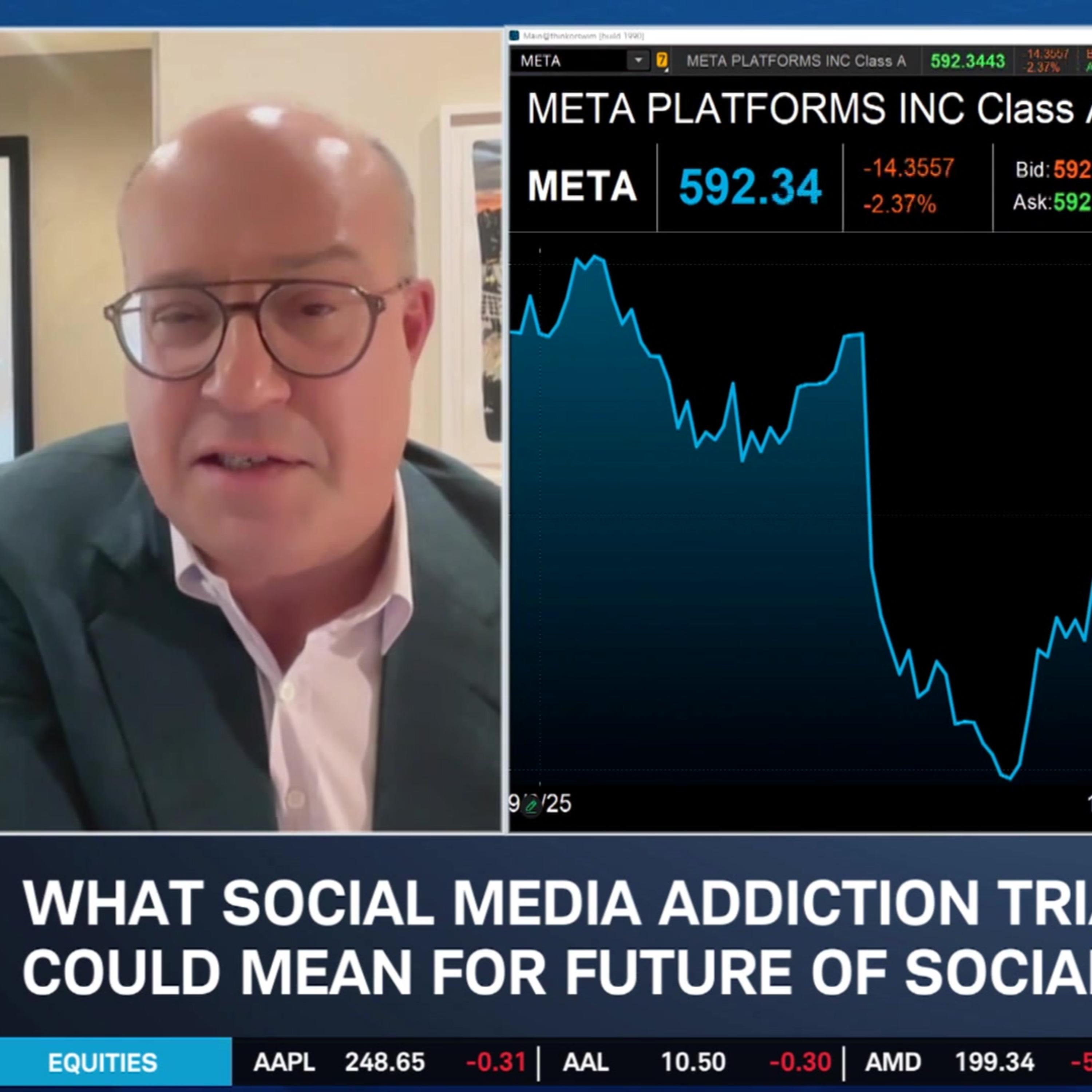
More than two dozen states are suing Live Nation (LYV) for a company break-up as many see the company's ticketing practices monopolistic. Seth Schachner explains why the lawsuit is so significant and the implications it creates for the entertainment industry. He also turns to another trial accusing Meta Platforms (META) and Alphabet's (GOOGL) YouTube of social media addiction.
======== Schwab Network ========
Empowering every investor and trader, every market day.
Options involve risks and are not suitable for all investors. Before trading, read the Options Disclosure Document. http://bit.ly/2v9tH6D
Subscribe to the Market Minute newsletter - https://schwabnetwork.com/subscribe
Download the iOS app - https://apps.apple.com/us/app/schwab-network/id1460719185
Download the Amazon Fire Tv App - https://www.amazon.com/TD-Ameritrade-Network/dp/B07KRD76C7
Watch on Sling - https://watch.sling.com/1/asset/191928615bd8d47686f94682aefaa007/watch
Watch on Vizio - https://www.vizio.com/en/watchfreeplus-explore
Watch on DistroTV - https://www.distro.tv/live/schwab-network/
Follow us on X – https://twitter.com/schwabnetwork
Follow us on Facebook – https://www.facebook.com/schwabnetwork
Follow us on LinkedIn - https://www.linkedin.com/company/schwab-network/
About Schwab Network - https://schwabnetwork.com/about
Get every episode summarized
Each time Schwab Network publishes, we email you a written briefing from the transcript — the topics, who appeared, and any specific claims, with the ad reads skipped.
Email me new episodesFree for 3 shows. No card needed.
Hosts & guests
Transcript ready
88 searchable segments. Every word is indexed and playable.
Full transcript
Schwab Network — Ripple Effects to Watch in META, YouTube & LVY Lawsuits. Machine-transcribed; use the interactive transcript above to jump the player to any line.
Welcome back to Next Gen Investing, and so now I'm really to discuss the growing scrutiny we're seeing on Live Nation and Ticket Master, including if the FDC could finally move against the secondary ticket market, and what a major trial involving meta and YouTube could signal for the future of algorithm regulation. So joining us now is South Shackner, Managing Director at Shrad Americas, and Seth, thanks so much for joining us on this Friday. We know Congress is still suggesting Live Nation play this bigger role in pushing ticket prices higher. Curious what you see as the most credible evidence that regulators can now point to from here to see this progress? Well, I think, you know, it's great to be here today. I think that there's just an effort on the part of states. I think 27 of them, you know, that are sort of being prodded by this report that's come out from Senator Blumenthal, you know, that kind of indicates certain practices that may indicate, just want to say may, you know, that Live Nation may have had a role in steering some tickets to what we call the secondary market,
which they actually own a little piece of that market. But in general, their primary tickets, you know, sell our holder. And I think that'd be a pretty bad thing if that turns out to be true. Actually, you know, it might be grounds for people to really push and, you know, come back against Live Nation and maybe, you know, protest that settlement or or just do things at a state level. The settlement that happened, you know, two weeks ago, I think a lot of people think it was kind of a slap on the hands at the federal level. I mean, I thought it did some good things, has kind of a lighter touch. It freed up a bunch of the exclusivities that I think, you know, we're really troubling between venues and ticketers and certain artists supposedly felt some pressure to go on board with Live Nation's promotional programs. So, and I think the settlement actually freed some of that up and was generally speaking a good thing. But, you know, it might unravel a little bit or the states might, you know, protest and do something on their own. You know, Seth, this is getting a lot of coverage and for
good reason, consumers is a huge pain point. But the lesser covered perhaps more sinister of the two stories is this bigger social media trial that's taking place. I know a few of them decided to settle outside a court. But what's the latest with what's going on in LA? You know, I agree. I mean, this case, if it were to result in a certain way, you know, if, if, if meta and YouTube were found guilty, which is probably unlikely, and it had, you know, another contingency, some structural implications, because the, the focus of the case is actually around technology and structure, not about content, could actually potentially have pretty massive implications across the board. I think it's really unlikely, you know, that the case looks at how the social networks were constructed. And, you know, if they were constructed with bad, really malicious intent to hook users and addict them. And it's kind of going after the structural side rather than the
content within the social networks, because, you know, the latter, the social nets are protected by section, section two, 30 basically. So, but, you know, two of them settled early, TikTok settled and snap settled. And I think right now, you know, meta and, and YouTube probably think they're going to win. And that's why they haven't settled right now. But, you know, if it extreme circumstances could change the products and could inhibit some of the algorithms and the way they work. And yeah, that would have some pretty significant business impacts. Okay. And continuing on with what you mentioned, of course, that meta and YouTube trial. I mean, what do you see right now? What a win or loss could mean for how algorithms are now regulated going forward? Um, this is a really great question. I mean, you know, I don't really know if there's going to be an immediate impact on the regulation of an algorithm per se. You know, I'm much more of a fan of moderation, which, you know, my hope would be that, that, you
know, both of these entities that are still on trial and even the other two as well, kind of use this as a warning or a bellweather to moderate their platforms. Um, you know, it better, basically, particularly TikTok, which is now going to have a U S entity as well. And that can be human moderation. They've all got editors and content forum moderators can actually be AI moderation tools as well. So I think that's what I would look to more than some type of, you know, you know, actual regulation that would come out of this. But I think, you know, actually, if there was something intelligent, whether it's on the algorithm or even AI, um, I would welcome that as well to see what it looks like from the US, the Europeans are always out in front of us on that. So Seth, kind of a bigger picture look at this, then, like, I'll just use X as an example. And my understanding they're not really the big named party in this. So, um, to the side, but it does seem like the incentive structure is encouraging this behavior from the, from the user where if you say something kind of, um, I guess that spur engagement makes people feel a certain
way they're more likely to click on your post. That makes it more likely to be monetized and it becomes sort of this self fulfilling service in a way without trying to overly regulate and adjust these algorithms. Is it more on the kind of trying to find a way to incentivize a different type of activity? I mean, it's a great question. Firstly, I see it as a two way street because, you know, that both sides are motivated. These algorithms, in my view, are created to amplify engagement, right? And it can be good engagement or bad engagement. You know, and I don't think they were personally set up for malicious intent. They just tend to work that way. And, you know, if you've looked at the structure of them, they all work a little bit differently. Maybe TikTok's a little bit more effective. So, um, you know, I personally just think it's going to be about moderation going forward, basically, rather than tearing apart these algorithms. And I think, you know, the stuff with TikTok's particularly
interesting because, you know, they're going to have like an American-led-owned algorithm, if you will. And, you know, I think the fear, um, on a macro level, and I'm not talking about users or about the, you know, the technology titans, is that they still create the same environments that existed. You know, remember, users opt into this stuff, right? No one's being forced to use a social network. And there, you know, I worked at a place called AOL years ago that's long gone, that eventually things come in and wash those competitors away. And it may happen with all of these things here. That's, that's in part while you're probably seeing people settle and make these close bets. So, um, it's a tough question. And I, I'm still a believer that you need to have moderation all across the board and, um, not change things too much personally. Okay, and I, I think it's a great point there and a good place to leave it. So appreciate your time. And, of course, happy Friday, Seth Shackner, Managing Director at Stratt America.
More episodes
More from Schwab Network

Stock Market Today: ORCL & ADBE Earnings, AEO Plunges Near 52-Week Low
Schwab Network

Thursday's Final Takeaways: Crude Taps $103 & PPI Hotter than Expected
Schwab Network

Balancing High-Conviction AI With High-Dividend Diversification
Schwab Network

EARNINGS PANEL: ORCL, ADBE
Schwab Network