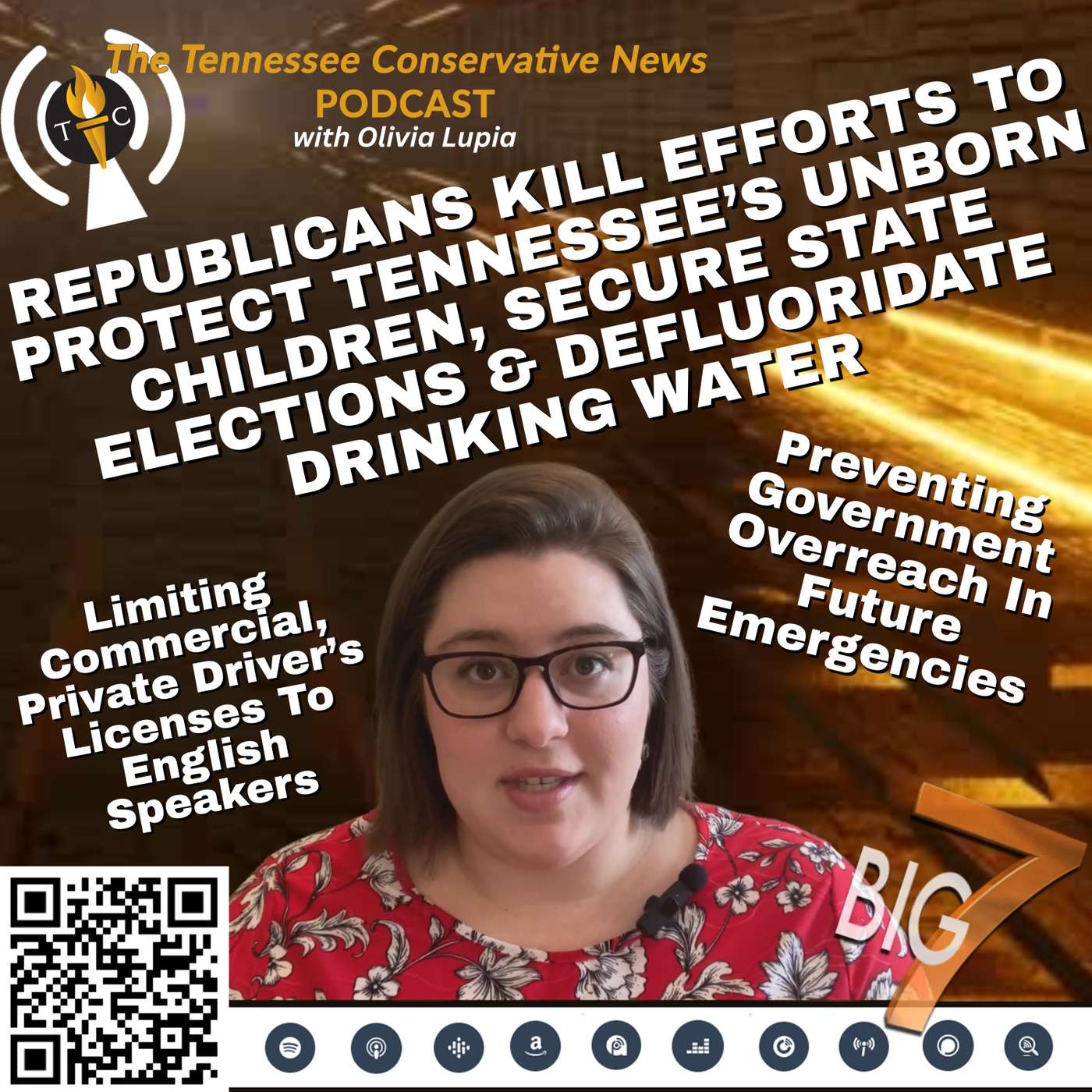
Republicans Kill Efforts To Protect Tennessee’s Unborn Children, Secure State Elections & Defluoridate Drinking Water…
About this episode
Republicans Kill Efforts To Protect Tennessee’s Unborn Children, Secure State Elections & Defluoridate Drinking Water…
Conservatives Try To Prevent Government Overreach In Future Emergencies & Limit Commercial, Private Driver’s Licenses To English Speakers.
If you value truth in Tennessee, step up now and support The Tennessee Conservative!
Go here to donate 👉https://tennesseeconservativenews.com/the-tennessee-conservative-will-go-out-of-business-without-your-support/
Subscribe to our FREE daily (M-F) eNewsletter - https://bit.ly/3ybSpV8
More of a listener? Check out TTC's Podcast - https://bit.ly/3IJ6Dnq
Not afraid to admit you're a Conservative? Advertise with us! Check out our advertising options here - https://tinyurl.com/2re6bfsw
Follow The Tennessee Conservative on these Free Speech platforms:
TTC on X - https://x.com/TnCoNews1
TTC on MeWe -https://bit.ly/3SbuqxW
TTC on Gettr - https://bit.ly/3LifSKC
TTC on Gab - https://bit.ly/3di03ai
TTC on Truth - https://bit.ly/3BINn5B
TTC on Rumble - https://rumble.com/c/c-399985
TTC on Parler - https://app.parler.com/thetennesseeconservative
Get every episode summarized
Each time The Tennessee Conservative publishes, we email you a written briefing from the transcript — the topics, who appeared, and any specific claims, with the ad reads skipped.
Email me new episodesFree for 3 shows. No card needed.
Hosts & guests


Transcript ready
818 searchable segments. Every word is indexed and playable.
Full transcript
The Tennessee Conservative — Republicans Kill Efforts To Protect Tennessee’s Unborn Children, Secure State Elections & Defluoridate Drinking Water…. Machine-transcribed; use the interactive transcript above to jump the player to any line.
Hey, boys and girls, it's Olivia here from the Tennessee Conservative to bring you this week's big seven update. And whoo, what a week it has been. We have a ton of stuff to dive into this week. Really just, oh my gosh, so much stuff to get into. We've got immigration, we've got abortion, we've got health, we've got fluoridation and waters, so much stuff to dive into here. But before we get into that, I want to remind everyone, if you are not already, to make sure that you are signed up for our free daily newsletter, pops into your inbox, chalk full of all this stuff, and more that we're going to talk about, you don't want to miss what's going on, especially during this time of the year. So if you are not already, you can sign up for that very simply, very easy to do. All you have to do is text news, N-E-W-S, to four, two, three, two, oh five, five, six, zero, zero. Simple as that. You can do that by the time I'm done with this sentence. So make sure that you jump on that to make sure you're not missing all the latest and greatest from the Tennessee conservative.
Also, I want to remind you guys that we are still in need of recurring monthly donations. Every dollar that comes in makes a difference for us. We are so grateful for every dollar that people give toward us. But having those recurring monthly donations really help us to best plan and budget and allocate and decide how we can bring you the amount and the level and the expertise of content that we have been delivering that you guys have come to expect from us. So if you feel compelled, if you're able, please head over to TennesseeConservativeNews.com slash support. And be sure to set up a monthly recurring donation in any amount that you feel led to give. We very much appreciate it. Thank you guys for partnering with us as we work to keep conservative journalism alive in Tennessee. All right, my friends, now into the good stuff. Kicking off the list, we're gonna spend a little bit of time on this piece because it's very important for a multitude of reasons. But bill proposing equal protection for Tennessee's unborn children killed in house subcommittee. So this is HB0570.
This was brought by Representative Jody Barrett and it would have applied the same standards of justice and enforcement for the unborn that exist for the homicide or assault of born persons. So basically taking laws that say, if you kill someone outside the womb, you have the standards of justice that apply and saying the same thing happens if you kill a child inside the womb for everyone. It asserted that innocent human life created in the image of God should be equally protected under the laws from fertilization to natural death and all preborn children should be protected with the same criminal and civil laws protecting alive of born person, the lives of born person. This bill was scheduled in the Population Health Subcommittee and it died a very unceremonious death because not a single member of that committee would motion to hear the bill. Not even allow Barrett to present it, nothing. Just dead silence, bill dies, that's it, end of story. So this is really problematic for a lot of reason. First and foremost, because we killed a bill
that talked about protecting unborn children. So you've got a committee that's made up of majority Republicans, a lot of them counting to be pro-life Republicans and they didn't even want to hear a bill that discussed expanding protections for unborn children. Nobody necessarily said you had to vote for it. Not everyone was going to agree with it. This bill garnered a lot of media attention here in Tennessee, a lot of national attention here in Tennessee. In speaking with a lot of the people working on this bill, we learned that the organizations who were supporting this bill had never faced so much direct media disinformation, flat out lies about the bill. I know I stepped in a couple of times to correct flat out lies about where the bill was in the legislative process. So again, whether or not you disagree with the bill, with a lot of organizations, including so-called pro-life organizations, coming out and saying things like, oh, well, the bill was dead or Senator Podi, who was the Senate sponsor. He said he's going to pull the bill, he's going to do this. No, and none of that was true.
So whether or not you agree with the bill, it's wrong to willfully manipulate the population into thinking something about the way the process works. And this is problematic because we are crying out constantly for people to be involved with local government, right? That's how this function. It only happens if we get involved, we create the change that we want to see, right? So when you lie to people about what is actually going on in the process, but at the same time, you continue to beg them to be involved in local government, you're kind of creating a chasm that erodes the trust that theoretically these organizations or these media outlets are trying to build to combat the broken trust of the mainstream media, right? So that was a huge challenge surrounding all of this, regardless of whether or not you supported the legislation itself. Second big problem coming in on this was the support and opposition groups that were coming out on this. The opposition groups were spreading a lot of, again, misinformation about the interpretation of the bill because it includes the word homicide, because Tennessee does allow the death penalty, they then made the assumption that, well, that means any woman who has an abortion will get the death penalty.
And that was just patently untrue. Again, whether or not you support the legislation, to not even understand it fully or to try and manipulate and say it says a certain thing is just wrong, right? No matter what side you're standing on. And again, this was opposition coming not only from liberal and left leaning organizations, but also from right side and again, so-called pro-life organizations. So some challenges with there. We did a great interview with Representative Barrett that kind of debunked and talked through some of these narrative issues. So you can go and watch that. It's definitely on the website. But again, we looped back around to this bill was killed because not a single Republican was even willing to hear it or have a conversation. And this speaks to a greater issue that I'm seeing in the legislature. And it's been happening a lot more and more. I think particularly this session, I've seen a ton of it where instead of going ahead and having the conversation or allowing a bill to be presented, which is what they're there to do to listen to bills, do things. They're just not motioning a bill.
And these bills are dying without even a chance for the sponsor to say, this is what it is and put it into the record. There is a time and a place to do that. If you're a Republican and a bill comes across your desk that's like, hey, we want to kick Colorado, for example, they just tried to pass a bill that legalized prostitution. And that comes across in Tennessee. No Republican should be motioning to hear that bill. There isn't a time and a place for those certain things. But when again, you call yourself pro-life and to not even hear a bill get passed, not even passed, excuse me, rather presented, that speaks to a really big issue about the commitment our legislators have to doing their job, these conservatives, these Republicans, et cetera. So this is a really big issue that's happening. And I have to say it happens not only to our conservatives a lot of times, but it also happens to the Democrats. And again, whether or not you agree with the legislation, most of these bills deserve a chance to be presented. You don't have to vote for it, you don't have to engage, but you absolutely need to hear these bills. And that opens the door for discussion.
Again, the problem is a lot of these Democrats are having these radical bills at least heard on the floor. Because, oh, imagine that. Republicans, these great talking points about how they put down the Democrats, and I said this not, but we're not even willing to have a conversation or open up discussion on an issue that directly pertains to basic tenets of the conservative or the Republican platform of the values that we say we espouse, right? There's a really, really just a lot of problems with the way this bill was handled from start to finish. Representative Barrett provided his comments to us about the failure of the bill, writing in part. If the committee had heard the bill, they would have learned that our legislature has already codified with the passage of Tennessee's trigger ban, that's the abortion ban, that the state has a legitimate substantial and compelling interest in protecting the rights of all human beings, including the fundamental and absolute right of unborn human beings to life, liberty, and all rights protected by the 14th and 9th amendments to the United States Constitution. That's not Barrett speaking. That's what's already in the abortion ban bill.
So, again, this bill, this equal protection bill was intended to close a loophole and we didn't have any Republicans who wanted to have a conversation about it. So, Barrett is appointing kind of not unexpected, but again, symptomatic of a lot of bigger issues, I think, that are going on in the legislature, that are being used to shut down legislation before it even has a chance to get off the ground. And that's a real challenge. Okay, enough of that soap box. Moving on, election integrity bill killed by Tennessee Senate Republicans. On the Senate State and the government committee killed a bill on Tuesday, this was last Tuesday, seeking to add election integrity and security measures to Tennessee ballot to prevent illegal crossover voting. This is a bill that Senator Bowling, Senator Dennis Bowling has been working on for quite some time. She's a great election integrity champion. Basically, all this would have said is that we have to have paper ballots with a watermark on them and then any technology that we use to count those ballots or scan those ballots has to be capable of reading a ballot with that watermark on it. So it would prohibit the use of QR codes
or bar codes or things like that on ballots, just to have a paper ballot with a watermark and then any technology that is used to count those ballots has to be able to read a ballot with a watermark. Kind of common sense, if you ask me, but what do we know? After Senator Bowling presented the bill to the committee, emphasizing that the method suggested in the bill are not new and would not pose a significant financial cost to the state, the coordinator of elections, this is your coordinator of elections in Tennessee, Mark Goins, go and testify against the bill, contending that a proposed amendment that Bowling had made would prohibit certain technologies currently use for tabulating and scanning votes, which would ultimately reduce the system to hand counting paper ballots in all 95 Tennessee counties. We can have a separate discussion about the merits of hand counted paper ballots versus the vulnerabilities and proven evidence that electronic machines can be hacked and manipulated, et cetera. The challenges you've got, your coordinator of elections saying, I don't, I think what we do is fine. That's not even willing to examine or say,
well, we already spent money to do the system that we had, $27 million worth of state and federal grant money that we already have, so we don't really need to do more. And if you want to feel more comfortable, you could just audit because we have a paper trail. So your ballot, even though it's recorded by a machine, is recorded on a paper receipt theoretically, assuming everything works right, at least in most counties, it's the way it works. So that should be fine. If you don't like it, you can do something else, but you can't. Senator Adam Lowe addressed the issue of voter confidence, not just broad election integrity, saying, I think it's always important for us to elevate the perception of the public in relation to the confidence in that integrity. We can tell them all day that we're number one, but if you're the shortest guy in the basketball team and this other guy's taller and he's still only five foot, you've still got a short basketball team, so voter confidence is a big thing. And he made a good point there. He referenced a 2024 study performed by Eastern Tennessee State University that showed approximately 80% of Tennessee voters had some level of confidence that their vote would be accurately cast the count
as Sony were from like a little bit to, yeah, I feel great. So 80% fall in the, I have somewhat confidence. The other 20% however, which was the point that he thought was interesting, was that the 20% who said they don't have confidence, the only way that they would consider saying they had confidence was through hand counted paper ballots. So his point was, even though it's a small group that saying, hey, we don't necessarily have confidence, they all agreed on this one same thing to fix it. So that's just a really interesting, he just made an interesting point about voter confidence. It's not necessarily always just about voter integrity, but that voter confidence plays a huge role in voter integrity. So a lot of the committee members also touted, the Heritage Foundation scorecard election, which puts kind of see in like number four or five every year, I don't know, they talked about basically, we're number one, we're the gold standard and I will tell you is someone who came from Colorado, we were also the gold standard supposedly, but we have had all mail and ballot there, there was rampant election fraud.
If you haven't heard of Tina Peters, you can look her up. She's currently sitting in jail as a political prisoner for exposing rampant election fraud for the quote unquote gold standard headquarters of the minion voting systems Colorado. So just interesting discussion. Ultimately, the bill failed seven to one, Senator Low, Adam Low was the only one who voted in favor. So all the rest of the Republicans on the committee didn't even wanna pass this out to say, hey, let's have a conversation about what we could do to be more safer secure. Just interesting, it's, you know, election integrity continues to be one of those things that's like a huge, huge, huge issue for conservative voters across the board. Even a lot of Democrats are not coming on that issue because across the voting remains such a huge problem. We don't even have a system that closes primary elections even though they're closed on the books, illegal crossover voting happens so much to the point where Republicans have admitted, we have articles about this, have admitted that they stay in office
because of Democrat crossover votes. So I'm not sure how you can be the gold standard or, you know, the number one or you can get all the little rankings from national things that say you've got the most, you know, secure elections in the country all you want when you can't even enforce your own laws in the books that prevent things that are illegal and that change the outcomes of local elections. So a little bit of hypocrisy there I think and I think it's pretty crazy when your state election department comes and testifies against bills that work to promote election integrity. So what can you say? It's a bummer is what it is, but we keep pushing on that issue because it's very important. There is a closed primary bill or a party registration bill that would help ensure those primary state closed, hopefully working its way through, but you know, we just have to say, we have to see how it all shakes out. Moving right along, Bill requiring counties to check Tennessee voter rolls for illegal aliens fails in the House subcommittee. Ha ha. So this legislation was designed to increase like local accountability when voters are applying
to be added to the voter rolls on their voter registration by requiring the local county election commissions or election offices to check that voter's name against the SAVE program prior to adding them to the voter rolls. So the SAVE databases is a federal program that runs through it helps check citizen eligibility or not citizen, basically citizenship checks to say this person is either legal presence or as a citizen so is eligible for any kind of benefits. Including the right to vote because that is a benefit of being a US citizen, right? So this bill, HB 1897 sponsored by State Representative Todd Warner, it just basically said that they have to check any new applicant to vote a registration against the SAVE database because the federal government under the Trump administration has worked really hard to make that accessible to all counties. Currently, state law offers the choice to the coordinator of elections to check the whole statewide data roll against certain things. They have to check it like against the state list
of criminals and things like that, but any checking against federal databases or any other databases outside of that is optional. So Warner is proposing, hey, well instead of forcing the state to do it on a state level, why don't we just ask all of the counties to do it to access this database and to check and make sure and then that way you're stemming any kind of illegals trying to get on the voter roll or people who are not qualified to vote kind of like at the root. So it was a great idea. Apparently the subcommittee didn't agree six to one failed. One I vote from Tom Leatherwood. So thanks representative Leatherwood, we appreciate it. But a lot of the committee arguments came down to things like they don't think the SAVE program is accessible and William Lamberth, House Majority William Lamberth, he's running another bill that kind of says the same thing like if the SAVE program ever becomes accessible through a specific web page or web portal that's secure whatever, then the government, the state entities can check against that. So he's kind of running like a way watered down version
of this, which the committee indicated they would be more supportive of the prize. But I'm not sure how they can say that it's good when Lamberth brings it up, but not good when Warner brings it up. So just an indication again of where some of our conservative legislators stand who have been fighting for these things for many years. So not super cool that that one got killed. Like I said, there's kind of a watered down version of it, supposedly running through the house. We'll see, we'll see, right? Moving right along. Ah yes, de-Floridation Bill's dead in Tennessee legislature for the second consecutive year. There were two separate pieces of legislation that basically would have said you have to remove, you cannot add chemical fluoride to public water supplies. There's been so much conversation about this. This has become very mainstream issue now, particularly with HHS Secretary Bobby Kennedy, who by the way came to the Tennessee State House like less than a month ago, I think, and stood up in front of this entire governing body, your general assembly, and told them all about these things, reiterated his priorities, including
moving food dyes, getting ultra-process foods, cut down, getting fluoride out of water. This has been something he's been talking about for a long time. Came to the Tennessee legislature, told them this to their faces, and they still killed two different pieces of de-Floridation legislation saying that the whole federal government's not doing it, so we shouldn't. A lot of interesting conversation has went on with these things on both sides. Great presentation's done in both the House by both the House and the Senate sponsor, particularly on SB 0162. Really excellent presentation. Just talking about the scientific, not only the scientific problems with fluoride that are really now coming to light in the evidence, that's just coming out and coming out and coming out. But also the problem with a government in essence, mass-medicating an entire population without their consent, because there is no off-doubt in fluoride. It automatically goes in the water, and it's unregulated amount of dosing. It's also an extremely hazardous chemical for the workers themselves to deal with a lot of issues. So if you're really interested in learning more about those facts,
please go back and watch the hearings on these bills, because even though they failed, there were some really, really great presentations done. And there was some decent discussion among it. I think it made better progress than it did last year, so that's good that there was a little bit more support. But ultimately, the vote was five to four against with one, two, three Republicans joining Democrats and voting no on that committee. It's just like, come on, how are you going to say that you're trying to be a conservative leader, working in lockstep with the Tennessee or with the Trump administration, and then when you have a member of his cabinet come down and say, these are our priorities. Look at that and say, well, obviously we know better. And there was a lot of emphasis too, placed on individual control over local control by these bill sponsors to say, an individual have a right to decide what they do and don't want in their water supply. But that was overwritten and saying, well, local governments can do that. They already have the control. Okay, so again, the local government
knows better than you and your family about health assistance. So again, disappointing, not super-surprising, but very, very disappointing, particularly given this year's push to say, we're really trying to be a conservative leader. We're trying to be a model for the nation, right? So really big bummer on that. And the second piece of legislation hasn't really made any progress in the house yet, but it differed from the first because not only did it say you have to take chemical Florida out of public water supplies, but it also applied to bottled water, sold in the state here, which I think is great. But Senator Mark Cody, who was carrying that legislation as a Senate, it was next on the list in that same committee. And he saw what happened to the first one. So there was definitely no way a second bill was going to do any better, especially when that had more provisions in the first. So he wisely just moved that to the general subcommittee of the Senate, which indicates that there's no intent to pursue that anymore for this year. So both of those are unfortunately dead. Again, here we are. This is your red Republican legislature at work right here in Tennessee.
So I ask again, reporting on this stuff in a legislative session that you will not get from any place else so that you can remain active and vigilant of your freedom in Tennessee. If you appreciate it, please do go to Tennessee conservative news.com slash support. And make a donation, mail your checks to PO about six, two, five, signal mountain Tennessee, three, seven, three, seven, seven. As I mentioned, in the video I recovered, I recovered, recorded here recently. I was out of town for about a week and a half and I came back and there's not two checks in there. Two checks during the time when we spend the most money. And it's just, we'll see how it goes. But we need your help. So if you can kick in, especially if you've never contributed before, guys, really somebody else will do it. I don't think so. I've not seen that to be the case. It's gotta be you. So if you're listening to the sound of my voice and you're never donated, please get off your tail, chip in. I'm gonna let everybody else carry you. All right, my friends, let's jump back in here.
Got a bill that would have allowed disenrollment of illegal alien students heads to the Tennessee House floor. This is crazy to me because, so this is the bill that caused a huge kerfluffle with like a big, big deal last year. I think 0793, yep, HBO 793. This was a bill that was intended to allow schools if they felt like it to charge illegal students to wish in and then potentially disenrollment from schools if they found that they were illegal and they couldn't pay the tuition, right? So it was kind of always intended to be a challenge to the Supreme Court ruling, which said that illegal aliens are entitled to a free public education. I mean, that's a different conversation about that ruling itself. But this is what that bill was initially intended to do last year. It went through, died on the house floor, literally on the last day of session because they couldn't get clarification about federal funding being in jeopardy. So Lambert said, hey, I'll just take it off and we'll kind of come back to it next year. So this year, he's revived the bill,
but the promise is it's just been completely gutted. All it is now is it's a reporting bill that basically says, if a child was registering for school, if parents can't provide proof of citizenship, they don't have to present any more documents than they would normally, whatever the requirements are to enroll now. But if they can't provide that proof, there's no consequences, there's no anything. Basically, they just have to make a note of it and then send that information to the Department of Education and the legislature so they can see how many students theoretically there actually are in the public schools that aren't citizens of the United States. They also don't have to provide the names or addresses or anything about these students. So it's, okay, basically Lambert said because he couldn't get actual confirmation about whether or not the bill in its previous form would jeopardize like a billion dollars and federal education funding like that, supposedly he went back and forth with the Trump administration about it. They said, well, we don't really know because we can't come on on a bill or law that like isn't passed it, blah, blah, blah, blah.
In essence, it's nothing, it's a big, fat, nothing burger. It will, you know, it'll hopefully give us a better idea kind of like that crime report that came out, which again, those of us who have been pushing our legislators about illegal immigration for a long time, those reports just confirmed what many have been saying for many years, is that illegal immigration crime is a huge problem in Tennessee. This report, when it gets done, if this bill passes, it'll just be the same thing. It'll just verify what people have been saying for a long time. Democrats have a crazy problem with this. There's been like wild testimony against this, all sorts of things, I don't know. Why, when it basically does nothing, I don't know where they have such a problem with it, they still arguing that it's too discriminatory, it's still targets immigrant children, blah, blah, blah. Whatever, I really, there's really not much more to say on about that one. Okay, keep going here, you guys are doing great. Thanks for sticking with it. Revived bill seeking to prevent government overreach in future emergencies to receive Tennessee House Bill. Here's a good thing, but this bill,
it's a carryover bill from last year and actually the bill sponsor, Representative Monty Fritz, has actually been carrying this legislature for four years. This was the fourth time he's tried to pass this legislation. So hopefully it'll cross the finish line this year, but this bill basically would prevent a local public official or even up to the state level. Any public official cannot declare the operation of or engagement in a lawful occupation of any citizen as non-essential by either executive order, proclamation or rule. So this is in response to the overreach that was done particularly by Governor Bill Lee's executive order during COVID, which ordered all businesses that were deemed non-essential to shutter immediately. So people lost their businesses, they lost their livelihood, et cetera, et cetera. And Fritz just wanted to ensure that nothing like this could ever happen again, because everyone has a right to make a living. It was just such a big form of government overreach. So this is one way of saying basically that no one can be declared non-essential in time of state emergency. So the bill worked its way actually
through the committee process last year. It was scheduled for a House for vote and then a Republican actually objected to it and said, I don't think this went through the right committee. Again, you can go back and watch that. Okay, but it went back through. This was the committee that it was assigned to. They didn't have time to hear it at the end of last year. So they heard it this year. It squeaked out 10-9 past. We had Republicans, Rebecca Alexander, Fred Ashley, Mary Littleton, Compton it and Ron Travis joined four committee Democrats in voting, no. So even with that, you've still got four Democrats, or excuse me, four Republicans who said we think that people should be allowed to be declared non-essential and we can dictate how your life goes in a state of emergency. So that's cool. Again, you had the office of the governor testifying against this bill. That's crazy to me. That's just crazy. This is the same administration, though the same governor Lee, who would not sign a bill that limited, that put more constitutional restrictions
on his emergency powers because again, in response to his overreach during COVID. So not surprising, really great that this passed. So hopefully this will go back to the house, receive some support there. And hopefully we can get this bill across the finish line because bless his heart for Monty Fritz to be carrying this bill for four years. But we appreciate his commitment to that. We appreciate his stalwartness in preserving and championing your life, liberty, and constitutional rights. So that's huge. That's a good piece of news, yay. And finally, my friends, Tennessee Senate Committees advanced bill to limit commercial and private driver's licenses to English speakers. Woo-hoo. Kinda. All right, so on Wednesday, the Tennessee Senate Transportation and Safety Committee approved bills aimed at restricting the licenses of commercial and private drivers to those who can read and speak English sufficiently. Great, right? We've been following these. You guys can, again, these are all articles on the website. You can go dig into kind of the semantics of these bills and the progress they've made. The committee voted to approve Senate Bill 1748, sponsored by our one and only iron lady, Janice Bowling,
with eight Republican votes in favor, one Democrat again. So that's good. This bill says that an officer and enforcement officer has to issue an out-of-service order to a driver who was issued a commercial driver's license if the officer determines during a safety inspection, like they have to go to the way stations, that kind of stuff, that the driver is unable to read and speak the English language. There you go, pretty simple. The legislation also applies penalties against employers of such drivers. So this is really great because this is one of the few blows that actually crafts accountability for the employers doesn't just go after the illegals themselves. So really great bill, I hopefully will continue to see that have success. It's also making progress in the House. The House version of the bill, HB 1817, passed the House Transportation Committee, subcommittee seven to one, and will now go to the full House Transportation Committee March 17th. So if you're interested in that piece of legislation, make sure you contact House committee members. Yeah, put some pressure on them. So the committee also approved Senate Bill 1889,
sponsored by Senator Brent Taylor. Seven to one, the Democrat was the only one who voted against and then Richard Briggs, Republican Senator Richard Briggs. We know how we feel about him. He marked himself president on voting's prize. So this bill requires an applicant for a driver's license who cannot speak and read English sufficiently to be issued a restricted license for a year and retake the written test without any help or whatever. And then the bill also requires evidence of US citizenship or lawful permanent residents to register vehicles. So here's the thing though with this bill, is it's been heavily amended. So now that restricted license is extended to 18 months. So if you have to take the driver's test in a language other than English, now you have 18 months that you get to drive on a restricted license until you have to take that test again without any help or in English only. The other problem is as they've expanded the restrictions so much that basically I'm not really sure what it is they can't do. So initially the intent was to have him say like,
hey, you can go to work in medical appointments. That's it. That's all you can drive on on a restricted license. Well, now it includes things like school and church and the grocery store and this and that. So again, if you can go all of those places that doesn't really take the illegals off the road. So we're kind of again into a bill that they can pass and say, hey, we pass this bill that does this. But what impact does it actually have? And this is of course to appease the Democrats and the more moderate rhinos who, you know, the poor illegals should be allowed to go to church. Even though they can't speak English and might crash into someone and kill somebody in Tennessee which we're already seeing happening, you know, they got to be able to get to the grocery store. They got to be able to use that snap money that you pay for. So it's, it's like good in principle, but it's again, it's being watered down to the point where I don't know how effective it's gonna be. But, you know, baby steps I guess, but not really, yeah. The House version, 1708, passed the full House Transportation Committee 16 to 3 on March 10 and has been referred to the House Finance Ways and Means
Subcommittee for a Schedule Sharing Date March 18th. Same thing with the Senate bill. It will also go to the Senate Finance Ways and Means Committee because they both have a fiscal note on the meaning that it will cost the state something to enact these, these bills. So, mostly what finance does with it, I'm guessing it will get placed behind the budget for now, but that doesn't necessarily mean it's that. A lot of times it does, it doesn't necessarily mean it's dead for say. So, just a lot of interesting stuff going on. You guys, this was a tough week. I have to say, for a lot of conservatives, we kind of took a beating this week, but there are still some good things moving out. This is why it is so important that you guys engage with those calls to action that we send out. Please, please, please email. I know, you may not think it makes a difference. It does, I promise you. So, I won't harp on it anymore. I will just leave you with one final reminder to make sure that you are subscribed to all of our social media channels so that you aren't missing anything. Sign up for that newsletter if you're not already and whatever monetary support you can throw away
would surely be appreciated because, as you can see, we are in the thick of it and we need your help to make sure that we are preserving those conservative values that we all stand for and believe in. Thank you guys so much for hanging in there. Have an amazing weekend and we will see you Monday with an all-new newsletter packed full of goodies that you don't want to miss out on.
More episodes
More from The Tennessee Conservative

Are Tennessee Officials Finally Listening To Voters On Unwarranted Surveillance?
The Tennessee Conservative

My favorite Dolly Parton song you've never heard & why. Plus a good playlist rec...
The Tennessee Conservative

Remembering Dolly… Plus Property Tax Outrage, Data Center Progress & TN’s $752M...
The Tennessee Conservative

State Lawmakers Considering Audit Of Metro Nashville Public Schools
The Tennessee Conservative