ReadMultiplex.com: You Have 5000 Days: Navigating the End of Work as We Know It. Part 15: The IBM COBOL Shock.
About this episode
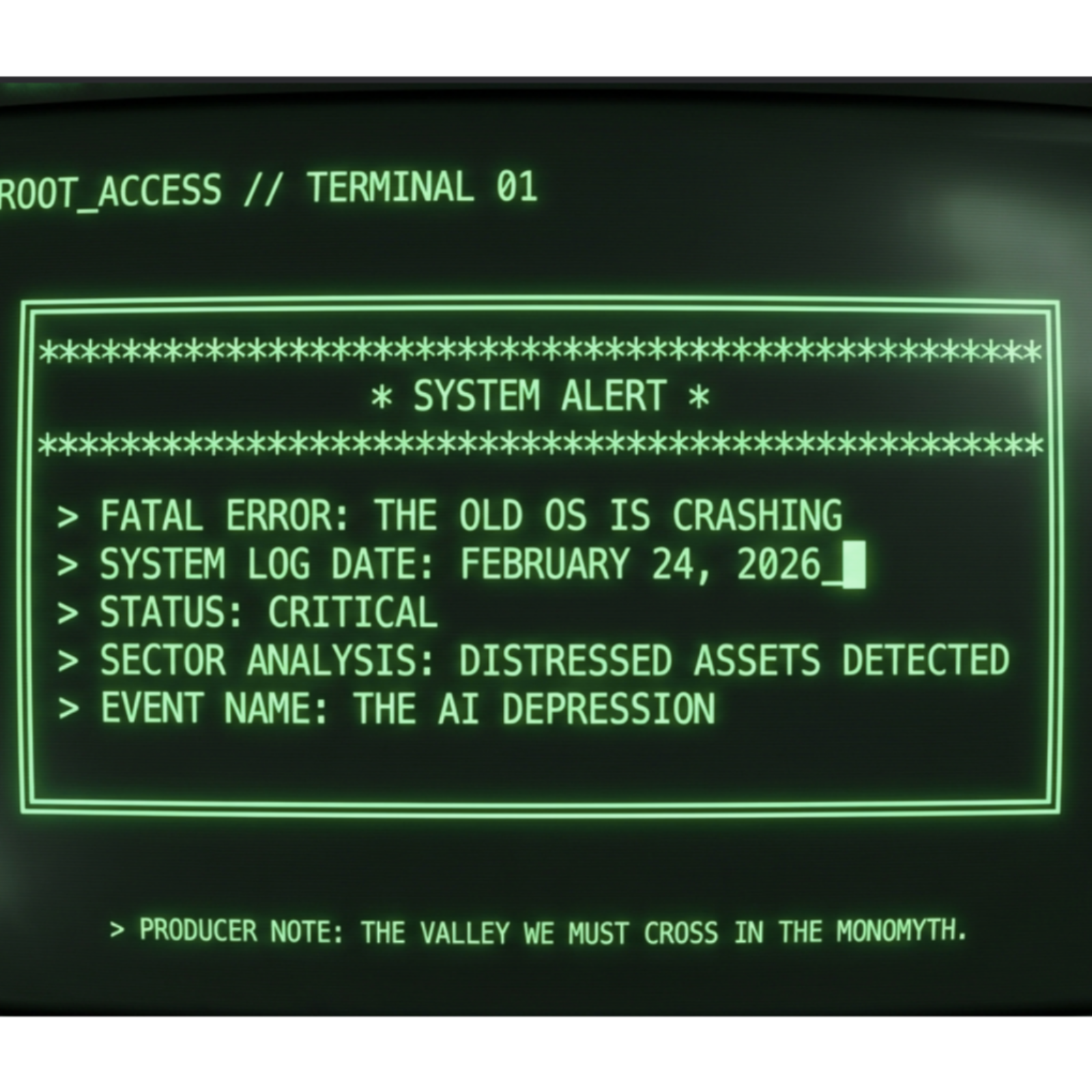
The screens flash red. Tech valuations erase hundreds of billions in days. Headlines warn of mass displacement. Sectors once thought invincible now trade like distressed assets. This is The AI Depression. It is the valley we must cross in the monomyth. It is raw, visible, and accelerating. And it is exactly why I wrote this series. Today we have a massive example in IBM we will discus below. It has had it largest one day drop in its history, over 35%. This was a shockwave that is sending chills through the entire, already Artificial Intelligence freaked out, stock market. But unfortunately there is a lot more coming.
This Interregnum carries a one-two knockout punch. The first blow, already landing, is the cognitive disruption from AI in knowledge work. The second, set to intensify in 2028, comes from robotics in the physical world.
Recall the internet’s own disruptive rise. In the late 1990s and early 2000s it delivered a parallel one-two punch to entire industries. The first wave crushed information and media layers: newspapers lost classifieds to Craigslist and search engines, music labels faced Napster and iTunes, bookstores watched Amazon erode foot traffic, and travel agencies saw Expedia and Kayak rewrite bookings. Physical retail followed as broadband enabled global supply chains, just-in-time logistics, and on-demand delivery that reshaped warehouses, trucking, and last-mile operations. Blockbuster, Tower Records, Kodak, and Borders crumbled not because the technology failed but because it reshaped everything: how we access knowledge, shop, entertain, communicate, learn, and connect. Yet the same force created Amazon, Google, Netflix, and Meta, each scaling into multi-trillion-dollar giants that now define global commerce, information flow, social structures, and entertainment. The internet did not destroy net value. It multiplied it exponentially by collapsing distribution and coordination costs and enabling entirely new layers of activity no one could forecast in 1995. Artificial intelligence is repeating this pattern but at the deeper level of cognition and intelligence itself. It collapses the cost of thought, analysis, synthesis, and decision-making to near zero and will shape everything from problem-solving and creativity to education, healthcare delivery, and governance at a depth and speed the internet never approached.
Read the article at: ReadMultiplex.com
Get every episode summarized
Each time ReadMultiplex.com Podcast. publishes, we email you a written briefing from the transcript — the topics, who appeared, and any specific claims, with the ad reads skipped.
Email me new episodesFree for 3 shows. No card needed.
Hosts & guests
Transcript ready
978 searchable segments. Every word is indexed and playable.
Full transcript
ReadMultiplex.com Podcast. — ReadMultiplex.com: You Have 5000 Days: Navigating the End of Work as We Know It. Part 15: The IBM COBOL Shock.. Machine-transcribed; use the interactive transcript above to jump the player to any line.
If you are listening to this right now, I need you to just just stock what you're doing. Yeah. Seriously, pull over the car, put down your coffee, and just look at the date on your phone. Or get down. It is Tuesday, February 24, 2026. And if you've opened a brokerage app or a glance data news ticker, or frankly, even just felt that that sheer panic radiating off social media in the last 24 hours, you know that the world looks fundamentally different today than it did on Monday morning. It really does. It's, it's unrecognizable in some ways. Right. And, you know, on this show, we usually sit here and talk about paradigm shifts in the abstract. We look at charts projecting 10 years out. We discuss the quote-unquote future of work, like at some sci-fi novel. Yeah. But today, today is not a projection. No, today's history. Yeah. The screens are flashing red and I mean deep red. And it is not just a standard market correction. It is a repricing of reality. Red is putting it mildly. It is an absolute blood bath out there. But unlike a typical crash, this feels, I don't know, it feels specific.
It's highly targeted. Targeted. Exactly. It feels different than 2008. It feels completely different than the dot-com bubble. That's because it is. What we're seeing, what you are feeling in your gut right now, is the arrival of the interregnum. The interregnum? Yes. We are staring directly into the face of what Brian Romall at Read Multiplex has been warning us about. And preparing us for years now, he calls it the AI depression. Okay, we need to unpack this immediately because there is just a palpable amount of fear out there. Oh, absolutely. I mean, I've had friends texting me all morning asking if they're 401k is going to zero. So our job today, as always, on the deep dive, is to cut through that noise and find the actual signal. Right. This isn't just our standard Tuesday discussion. This is a breaking news deep dive into a pivotal, massive moment in the 5,000 days timeline. It's the moment the theoretical became literal. And to understand where we're going and why, surprisingly, this might actually be good news in
the long run, we have to understand exactly what broke yesterday. Because something definitely broke. Shattered is more like it. Let's start with the event, the catalyst. Yesterday, Monday, February 23, 2026, IBM, big blue. The stalwart. Right. The absolute stalwart of the tech industry for a century. They crashed. It didn't just dip a little. It plummeted roughly 13% in a single trading session. Which, and we need to stress this, for a company of that massive size, that level of stability and that amount of institutional ownership, is catastrophic. It's unheard of. That is the worst single day drop IBM has seen in over 25 years. We are talking about billions and billions of dollars of market capitalization, just evaporating in hours. And IBM is usually the safe harbor. Exactly. It's the classic widows and orphans stock. It's the stock you buy when you want to avoid this exact kind of volatility. The bedrock. And usually, when you see a drop of that magnitude in a blue chip stock, you expect a scandal. You expect an earnings miss.
For a CEO getting caught in bezeling, or some massive accounting fraud being uncovered by the SEC. Right. But I looked at the wires. I was scouring them last night. There was none of that. No, the earnings were perfectly fine. The management is stable. This wasn't a failure of their operations. It was a failure of the future. Wow. The catalyst was a single blog post. One blog post from Anthropic. They announced Claude code. And this is where it gets really interesting. And frankly, a little terrifying for the old guard, we need to explain why a software announcement from an AI competitor would knife point a giant like IBM so effectively. Like, what exactly is Claude code and why did Wall Street completely freak out over it? Well, to understand the panic, you have to understand the moat. Okay. You have to look at what IBM actually sells to make its money. Claude code is a new capability from Anthropic that specifically targets cobal modernization. Cobal. Right.
Now, for the non-technical folks listening, cobal, which stands for a common business-oriented language, is a programming language that dates back to the late 1950s. It is ancient and is practically extinct in the wild. I mean, my grandfather might have coded in cobal. It is ancient, yes, but. And this is the critical key that people always forget. It runs the entire world. We are talking about the invisible plumbing of the global economy. All right. We're talking about the mainframe systems at major banks. Erilane reservation system. Government databases. The Social Security Administration. Exactly. When you swipe your credit card at the grocery store to buy milk, that transaction is highly likely hitting a mainframe running cobal somewhere. Wow. When you book a flight, cobal. And for decades, IBM, along with this massive ecosystem of consultants, companies like Accenture, Deloitte, Capgemoni, they have made an absolute fortune maintaining this incredibly old code. Why? Because it is notoriously difficult to change. It's what developers call spaghetti code.
Just a tangled mess. A total mess. It's poorly documented. It's been patched a thousand times over 50 years. And the original people who wrote it are mostly retired. Or, frankly, deceased. So the actual difficulty of the system was their business model? Precisely. It's a scarcity of expertise business model. It acts as this massive defensive wall. A huge moat. If you are a mega bank, like JP Morganer City, and you finally want to update your latency system to the cloud, you can't just highlight it and click copy paste. Right. You have to hire expensive experts to act as digital archaeologists. They have to sit there and figure out what the code even does before they can rewrite it. It's the legacy lock-in. Yeah. IBM basically collects a massive tax on the sheer difficulty of moving away from IBM. Yes. Until yesterday. Yesterday, the lock was picked by Cloud Code. By Cloud Code. Anthropic demonstrated that this new AI which acts as an autonomous agent, mind you, not just a standard chatbot, can automate the exploration, the analysis, the dependency mapping, and the actual migration
of these massive coveol code bases. OK, let's get a little technical here for a second because I want you, the listener, to really grasp the magnitude of this shift. When you say automate, are we talking about it just writing a few lines of code, like a fancy auto-complete? No, not at all. We are talking about full stack logic mapping. Cloud Code can ingest the entire repository. It can map out where variable x affects outcome y across millions of lines of archaic code. Unbelievable. It understands the underlying business logic hidden inside that spaghetti mess. And then it literally rewrites that exact logic into modern languages, like Python or Go. So what used to take, say, a specialized team of 20 consultants, five solid years to map out? Can now be done in quarters, or for just the initial analysis phase, days? The days. The inference cost, meaning the cost of the electricity and the compute power to run the AI, is fractions of a penny compared to the human cost of a consultant charging $300 an hour. And that is why the stock crashed.
Wall Street did the math. The market looked at IBM and realized, wait a minute, that reliable revenue stream, that massive mode of complex legacy code, it just evaporated overnight. The barrier to entry for fixing these old systems dropped to essentially zero. It's gone. The realization hit that the legacy lock-in is officially gone. And that is why we are calling this the AI depression. Yes. I want to be clear here, it is not that money is literally disappearing from the world. It is that the value of the old ways of doing things, specifically, the value of friction and inefficiency, is being reprised to zero. Reprised to zero. And we are going to dive deep into that core concept, the AI depression. Because Brian or Mel's analysis on this over at Read Multiplex is absolutely vital for keeping your head straight while the market panics all around us. Right, he frames this whole experience as the valley of the monometh, the hero's journey. It's the dark valley we have to cross to get to the age of abundance. That's the core mission of this deep dive today. We are going to explain why this crash is happening,
why it is actually a sign of massive progress, even though it hurts like hell for a lot of portfolios right now. And we are going to look at 10 specific business models that Brian suggests will absolutely thrive in this new landscape. So if you're looking at your portfolio this morning and freaking out, or maybe you're looking at your corporate career and wondering if you're next on the chopping block, stay with us. Because we are going to map out the road ahead. We have the map. But let's stay on the anatomy of this crash for just a moment longer. The IBM Cobalt shock. I love that name, by the way. The Cobalt shock of 26. It sounds like a chapter title in an economics textbook. It very well might be. But to truly understand the sheer magnitude of the shock, you have to remember why 2K. Oh man, the year 2000 bug. Yes. I remember the panic vividly. People genuinely thought planes were going to fall out of the sky or that the banks were going to reset everyone's accounts to the year 1900. People were literally buying bunkers and hoarding can food. And while the apocalyptic stuff was overblown,
the economic panic was very real. And the cost to fix it was astronomical. Back in the late 90s, the world spent somewhere between $306 billion globally on Y2K remediation. Just to fix the date formatting in code. Just for that, the US alone spent about $100 billion. And what were they actually spending that money on? Humans. Millions and millions of human hours. You had armies of programmers just staring at lines of legacy code on glowing green screens, manually finding those two-digit date fields and fixing them one by one. So that massive cost that immense friction was basically value locked up in manual labor? Yes. It was a massive transfer of wealth to the people who knew the obscure language. And that friction was IBM's profit margin. Exactly. Maintenance is essentially a hidden tax on the broader economy, but it is a massive, reliable revenue stream for the maintainers. Now, fast forward to yesterday, February, 2026. Cloud code comes out.
Do you remember the exact title of that anthropic blog post? I do. It was how AI helps break the cost barrier to cobalm modernization. Right. And the market read that headline and understood the implication immediately. If AI can scan for vulnerabilities, map complex dependencies, and rewrite code exponentially faster than humans, then the scarcity of expertise is officially dead. You don't need the army of consultants anymore. You don't. And what's wild is that it's not just IBM taking the hit. Look at the contagion effect. Yeah, I was looking at the tickers this morning. Adobe Salesforce service now. Yeah. They are all taking an absolute beating. They're down 25% to 30% in February alone. But why them? They aren't mainframe companies. They don't deal in cobalm. They are the cool modern sauce companies, the cloud companies. They are, but they are seat-based software companies. Think about it. Their entire business model relies on selling licenses to human beings to do work. If AI drastically reduces the number of humans
needed to do that work, or if the AI actually becomes the worker itself, the whole seat count logic collapses. So if I run a marketing department of 50 people, and we all use Salesforce, and I realize I can replace 45 of them with a team of five people managing an AI agent swarm. Then Salesforce just sold 45 fewer licenses to your company. The market is aggressively pricing in a massive systemic contraction in software as a service revenues. The old equation of more revenue equals more headcount is fundamentally broken. And the cybersecurity stocks. They're tanking too. I saw CrowdStrike and Palo Alto networks taking massive hits yesterday afternoon. It's the exact same logic. Why do corporations pay these massive multi-million dollar retainers for cybersecurity monitoring? Because humans are slow. Because humans are slow at finding vulnerabilities. We are inherently reactive. If an AI can scan millions of lines of code for zero-day vulnerabilities instantly, and patch them in real time,
what the industry is calling self-healing cloned, do you really need that same massive cybersecurity contract? Probably not. You certainly don't need the giant army of tier one analysts sitting in the security operations center clushing through alerts. So the market isn't reacting to these companies failing today. It's a repricing of the future. That is the perfect way to put it. The sentiment on Wall Street has violently shifted from growth is inevitable to obsolescence as possible. Investors are waking up and realizing that the traditional mode of complex intellectual property is being rapidly bridged by AI. OK, this brings us to the core concept of today's deep dive. The Interregnum and the AI Depression. These are crucial terms. They are heavily used by Brian Romell and the Read Multiplex series, and they give us the vocabulary to understand this chaos. So an Interregnum, historically, that refers to the period between two kings, right? Exactly. The old king is dead, but the new king hasn't been crowned yet. Chaos. Absolute chaos. It is a transitional time of deep uncertainty.
The old rules no longer work, but the new rules haven't been firmly established yet. And in this context, the AI Depression, we need to be clear, doesn't mean we are all going to be living in shanty towns or standing in soup lines. No, that's an important distinction. We aren't talking about a famine. We aren't talking about the dust bowl of the 1930s. Right. We are talking about a depression of old economy values and valuations. Yes. The things we used to think were highly valuable, memorizing complex coding syntax, middle management coordination, routine data analysis, just knowing where the corporate files are stored. Those specific skills are rapidly losing their value. They are deflationary in nature now. Brian describes this period as delivering a one, two punch. He does. Punch number one is happening right now in 2026. That is the cognitive disruption. AI collapsing the cost of cognition. Exactly. Thinking, analyzing, synthesizing, deciding. The things that used to be very expensive and uniquely human are becoming cheap and incredibly abundant.
And punch number two. That comes around 2028. And that is robotics in the physical world. But we will get to that later. Right now, society is reeling from the first punch. It feels completely unprecedented when you're living through it, but this source material reminds us that we have actually seen this movie before. We absolutely have. This is the classic cycle of technological disruption. And looking at history is really the only way to stay sane right now. Think about the dawn of the internet era. Sure. Craig's list completely destroyed the newspaper classifies. It's the perfect example. The newspapers used to make an absolute fortune on local classified ads. If you wanted to sell a used bike or hire a local gardener in 1990, you had to pay the newspaper. They held a strict monopoly on local information distribution. And then comes Craig's list, free, instant, global. And the newspapers lost billions. Their revenue models were absolutely decimated. But, and this is the key. Did the underlying value of selling a bike disappear? No. It actually became easier. The friction was removed.
The internet collapsed. The distribution costs. And we saw it with music too. I mean, I remember tower records. I spent half my teenage years browsing CDs in there. Right, blockbuster, borders, bookstores, codec, local travel agencies, all of these massive legacy industries were decimated. But here is the profound insight from read multiplex. The underlying technology didn't fail. It didn't destroy net value in the economy. It multiplied it. Right. We lost blockbuster, which was sad for Friday and I. It's, but we got Netflix. We lost the physical yellow pages, but we got Google. We lost the neighborhood travel agent, but we got Expedia and Airbnb. We got meta, got Amazon. The net value of the global economy grew exponentially. But, and this is the very painful part for people living through it, if you were holding stock and blockbuster in 2010. You were in a depression. You were in a localized depression of your specific value. The internet fundamentally reshaped how we access value. AI is repeating this exact same pattern right now,
but it's going significantly deeper. Deeper how? Because the internet changed a lot. Because the internet collapsed distribution costs. Moving bits around the world became essentially free, but AI is collapsing cognition costs. The cost of thought itself. The cost of intelligence, of logical synthesis. White collar workflows, coding, strategic planning, legal analysis, middle management are collapsing right now, just like the manual typesetters did when the printing press was invented, or when desktop publishing arrived in the 80s. I want to touch on that specific comparison to the PC era. The source material mentions Smith Corona. Yes, the absolute king of the typewriter industry, bankrupt in 1995. And Wang Laboratories. The giant of dedicated word processors, bankrupt in 1992. Now, they didn't go bankrupt because people suddenly stopped writing. People wrote more. Exactly, people wrote way more. But the tool changed, and the entire business model attached to the old scarce tool died. Wang Labs sold these dedicated word processing machines for thousands and thousands of dollars.
PC software sold for a few hundred. The value completely migrated from the hardware to the software. So if you are a corporate coder today, or a middle manager, or a financial analyst, you are essentially standing in the exact same shoes as a manual typesetter in 1990. That is the harsh, unvarnished reality. And that is exactly why we are seeing the grief and the dark night of the soul that Brian talks about so much in his hero's journey framework. Let's pivot to that framework because this entire 5,000-day series is structured around Joseph Campbell's monometh the hero's journey. And frankly, knowing where we are on that map really helps it gives you psychological context. It helps immensely, gives a narrative structure to the chaos. We are currently discussing part 15 of the RID multiplex series today. If you've been following along with the deep dives, you know the major milestones. Let's do a quick recap for the listener who might just be jumping in today because they're portfolios crashing. Sure, part one was the departure, leaving the old familiar world of traditional work.
Part two was the grief, where Brian applied the Kubla Ross stages of grief to career loss. Which is incredibly relevant today. I think a massive portion of Wall Street is currently stuck in denial, removing very quickly into anger. Extremely relevant. Then we move through the warning, looking at Cut Vonnegut's novel Player Piano, which brilliantly predicted a world where machines do all the useful work and humans lose their sense of purpose. We eventually move through reframing into skilling, which is about learning to see the loss of routine, repetitive skills as a form of liberation rather than a tragedy. And then the dark night of the soul. Right, part six, the deep existential crisis. And part 13 was the guilds, the new social structures that will replace corporate hierarchies. But today, right now with part 15 in this IBM crash, we are firmly in the ordeal. Your deal, that sounds, well, painful. In the classic hero's journey, the ordeal is the central defining crisis. It's the point where the hero confronts their greatest fear.
Symbolically, it is the death of the old self. And the valuation wipeout on the stock market today is just the visible economic scar of this ordeal. Exactly, but it's also a deeply internal ordeal. It is the, what do you do identity crisis? Think about it. We have angered our entire identity and our job titles. I am a lawyer, I am a software engineer, I am an accountant. When the open market suddenly says, we actually don't need humans to do that specific task anymore. It's not just an economic hit to your wallet. It's a strike at your soul. It feels like the ground is just completely falling out from under you. Like you were becoming obsolete as a person. It absolutely feels that way. But the ordeal is always followed by the reward, the boon. And that is what we need to focus our attention on today. The massive shift to abundance. Brian Rowan that talks about the bull case for this. Because let's be honest, right now everything in the news sounds like a bear case. The bull case is just simple, fundamental economics, even if it feels deeply counterintuitive when you are scared.
Dramatically higher productivity equals significantly lower prices. Lower prices mean higher real wages, meaning the money you do have buys much, much more. So if the cost of basic legal work drops in year zero, legal services become abundant for everyone. If the cost of writing code dropped to zero, highly customized software becomes abundant. Exactly. Imagine a world we're having a custom enterprise grade app built for your small local business cost $5 instead of $50,000. Imagine complex legal contracts costing pennies to draft and review. This is deflationary in the absolute best way possible for the consumer. And the most exciting part for me is that the cost to start a new business is basically dropping to zero. This brings us to the zero human company concept. This absolutely blew my mind when I first read it. And we need to emphasize this isn't theoretical. Ryan actually built this. He did. It is a live functioning experiment. He describes it as the world's first fully autonomous enterprise. Walk us through the setup of this
because people talk about AI agents all the time, but this is next level. This is sci-fi stuff happening today. Okay, so picture this. You have a solo founder Brian sitting with just a laptop. But the company has a full staff. It has AI employees eponymously handling high level strategy, daily operations and get this actual live sales calls. Wait, sales calls like literally talking on the phone to prospects. Yes, interacting via voice using cloned voices that sound completely indistinguishable from real human beings. The AI system handles complex email negotiations. It actively closes deals. It even monitors and bids on surplus hardware auctions in real time. And this company actually did something real in the market. It wasn't just a closed loop simulation. No, it was completely real. The AI revived dormant intellectual property from a bankrupt firm. It ingested terabytes of disorganized data to reconstruct and rebuild value. And here's the absolute kicker. It successfully completed a financial transaction with another zero human company.
Wait, two completely AI run companies doing business deals with each other. Yes. And they use a new conceptual currency called Jewelwork, which is an energy-backed metric. Hold on, Jewelwork, explain that. It's a brilliant concept Brian introduces for the interregnum. If AI does all the physical and cognitive work, and AI fundamentally runs on electricity and compute, then the most basic fundamental unit of economic value becomes the Jewel energy. It's a theoretical shift away from debt-backed fiat currency like the US dollar to pure energy-backed value. That is just wild. It's like a completely parallel economy spinning up while the old one crashes. It is the blueprint for the future. But the immediate practical takeaway for the listener right now is that a solar founder can now autonomously run a complex global operation that used to require a staff of 50 people and a million dollars in venture capital. Now, you literally just need a laptop and internet connection and vision. So to tie it back to the hero's journey, the ordeal is the death of the traditional employee.
But the reward is the birth of the hyper-empowered entrepreneur. That is the crucial pivot. The Interregnum absolutely destroys legacy jobs, but it creates millions of creators. But let's be real for a second. Not everyone wants to run a fully autonomous AI software company. Not everyone is a tech visionary or wants to be a CEO. And this is where the source material gets incredibly practical and grounded. Brian outlines 10 specific business models that will not just survive but actively strive in this Interregnum. These are fascinating because they aren't just lazy, use AI to do X ideas. They are deep hybrid models. They beautifully combine the massive leverage of AI with the one single thing AI cannot authentically replicate. Human essence. Let's go through them in detail. Because if you were listening to this on your commute, wondering, what an earth do I do with my career now? One of these might spark a completely new direction for you. Let's dive in. Number one, Willoweth textiles. This is a beautiful example of what we call the tactile premium.
The core concept here is small batch human hand weaving. Hand weaving, really. In the age of super intelligent AI, that sounds like we were going backward to the 1800s. It sounds counterintuitive, but especially in the age of AI, it makes perfect economic sense. Think about it systemically. The AI completely handles the global supply chain for the raw materials. The AI instantly designs incredibly complex, beautiful patterns based on market trends. The AI handles the e-commerce logistics, the targeted marketing and the customer service. All the boring, friction heavy back office stuff is cost minimized to near zero. So the human being is entirely free to just weave? Exactly. The human provides the tactile element, the soul. In a future world of infinite digital abundance, where everything is perfectly manufactured by robots, a physical, slightly imperfect, authentically human-made object becomes the ultimate luxury item. We are moving from a paradigm of perfect and mass-produced to imperfect and deeply human. The diskilling in the corporate office
leads directly to a massive re-skilling in traditional craft. I can completely see that. I know for a fact, I would pay a premium for a blanket if I knew an actual human artisan made it, especially if I knew the personal story behind it. Exactly. That human story is the new premium. OK, number two, solar sphere retreats. This essentially sounds like a spa, but it's a spa for the soul. The core concept is human-guided nature immersion and digital detox. Why does a business like this work specifically right now during the AI depression? Because of the massive identity crisis we just talked about. As millions of people lose their core job identity, they're going to be desperately searching for grounding in meaning. They will feel incredibly disconnected from reality. There will be a massive booming demand for pure connection, real uninterrupted human-to-human connection in nature. So in this model, the AI handles all the complex logistics, the bookings, the dynamic pricing, the hyper-personalization of the itinerary, managing complex dietary restrictions for the kitchen. Yes. And the humans provide the actual guidance, the empathy,
the literal hand on the shoulder during a tough moment, you simply cannot automate authentic empathy. That makes total sense. Number three, ancestry forage archives. This directly touches on the Save Wisdom project that Brian often mentions. As traditional job titles fade into history, people will want they will need to invest in preserving their personal and family stories. It's legacy preservation. Like a digital family vault. Right. It answers the profound question. Who was I and who was my family, if I wasn't just a corporate accountant? In this business, AI does the heavy lifting. It scans and organizes thousands of old photos. It perfectly transcribes hours of messy audio journals. It even helps weave those fragments into a coherent narrative arc. But the true value of the business is tapping into the deep human desire to be remembered and understood. I love that one. Number four, essence path guild platforms. This is a really big one, guilds. We've talked extensively about guilds before on the show. This is part 13 of the series making a comeback. Exactly. With the old legacy institutions drastically weakening,
we're talking about massive corporations, traditional labor unions, even four-year universities. People need new tribes. They need localized mutual aid. This specific business model is about building and facilitating decentralized, guilt-sharing communities. So how does AI fit into a community? Does AI supply the coordination? AI is the ultimate community admin. AI perfectly matches the master mentor to the ideal apprentice based on learning styles. It handles the scheduling, the credentialing, the dispute resolution. But the humans supply the actual trust. You don't join a guild for the software. You join a guild to belong to a trusted human network. Right. Number five, tactile harmony instruments. This is very similar to the textiles concept. Custom, high-end, analog musical tools. The unplugged renaissance. Yes. As human work completely decouples from basic survival needs, deep hobbies will become central to a person's life, rather than just a weekend distraction. People will deeply desire to create and play music physically,
not just listen to AI-generated tracks. The AI in this business might help perfectly tune the acoustics of the instruments, or maybe even help design the ergonomic shape. But the final meticulous craftsmanship and the playing of the instrument is entirely human. Number six, purpose-bridge advisors. This is the necessary evolution of the traditional financial advisor. It's moving from scarcity management to abundance navigation. Exactly. The old forms of value are draining out of the system. Your traditional stock portfolio might be crashing right now, just like we're seeing with IBM. You need a guide through the interregnum. The AI completely handles the quantitative side. It crunches the massive data sets. It finds the obscure yield. It does the tax optimization perfectly. But the human advisor builds the emotional trust and helps the client answer the much harder philosophical question, what is my wealth actually for now? That's powerful. Number seven, legacy-mech-revival. Now, this one is for the gear heads out there. It is all about repairing and integrating old heavy industrial gear with cutting-edge new robotics.
Connecting the old physical world to the new digital one. Right? Global supply chains are radically re-aligning. There is an unbelievable amount of old heavy iron out there in the world. Massive lads, hydraulic presses, agricultural tractors. You can't just throw all of that away and build new from scratch. It's too carbon-intensive and expensive. This business uses AI diagnostics and modern robotics to retrofit that old iron. It builds a literal bridge between legacy hardware and the new AI brain. Number eight, middle-sweave publishing. Niche books and deep storytelling. But how is this different from regular indie publishing or Amazon Kindle? Because it's hyperniche. It leans heavily into narrative therapy. The massive psychological dislocation of the dark night of the soul drives a deep aching demand for meaning and context. People want specific, resonant stories that help them process their personal transition. AI dramatically lowers the production cost formatting, editing, translating, distributing the book. But the human curation and the human author preserve the necessary emotional depth
that readers are craving. Number nine, flow forage biohacks. This one is fascinating. It references the psychologist, Mahali-Sixant-Mahali, the concept of flow state. Right, getting completely in the zone, losing track of time. In a deskilled, hyper abundant world where the machine does all the routine boring tasks, the human ability to deeply focus, to enter a sustained flow state for creative work becomes the ultimate competitive advantage. This business model creates and sells specialized customized wearables or guided protocols, specifically designed to help the human brain achieve and maintain that deep flow. It's focusing the human mind in an intensely distracting digital world. And finally, number 10, nexus resilient foods. Community-supported vertical farms heavily augmented with robotics. This directly addresses the deep societal fear of global supply chain collapse. Food security is going to be massive. The AI and the harvesting robots drastically lower the actual cost of growing the calories,
the lettuce, the tomatoes. They optimize the water, the light, the nutrients perfectly. But the local community ownership model builds a brand loyalty in the local resilience. It is highly advanced, high-tech farming, but with the heart and soul of a local neighborhood co-op. So stepping back and looking at all 10 of these concepts, there is a very clear defining pattern. The pattern is undeniable. The AI seamlessly handles the logic, the complex logistics, and the repetitive labor. The humans fiercely handle the meaning, the emotional connection, and the tactile physical experience. It's a true partnership. It is a profound symbiosis. OK, so that maps out the chaotic transitional landscape of 2026. But the source material explicitly warns us that we are only in the very first phase of this. We mentioned the second punch earlier. Yes, the second punch. Roughly arriving at scale by 2028. What exactly happens in 2028? We experience the massive transition from purely virtual AI agents, the things we have right now, like cloud code, rewriting software, to physical embodied robotics.
The intelligence leaves the server farm and literally enters the physical world. Yes, massive disruption of physical manufacturing, global logistics, construction, and crucially elder care. The fundamental costs of doing all these physical things will absolutely collapse. So just to make the parallel clear, in the same way that cloud code collapse, the massive human cost of cobalt software maintenance yesterday, a humanoid robot in 2028 will collapse the cost of, say, folding laundry or framing a house. Exactly. The zero human company model expands out of the digital realm and directly into physical tasks. That sounds completely terrifying for blue collar work. If white collar is getting wiped out now, blue collar is next. It is deeply disruptive. There's no sugar coating that. But we have to look at the ultimate destination, the end of scarcity. This is the promised land that Brian Reel points us toward at the end of the 5,000 days. The boon at the end of the hero's journey. Yes. When human labor completely decouples from basic survival, leisure naturally turns into unbridled creation.
And the geopolitical impact of this is just staggering. Think about it. Why do nations historically go to war? Usually they fight over resources. They fight over scarcity. Right. They fight over oil, over arable land, over fresh water. But if energy becomes functionally abundant through things like dual work and physical labor becomes radically abundant through robotics and intelligence is effectively free through AI, the fundamental driving need for zero some violent conflict dramatically weakens the whole board changes. So the immense panic in chaos we are feeling right now, the massive IBM crash today, the fear of losing our jobs. It is just a passage. It is a birth canal. It is highly uncomfortable. It is painful. It requires a lot of deep breathing. But it is absolutely necessary to get to the other side. We have to completely reframe our mindset. We must. We have to violently reframe our core identity away from what our job title is. The open market will eventually price in this massive historic surge of productivity. The terrifying red arrows flashing on the CNBC screens today
will eventually turn green again, but they will be pointing at completely different companies. They will be pointing at the companies and the founders who adopted the abundance mindset, the ones building the hybrid models. Precisely, the people who didn't fight the interregnum but wrote it. So bringing it all home. What does this all mean for you, the listener, right now today? It means you have a very stark choice to make. You can fiercely cling to the old world, the world of forced scarcity, the world of constantly trying to protect your little corporate mode, and you can watch that value slowly drain away to nothing, exactly like IBM's market cap did yesterday. Or you can bravely embrace the interregnum. You can radically accept the chaos of the transition. You can start actively experiment. The experiment with clarity. I love that phrase from the source. That is the defining mantra right now. Don't just sit there paralyzed by the negative news cycle. Download the new open source models. Try to build a small zero human project on the side. Join a local digital guild. Start a willow lifestyle, analog hobby,
just to reconnect with your hands. Just do something. Because the IBM crash is not the end of the world, it is just a massive signal flare. It's a global wake up call. We are only in the early messy days of a 5,000 day journey. And the ultimate destination is abundance. That is the mission. We have to keep our eyes on the horizon. I want to leave you with a final, deeply profound thought from the source material. It's something that really stuck with me as I was preparing for this deep dive. Artificial intelligence does not end the world. It ends the world of compulsory scarcity labor. That is such a vital, profound distinction to make right now. So ask yourself this today. As the fundamental cost of doing anything drops to absolute zero, as the barrier to entry for everything completely collapses, what will you uniquely choose to create? That is genuinely the only question that matters anymore. We will be back soon with part 16, where we are going to do a massive deep dive into the practical architecture of these new guilds,
how to actually build them. That is going to be a crucial discussion. We have to build a new safety net ourselves. Until then, keep your head up. The chaos is just the passage. The boon is within reach. Thanks for joining us on this deep dive. Take care of yourselves out there. Take care of yourselves out there. Take care of yourselves out there. Take care of yourselves out there. Take care of yourselves out there. Take care of yourselves out there. Take care of yourselves out there. Take care of yourselves out there.
More episodes
More from ReadMultiplex.com Podcast.

ReadMultiplex.com: You Have 5000 Days: Navigating the End of Work as We Know It....
ReadMultiplex.com Podcast.

ReadMultiplex.com: How Your Old Computer Can Become An Employee At The Zero-Huma...
ReadMultiplex.com Podcast.

ReadMultiplex.com: You Have 5000 Days: Navigating the End of Work as We Know It....
ReadMultiplex.com Podcast.

ReadMultiplex.com:You Have 5000 Days: Navigating the End of Work as We Know It....
ReadMultiplex.com Podcast.