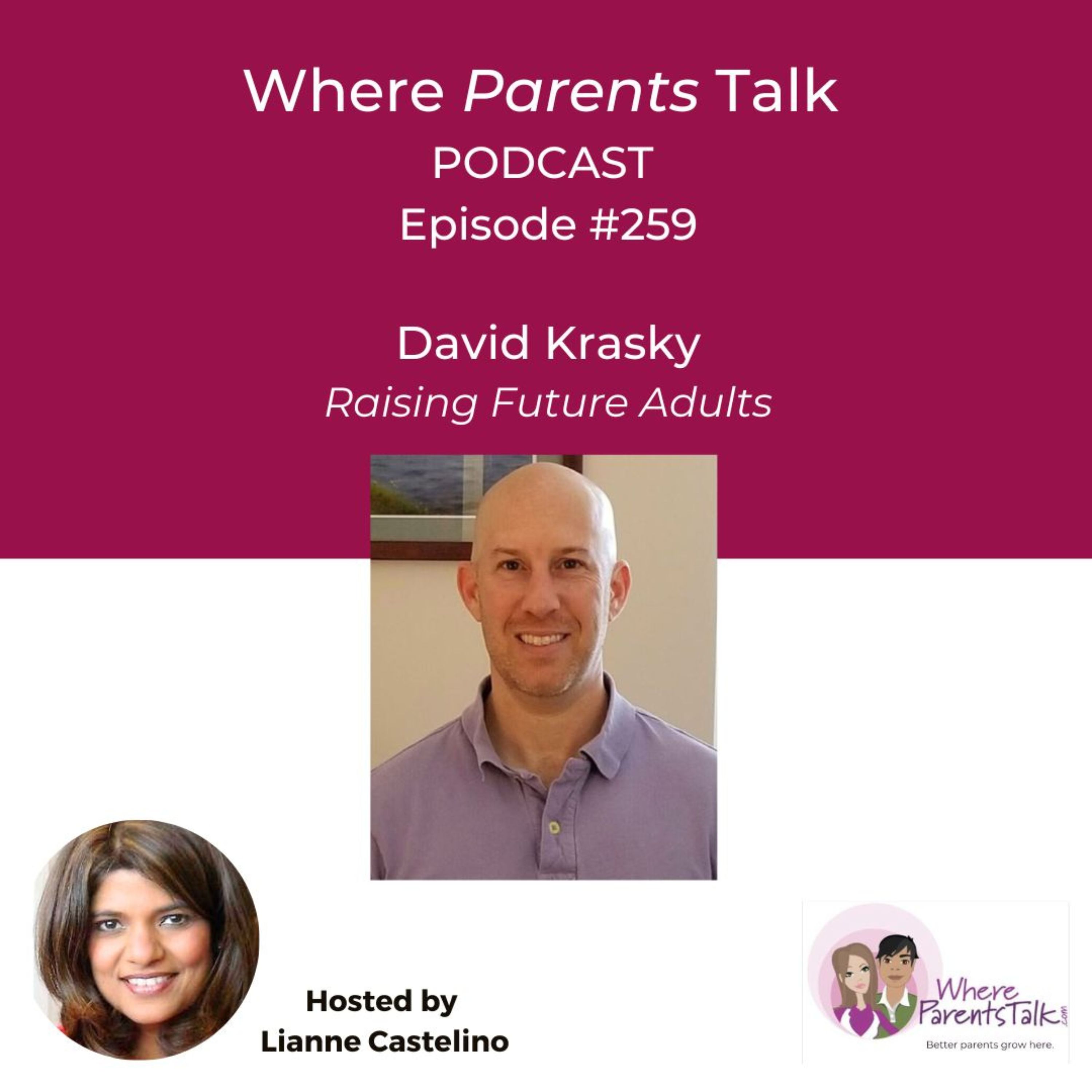
Raising Independent Kids in an Overprotective World
About this episode
Why are so many young adults struggling with independence today—and what can parents do differently?
In this episode of the Where Parents Talk Podcast, host Lianne Castelino speaks with licensed school psychologist, author and father David Krasky, whose book Raising Future Adults explores how parents can prepare children and teens for real-world success.
Drawing on two decades of experience working with families and students, Krasky explains how modern parenting trends—including overprotection, helicopter parenting, and the pressures of technology—may unintentionally limit a child’s ability to build independence and essential life skills.
The discussion explore practical strategies for helping kids develop executive functioning skills, resilience, and social confidence—while balancing the parental instinct to protect with the long-term goal of raising capable adults.
In this conversation, you’ll learn:
• Why independence among teens and young adults is declining
• The long-term risks of overprotective or “helicopter” parenting
• The critical role of executive functioning skills in real-world success
• Why social skills may be one of the most important predictors of future success
• How “lighthouse parenting” can help parents guide children without controlling them
• Practical ways parents can encourage self-advocacy and independence
• Strategies for supporting neurodiverse children while fostering autonomy
This podcast is for parents, guardians, teachers and caregivers to learn proven strategies and trusted tips on raising kids, teens and young adults based on science, evidenced and lived experience.
You’ll learn the latest on topics like managing bullying, consent, fostering healthy relationships, and the interconnectedness of mental, emotional and physical health.
Links referenced in this episode:
Get every episode summarized
Each time Where Parents Talk: Evidence-based Expert Advice on Raising Kids Today publishes, we email you a written briefing from the transcript — the topics, who appeared, and any specific claims, with the ad reads skipped.
Email me new episodesFree for 3 shows. No card needed.
Hosts & guests
Transcript ready
280 searchable segments. Every word is indexed and playable.
Full transcript
Where Parents Talk: Evidence-based Expert Advice on Raising Kids Today — Raising Independent Kids in an Overprotective World. Machine-transcribed; use the interactive transcript above to jump the player to any line.
Welcome to the Wear Parents Talk Podcast. We help grow better parents through science, evidence, and the lived experience of other parents. Learn how to better navigate the mental and physical health of your tween, teen or young adult through proven, expert advice. Here's your host, Leanne Castellino. Welcome to Wear Parents Talk. My name is Leanne Castellino. Our guest today is a licensed school psychologist and former substitute and teacher assistant for students with severe emotional and behavioral disorders. David Krasky is also an author. His book is called Raising Future Adults, How You Can Help Ensure Your Children Grow Up To Be Thriving Adults. David is also the father of two teens and he joins us today from near Fort Lauderdale, Florida. Thank you so much for making the time. Thank you for having me and thank you for hosting
this space for everyone. Well, and you know, I get to have these really great conversations about different aspects of parenting and one of the topics that continues to be quite popular is independence and raising future adults because that is becoming more and more complicated, I guess, in the world that we live in. Your book deals with this topic and really focuses on long-term outcomes in many ways. Why do you think so many parents struggle to raise independent thriving kids? I think there's been a few things over the course of decades and probably even more centuries when you look because I always talked to the kids that I work with about this of well, when teenagers were around 100 years ago, they had jobs, a lot of them didn't finish school and just started working, some started families in their teenage years. So the expectations were different and also they were forced to be independent and then over time you had all these changes when it comes to school demands, work demands, laws and then in the last 30 years,
where if any of your listeners have followed authors or podcasts or anything else, you've had this influx of this helicopter over parenting they talk about along and they have kind of correlated with more information being out there and when there's more information and more viewers, you have to have something that's really attractive. So a lot of what parents have seen in the news in the last 40 years is usually the stuff that makes them more worried about parenting. So all the horrible things that might happen to children and teenagers. So I, you know, were around the same generation, I wear my Gen X title very proudly on my sleeve and I tell the parents and I tell their kids when they're with us that my first memories is a young adult that watching television and the news and hearing what's going on around me was the Columbine shooting in Colorado, 9-11 and then the creation of the internet were the news and
everything's just coming at you. So when you look like well where did this come from? Why are our kids not as independent? A lot of it is because well we didn't have the security or safety within us or calmness to let them develop these independent skills because of anxiety and that's the reason why? Like parents will tell me directly, you know, on a micro level when I say, well why don't you let your kid walk around the mall with their friends? They're 13, 14, 15 and almost always it's one of the the answers of because of their safety. It's not because like, well they're going to steal something or they're going to get in trouble with the security there. It's always there's bad people there. They might get injured or hurt on the way to the mall or something catastrophic might happen. So that's where I've kind of seen the pattern at least professionally the last 20 years and anecdotally working with parents where why aren't these kids or why are there not as many young
adults equipped for the worlds because they didn't have the opportunities to practice these skills to build it. So then what was the catalyst, the tipping point for you to say to yourself, I want to write a book on this topic. I think I was always a very good long-term thinker. So when we started having kids we were and my wife luckily, she's in the special education world so we have very similar views and we knew that the hard parts of parenting is usually going to be the most effective or lead to the most effective outcomes. So it's hard to stay calm and be consistent when your child's dysregulated but we know over time it works. Also I joke with all the families I work with we got to practice on other people's kids before we started having our own. So by the time we had our own we were equipped to be with a kid who's two years old and having a meltdown in a
store and not feeling that well I can't let them do this because others are looking at me and there's judgment. So one of the things that we always knew and we were always a good team about it is we're going to be consistent and the goal is that we want our kids to be able to grow up to have the same skills that we did that made us successful and it wasn't just the reading and writing and math skills. So I started writing articles about eight years ago and just looking at how many we're getting views in which were the most popular and then that coupled with what I was seeing more and more and was getting asked to see more 18 to 25 year olds which I usually saw younger kids 10 to 20 and it would be the same theme of they're not ready for college they're not ready to be on their own they don't want to drive they need me to call their professor they need me to wake them up and just this pattern kept continuing and at first I thought it was little outliers
like I like this isn't that common and then I started talking to other parents and finding oh no these kids are not developing the life skills executive skills in order to self-manage and succeed so that was one of the things that that coupled with I always wanted to publish something just because you know bucket list item was always the kind of type A like if I'm going to learn to do something I'm going to be like really good at it and push myself a little so that's what led to it. So take us through your approach to putting this book together you know you've got the different lenses that we talked about as a school psychologist having worked with kids as a teacher assistant etc as a parent yourself look what did you learn through the course of writing and researching this book that you know found you found particularly interesting the gave you pause. A few of the things that came up at first when I was younger I always had this expectation or believe that oh these these older people these parents man they got it so figured out you know
I hope I could be like that and I hope I can do that and what I found is parenting is a lot harder because there's more stressors and more things that kind of get in the way of parenting than there was 50 years ago 100 years ago and then the other part of it was that if parents don't take care of themselves it trickles down to the kids and how they raise their families so we talk a lot about you know the self-care for the parent and that if the parent isn't a good place in taking care of themselves they'll be a better parent but a lot of times parents look at that as selfish or I don't have time for that or I have to work more do more make the money so we have all these external factors that are kind of up in the air affecting it so I try to bring a very practical real life approach which was another reason I wanted to write what I wrote I wrote it for parents and for people working with kids with practical real life idea strategy solutions versus
more theoretical and academic applications and something that's easy to read where you can turn to a chapter and say oh you know here's some great tips if you're about to go on vacation and you're worried about your kid being overstimulated or here's some great tips about I'm really worried about my letting my kid leave the house on their own more bike around the neighborhood here's slow ways I can get more comfortable with it and we could compromise so on that note then you know many parents feel torn between protecting their kids and preparing them for adulthood and it's a constant challenge that many of them don't seem to know how to get out of what are some of the common mistakes that you've observed where you know these mistakes unintentionally hinder independence in young kids and these are let's call the mistakes that parents are making I look at any type of action in terms of a pendulum where you know you have your kind of very permissive under parenting they call it sometimes where
they let the kids do whatever no rules you want to bike it to in the morning around the neighborhood by yourself you're eight years old no problem that's fine versus the other side of it where I work with some families whose children are in college and they're constantly checking the life 360 they need frequent updates from their child they're still looking at their child's grades even though they're in college and we always talk about well what's the eventual goal so my my joke with parents always is when the kids are younger like you know they eventually have to do this unless you're going to college with them you know they have to learn to sleep in their bed by themselves and be able to self-soothe and do that they have to be able to wake up on their own and prioritize and know what to do first and plan ahead where if they know they have a party Thursday night but they're also have a test Friday they're gonna have to study during the week so one of the things we always talk about is real life what's the eventual goal
and I think what happens a lot of times is and no fault of their own and I'm probably guilty of this sometimes too although I try very hard not to is we want to solve and fix because we're worried that the consequence is going to be much more dire and long lasting than it usually is so we shift the narrative more towards any consequence really is supposed to be there to teach right to change behavior I always tell them like I tend sometimes to drive a little fast and when I was younger I'd get tickets and that worked for me to slow down because I like my money more than I like speeding the cop didn't take my phone he didn't say you're fired from your job the consequence of me speeding eventually got me to drive a little bit slower until I had kids and I was like much more safe so we always talk about as a team you know the parents and the child and I what's the eventual goal the eventual goal if you want your child to live on your own
and to succeed they're gonna need these other skills that if they don't have time to practice them and the opportunities they're not just gonna automatically turn them on when they turn 18 it does shift the mindset completely when you look at it that way for sure moving from the immediate to more of a long-term view if you could give parents one research back habit that could boost independence in their kids does anything come to mind on that the main one only because seeing the trend over the last 30 years and there's a lot in the news about the loneliness epidemic so I don't know if anyone's heard about it but if you google it it's there's articles in time and us news and other major outlets that they're finding with the advancement of technology and social media and cell phones and the over scheduling of many kids and overworking of kids and multiple countries they're not able to develop the social
skills necessary to really succeed in the future so I think of the example of I have a senior at Harvard University who on paper looks perfect but he doesn't interview well because he never developed those interpersonal skills and he is not getting the job like the other kid who maybe went to a community school on paper looks okay but the person hiring him immediately decides within not immediately but when in a few minutes I would love to spend 40 hours a week with this young and I know whatever skill they might not have or whatever experience they didn't have they can learn that and we can teach them so I've really been biased when it comes to letting kids develop their social skills and that's a big umbrella too right like you have the problem solving piece social initiation um the dating world maintaining friendships solving problems with each other
so a lot of the the kids I've had for the years that they've come to me and I see it my own kids the ones that have those really strong connections and because of their interpersonal skills or even if interpersonal they're not as advanced so I think of some of the neurodivergent kids or or people with ADHD or social anxiety the ones that have enough time to practice and hone those skills and find people they can connect with can cope with almost any difficulty and any stressor that comes their way versus the ones that don't even the smallest situation becomes very very difficult because oftentimes they feel like they're dealing with it alone it's a very very very good point when we talk about um parents trying to let go uh pain point for many parents is the balance between guidance and letting go so guiding your child and letting them go and the the challenge for parents comes in the fact that they feel many of them like they're failing if they let
them go so what can you say if anything around you know what parents can do in that situation I like the term and I think there's some books on it now that call it lighthouse parenting if you've heard of it at all no so they talk about you want you don't want to be the helicopter you don't want to be you know someone on the other side of the world that's nowhere near a lighthouse is someone that's stable the light's always there if the child needs it at any age you're there to help guide a little bit but I always kind of fall back to your your job also as a parent is to help teach so in the teaching world one of the the terms or cliches they say it's I do we do you do so the goal is always well eventually you're going to have to do this on your own so I want to make sure I teach you whatever it is the skills now some kids and this is where I think the parents and whoever you're working with can come up with a good spot to move
forward from based on your child's skill or young adult where okay right now they might need a little more guidance versus another one who needs maybe not at all and listen they've proven that they're ready and the school site world also were really big on data you know everything's based on data so we're always talking about well the research shows this or even based on the observational data of your child they've done this multiple times or you've witnessed this multiple times and many times they're aware of it they'll say well it's not them it's a me issue where we always fall back and okay you know you got your emotional brain right that lizard brain that kind of takes over versus that logical rational thinking and we try to fall back and okay what's what's the worst that can happen what's realistic that's going on here and how much failure for lack of a better term is maybe good because that's sometimes the best teacher and where my
child's going to learn the most now you don't want it to be well the consequence of failure here is death or homelessness or something very severe but we want to look at it very practically of well if your child has to call the employer to thank them for the interview they had not you do it this is a good skill they're gonna have to practice and maybe they don't and it's affects them getting the job or not but hopefully over time they'll develop that skill and they'll be able to get the job they want or make the connections to lead to something better now with respect to the skills there are a long list of really critical skills that pave the way for independence and certainly adulthood executive functioning skills are among them it's normally they are associated with teachers and the school system but first of all could you define what executive functioning skills include and what is a parent's role in promoting and fostering
them so I always thought of executive skills when we learned about it in school as the manager in the brain right the the conductor of the orchestra the one that's kind of driving the engine so under those executive functioning skills blanket are things like planning monitoring your own output and energy sustaining attention and energy long enough to complete a task problem solving if things aren't working working memory holding things in your mind being flexible so being able to pivot or shift is something isn't working and one of the measures that we do I do a lot of testing my office of looking at different disorders and diagnoses that have to do with learning and attention and a lot of the tasks I explain to the parents and they look at me you know and roll their eyes like oh my gosh like I couldn't do that I didn't realize this task entails so many things so when we talk about executive skills and what parents can do we often talk
about not the academic world but the real world so great examples I give them are the ones I mentioned before your child wants to go out to a party Thursday night or Friday night but they have a lot of work to do during the week and if they don't complete the work during the week they're not going to go to the party it's not really your job to remind them every 15 minutes to get their work done or they can't go because if you and you've had teenagers first thing they say oh my god I know you're nagging me leave me alone I'll do it so it doesn't work it doesn't lead to anything productive so in that week they're learning how to prioritize they're avoiding the distractions of tiktok and Netflix and all the other things they're having to be a little bit flexible where okay I was going to study now but I you know something came up where I was going to do the work the energy and motivation piece which is very difficult for a lot of kids I work with being able to say I'm not in the mood to work but I'm going to do it anyway so one of the things I've learned
recently from a lot of ADHD executive function coaches it's motivation doesn't build momentum momentum builds motivation so some of the things that we do as parents and we don't even realize it sometimes asking your child to clean their room there's an executive demand there they have to know where to start they have to know when they're done they have to put in enough energy to get it all done they have to avoid distractions and being tired and being bored or even little things like planning to do their homework when they come home and they have multiple things to do they have to organize to know which to do first so I love asking kids you know how do you know what to do first do you do what to do the soonest do you do what's the most points compared to all your other assignments so this has the most weight do you do what you hate first to get it out of the way do you do what you love first to just you know do it while the music is on
so those are examples of things that parents are already letting their kids do now some of the stuff parents don't let their kids do as much anymore are a lot of the planning things when it comes to their social world so we in general now organize the play dates right very few times I hear if oh my kid just like bikes around the neighborhood and knocks on doors and he figures it out and then he asks to be home by the time it's dark this is where I really age myself right and like nobody knows where we are and we have to kind of problem solve and avoid trouble and even in bikering around those are some executive skills when it comes to being aware of danger and sustaining your attention on things and problem solving with friends when everyone's disagreeing on what to do or what not to do when you talk about independence and neurodiversity that is a reality in many families what practical steps could you suggest to truly try to raise independent kids who you know may
have ADHD or learning differences or be a neurodiverse in some way we always talk about what their adult lives are going to look like real time so as what we know right now where a lot of parents I think because when we were raised it was very different 30 40 years ago where now I tell the families you know if your child needs to use audiobooks for the rest of their lives they can if they need to get accommodations it work because of sensory sensitivities or issues with longevity and energy during the day and they get very overwhelmed or overstimulated they can because of laws and what's available in practice so we always first talk about well what will be available to them in the future realistically we also talk about starting very small so with families you know when I have a 13 year old boy with ADHD so I can't imagine him right now
on his own in college remembering to do work so I think practically of okay well what's he going to use what skills do I want to teach him if he needs to use reminders in his phone and that works but if he needs supports and this is where I really you know show them the resources out there and we talk about kids self advocating for themselves as they get older he can work with different types of coaches or tutors if he needs he can work with different mentors he can do things like in the ADHD world they talk about let's say body doubling where him and a few peers work together because it keeps him warm task or he can use different methods or use different apps so those are a few of the things that I always bring into practice and remind parents kind of alleviate a little bit of that stress but again getting back to those interpersonal skills and those social skills if the child learns how to advocate for what they need as they get older and know how to work with others and
build a team there's going to be more opportunities for success and if you're parenting in the way that you're not you know doing too much for them and you're you're more they're like a resource as they get older and a team member and a compound and so on to work with and collaborate with they'll come to you and you guys can problem solve together when you talk about kids advocating for themselves how can a parent support that behavior without feeling like they're overstepping and then going back into that you know protection type mentality that we're trying to get out of to some degree right it's always great for kids to see us do it so I think the modeling is wonderful you know leave them in the room when you're calling customer support and yourself advocating for this thing or in my world you know calling the hospital the insurance company somebody working on the house but also I want my kids to see and and I hope parents do this
more and more with the mental health stigma slowly diminishing over time which it's still there but it's it's better than 50 years ago of being able out loud to say wow I'm really stressed I need blank today or I'm feeling really overwhelmed and I need blank or man I'm really anxious like this is what's going on I'll be okay soon but these are the things I need that alone I think is wonderful from birth on for your kids to see oh this is okay so then we make it okay and we normalize it the next if we need you know you're always modeling it for them so if they need help emailing the teacher asking for help you know we want them doing it with you first so we want them comfortable enough and you know I always tell them when they're in the room with me but the right voice tone if you can and the right words so you're not screaming at mom so if you need a minute you know I do this very often if you need a minute if you need to leave the room or whatever else we can shift topic when you can tell mom or dad what you need and they'll be more apt to listen
you got it so it's a lot of that practice very real life very practical and then revisiting it and seeing okay did that work or that didn't work and if it didn't work why not you know what else can we do do we need to work together so you know we have kids yours are a little older than mine but they've lived in the world of just email your professor just email your boss I've worked with countless families where the parents emailed the boss and the professor where I always say I'm like well does your does your child not know how to do it well they do I just want to make sure it's done right I'm like well let's see how they do it you know let's let's look at the data where if we are proof okay like the wording is this or that or whatever but don't we want to teach them you know let's give them opportunities and if we need to tweak and edit or do it together again it's like I do we do you do but the eventual goal that's you do is there one key takeaway
David from your book that you hope parents leave with I think the over overlying theme it's this little person you have this child this teenager the eventual goal for almost all of us and unfortunately there there are some children they're going to need some kind of support their whole lives but the majority of children are going to be able to live independent lives the hard part of parents it's not just thinking about right now in the moment it's thinking how is this going to help my child for the future so that's why I like the subtitle of the book it's thinking you know of their future that's always the goal so the child having the meltdown at at the theme park or in the restaurant or the store it's now as an opportunity for your child to learn how to self-soothe this is great where I do that very often in the office where you know the parent looks at me if
this child's getting dysregulator upset my mind like this is okay now we get to practice so that's again like the overlying theme of thinking long term and every opportunity they have it's not good bad it's not right wrong it's now we get to practice now we get to make things better it's really a great way to look at it David Krasky author of Raising Future Adults in Licensed School Psychologist lots to think about thank you so much for sharing your time and your perspective with us today thank you Leanne take care to learn more about today's podcast guest and topic as well as other parenting themes visit whereparentstalk.com
More episodes
More from Where Parents Talk: Evidence-based Expert Advice on Raising Kids Today

Raising Body Confident Kids: Dr. Charlotte Markey on Body Image, Diet Culture &...
Where Parents Talk: Evidence-based Expert Advice on Raising Kids Today

The Recipe for Independence: Teaching Kids Life Skills Through Cooking
Where Parents Talk: Evidence-based Expert Advice on Raising Kids Today

Cyber Smart Parenting: Protecting Kids in a Digital World
Where Parents Talk: Evidence-based Expert Advice on Raising Kids Today

Overcorrecting in Parenting: Nervous System Regulation, Burnout, and Finding the...
Where Parents Talk: Evidence-based Expert Advice on Raising Kids Today