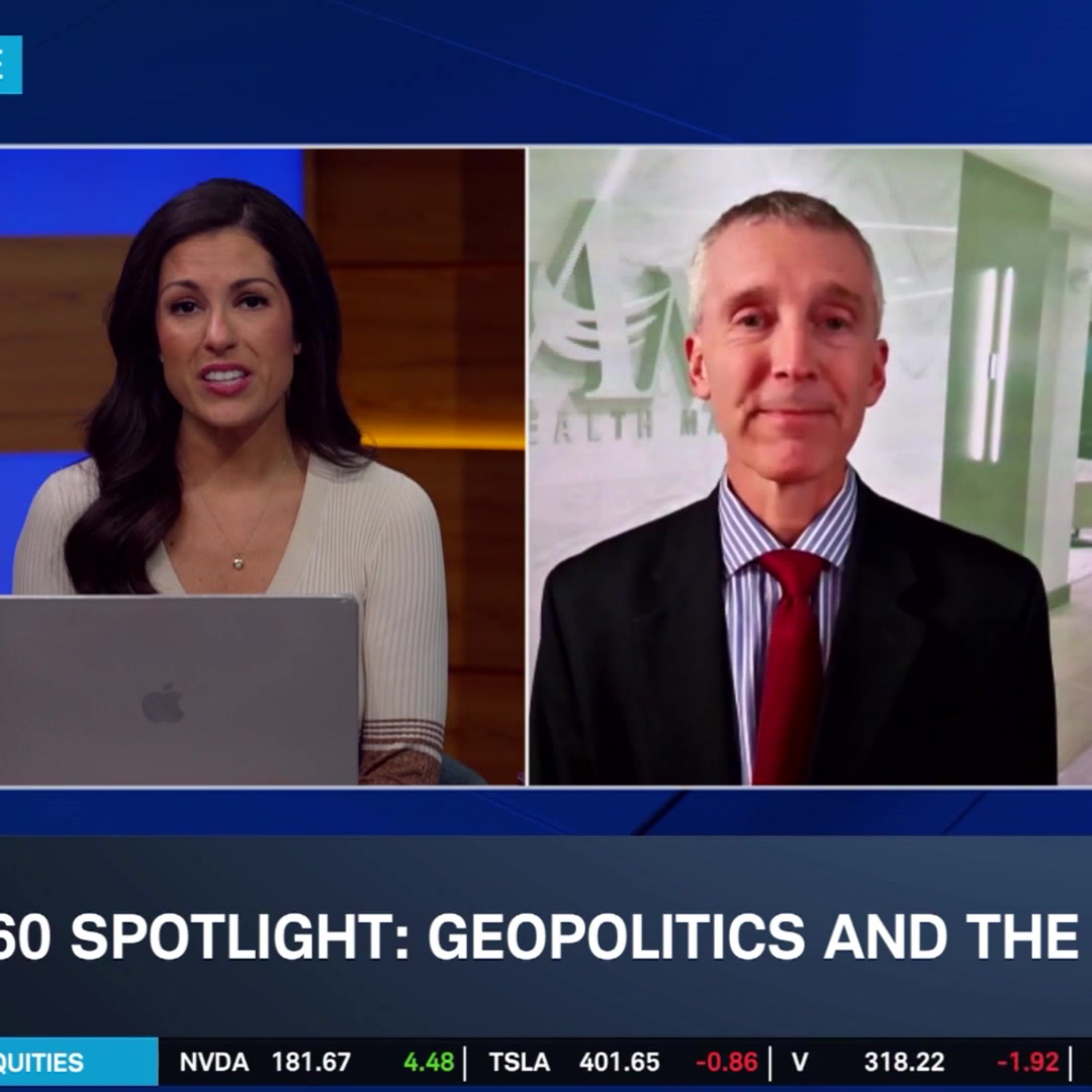
"Punch but Not a Knockout:" Iran Trickle Effects on Gas, Bitcoin & Gold
About this episode
Brian Jacobsen turns to the commodity space in crude oil and beyond after the U.S. and Israel launch joint attacks on Iran. He sees gas prices ticking higher and inflation to accelerate, though he attributes the rise to a "punch but not a knockout." Jacob also weighs Bitcoin against gold to determine how each withstands times of volatility.
======== Schwab Network ========
Empowering every investor and trader, every market day.
Options involve risks and are not suitable for all investors. Before trading, read the Options Disclosure Document. http://bit.ly/2v9tH6D
Subscribe to the Market Minute newsletter - https://schwabnetwork.com/subscribe
Download the iOS app - https://apps.apple.com/us/app/schwab-network/id1460719185
Download the Amazon Fire Tv App - https://www.amazon.com/TD-Ameritrade-Network/dp/B07KRD76C7
Watch on Sling - https://watch.sling.com/1/asset/191928615bd8d47686f94682aefaa007/watch
Watch on Vizio - https://www.vizio.com/en/watchfreeplus-explore
Watch on DistroTV - https://www.distro.tv/live/schwab-network/
Follow us on X – https://twitter.com/schwabnetwork
Follow us on Facebook – https://www.facebook.com/schwabnetwork
Follow us on LinkedIn - https://www.linkedin.com/company/schwab-network/
About Schwab Network - https://schwabnetwork.com/about
Get every episode summarized
Each time Schwab Network publishes, we email you a written briefing from the transcript — the topics, who appeared, and any specific claims, with the ad reads skipped.
Email me new episodesFree for 3 shows. No card needed.
Transcript ready
167 searchable segments. Every word is indexed and playable.
Full transcript
Schwab Network — "Punch but Not a Knockout:" Iran Trickle Effects on Gas, Bitcoin & Gold. Machine-transcribed; use the interactive transcript above to jump the player to any line.
It's time to spotlight the market response to the U.S. and Israel launching a joint attack on Iran joining us now. Brian Jacobson, chief economist at Annex Wealth Management. Brian, great to have you with us this morning, you know, seeing a mixed reaction, actually, not mixed any more. Now the Russell is low on the day, so an entirely in the red reaction to the events of this weekend. I would love to just start with your thoughts on the response that we're seeing, and if it is of the size that you expected when you saw the headlines coming across this weekend. Yeah, thanks for having me. I think it would have been a little different if the markets were open on Saturday, right? You probably would have seen a bigger response, but we did give us some time to digest the news, see what sort of response there was. And I think that really what we're seeing here, you know, if you look at oil prices going up, and then also copper prices going down, to me, this is a classic, almost like an inflation and growth jolt, it's almost like a punch, but not a knockout. And I think that's what the market is really pricing in here, because we are seeing with that 10 year treasure yield moving higher, but it's mostly because of shorter term inflation
expectations and the possible cost of the deficit spending associated with replenishing all the missiles and the defense buildup. So I think that what we're seeing here makes a lot of sense, but it is more one of those things. Oh, I think we may have lost a Brian there. We'll give him a moment to take a look at that connection and see if we can get him back. But let's take a look at where the oil prices stand right now, as he was just mentioning them. Oil had gone up crude is above 70, 70, 88, a barrel. That's up almost 6% has come off some of those highs. We did see a jump more than 7% as of early this morning. If we're taking a look at Brent, we are up close to 7% still there, up 6.8% at 77, 85 a barrel this morning on these increased to the geopolitical risk concerns regarding the ongoing situation in Iran. We will be back right after a short break. Stay connected to the markets and the Schwab network.
To an end 24 hours a day, seven days a week on Schwabnetwork.com and on all your favorite streaming services, Schwab Network, available anytime, anywhere on any device for free. Whether you're an experienced investor or just getting started, Charles Schwab offers a webcast that's right for you. Do you like using charts when analyzing your stocks? Our technical analysis webcast series breaks down different charting techniques like trend analysis, price patterns, moving averages, oscillators, and much more. Best of all, you can ask questions directly to an education coach. It's interactive learning at its finest. Stay tuned in live or on demand. Head over to Schwab.com slash coaching and start learning today. Welcome back to Trading 360.
I'm Marley Caden joining us again, Brian Jacobson, Chief Economist at Annex Wealth Management. Now Brian, let's just start where we left off here. We're talking about oil, talking about the reaction that we're seeing in the markets. You said not totally unexpected, you know, with some time to digest some of the headlines that we got Saturday and yesterday, but you said something really profound in the notes that you sent over. And I want to dive deeper into it. You said if history is a guide, these types of events tend to unfold quickly, but their second and third order consequences can play out over longer horizons and in unpredictable ways. We're hearing from the administration now that the potential four week timeline may no longer be in play here. This could be a longer dated issue here now in this ongoing situation with Iran. What are your expectations of some of these unpredictable ways that we might see the impact show up? I apologize for the technical difficulties I had there before, but I think that in terms of what we might see going forward, it could actually be further pressure on the AI trade.
Most people are thinking we're going to see this with defense stocks and we're going to see a negative with airlines. But if you think about what's going on with artificial intelligence, the data center build out under pressure already, look at the private credit story there. So funding costs are going up, but now the energy costs are also likely to go up. So this could be further pressure on the data center build out theme and some of these big hyperscalers, the money that they're throwing effort or data center build out. Is it good money after bad that they're throwing it at this point? Certainly a possibility there with lots of the prices tied to things like, you know, as we're seeing, this rate of remove is not officially shut down, but many tankers just generally avoiding that area already seeing reports about the cost of ensuring any of the tankers that want to go near that area. How sensitive is the global oil market right now and that also beyond that, the broader inflationary picture long term because of this impact? Yeah, we know that consumer, their expectation of inflation is very much driven by the price
at the pump. When they see gasoline prices go up, which we are likely to see as a result, their inflation expectations shift higher. Now the Fed is really focusing on inflation expectations. Yes, they do want to see realized inflation come down. But what they know from a lot of the research is that future inflation is driven by expectations. And so they might need to change their tune to squawk a little bit more hawkishly as a result of this. Typically, we would view this as a supply shock, something that they could just look through. They might be less willing to look through this type of shock just because of the effect that it might have on inflation expectations. And if we to find ourselves in a potential supply shock situation, do you expect that OPEC plus may involve itself? Yeah, I think that they did step in and say 206,000 barrels per day, but that is weak beer compared to the 3 million, 3.3 million barrels per day coming out of Iran.
Now we haven't gotten any indication that their production has been too much affected. But I don't think that Saudi Arabia, Qatar, UAE, I don't think any of those countries have a lot of spare capacity to fill that void. And so that's why I think that it's a midterm election year. We know that this is going to be a politically charged topic. The sooner it can get done, the better. Because the last thing that we, I think President Trump wants is that when we get to October is to have the still going on. And there suddenly there's going to be talks about, is this another quagmire that the United States has gotten into very similar to what we had, say, in Vietnam. So I think that in a midterm election year, there's a lot of political and economic incentives to try to get this done quickly. And you mentioned that if the markets have been open over the weekend, we could have ended up with a very different picture, but Bitcoin markets were open over the weekend. We watched Bitcoin sort of sell off still not taking that 70,000 mark here, but we are now seeing gold and oil, of course, move higher.
They're not moving in tandem here. Bitcoin is not participating in the safety trade as the digital gold, as many of us were referring to it at least late last year. I haven't used that term so far this year with the Bitcoin performance that we've seen. But what are your thoughts on that action that we saw and sort of the departure we're seeing as Bitcoin and gold really distinguish themselves against each other? Yeah, I think it does highlight how gold is a safe haven asset or perceived as such, whereas Bitcoin is not. If you think about the people of Iran, what was happening when there were the protests going on? Well, the government shut down the internet. Were they able to actually access those Bitcoin wallets? Can you get your digital wallets if the government is going to step in and suddenly just cut off your access to it? I think that really reminded people that while Bitcoin itself, it might be the sensorless commodity, it still does depend upon a lot of government provided or perhaps potentially throttled infrastructure. So, I think that gold is showing how it is going to react in these types of geopolitical
situations. Maybe Bitcoin is still good in terms of being a store of value to hedge against inflation, but not necessarily against a big geopolitical issue like this. Well, certainly not if you could potentially lose access to your funds. You bring up a great point there. You also mentioned defense and airline stocks and of course lots of the headlines around all the flights canceled around the Middle East and defense stocks presenting a potential opportunity with the geopolitical risks. But defense stocks have also had a huge run-up over the last year with increased defense spending not just domestically but internationally as well. Is it already priced in? Are these geopolitical risks the reaction trade for I guess lack of a better term already priced in to some of these defense names? I think longer term, yes. A lot of this has been priced in. We are seeing a pop in some of the names like Lockheed Martin RTX. Those are moving up anywhere from four to five percent. But it's not the type of move I would have expected. If this wasn't already almost announced that Germany is going to expand their defense spending.
The United States is going to have to replenish these missiles. We know that President Trump has actually asked for more defense spending. So I think coming into this, there was already high expectations for defense spending. And so an event like this, it might move the needle temporarily. But it isn't something I think that is really going to change the longer-term valuation outlook for those companies. All right, Brian, last question. And I'll have to be quick because we're running a little tight on time here. But in your view, is this a truly path-altering event here or might this just be another bout of market volatility? Yeah, I view this as a bout of market volatility. Nothing typically good happens when the VIX is above 21. So you can maybe wait for that to come back lower. But I do expect that this is just going to be very kind of sporadic. And something that hopefully God willing, a week from now, we can look back. And the market is going to focus more on the fundamentals of the businesses. Or some new geopolitical issue. Well, Brian, we really appreciate you taking the time to break all of this down with us. And highlight some of the places we may see the impact show up in the near and long term.
Brian Jacobs and the Chief Economist at Annex Wealth Management.
More episodes
More from Schwab Network

Stock Market Today: ORCL & ADBE Earnings, AEO Plunges Near 52-Week Low
Schwab Network

Thursday's Final Takeaways: Crude Taps $103 & PPI Hotter than Expected
Schwab Network

Balancing High-Conviction AI With High-Dividend Diversification
Schwab Network

EARNINGS PANEL: ORCL, ADBE
Schwab Network