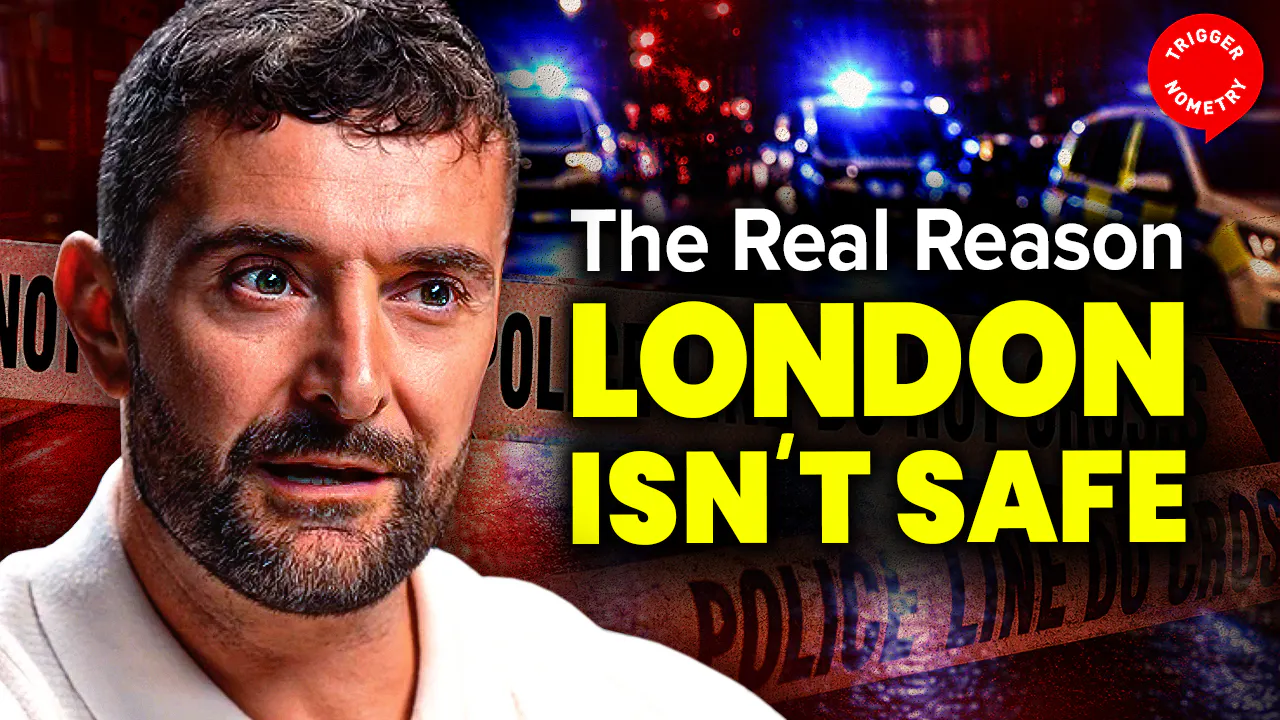
About this episode
Get every episode summarized
Each time TRIGGERnometry publishes, we email you a written briefing from the transcript — the topics, who appeared, and any specific claims, with the ad reads skipped.
Email me new episodesFree for 3 shows. No card needed.
Hosts & guests
Transcript ready
1,133 searchable segments. Every word is indexed and playable.
Full transcript
TRIGGERnometry — Police Whistleblower: "I Quit to Share the Truth". Machine-transcribed; use the interactive transcript above to jump the player to any line.
This episode is brought to you by Pal Molliv. Family time isn't just the big moments. It's weeknight dinners, sitting around the table, everyone talking all at once. So when the plates are empty and the sink is full, use Pal Molliv Ultra. Pal Molliv's most powerful formula removes up to 99.9% of grease, leaving your dishes sparkling clean, and the new convenient pump makes cleaning even easier, so you can spend less time tackling dishes and more time together. Shop now at PalMolliv.com. I think London is on a very, very bad path and something has to be done immediately.
The police needs reputing from scratch. I think impartiality has gone a little bit downhill. We had one training in which one of the questions asked of us was as follows. How treating everyone equally would potentially lead to inequality? You know this is a little bit or well-earned. If something similar happens to 2011, I don't think we'll be able to call. We might be indeed seeing the total collapse of the police. The British government wants to force YouTube to down rank independent content like ours and replace it with approved messaging from the mainstream media. The only way you can fight back and continue to enjoy our content is to make sure you're subscribed. Like this video and comment below to have your say on what the government is doing.
Dimental, welcome to Trigonometry. Thank you. Thank you for having me. You're a former police officer with a metropolitan police. We will talk about your story and some of your views on policing and other things that are happening. One thing we wanted to talk about is we both ourselves have experienced this. I've seen people get mugged repeatedly now in London and I don't spend a lot of time in London. More broadly, we hear from our supporters, friends, people who live in London that they just increasingly feel less safe. Do you think there's a reason for this? Do you think it's true that people are less safe? Yes, I think that's most definitely the case. I actually think people don't speak enough about how dangerous London has become because they have reached a level of detachment from reality only because they have realized they are speaking about the topic. They're bringing it up. Nothing really happens.
A lot of people know how dangerous London is but they actually don't talk about it. Your friends, I think, are rather in a minority of people who still talk about that topic. For example, the new statistics saying that the crime in London is going downhill. It's going downhill only because people are not literally bothered to report it. I'll give you an example from my own self. I don't have many, many hobbies. One thing I like a lot, it's mountain biking. I'm a big mountain bike fan. I bought me a brand new, quite expensive mountain bike because I'm a big guy and I'm quite heavy so I wanted to buy a nice piece of machinery there. After a couple of months, I got stolen. I didn't report it myself. Why? Because I know it's not going to go anywhere. So yes, to answer your question, they're absolutely right. It's getting very, very volatile.
It's getting very dangerous. I've seen that even when I was back in, back working for the Met, I remember people will be someone get their phones snatched. Then suddenly people getting pushed away, pushed on the floor and then getting their phones snatched. Then people branding knives and getting your phone away. I was seeing the violence was escalating drastically. That's my personal view to be honest. Also I've seen that a lot of people started to, you know, criminals started to attack police officers. Absolute disrespect towards, you know, law enforcement and anything of such sort. So yes, I think London is on a very, very bad path and something has to be done immediately. And the question that will be on everyone's lips is why is this happening? And I think your personal story ties very much into this. So why do you think it's happening?
Okay. From a police perspective, I think a lot of officers, they call it disillusionment with the job. They understand in a way that they're fighting a losing battle. I think for the first time in the history of the Met, voluntary resignations has surpassed people who retire. Wow. And that's absolutely extraordinary. And whatever I say here, everyone can go and look it up. I am here mostly because I want to speak to the regular member of the public, you know, for the taxpayer and ask them to go and check these things for themselves to actually realize that the situation is not good at all. So it's the disillusionment with the job. It's impossible tasks. I used to work in Westminster from being famous chairing cross police station. It is not exaggeration when I say that is non-stop call, after call, after call, after
call. It is impossible for you to keep on top of that. Let alone proper investigate further on. There's some wonderful people steaming the metropolitan police and I think London is incredibly happy to have them. I have been inspired by such people. Probably that's why I last in the Met so long because I thought to myself not everything is lost. But I think the amount of work is impossible. Nobody wants to join the police because specifically lately, lately the last few years, you know, there was a lot of bad media coverage, some egregious examples. You know, if you want to speak about these egregious examples later on, you know, we can address that but they don't recruit and they're losing mostly the best people they have. This is a recipe for a disaster and it's just matter of time before something happened and they won't be able to control it. And I think deep down they know that. I really think deep down, you know, the senior leadership of the metropolitan police realizes
that. So tell us your story then. How did you decide to join the police? Why did you join the police and then what happened from there? And maybe just tell a lot of people who are saying you've got an interesting accent. Just tell us a little bit more about you. Yes, of course. I am a originally Bulgarian and I came to the United Kingdom because of my grandfather to put it that way. From a very, very young age, he talked me to read the classics. So I started with Russian classics. Unbelievable. I have to read those two. Yes, you know, probably in Tolstoy and Gorky and you know so much about life. If you want to be depressed. Yes, yes, yes. And then I moved to French classics. Yes, of course, wonderful. And then I ended up with reading British classics. And I thought to myself, one day I want to go to Great Britain, you know, and I ended up in Liverpool. That was the first place which I went to live. An incredibly unique place.
Not English, not British, Liverpoolian, you know, more power to the people there. They are very, very friendly. Some of the best people I've ever met. However deep down I always wanted to come in London because when I was in Liverpool, I'll get the bus and I'll come to London. I just going to walk around and I see this magnificent city. And I'm thinking about the history that brought this city into existence. All these lovely, amazing people who made it happen for me to have the opportunity to walk as a free man, as an individual, according to what I think is the best values in the world, the British values. That's what I think. I sincerely believe that. And I was thinking to myself, well, I am young. I believe I have courtesy and dignity, transparency and integrity. I'm relatively fit. What can I do? To help this place, this country, this city that I felt in love with, preserve itself and not only, but make it the best city in the world.
And I think the best position to do that is actually joining the police because you can make an everyday difference in someone else's life. And that person can remember that and they can make that difference for someone else. And you can spread that goodness upon hundreds of thousands of people, you know, for the next 10 to 15, 20 years. So I joined the police. I applied. I got the job one day before I came to London. I got a phone call, you know, hello, Dimitra, you know, you and that university degree path. Welcome to the police and you know, you're going to work becoming the best constable you can possibly while attaining to this university degree and, you know, even further fulfill your professional, you know, goals. I don't think too much of that sounds very nice. In my head, I'm thinking this will be probably something very well related to the legislations,
which are constable most definitely needs to know inside out. That's absolutely paramount. I thought to myself, okay, you know, that's great. I'm happy. I come to London. I find myself a place. It was a little bit of a COVID. We had a few lectures online and then eventually we started going to university. And this is the first time when I was starting to think this is not very well conducted. Brand new building in the city of London is India. I can name it. I was assigned to an university called Angliorosky University. So we go there and sometimes in the beginning, I know it's the beginning, we're the first course, you know, they used to call us also the guinea pigs and the police bear done in mind because it will become very relevant later on. So we go there in the beginning sometimes the internet wasn't working very well. Well, you know, it's a brand new building. That's absolutely fine. And guys, you are in room 10. Oh, no, no, no, guys, I'm very, very sorry.
You're in room 12. Oh, I apologize. You're in room 15. You know, and I'm thinking to myself, this is all paid with taxpayers money, millions, upon millions of pounds of pounds are implemented into the program. And I understand we have the first class, but I think they must be some expectations from an establishment, which is paid by taxpayers money to be adequately prepared to make the program, you know, a relative and, you know, smooth, as smooth as possible. Anyway, you know, those things, they were a little bit strange. But then we started having some lectures and the materials given to us, I think a lot of it has no relevance with the training of a frontline police constable, specifically in the beginning of their career. For example, they used to teach us theories such as broken window theory.
Well, that's okay. Maybe for someone, if someone wants to expand in the professional conduct in the future to come as a criminologist, maybe they can look upon that in the fullness of time, but not at the moment, you need to know how legislations are presented and how legislations are presented in circumstances in which a constable may happen to be part of, you know, was that a burglary, was that theft, was that robbery, do you understand what to do? You know, it should be more police oriented, specifically about the job, not about theories. Then we had one training in which one of the questions asked of us was as follows. How treating everyone equally would potentially lead to inequality? You know, this is a little bit or well, yes, yes, this is a little bit or well, I'm looking
at that and I'm thinking officers, police officers in training told that question in a very, very interesting, very interesting word, you know, and it seems to me it goes against the very core principles of impartiality. You know, it makes you think, oh my God, what do you mean I'm treating everyone equally and my lead to inequality, it's very, very, very confusing, very, very confusing. And I think this is extraordinary but thing to introduce to officers, specifically some of my colleagues who are very, very young people, you know, in their 20s and I'm thinking they're getting confused here. And I thought to myself, this is crazy, I don't want to be part of that. You know, this is waste of tax pay as money. I want to be a police officer. People are getting rock, people are getting stuck selling drugs, fights all over the place. Let me be, let me get off this course and let me specialize, you know, let me just be the officer. I wanted to be to protect this city and I truly mean that from the heart.
Anyway, so I was very, very lucky because my class, my class was actually very outspoken about that. On few occasions we actually made it very, very clear, the whole class that we want to be taking off this course. Guess what we were told on many, many, many occasions. Guys, you either do this or you're going to lose your job. I want everyone that will be watching the show just to think for a second. If they think it's appropriate to tell a police officer in training that if you do this, if you don't do this, I'm sorry, you're going to lose your job. That's a coercion to the best, I think, to the max. This is really, really, really, really bad. And when they said that quite a few times, I was looking around me and I could see the faces of my colleagues. There was so gloomy, you know, they had nothing to say about that.
And Dimitra, just to interject one thing, I think it's important to say that one of the problems is that having a university degree was made a requirement for police officers. Absolutely. And this is why you're all sitting doing this course. Yes. I imagine most of you would rather just be out there being given practical skills to do with how to police. In a heartbeat. Right. Yeah. And they used to say that quite a few times, you know, guys, if you don't do this, you're going to lose your job. However, a few days after that, they'll come and they'll say, you know, something, do or you guys, you're the first class, you're all going to pass. And I'm sitting there, I'm thinking, this is an extraordinary thing to say. I really was, that was bewildering. Oh, don't worry, guys, you know, you're the first class, you know, yeah, we have made some mistakes, but you are the guinea pigs, like I've mentioned in the beginning of our conversation. And I'm thinking to myself, this is this is extraordinary conduct. You know, if this is a serious university, you know, I don't think they'll be acting
like that. You know, there will be a dialogue. There will be a discourse, a proper discourse of why we actually don't want to be on that course, not be taught where we have to do it or you're losing your job. But that was not the most extraordinary thing we have been taught. On few occasions, and I'm not exaggerating. And if some of my colleagues are watching that, I beg of them to come forward and say the same thing. And I'm already spoken to one of them. And he said, yes, Dimee, I clearly, clearly remember that on one occasion, at least, the lecturer who was supposed to deliver a material to us, read that material to us, said, she looked at the, you know, the PowerPoint. And she said, and I quote, oh my God, who wrote this? Please guys, don't shoot the messenger. I'm only here to read you that. And I'm looking around me, I'm thinking, am I drinking precipice? Are lecturer openly mocking the very same material they're going to deliver to us?
I went back to the station, you know, after my university days. And I said to my supervisor and to my inspected heart, I want to be taking all the course as soon as possible. And I stopped submitting any work required, you know, of me. And everything I have submitted before that was halfway through because I was reading really, really scared that I'm really going to lose my job. But I reached a breaking point. I'm thinking I cannot morally continue like that. It may cost me my job. But I live my life on a very, very simple mode. So if it's not right, don't do it. If it's not true, don't say it. I couldn't. I really, really couldn't. So I stopped submitting anything. I haven't submitted anything for probably 12 months. I haven't submitted a dissertation, you know, final work, nothing at all. And I spoke to a chief inspector in learning and development.
And they told me, you need to write us a letter. And we're going to assess the letter. And if you made the exceptional circumstances criteria, you may be taking all the course. So I write everything I told you in the letter. And I specifically said to them, I truly think it is indeed. And exceptional circumstances for someone to mock the very same material. They're going to read the speeches that that's extraordinary. My application wasn't adequately under the umbrella of exceptional circumstances. And I was told that I have to continue with that course. And in a little bit more strong worded email from my site, I said, I am not doing this. And that's that, you know. And then after I said that, I send that email, I received an email from another external
company, which was given the contract initially. And that external company has given before universities the ability to teach new offices. And that email sets me literally a limiter. You either do this or you need to resign. And then it follows, of course, I hope it's not the last time. And you know, we want to help you out. And that was a breaking point. That was a breaking point because a few days before that, I did an attachment with A, A, which means I'm responsible vehicles. And I was so happy to be surrounded by such professional police officers. And I did 10 hours with them. And in the end of the shift, they told me, okay, do you mean that you can send us an application. And we will see what we can do for you. And I know what that means, you know, I'll send an application. Probably I'll be given a chance to prove myself and eventually join them if I pass all
the assessments required. So I was very, very happy. I went back to, you know, to my inspector, to my sergeant. And I was like, Demi, Demi, we're going to sign you off immediately. You know, and you can go specialize everywhere you want. But we can't because you don't have the degree. And this is when I send the email and Demi comes back, you either do this or you need to resign. And that was a breaking point. I resigned. I resigned two days after that. And my last day was on the 31st of March, 2024. And it was a devastating moment for me and for my partner. I'm not with my partner anymore because I became very, very detached from everyone, from her. I just couldn't understand why this is happening. The news doesn't just tell you what's happening. It tells you what to make of it. And the real red flag isn't what said. It's what gets left out. That's why I use ground news.
Every day they gather thousands of stories from across the political spectrum. Compare how different outlets are covering the same story side by side and contextualize it, including specific differences in how each side is reporting it. That's how you see what whole audiences are not being told. My favorite feature is their blind spot feed. Every day it flags upwards of 20 stories that are being ignored by either the left or the right. Some examples follow along at ground.newslashtrigonometry. Take this story. A pure research survey found that 56% of Americans now support banning social media for anyone under 16 with a majority of Republicans and a majority of Democrats behind it. Genuine bipartisan agreement is rare enough to be newsworthy on its own. And yet coverage came almost entirely from the right. The left barely touched on it. On the other hand, look at this. An AP poll found that 66% of Americans now say democracy is central to what it means to be American down from 80% five years ago. That is a serious story about how the country sees itself, especially on its 250th anniversary.
And it got three times more coverage from the left than it did from the right. Ground news puts all of this in one place. Headline comparisons, bias breakdowns, ownership insights and context so you can actually understand what's going on. Or just react to what you're told. Go to ground.newslashtrigonometry or click the link in the description of this episode. Get 40% of their vantage plan the same one that we use and stop being managed by the media. I did have two exit interviews, which is quite extraordinary on its own, on my second exit interviews, on my second exit interview. The chief inspector that wanted to help me out had a conversation with the chief inspector in learning and development. And they were speaking for over 45 minutes, but I very vividly remember she's saying to her, I'm sorry, but why are we losing this officer again? He's public order trained level to he stays a train.
He speaks multiple languages. His inspector is here. His sergeant is here. They're very, very supportive of him. His team is very, very supportive of him. Why are we losing him? I vividly remember that. And I don't know what the structure of the metis, what type of a contract precisely they have signed with this university awarding degree. I really, really don't know, but they couldn't give me a decisive answer. They wanted me to wait. And I couldn't judge them. And I was broken. I love every moment, policing London. And I think I have benefited quite a few people to say the least. And I think my colleagues can quite a few of them can say that I was a substantive and well overall, in general, complete officer to begin with. I have done so many things to help my colleagues. So many cell exits with other teams, which I don't know anything about, pulled people
from the bridge, you know, going into the bathroom. If I may put it that way, I did it so selflessly. I was really prepared if the circumstances are such I'm not exaggerating to lose my life if I have to, but to preserve human dignity and goodness. And I sincerely believe that. And probably that's why the impact was so heavy on me and resulted in me eventually breaking up with my girlfriend. I was in a very, very dark place. I just couldn't take it anymore. And what point I thought, you know, I lost my meaning of life. You know, I was good at this, you know, I just wanted to make a difference and have taken that away from me. And I'm not seeking vengeance. I just hope people can hear my story so that who never, never happened again. To other complete decent offices who wants to make a difference because we need them now more than ever. To be honest, more than ever.
Yeah, yeah. That, that, that, that, that, it's a little bit of a, it's a little bit of a sad story. But let me continue. I'm sorry, just had a little bit of a flashback. Three months after I resigned, it was a beautiful summer day. I think it was July, you know, I'm at home doing nothing. I opened my laptop and I go to my private email. And I'm seeing there an email from Andy Eroskin. Congratulations, Demita. We have awarded you a diploma in policing. And I'm thinking to myself, of course, this is a mistake. They have made so many mistakes, you know, probably there was, there's some type of an explanation. You know, that's not true. You know, maybe, maybe they made a mistake, like I said. Anyway, I was free. Let me go into my angler Eroskin profile. I go into my angler Eroskin profile. Lower than behold, I have been awarded a bachelor in policing with no honest, with no honest,
which is an insult to injury. You know, that, that, that is so insulting to my intelligence that I was so bewildered at that moment. I agree, and I'm thinking to myself, I left because of this insanity and eventually, you awarded that to me without me submitting anything for over a year. It was quite, quite, quite interesting. I'm thinking to myself, let me actually download that diploma because that, that is extraordinary. Few months later, because I still talk to quite a few people in the Met. And in the Met, there's a lot of gossip. The gossip in Met can be very, very precise because it's a very, very close community. So the gossip, most of the time, is actually quite accurate. And I heard that someone was awarded a degree, not only without submitting hesitation, but without submitting level two in maths. I don't think it's possible. Man, it's possible. If they're giving me a degree without me submitting anything, maybe they did that to someone
else. Let me double check. Let me just check. And I sent a freedom of information request, which I have is on my emails. And the freedom of information request goes as follows, I think, from memory. Has anyone been awarded a degree in policing without a submitting hesitation or be submitting hesitation or level two, achieving level two in English or maths? The freedom of information request comes back and says, no. Yes. And I think, I think, is either the freedom of information request might not be truly accurate? Or the university needs to explain how this is actually possible to happen. And I wanted to find out. I went back to the very building, which we used to have our lectures in East India. I go there. They're not there anymore.
I'm thinking, oh, they're not here anymore. Well, they lost the contract with the Metropolitan Police. I actually think by now the university degree has been scrapped for, I think, few years because the backlash was nationally quite loud. You know, people say, this is not working well. People resigned because of it. You know, the amount of work, officers experiencing policing, London and on top of that, they need to do quite frankly, in my opinion, Alice in Wonderland, the grid's quite striking. And I go there and say, okay, but do you know where they have moved to? Where we don't know. And I can't find anyone from anglia risking. You know, I wanted to go there with my diploma, tell them my circumstances and just ask them, how this is possible? You know, tell me how I was awarded that without me submitting anything to begin with. It seems to me the university never has taken into account that there will be someone like
me that eventually will speak about that. I think they thought maybe to some extent they can intimidate us, but that is not going to happen because they're bigger things about me and them. And the bigger things are the health and well-being of Londoners and how the police can preserve that, not only preserve that, but to make sure the many, many problems of London which already exist can be resolved. This is bigger than me, this is bigger than them. We need to find out exactly what's going on because I think it's absolutely outrageous. And I think the worrying thing, there's many worrying things about your story, but the thing that resonates with me is how we meant to have good police officers when we're not doing the training programs that will prepare them adequately for the job. The front is having an answer for that. And I have to be very, very honest. I'm a big believer in individual responsibility.
There were other officers like myself that could say, no, we are not doing this. This is insanity. However, for one reason or another, and I understand, I understand the price to pay it's truly, truly devastating. Like in my case, maybe some of them thought, I'm just going to get along with it. And maybe in future things will get better. I don't think in future things will get better. You are holding the office of constable before you being a student or anything else. It's absolutely necessary for you to have that honesty before anything else. I don't want to do this. I don't only say it to the people in university or to your sergeant speak to your colleagues. Unite with your colleagues. Say it clearly. I am not doing this. What are you going to do? This is crazy. We don't want to do university degrees.
I want to be the best police officer. I can't. It is up to them. They could stand up and say, no, we're not doing this. A lot of them didn't for one reason or another. I understand some people have families. Some people need that income. But essentially, to some extent, they are a little bit part of why this is perpetuated upon them because they haven't done enough. Maybe some of my colleagues won't like that. But I think that's the case. You need to stand your ground. It was crazy. It was insane. You can't continue like that. You know the struggle you have been through. You get to know this in Wonderland. Be great again. I mean, why? Why you need to go through that struggle, taking so much away from your time. You know, he is that we never come back. And I think it's up to them. They need to make a stand. In everything policing as well, I am a big believer that if you're a frontline police officer, you should look after yourself. Instead of finishing the shift and saying, oh, you know, guys, let's go to the pub.
That's absolutely fine. You're socialized. Sometimes you need to say, you know, guys, let's go to the gym. You can't have five or six officers jumping on a, on a, on a, on a just a regular male who is a little bit more volatile in order for you to detain him. You know, you need two, three officers maximum to be able to do that. We already struggle with numbers. We need to expand on standards, but standards. No matter what you give me, Francis, you can give me the best training in the world. If I don't want to do it myself, it will go nowhere. It starts with an individual. But that also comes to recruitment, Dimitar, because I mean, look, this is just when I walk around London, but I've noticed the standard of police officers, the way they conduct themselves, the way they dress. And also the shape that they're in, I mean, they don't look like they'd be able to arrest anybody to be brutally honest. And they don't necessarily look very professional.
Of course, not all police officers are a lot of police officers that do. But even in the 40 or so years that I've lived in this city, I've seen a market decline in standards. I agree with you, yes. You know, not a religious person, but there are a few things in the Bible, which are actually quite correct. You know, open rebuke is better than secret love. I will heartedly agree with you. Again, I don't think some of my ex colleagues understand the incredibly important nature of the objective, reality, physical reality of frontline policing. I'm here to speak only about frontline policing. You have to be most definitely in my opinion, above average, when it comes to an average fitness test, what an average male can do or a female. Some of one of the fitness police officers I've ever worked with was a female.
She was always downstairs with me in the gym. She was incredible. But I don't know what is stopping them. I think I have a theory what is stopping them. A very good friend of mine who is doing the police, he's the, I mean, a few decades now, told me that a lot of people come and when they see the horrible circumstances of what policing means, they become very, very cynical. Not only their approach in work, but in the personal lives. And I think he's actually correct. It takes a lot of effort to go to the gym. It takes a lot of effort to be immaculate every single day. And in my opinion, being a police officer, holding that incredible, important role in London, it is the demanding position. And if you're not ready to reach that level, perhaps, perhaps you can go home,
you can speak to someone in work and say to them, you know, buddy, I don't think I'm the best version of myself. Let me get, let me get some help. What can I do? I'm always giving people the benefit of the doubt. I'll never say, you know, that job is not for you. No, no, no, never. I want to help you out, buddy, but you need to do it on your own. And like you said, yes, I quite often go to Central London and, you know, I walk past by people and when there's a police guy and suddenly a few offices looking like you just described them, come out. I can just hear the public. Oh my God. Look at them. I mean, it's actually quite dangerous because one gentleman was walking and he saw this offices having a coffee and he said they look like caricature in uniforms. And it's not only you, it's quite a quite of a quite of a situation.
And that situation can only be addressed within the individuals to begin with. However, the institution is quite difficult to inspire them to be that best version of themselves. But surely, Dimitra, this comes from the top. It's the people at the top who set the standards of any organization. Because if you don't set the standards at the top, then look, there's some people like yourself who's self-motivated, who are really passionate, but there are other people who are just there because it's a job. And if you let standard slip, then it's going to affect everything and everyone. To me, this is a crisis of leadership, isn't it? The people who watch this show have generally done more thinking about how governments operate the most, but there's a difference between understanding the problem and having actually built insulation against it. That's a World MacArthur operation. He's been living as an expat for over 25 years, visiting more than 110 countries,
and calling nine of them home. He founded expat money nearly a decade ago to help others do the same. When he helps someone build an international plan, the knowledge he brings is entirely first and every recommendation comes from something he has already done himself. Expat money works specifically with freedom-minded families and investors who want to reduce their exposure on any one government or any one system. Second Residency, second citizenship, to offshore banking, international real estate, legal structures that spread your life across borders. Michele has put together a free report called Plan B Residencies and Instant Citizenships. It covers five routes to a second passport, including one that almost never gets discussed. Our foreign residency functions as genuine political insurance, which countries actually make sense, depending on what you're trying to protect. And what it realistically costs. Go to expatmoney.com slash trigger or click the link in the description of this episode to download the report. There's no charge, no catch. That's expatmoney.com slash trigger.
To me, this is a crisis of leadership, isn't it? It is definitely a crisis of leadership. Let's speak about leadership indeed. I think I don't want to find anyone in the senior leadership of the major police. There's some lovely, lovely, extraordinary great people there. But in general, I think they have reached a level of astonishingly being capable of self-deception. And I call that the Magic Excel document. We need 10 people to go to that place. And we need 20 people to go to that protest. You know, let's see how we can manage the numbers. It's all about numbers. But the quality of offices, it's through the window. It's all about numbers.
And I always thought to myself, this people in this position of so much power and decision-making, they should know better than anyone else. It's not only about numbers. A football team has 11 players. If you take a run-out, though, and put me in, it still will be 11 players. But the performance will deteriorate massively. I don't think too much of it. Can they not see the bigger picture? And unfortunately, I think which is very, very sinister, I think maybe some of them do. But the next promotion. The next promotion is very well paid. You have a lot of power if you are chief inspector and above. Working for the Metropolitan Police. It is a nice place to be. I think some of them understand that. And I would like to say that quite a few of them understand that quite well. But why nothing is done, I think it's because the politics are so complex on that level.
I think the police needs rebuilding from scratch, not today, tomorrow, before it's too late. It has to be solely based on the Pilian principles. And that's that. That's that. Nothing else. Nothing more. Which I want. Well, for example, treat everyone equally. I mean, treat everyone equally. Honestly, integrity, the rule of law, be impartial. That's very, very important. I think impartiality has gone a little bit downhill. Because officers like these documents I saw this document I told you I saw in one of the trainings,
you know, saying that treating everyone equally can lead to. I think well, I will. Yeah, in any, in equal, yes, impartiality is very, very, very important. Very important. Just work according to the law. Bring courtesy back. Bring discretion back. I think officers have been taking a lot of discretion away from them. And that's a big problem. You know, I think you just exercise more discretion, of course, based on your impartial approach. If someone stills a sandwich, because someone has nothing to eat, of course, you're going to give them that discretion. And you're going to treat them differently. If someone just uses a sandwich because they can't be bothered, you know, to pay. In that sense, I understand, yes, maybe your treatment, according to the particular circumstances might be different, but discretion has gone, you know, discretion is over.
And I have been through a situation like that, which discretion I thought to myself could be implemented, but it wasn't. And I don't know why. And this thing about equal treatment leads to an equal outcomes. You're hinting at something that's been a huge discussion in Britain, which is what people talk about as two-tier policing. Yes. And what they're talking about is a mixture of things. It's not just about, you know, racial disparities and things like that, but it's, you know, the way that protesters against lockdown were treated versus BLM protesters. And other things of that nature, where the public see that similar behavior results in very different treatment. And then we hear from people like you about guidance. We hear from other people about guidance around the treatment of different racial groups. We see cases like the Henry Novak case, for example, where police officers arrive at a scene, immediately are effectively misled by the races of the people involved as to who's the perpetrator,
who's the victim. And overall, a lot of people now have this picture that the police have been trained effectively, at this point, not to treat people equally. Is this true? Is this an exaggeration? What are your thoughts on it? When in one of the lectures in university, I think it was just a little bit after BLM around that time, 2022, I think, 2020. Well, I'm not very, very sure. I don't really remember. The very same lecture that said, you know, all guys don't shoot the messenger, ask a question from all of us. Guys, what do you think about Black Lives Matter? And a very lovely, very good-hearted girl in our class, you said, well, all lives matter. I swear to God, Constantine, that's exactly what you said. Can you say that?
And I'm thinking, can you not see the goodness in this young woman's voice? It was crazy. It was quite a thing. Who can you say that? And that, who can you say that, makes you think, am I right to say that, that whole lives matter, which is a perfectly reasonable thing to say? Am I right? Am I maybe I'm wrong? Maybe I need to find within myself where maybe I have some type of a bias, maybe something that I don't understand. It makes young officers question themselves, you know, when a perfectly reasonable statement like, all lives matter, it's absolutely fine. Of course, Black Lives Matter, all lives matter, any lives matter, that was quite a thing to say. Will you ever ask about, you know, what are your internal biases and things like this? Thank you. I am going to say something now.
They were very, very clever with this. They gave us a white piece of paper, okay? And they say, guys, this is anonymous. You don't have to write your name. Just write down if you think you ever had some privileges. And I took that piece of paper and I wrote it, I'm Bulgarian. My ancestors were four and a half century under the Ottoman Empire. Some of the savagery have been well documented from journalists, from France, to Russia and the United States. I have more privileges and I give it to them. I don't know what happened without a piece of paper, but it was the most bizarre thing that I've ever encountered in my life. What do you think was the point of that exercise? Did you get a sense of what they're trying to achieve by the conversation about BLM, by the conversation about privilege? What is it that they wanted you to learn? I think this is this is my opinion, I might be wrong, but I think giving someone this piece of paper and asking that question is solely reading the room to what extent some of the people here
might think they might have some privileges. And if someone has put a privilege or something like that, we need to address it. We need to train them, you know? Maybe we need to train people that haven't put that they have any privileges. Maybe they cannot see it, that you have a privilege and you can't recognize it. That's what I think. I think it's way more sinister than that. Without speaking in depth of what exactly you mean someone has a privilege. I mean, this is a conversation that we can have here for hours on end. It's quite extraordinary to introduce that out of the blue on a white piece of paper and just give it to a frontline police officer who need to go back to the street and you know, tackle criminals, you know, and wrestle with them on the floor. What privileges are you talking about? Jesus Christ. Yeah. It's so extraordinary. I guess what I'm getting at, trying to understand, not getting it, I'm trying to understand is
what the truth is about the idea that police officers have been trained now for some years to treat different people differently. Is this something that you see or saw on whether on the frontline or in your training or anything? And I'm open to the possibility that maybe it's exaggerated or maybe it's not true, but I'm really trying to understand what your perspective is on it. Well, this document was obviously introduced to some police forces. The question which was introduced to us, that's definitely was in Augusto Dometropolice and police. I think when you introduce fundamentally such incredibly difficult topics without very much explaining them, you're putting a seed of questioning, the person start questioning themselves, do everything I know and do actually might be biased, it's confusing them.
If you suspect, let's say for the sake of argument that someone may be biased or have some inclination towards treating different people differently, maybe people that look like him just for the sake of argument, you may have a training, I mean the training is already there, the police fundamentals, like I said, they're already there, transparency, honestly, in honesty, you know, impartiality, you don't need to make these young people questioning themselves all the time because eventually, they will be confused and eventually when you confuse sometimes in a situation which requires your immediate professional attention, asking the case of may he rest in peace this young man, Henry Novak, may lead to tragic outcomes. And that thing with, I don't think so, makes my blood boil. To begin with, nobody should ever
speak to a member of the public regardless of the circumstances, even if you're suspect, even if I know you're the bad guy, a mate, don't approach people like that. Eventually, maybe you get to know someone and speaking to them for five, ten minutes, maybe then you can, you know, slide it in, hey, thank you mate, thank you very much, but in the beginning, as I said, you represent the office of a constable, you need to be macularity, my opinion, of speaking to these people, I always approach even the suspects, even the suspects, you know, hey, tomorrow is a better day, I'm not here only because of them, of the person that called me, I'm here because of you as well, let me see how can I help you I never approach anyone, hey mate, listen to me mate, that's extraordinary, I've seen that, it only escalates things. And in the case of Henry Novak, why they haven't given, why they didn't attend to him medically, it's it's it's seriously beyond me, fundamentally the most important thing
of policing is preserve life. Even if I know these guys, you know, this guy, he he is the perpetrator, you know, I just I just saw him shooting that fell over there, but that fellow is being attended already. And in the process of me, detaining him, I knock him out so badly that he doesn't want to come back to, you know, to to to life, you need to immediately attend to him, no matter what he have done, if they're so, if there's the range men on the street, stabbing people, and in the process of you detaining him, you shot him in the like, or you shot him in the chest, you know, immediately need to attend to them as well, you need to preserve their life by all means necessary, they should have stripped him, and I'm sorry to say, make it immediately and see if he's bleeding, not just roll him over and put him handcuffs, this is, you know, I can't watch this video, watch it a few times and I can't anymore because it makes me truly truly truly truly sad, truly sad for this 18 year old young man, it's it's just the most egregious thing I've ever seen in my life.
When you buy seafood, what do you worry about most? Nutrition, sustainability, taste, I've asked all of those questions, this is why Wilder Laskin Company called my attention, it is the best way to get wild caught perfectly portioned nutrient and seafood delivered to your door. You've not tasted fish this good. When we first got a delivery from Wilder Laskin Company, it stood out immediately, the care that goes into it, the packaging, the clear sourcing, their attention to detail, you can tell this is a company that does things properly. What makes Wilder Laskin Company special is how they source everything, 100% wild caught, never farmed. No antibiotics, no GMOs, no additives, just clean real fish, frozen off the boat to lock in flavor and nutrients like Omega 3's. You get flexible shipments, expert cooking tips, and a box that genuinely feels like it's come from people who care about what they're sending. My favorite variety is their Pacific Halibur. Firm and meaty, it cooks beautifully in a pan, on the grill and goes with almost anything,
and there's no risk. If you're not completely satisfied with your first box, Wilder Laskin Company gives you a full refund. No questions asked. Get seafood you can trust. Go to WilderLaskin.com, Slash Trig for $35 off your first box of premium Wild Cork seafood. That's wilderlaskin.com Slash Trig for $35 off your first order. Thanks to Wilder Laskin Company for sponsoring this episode. And I think a large part of the problem, Dimitar, is if you wanted to be a firearms officer, and I think a lot of people don't want to be firearms officers anymore because they go, well, if I do my duty and I shoot someone who is posing either a threat to me or a threat to the public or both, I'm the one who's going to get arrested here. Yes, France is absolutely. I don't think like that. I don't care. And I don't care in a way of, I understand
the things bigger than me. I truly believe that just as for all, it's bigger than the preservation of my own life, even sometimes maybe my own freedom. I wanted to join, I'm response, knowing this might be the case, but I am prepared to face the consequences. And I was ready to face the consequences because I knew deep down inside of me, I will be so well prepared, so well prepared. I will train myself every single day, not only in my physical ability to do something, my tactics, my firearm tactics, my communications, even if it's only in my head, my knowledge of the legislations. So if that time comes one day, I will face it as a man who believes has reached that level of professionalism. And whatever may happen after that, I don't care because they're bigger things than me. I can't just say to myself, well, you know, something,
I don't want to do this. You know, I just want to have a family and you know, maybe someone else can do it. No, no, no, no, no, no, no, Francis, it's necessary. Someone has to do it. And I was prepared to do it. But I understand that, Dimitra, but there are people who are going, look, if I do my duty and I'm going to get punished for it, then why would I do that job? Well, look at the Chris Cabake. Yes, yes. Look at the, I mean, yes, yes, yes, you're the guy who wanted to be a firearms officer. I'm not Francis isn't, but this is a situation where someone has committed firearms offences is using his car to try and ram police officers and armed police officers or shoot him. And there's a big, there's a big media who blower about this and the guy's, the guy, the officer who shoots him is trying to murder. Yes, he's tried to murder. I think it's, it's grotesque. It is grotesque. This country is a, what's famous once, maybe one day again for probably having the
best justice system in the world. Right. Very rigorous, very open, you know, we all put in the same you know, level and we all be, you know, judged accordingly. So open scrutiny is very, very welcomed, you know, very, very welcome. Though the portrayal of what happened there, in my opinion was indeed actually taking away from an impartial honest process, but it was a little bit one way this officer is a murderer. Seriously? What do you know about air-ve training? What do you know about receiving an information about a vehicle which was linked to armed offenses? Someone tried to ram you with their own car, maybe having a gun because that's the information you have. Maybe they're trying to ram with you with the car, but maybe next to him there was a gun. You don't know that, you know, that vehicle is linked with guns and not only that he's trying to ramming with his car.
What do you think is the best solution in that split second? The police officer in question has made that decision and I think that decision was based on self-defense and defense of orders. Because I was walking in North London and this chap came up to me and he said, I love trigonometry, I want to let you know that I'm a police officer. There's a lot of police officers that watch the show and one of the things a lot of the people in the force believe is that neither senior leadership nor the politicians have our backs. There's an incentive like that, quite a quite strong within the metropolitan police. But it's true, isn't it? I mean, they clearly don't have their backs because if they did in this situation, the guy would get a medal, not a murder truck, right? They could be, they could, they can receive an award for example, a reward, yes, that can be the case most definitely or they were acquitted, I think quite, quite fast.
So they some hope still though you should never have gone to trial. Never. Maybe for, I think I'm not defending them by all means necessary, the people who took him to trial. Maybe for the sake of that seeking, that ultimate justice, it was, you know, this officer was through indeed a horrific, I think, you know, trial, you know, and that's, I can only imagine what he has been through, but it was not that much about the trial we've seen to be a witchcraft. Like they were trying to convince him. I think that's the problem. It's not questioning, oh, let's see exactly what happened, what you have done, could you have done anything, but all these questions that they're asking you, I think it was a witch hunt, they, which hunt, yes, that's what I think, that was the problem. Right. And but this is, this is kind of what I'm getting at is you say, you know, in the interest of absolute justice, but as you know,
better than I, justice, there's, there's justice as a nuanced thing. There are different people. If you hound a police, an armed police officer in the way that he was hounded both in the media, by politicians, by activists, and you put him on trial for murder when he's clearly not only done the right thing, but done the courageous thing in very difficult circumstances. That's not justice. That's injustice. And this is something that a lot of people feel is now happened in the country where the rights are using inverted commas of people listening of perpetrators of crime, which is what Chris Cabo was. He was a criminal. Yes. A placed far and above the interests of the ordinary person who is the victim of those crimes or in this case of the police officer whose job it is to stop criminals like Chris Cabo doing what they do. I think to some extent, they might be some ideologues within the system, the police, the the the courts, which indeed may perpetuate some
ideologies and therefore affect the process of justice. Now, why we have people like that in such position of power, positions of power is beyond me. I don't know how they're selected. I don't know how they think. I don't know if they can't see for themselves that this is actually not transparent. I say that word quite often. This actually is leaning one way rather the other. Let's not forget that the courts are there for one thing and one thing only to be absolutely honest and clear the picture. Their job is not to try to find someone guilty or not guilty, but to find out what is the truth and you here come very, very correct. Unfortunately, I think we are living in a situation in
a world in which truth can be interpreted very differently according to the people, you know, people in power. That worries me a lot because if we're going to have an ideologues making decisions what is wrong and what is right, then we are on a very, very slippery slope. I think we're very, very close to a point of no return with some insanity going on in London and in England to begin with. Because we're talking about ideologues setting policy. Yes. I mean, there's a lot of problems with that. But one of the major problems is ideologues see the world through their lens. It's an ideology and with policing you can't have ideology, you have to have reality. Absolutely. Yes. Yes. Correct. So you look at something like stop and search and people are going, oh, we need to get rid of stop and search. Now again, I've never policed a day in my life. But to me, that seems lunacy. It is, it is lunacy. It is absolutely crazy. Why is it lunacy? I would tell you,
stop and search is a very, very controversial because according to statistics, black kids maybe stop a little bit more than, you know, anyone else. Okay. I've done few stop and searches and I will tell you something specifically when I was in a, S&T safe and neighborhood team. Most of the stop and search searches were in relation to drugs, you know, if you can find some drugs on them, you know, drug perfinalia. Because this case, they go into inside properties, you know, one's take case and they smoke weed and they listen to loud music. Well, guess who is calling us there? It's the black lady next door. Who had enough of them? Guess who called us again? The black gentleman who told me, I can't deal with this kids anymore. Not only they're getting, you know, a high on my, in front of my apartment,
on the staircase. Last time one of them pissed in an elevator. The people who are calling me to do the stop and search and go and attend. Most of the time were black themselves. They were black, lovely people living in these buildings who had enough of kids running up and down smoking weed and causing havoc. You know, stealing your bikes and like this guy said, you know, pissing in the elevator. So stop and search is not exactly as people think. Most of the time, it's other black folks calling on, you know, these kids, some of the stop and searches in Soko, for example. Soko is very famous for getting your phone snatched, your watch snatched. If there's a hot cramp spot and you are dressed in a black Nike, you know, tracksuit with a mask on, of course,
that's not enough for anyone to stop and search. Maybe just the way you want to dress, you know. But when you're running away from the police and you try to hide yourself away from the police and before that there was an intelligent sources described someone like you feeding that description of just rob the phone 20 minutes ago, you might be indeed get stop and search, not because you might be guilty, but you may feed very, very well the description of that person found in that exact location in which 20 minutes ago someone got the phone snatched, you know, and you really, really look like that person. If you have nothing to hide, that's absolutely fine. You can stop and search me. You know, if you, if you have a description of a Eastern European guy, you know, looking at me snatching phones, you know, I want to be stopped and search as soon as possible because I want to eliminate myself. I want the bad guy actually to be found. So stop and search most of the time,
in my opinion, looking at my colleagues as well, it's very, very well researched. It's not done for the sake of stopping searching people. That is not true. That is not true. Actually, the stop and searches which have been conducted are very, very professional, you know, very cautious. They take that time, they explain everything in detail. They will need to give you a record of the stop and search. If you think it was not right for you to go in, you know, and say, you know, I don't think that was right, you know, I don't think that office has stopped me for the right reason. And that never happens because most of the time the intelligence sources are quite, quite spot on. And it's not just crimes. It's also preventing crimes. Yes. But if you've got the report that somebody is carrying a knife, yes, you could be saving someone's life. Absolutely. Yes. And knife's a knife's a how can I put it much more prelevant that people think a lot of people carry knives. However, they tend to hide them
sometimes near them. If they're in a particular area, they might not carry the knife with them all the time. But if another gang comes, they know where the knife is and they can run and get it. So a lot of people might be found not carrying a knife, but they might have knives somewhere. Close to them or within some of their friends, which haven't been stopped in search. Knives, it's an epidemic. It's a really epidemic and it's extremely dangerous. Yes, I agree with you. And they have ways around it. You know, they know what to do. They really do people who actually carry knives. They're quite well educated on the topic. If that makes sense, they really do know what what what what do you mean, the matter? Well, like I said, they might hide the knife. They might hide the drugs. They might not have it on them. So let's say 20 minutes ago, you saw someone matching my description, you know, pulling, you know, having a knife, you know, just putting a knife in my in my pocket. Okay. And however, in this 20 minutes, until the police come and found me,
you know, I'm in my area, you know, and I'm let's say I'm I'm doing something dodgy day, you know, but I know, you know, I don't want to carry the knife with me. You know, I'm going to be here, let's say for the next half an hour, I might leave the knife somewhere close by. And on my way out of this area, I can just pick it up with me. So you have that information, you come, you stop and search me, but then I if he's not on me because I've stashed it somewhere. That's it. And now you've committed a point, whatever the term would be, a pointless or a fruitless or a baseless stop and search. And you are now, yeah, negative, negative, yeah. And why is there an epidemic of knife crime in London? Because of how volatile the city is. The city is a I will give you an example, which I think fits the characteristics of London quite well. I'm from Eastern Europe. I said that to all my friends, Eastern European friends across the seas, my English friends, pick any Eastern European country, pick any city in any Eastern European country, any street,
any day, any time. I will walk there on my own, no worries. I would never, ever do the same in London in some areas. Never. I'm going to get jumped. I want, I want, I am, I am genuinely scared. I'll do that everywhere else in Eastern Europe. Lovely. With pleasure here, I won't do the same thing. I go back home sometimes and I say to, you know, people in Bulgaria, it's a probably Eastern European country. How dangerous London is. And they look at me in this belief in an absolute disbelief. I said, well, yeah, oh, yeah, fights. You're watch gone. People getting stopped almost on daily basis. I think I'm not very, very sure 40% of all mobile snatches in continental Europe. I think I can conduct it in London. I'm not very, very sure, but it's something extraordinary. Can you check that out with Venice? I'd say it's what we use to fact check things
while we're working. Yeah, please, please. I'm interested. Is it true that 40% of phone snatching in Europe is in London? Just check that. Thank you. And do you put that down to the problems of policing that you told us about, which is effectively if you don't have enough police, if you're losing good police officers with the quality of the police officers declining, we know, you know, Theresa May's government, there were slashes to, or when she was home secretary, rather, there was huge budget slashes. And therefore you couldn't, you lost tensed, I think, over 10,000 police officers. Is the reason London has become less safe and more, there's more crime because there's not enough good police officers? I think it's partially because of that. And what else? I think people don't care. People think that they can get away with everything. The social cohesion of so-called diversities are strengthening London. In my opinion, it's a fairy tale. I have never seen a city so beautiful with so much potential and yet so divided.
I am really, really shocked to see that. I think a lot of these young kids, these gangs, they don't care. They have absolutely no connection to anyone and anything, but the gangsta lifestyle because it seems so easy to get away with it. And yes, it seems so easy to get away with it because, like you said, there's not enough police officers. The second part is even there are some police officers, like Francis said, they look at them and they're thinking probably they look like sack of potatoes in uniform, Iowaldradam officer. They try to determine, push them over and get away with it. I think all those factors contribute to that. It's interesting you say that you guys were talking about this. I saw that scrolling my Twitter yesterday. I saw this video of a guy posted this video saying, oh, the police in London don't
fuck about. It's guys on bikes, snatching phones and then a police officer comes in and just smashes them off the bike or they tackle them off the bike or they ram them, not the ram them with the car, but they sort of enclose them. And I was like, oh, wow, have they changed policy? That's an AI. I watched the story yesterday. This is what we want. Oh, okay, that was an AI. Yes, yes, it is. It is. It is indeed exactly that it's an apathy they don't care. Police are not there to begin with. They don't look respectful enough to a police officer should be especially from like police officers should be to some extent possessing authority. So when I see police officers coming from Poliska, I want to think for myself, you know, something man, I rather do what I got to do. I don't want to mess with this guy. Exactly. I don't want to get detained by these officers. It's not going to be and they obviously
seem like they're going to detain me. Maybe I should do something else with my life. However, these officers are getting less and less and far between. And that's a tragedy and the taxpayers are paying for that. Did you were able to look it up? So the UK as a whole accounts about 40 percent. Okay. So the UK as a whole is 40 percent of all phone snatching in Europe. That's I mean, that's insane. That's crazy. Oh, Constantine, it's beyond belief how bad it is. Can I ask you a question? Because this is really, this is going to, this as a Londoner, this boils my urine. You see these kids. You see them nicking phones. Yes. You see them cycling around. I don't see a police officer. I'm like, why don't you arrest this kid? I mean, it's not exactly a difficult crime to solve. They don't have enough people, Francis. Like I said, specifically,
West Minister, which I used to work, you go from cold to cold to cold to cold and to some extent, if you're experienced police officer and you are, let's say, on Oxford Street and very, very quickly, you need to go to, I don't know, just region streets. No, that far away. You know, somebody snatched your phone. Let's let's be very, very precise. I snatched your phone until the victim finds someone to call the police. Until the police ask you a few questions, until a police unit is dispatched to come and see you, the fellow on a bike, it's in Lumberth in that electric bike. You know, he's in Lumberth. He's, and a lot of police officers, they know that. Yes, of course, they're going to put the blue lights on. They're going to try to come and speak to the victim as soon as possible. That's absolutely fine. But deep down, they know the whole process. Until they get dispatched, until they come and see you, especially in our Oxford Street,
it will be, you know, made for pedestrians alone. Is that going to be a crime heaven? That is going to be something else. Your phone is going, so they know that. They know that. But I will say something a little bit controversial. Snatching phones, it just, a little part of actually what is going on in London, the robberies, something else. People being threatened with knives, beaten in front of their wives and partners, you know, there are a few videos like that on social media getting their, you know, watches away from them. The violence is escalating quite a lot. A lot of people are not afraid to stand in front of police officer and abuse them. Sometimes even become physical with police officers. And I think, I think that's very, very, very telling. Very, very, very telling. I have a colleague who in one of these protests, which used to happen every Saturday, got dragged
in in the crowds. I think they stole her helmet. I think they stole her butt button. And I think they broke her hip. I'm not very, very sure if she had a broken hip or not. And then they sped her off. Yeah. I mean, it's, it's, it's, it's, it's really, really bad. It's really, really bad. If something similar happens to 2011 in London, I don't think we'll be able to call you talking about the riots. Yes. Yes. Yeah. Yeah. Yeah. Yeah. Yeah. Tim, it's been absolutely pleasure having you on. Thank you. We're going to go to questions from our supporters. I really thank you for coming on. I think it's really important for people are you to come forward to tell your story and to explain to people at the normal level of the person, the frontline police officer. And this will be true in the NHS, the between prison of service in many different eras. What's actually going on? Because politicians talk about politics and media people talk about this at a political and media level. But just to hear your story from your experiences has been really valuable. So thank you for coming on. Before we get
to questions from our supporters, what's the one thing we're not talking about that we really should be? Before Dimitart answers a final question at the end of the interview, make sure to head over to TriggerPod.co.uk where you'll be able to see this. What does the public most misunderstand about being a police officer? Why is there two-tier policing? Is it now time for all police officers to be armed with guns? What's the one thing we're not talking about that we really should be? The very painful topic of introducing higher standards when it comes to recruitment. The very topic of few, I have to say it, I think to some extent the frontline has been quite saturated by female officers which are absolutely wonderful in what they do.
But when it comes to volatility and being able to objectively restrain someone, I think they are not prepared to such level of violence and they need a lot of backup sometimes and because they need backup most of the times they're taking away a unit that might be dealing with someone else. If we have more officers that's absolutely fine, I want and I wish everyone the best, I want everyone to expand in their work but we are at such stage of low numbers that if we don't address the quality of policing we might be indeed in the next few years seeing the total collapse of the police in my opinion. What do you think the answer to that is because when
we had Chris Donaldson who's former police officer himself and in fact he worked as way up I think. He mentioned that we talked about the female aspect of this that you bring up the physical strength that being able to deal with violence and what he said is the thing is there's a flip side to this which is where female officers can quite often diffuse the situation in a way that men are less likely to do which I suspect is probably partly true. So is it about having the right mix or partnering people in the right way or having more people or do you think it's just a question of people being put into positions for which they're not suitable? I think DEI has introduced a few of these policies that we need a certain amount of that type of people, certain amount of these type of people which is absolutely crazy that's insane because the moment you say I need more Bulgarians you know give myself into example you are taking a way the opportunity of someone else that might be much better suited for that position and that's true.
And I disagree actually with that that they're better in diffusing situations. The fusion diffusing situation needs courtesy and professionalism that's the only thing that it needs. It doesn't matter where it comes from as long as the other person can see that it's genuine. Regardless if it comes from me or you or some other lady it truly truly doesn't matter it has to be sincere. Courtesy is something that you cannot fake. Discretion is something that you cannot fake. Maybe some female officers may possess that more naturally but then again what makes a person naturally more cautious. We can't we can't take and choose when it comes to the reality of frontline policing. I rather have someone who is more physically capable of doing things and then work on their courtesy and discretion than someone that has only courtesy and discretion
but it's not working on the physical ability to do something because most criminals really don't much care how coaches you are especially if they're guilty they want to get away they want to get away of course that does mean you have to pros and make but they really don't care they're thinking I'm going to get out of this what I'm going to do what I'm going to say you know it's it's whole avalanching their head so to some extent they might be right but I wouldn't myself use that as a theory to just put more coaches people regardless of their sex. When we saw I mean with the Manchester Air... the Manchester Airport. Yes. Confrontation I mean you feel sorry for the for the female police officers involved in that situation who were badly injured but but you you in as you just said early in an ideal situation those guys who punched police officers really should have been very hesitant to do so because of
the stature and the presence of those police officers and they would ideally be thinking I don't want to punch these people because that's going to end very badly for me. Yes absolutely. And clearly that deterrent wasn't there which is what you're saying. No it wasn't it wasn't and it's the somethings I actually think it might be invitation. Of course. And I think we should address something else here as well which again may sound controversial but we live in a very very multi-cultural society. And I think perhaps we have to take into consideration that some cultural upbringing may have different views on women. Yes. Yes. I think we're right. Yes. That is very very very important. And oh I see you even more what you're saying. So when it comes to policing the way somebody from
a certain background might react to a female police officer is different. Yes absolutely. I've seen that many many times. I've seen that many many times. I've been I have done very many say wigsits. Say wigsits is when someone is very very angry and you know you need to detain them inside the cell and you know there's a particular way of how you get away from them and I've seen people being angry being handled by female police officers quite often. And they come from most of the time particular backgrounds in North Africa and South East Asia. Most of the time. And I've experienced that myself. I've experienced people telling me why we didn't English you're like us you're a foreigner you're one of us quite a few times. Most of the times I think I'm Russian because of my feminine. Yes. And they have been told me why we then you know
why we didn't English they never say the British. They say the English. We think we are British. They think this is England. It's quite interesting that we want to achieve something which is under United Kingdom. We have British but they don't see the locals. I've British they see them as English and to some extent I think the animosity is quite open. And I'm very very very sorry to say that but I have experienced that myself. I have seen it. I've heard that many many times. Oh why are you helping them? Why join the police? I crazy stuff like that from quite a few people. And it's also as well. Let's be honest about that. In this country you're taught never to hit a woman. Now some people do because they're not very nice people. They're not good people morally but that is what you're taught in this country. There are other cultures I don't really have an issue with it. Francis the insanity of the sea. This is my opinion again.
You know I think it's an insanity what we have found ourselves to be in. Let me paint a picture. People in suits paid by taxpayers money going to the home office. Okay. For months thinking about what we are going to do and came out with leaflets saying you need the other person to say yes before you have sex. Don't have sex with someone who is asleep. For the love of God are we living in a age of total delusion? Yes. This is crazy. I said that to my sister and she thinks I am joking. People outside of Britain think you people are totally nuts. And I mean that because I feel sorry for this country that has given so much to the world and it doesn't really matter in my case where I have come from
because where you come from yes it did matters a lot but essentially what matters is your ideas. What you believe in how you want to leave your life that's why I have chosen to live in Britain. I don't consider myself British maybe one day if I marry a British lady and we have kid maybe that kid will be British but not me. I consider myself as a subject of this great place and I want to help out but I am afraid to say that I think I'm in the minority there's a lot of people who don't think that way whatsoever are openly hostile and for the united kingdom government to approve that. I think tells you everything you need to know of where we are heading. Absolutely. Dimitar has been an absolute pleasure. Thank you so much for coming on the show. Make sure to head over to our substat where you get to our Dimitar your questions. This is I believe Broke and Windows series one of the best forms of crime prevention in the community. Why is low-level crime not cracked down on very hard so that you prevent crime escalating
as much in the world?
More episodes
More from TRIGGERnometry

It's a Slopulist World and We're All Just Living in It - Konstantin Kisin
TRIGGERnometry

How China Fakes Its Success with Frank Dikotter
TRIGGERnometry

Reform Donations Scandal and War with Argentina? - Off the Fence
TRIGGERnometry

The Historians Who've Had Enough of Woke History - Nigel Biggar and Robert Tombs
TRIGGERnometry