About this episode
By Newsbreak's Shanell Daniel
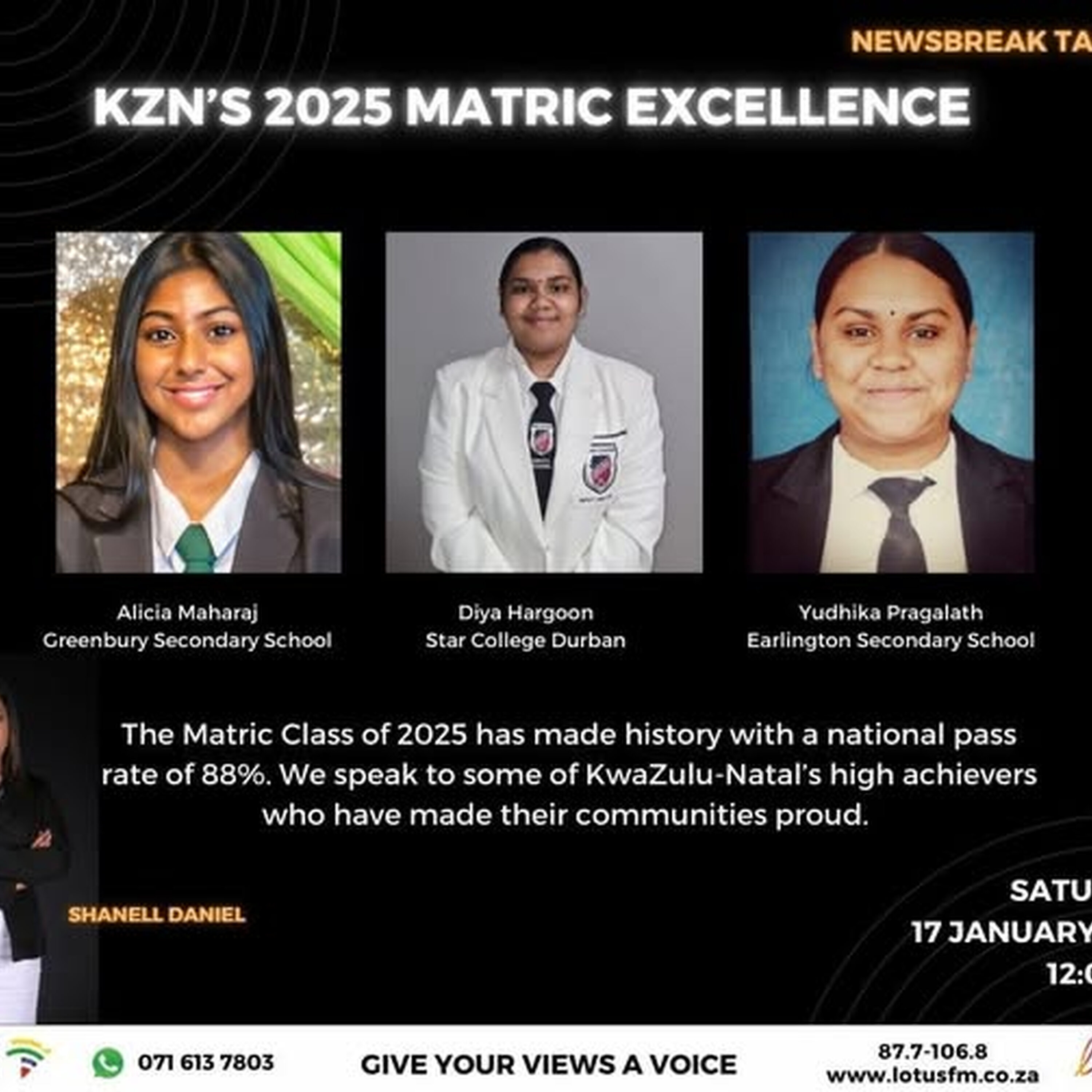
Despite many challenges the Matric Class of 2025 has bagged a historic national pass rate of 88% – making it the highest in the country's history. But, how did they do it? Top achievers, Yudhika Pragalath, Alicia Maharaj and Diya Hargoon provide insight into how they approached matric while Star College Durban principal, Ahmet Kayya, and deputy principal, Nurulan Khabsatar, explore the role school staff play in the academic success of learners...
Get every episode summarized
Each time Newsbreak publishes, we email you a written briefing from the transcript — the topics, who appeared, and any specific claims, with the ad reads skipped.
Email me new episodesFree for 3 shows. No card needed.
Transcript ready
456 searchable segments. Every word is indexed and playable.
Full transcript
Newsbreak — #PODCAST MATRIC 2025 HIGH ACHIEVERS SHARE THEIR SECRETS TO SUCCESS. Machine-transcribed; use the interactive transcript above to jump the player to any line.
Well, they've entered grade R in 2013 and faced the COVID-19 pandemic in grade 7, but despite the many challenges they have faced, the Madrid Class of 2025 celebrates the historic national pass of 88 percent, that making it the highest in the country's history, and all I can say is, wow, this is Newspaper Talk, I'm Chanel Daniel, welcome to the show. I have a very, very special show lined up for you today, and you know, considering, like I mentioned, the 2025 Madrid Class received a pass rate of 88 percent, the highest level in history in the country,
this follows the 2024 pass rate of 87.3 percent, and Quasulinertel achieved a 90.60 percent pass rate, and let me tell you, today it's a full house in studio, I have the privilege of being in the presence of greatness, that's all I can say, I am joined in studio by some of Quasulinertel's outstanding 2025 matriculance, and when I approached this school, I had no idea that I'd be having a studio full of girls today, but I am so excited about that, but for now, let me introduce you to my very special guests in studio today, I want to introduce you, first and foremost, to Alicia Maharaj from Greenberry secondary school in Phoenix, North of Durban, and at just 18 years old, she's already showing us how it's done. Alicia, welcome to the show. Thank you for having me, it's a privilege. Oh, so lovely and soft-spoken. Alicia, seven distinctions, can I name them? Sure. English, Afrikaans, Mathematics, Physical Science,
Life Sciences, Information Technology, Life Orientation, and an aggregate of 89 percent. Wow, how are you feeling? I'm feeling absolutely ecstatic. I really couldn't believe it before, but it's so amazing seeing that all the hard work and time that I put in, it really paid off, and that was so rewarding for me. Another great mind is sitting also quietly in studio, I'm not sure if she can see me, but she's done exceptionally well, 18-year-old, the Aharkun from Star College in Durban, but before we hear from the Ah let me tell you a little bit about this young lady, she received 11 distinctions. And an aggregate of 93 percent, and she's been placed first in case of independent schools. Dear, welcome to the show, maybe you can tell us what were the subjects that you had aced. Thank you so much for the opportunity, I had my distinctions in English home language, Afrikaans first additional language, pure mathematics, life orientation, physical sciences, life sciences,
accounting, business studies, religion studies, tourism, and IEBAB maths. Well, there was a mouthful, wasn't it ladies? That's a lot, and you all have done so so well, it's really such a privilege to have you on the show. I'm feeling so proud when I confirmed that 17-year-old Yutika Pragalat was coming to studio, just so happy to have her here. Yutika, you're from Arlington Secondary School in Phoenix, North of Durban, and she obtained six distinctions in English home language, mathematical literacy, life orientation, business studies, geography, life sciences, and an aggregate of 85 percent. Yutika, welcome to Newspaper Talk, how excited are you? Thank you so much for having me here, I'm actually really over the moon, so excited, it just feels so surreal. Knowing all the hard work, the time, the effort has paid off, it was definitely worth it. I think definitely a lot of hard work going into it, but you know, ladies, I wanted to share a secret with all of you today, I don't tell people a lot of secrets, right? So the year you entered
grade R in 2013, I did my final year in university, so I'm not as young as you guys are, so I'm sure there's a lot that has changed since I wrote my metric exams back in 2010. So tell me Alisha, what was the last 13 years like for you leading up to these excellent results? Wow, it's been such a journey, and I've truly been supported all the way from my primary school, hopefully. I've always tried to work hard there, and my teachers were always so supportive. Even during COVID, we had to do a lot of online learning, so that was very difficult as well, but we got through it with the help of my teachers. Even in grade 8, we had to miss quite a bit of days of school, but having to catch up from all those days, that was very difficult, but at the same time really rewarding. The grade 11 year too was so difficult, very similar to grade 12, so it was basically two years of grade 12 that we had to do, but at the end it was really all worth it. And it being worth it, I want to hear
your story about leading up to getting your results. What was that night like? How did you get your results? Did you go to the petrol station? Did you get it online? Did you go to the school? What was that vibe like? Yes, we did go to the petrol station to get the newspaper, because I wanted to hear first from the newspaper, not from anyone else. So it was really busy there, it was really hectic, and my parents were searching for a newspaper to find to see my results for the first time, and I had no idea what to expect. I'd hope for good results, but it was truly like way beyond what I was expecting, and I was so incredibly grateful, and it was such a pleasure. And you think your experience, is it similar? Was it more than you had anticipated? It was actually the same for me, I wanted to know first from the newspaper, I think I was also in for the experience of it, it was quite a journey. And yeah, 11 is, did that come as a surprise? What was that moment like? How was the family reacting? When I first found out it was because my deputy principal had called me,
in that moment I wasn't too sure, but at the same time I was sure. But that night of the metric results released, my friends sent me a picture of the newspaper, and the build up to finding my exam number, and you're looking at thousands of numbers, and you're not sure if you're reading the right number, or the right subject code, it was just, I wasn't a panic that night, but I walked into my parents' room, and I was proud to tell them that I had received all 11 distinctions, and I told them, don't tell anybody, but they were so proud, they just had to share the news, and it was just so amazing. Wow, such an amazing experience, I'm sure, for all three of you ladies. Dear, tell me, what made you take on 11 subjects? Oh, my mom actually, so at the end of grade 9, I just wanted to choose the standard S7 course, physics, bio-accounting, and maths, but my mom said, no, you can do more. She knew what I was capable of, so she made me take 13 subjects, and at first that was a bit much, so I dropped two, but my 11 subjects, I would say, I managed them quite well because I had the support of all of my teachers. I wasn't alone in my journey. Okay, so you started with 13, you decided to go with 11, and you passed, and did exceptionally
well on all 11. Basically. Wow, okay, okay, okay. Okay, so Yutika, an 85% aggregate, really not easy to achieve. I wonder, what was your matured year like, your grade 11 year like? What was some of the challenges that you had experienced? So throughout the year, I would say my matured year, it was actually a very long journey. I mean, with the amount of time we've given, it was not something easy to manage. Basically, what I used to do, and what led me to getting these results were making a study timetable, as silly as it is sound, you know, teachers telling you continuously, make the study timetable. So I actually sat down and I did it, and if I tell you how much it actually worked, it allowed me to allocate subjects I needed to prioritize and actually worked on it, and that is actually what led me to getting my six A's. Wow, fantastic. You know, I really want to unpack some of those challenges. You're talking about how you approached your matured year, sharing what this year, 2025 had been like, oh, you so when we come back, we really dive deep and get
into some of that nitty-gritty. Stay tuned. Well, it's Newsbreak Talk. Chanel Daniel, welcome to the program this afternoon. If you've just joined us, we have the privilege of being joined by three lovely young ladies who have excelled in the 2025 Michik examinations. I'm talking about Alicia Maharaj. I'm talking about Dia Hargun, and I'm talking about Yutika Pragla. So there's a lot that I want to unpack with these three young ladies today, just to get into their minds and how they did what they did. Really doing their community so proud, but I'm sure that there's a lot of academic pressure. There's a lot of expectations. Michik examinations are very high stakes, and a lot would say that they determine your future path. I wonder, Alicia, was that something that was in your mind persistently?
Definitely. Throughout this entire year, actually, I mean, we've constantly been reminded by teachers that this is what everything is built up to. So there definitely was a lot of stress that we had to encourage throughout this year. However, I've been able to manage and overcome that with the help of my family, my friends, and also just finding things that I enjoy that keep my mind off that. Talk to me and let's unpack that word manage. How did you manage it? Because it's a lot, and I think overwhelming at times isn't it? Definitely. It can be. However, there's a lot of meticulous time management, a lot of prioritizing and deciding what subjects you should put first and how you should manage your time there. Also, like I said, a lot of it had to do with getting your foundation in grade 11, and I was lucky enough to have an amazing tutor throughout both grade 11 and grade 12 who guided me throughout these years. And so with that
foundation, it was a lot easier to go into grade 12, with less stress knowing that I had that background. And dear, I wonder from your side, talking about that foundation that Alicia had mentioned, was that something that you had to lay in grade 11 leading up to that pressurizing matriccia. And we got to our matriccia. We were calm. We knew every teacher told us this is the make or break here. But we were also confident in ourselves. So it wasn't as stressful as what I think people would have said to us. I think I would use share those sentiments. Was it not as stressful or was it more stressful? Because I think a lot of times we put a lot of effort in your grade 11 year and your matriccia would be smooth. Was that your experience? As much as grade 11 is an imperative year, grade 12 requires so much from you. I mean, we have so much time, we have almost doubled the syllabus to cover in such less time, extra classes, the such
classes, you know, all our teachers' hard work. So it does take a lot at the end of the day. There was no time to mentally relax or even physically relax. So yes, I would say grade 12 was a bit harder than grade 11. Talk to me about that because it sounds like a mental and emotional strain. What was some of the things that you felt emotionally or in terms of your stress, if you could make it more tangible for us to understand? Emotionally, it was a lot. I mean, there was a lot of pressure to meet these expectations. Was that internal pressure or from those around you? Mine as well as others, but honestly, it would have been more for myself. There was a lot of pressure I put on myself just to achieve what I wanted to. Okay. And Alicia, from your side, when it came to that stress and anxiety, was there ever, and I actually dare to say this in the presence of you ladies because, you know, I don't want to say a fear or failure because you're so
exceptional, but was there ever a fear that you're not going to do as grade? What was that stress like? Yeah, definitely. There was a lot of doubt or uncertainty at a time. Definitely throughout the year of grade 12, it's not always, you know, improving each time. You can have regression and you can have setbacks. But for me, it was mainly not putting my mind towards that and not letting that consume me and just moving forward to the next best thing because I didn't want that to in any way harm the platform. Yeah, I wonder, you know, 11 subjects. Did you, at any point, doubt yourself? What was going through your mind as you were studying? Was there anything that you maybe were struggling with? Well, it was hard to balance the time and allocate to 11 subjects because when you finish school at three, you have after school tusions, by the time you get home, it's not exhausted. You just want to get into bed and go sleep. Sounds like a full-time job.
Yeah, it was like full 75 every single day. Yeah. So finding the time to study for all 11 subjects was a bit exhausting. Sometimes I would just have to leave it till the night before and pray for the best. When I walked out of the exam room, my parents would ask, how did it go? I would just say, we don't know. Just wait for the newspaper. Don't expect anything. Okay, ladies, Alicia, did that ever go through your mind? I'm not as prepared as I'd like to be and walking out of that exam, sinter thinking, oh no, whatever I done. It was ever easy for any of us walking out of the exam room. I mean, you're full with a bunch of learners and everyone wants to discuss the paper. And I always try my best to avoid that because the last thing I wanted was to consume myself with what I could have gotten wrong or what I could have done better. So a lot of the times I would, and I also found a very great group of friends who supported me in that and helped keep my mind off that. So there was a lot of that, but I definitely tried to focus on moving forward through each
exam. You know, you touched on something that I want to take further with Yudhika. The value of friends during your matricula, I know quite often there are some matriculants who say, you know what, I was quite isolated or there was a lot of peer pressure. So I had to just exclude myself from the group for this time being because of my future. I wonder what was your experience when it came to that? Was there the support system in terms of friends? You came out of the exam room and you're like, what did you write in this answer? What did you do here? What did you do there? What was your experience? Okay, so I think that is always the case after every single examination, this whole bunch of friends, what did you write for this answer? What did I write for that answer? And closer to my NSE exams, I tried to avoid that at all cost because I just tried to leave what I wrote, what I learnt in that same exam hall, focusing on what was to come, because a self-doubt is a huge thing. Yeah, and I didn't want it to affect what was ahead of me. But you know, and I remember back
writing matric exams, as much as there was time to prepare, it never seemed like it was enough, and the 11 subjects, I'm sure, you know, as you mentioned, you felt all that pressure and stuff, so did you find that you needed more time to prepare? Do you think maybe that's something the department needs to take into account? Yes, I do. When I finished my trial exams, it was I think the second of October, and my first APMATS paper was on the 16th of October, so after trials, I just wanted to sleep for like one week, but you start finals, two weeks after that, and it's just not enough time to prepare for 11 subjects. So I do think the department should take into consideration how they're planning out their timetables. Alicia, you know, we're talking about some of your peers, and while I don't know what your specific experiences have been there, Alicia Yiddhika, I know there are learners at school that experience, you know, socio-economic factors,
or when we look at the department of education, and they're being in many schools, a shortage of educators, a shortage of resources, we're talking about some learners coming to school hungry, because the food program maybe was not, you know, active or efficient enough. I wonder if you could share, although we're talking about you, it's important to touch on these things, because these are your peers, right? So Alicia, if you could maybe talk to us a bit about some of those challenges that the class of 25 had experienced. Yeah, definitely. I know, especially this year, there was a huge decrease in the amount of teachers that we had, so a lot of learners were left without teachers in their own schools, or having to maybe attend institutions for that. There were also a lot of learners, like you said, without lunches to be able to go to school, and that was, you know, a really detrimental thing that we've had to experience this year. Yeah. And Yiddhika, on your side,
you know, when it came to some of those challenges that your peers had been facing, how did you watch, you know, your school and the community come together to help resolve those issues? So I think one of the issues that we did experience was definitely how some of our peers were expected to the household chores at home. So with that, I think what Arlington had implemented, I mean throughout all these years, the after classes and the Saturday classes had definitely helped them, especially pull through and help them achieve, you know, these excellent results. When it came to the community gathering together, I know that, you know, at your school, communities were very important. So what roles did that play in you, you know, excelling and your peers as well? Well, I would say stock knowledge were a community, but we're also a family. So
when it came to peers, we're also supportive of ourselves of each other, sorry, whether you had one A or six A's or 11 A's, everyone we're just so proud of each other, we're so happy to share the news with our families and their extended families. And the teachers, well, I would say that, especially in the metric, our teachers, they gave it their very best, they gave us their all. I'm not sure on other schools, but in stock college, our teachers give us their personal phone numbers. So sometimes I would just message a teacher at two or three in the morning asking for help, and if the teacher was up, they would respond and they would call and they would help you. Everybody in stock college, we're just so supportive of each other. Yeah, Alicia, you know, they are talking about relationship basically, and I think at school level, although you have your educators and there is that level of respect, but I think there's also that level of relationship. Did you have that with your teachers where you were like, sir, ma'am, you know, this is difficult or I'm finding this challenging. How do I do this?
How did I do that? What was that access like for you? Definitely, especially at my school, I had such amazing teachers to go to, not just for academic issues, but just for personal stress or just helping us, you know, take our minds off academics for a while and focus on ourselves. Yeah. So that was really amazing to have with the teachers, both at Greenbury and my tutor, who I could go to for anything and he had an answer to all my questions. So that was really great to have them as a support system throughout this entire. And Yutika, on that point of, you know, a support system, I want to go a bit further from school to talk to your but about family, because at the onset, you were talking about family. So I think that's quite important to you, am I right? Okay. So tell me a bit about that family support around you during a matured year. What did that mean to you? My family support was everything to me when I was burnt out about like giving up the idea to remind me why I wanted what I wanted. And I think
just the words of encouragement telling me to keep going and you know, telling me is going to be okay, reminding me why I should always believe in myself. I think that was just so important to me and that was my leeway into achieving this with us. My mom always told me before any examination or test. Even in days, I was not writing to always believe in myself as much as she believes in myself. So that did go a really long way and I really appreciate my family. Yeah, you mentioned, you know, your mom saying, you can do this. You know, you are capable of so much more. What was that like for you knowing that you had that kind of support backing you? It was, well, my mom has always been there for me. She is my pull of strength throughout my entire schooling career. I wouldn't just say in metric, especially. She would be printing out study guides and other helping materials for me throughout the year and I would tell her, no, it's enough now.
But she would just be so worried about me because she knew that if I walked out of a paper and I wasn't happy, it would affect me for the rest of the exams. So I would come out and she would tell me, it's okay, just cry. Even if you fail today, you've got the next one, you'll build it back up again. My mom, I think I stressed out more. I felt like she was writing the exams, but my mom was always there for me. Alicia. Yeah, Alicia, you know, you're actually smoking in the eye and saying it's as if they were writing the exam. Did you have that experience? Yeah, definitely. My parents were there for me throughout and just constantly reminding me as well to take breaks for myself and stop studying at times and stop overdoing it. So yeah, they were a huge part of that and also just constantly checking it on me and making sure everything's going well. Yeah. Do you think you're nodding away there just talking about taking those breaks? Well, is that something that, you know, you struggle to do because you wanted to do so well?
Yes, definitely. My parents always told me to go to sleep. It's so late. It was constant. I mean, in my head, I just wanted to finish what I put my head on to. It was crazy. Wow. And, yeah, before we go to an ad break, it sounds like you didn't have any sleep, isn't it? No, actually, in my metric here, the one thing I valued the most was my sleep. Oh, lovely. I'll get along very well with you. I believe that you can't write a paper unless you're well, writing it to the least six hours minimum of sleep. So I used to make sure I got plenty of sleep. If it meant to have to stop studying and go to sleep, that's what I did. Okay. My parents were worried that I slept too much throughout my metric here. Okay. So it sounds like you guys had a lot of balance. And I think, you know, as the program progresses, I do want to get into that and then also speak to some of the principles here at DFUTs joining us in studio to talk about
metric from that perspective and leading the class of 2025. So stay tuned. Well, welcome back to the program. This is News Freak Talk. I'm Chanel Daniel. Let's go now very quickly to our WhatsApp line. I know there's a lot of messages and voice notes coming through this afternoon. Just before we speak to some of those heads of, you know, the secondary schools just to give us some insight on what it took to get the class of 2025 to where they are right now. I want to go to a message now. I think it's from Raj and Raj Kumar in Cape Town. He says, I would like to thank all my teachers for building a strong foundation for all the matriculants who excelled in 2025. Congratulations to all the matriculants who have done so well. A message from Rani in Stangham and is saying, we can only applaud our high achievers and tell
them how proud we are of each one. One phrase that stands out here is, hard work never fails. Keep up that positive attitude and pursue your dreams. Someone here asking about the girls' names. Okay. Alicia Diyar and Yudhika. And one voice note I think coming on the program this afternoon, let's have a listen. Hi to general Daniels and to the rest of our listeners. Congratulations to these high achievers who have obtained several their distinctions. You have done as proud. And to all the other scholars who have achieved the university exemptions, except for our granddaughters, CNN, the NFC, and the rest of the world. Guys, you have made it and you have also done as proud. You are really happy about the congratulations. We love you. Roy Simpum Stangham. Wow Roy. Congratulations there to those in your family that did so well in
matriculant. I want to now go to my next guests on the program this afternoon. You know, Starcollege Durban is one of the schools in the province that is setting the bar high for excellence. And we've seen this with Diyah Harkun who you have been hearing from on the show who is joining us in studio. But of course, while learners put in a lot of effort to excel, teachers and principals also play such an integral role in learner success. And we even hear this from the Department of Education. How important this is. So joining us in studio is principle of Starcollege Durban. I'm at Kaya and Deputy Principal Nurelland Kavsita. Am I right? Okay. So welcome to the show. Thank you. It's wonderful to have both a few here. You know, Mr. Kaya, principals and deputy principals play a critical and multifaceted role in matric success.
You really have to deal with the administration of it, but you also have to really be able to connect with the learners. Am I right? Has that been your stance on how to handle the matriculants? First, I would like to turn into everyone and thank you for this opportunity and I would like to congratulate Alicia and Yudhika as well in the achievement. Yes, I mean, achievement comes all together with your learners, with your parents, with your educators and with your management. As you said, you need to make, I mean, school running at the same time, but your matric results, your matric classes are always important. You need to connect with them. At this point, I find it important that your management team is quite important. So if you work for the same same reason, all together, and if everyone is passionate enough and you don't have all the
load on your shoulders as the principal as the head of the institution. That's why I mean Mr. Nurlan had of the girls high. We had last year Mr. Karajan had of the boys high. Mr. Kajada, who is running the matric examinations, the whole SMT, we worked very well together. So that connection comes with the parents from the first meeting to the last and all of us trying to teach our learners and not to stay in our offices. So it also builds the relationship with our learners. You know, Mr. Nurlan, talk to me about that relationship, you know, having that connection, like when we spoke to the young ladies earlier, they said they had that connection with their teachers where they could approach them. And I understand that at Star College Durban, you have a specific program to help learners boost their performance, especially
in their matric year. So talk to us about that and that interaction with the learners. Good afternoon. Thank you for giving us this opportunity. So I think it now becomes like a more established culture in the school. We try to try our best to have like a good relation with our learners as well as the parents and build up that relation so that they feel free to communicate, especially in a higher grades. Like, you know, Dia said they have the phone numbers of our teachers and they can, you know, communicate with them anytime they want. What was that decision like to give out your cell phone number? Was it fear related to that you're going to get calls all the time? Well, it's in fact not official decision. Okay. So like more of it, I think it's the established culture I can say. We don't, we never get like official decision of, you know, giving the so it's by teachers free well because you care so much. Yes. So, you know, it, it became like, you know, how can I say, like I said, established culture. So, you know, in the past they did. So
it just carried on other than that we never had like official decision to, you know, give the phone numbers to our parents or learners. Yeah. Mr. Kaya, Mr. Norell and just mentioned communication. And I think I was just taken not even to my time in school, but I remember some family members saying that when the older ones, when they were in school, teachers were strict disciplinarians. There was no open communication. There was a lot of discipline. What makes you as a principal want to change that approach in schools and have this open communication and a relationship with students? At this point, actually, I can say we, I mean, still trying to keep the same discipline environment at our school. However, one is not a conflict for another. So as long as the learners know how they can keep their relationship with the teachers in a polite way, in a restricted way,
I mean, they can only approach the learners to teachers. Sorry. When the teachers are available and only for their academic needs and I mean, when it is for their education, not every time to bother them. And they know this as Mr. Norell and mentioned that culture was established day. So the learners are aware that they should not bother the educators for anything not important. Only for important things, as they mentioned, like if they have, like say, some questions that they struggled, only those times, they try to communicate to them. And in this aspect, educators also accept this. So they don't become hesitant to give their numbers to the learners. You know, talking about educators, I want to talk about the importance of developing and empowering
stuff because, you know, quite often, I mean, my line manager is here today. So basically, we perform as good as she is and we're performing very well, by the way, as New Strike Talk. So applause to her. But, you know, your learners do as well as your teachers equip them to be. So how important is, you know, developing and empowering your stuff? I have a good relationship, I guess, with my educators. It was also mentioned yesterday afternoon when we had the metric results celebration at our school. So one of the teachers was talking to the circuit manager from the Department of Education. I mean, how our stuff is connected to one another, how in the mornings, I mean, one grid to another, everyone talks to another. I mean, they start
positively to the day. So that is the first thing. But obviously, most of our educators are the experienced educators. I mean, they've experienced of many years and they've been at that metric level. They had so many metric classes they taught. And obviously, from our school's perspective, we always try and acknowledge and appreciate the efforts when they get good results. When we talk about challenges, Mr. Nurlan, challenges for educators, challenges for learners, what was the approach like and how do you break that down to resolve those issues? Because as much as we can at many times, whether it's, I know that you're from an independent school, but as an educator, you would understand in the country that there are many challenges that the Department of Education faces. So it's kind of up to schools, up to principals, up to teachers,
to make do, to shift the environment in a school. So how do you do that? As deputy in your school, when it comes to dealing with those challenges within the education system and ensuring that your learners excel despite those challenges? Well, we don't do anything like, you know, out of ordinary, it's a common solution. So the main thing is, I think, with parents and with learners and as well as the school, we work with towards the same goal, you know, we are all on the same page. And obviously, none of the schools are, how can I say, perfect. We all have, you know, our challenges. And as long as even with our differences, you know, we all work for the same goal, especially for great 12s, our goal is, you know, achieve. Parents want to achieve, learners want to achieve, as well as the school. So that kind of overcomes many of our challenges.
And we also, you know, try to invite our old medicalans as well to give the motivation speech and assemblies and, you know, share their experience as well, especially for great 12s. And we also try to invite officials from the university as well to give them, you know, some kind of experience. Beyond school. Yes, definitely. Some even, certain professional people in certain careers, successful people in certain areas, they also are invited as well to give them their side of story. So I think with those kind of things, we overcome our challenges. Again, it's impossible to be like, you know, challenge-free. Yeah, we always have a worry until the last announcement. Wow, okay. And when the metric results announced, we always take a long way. Like a sigh, and then you go to the next lot of machines. And then we start preparing for the next one. Okay. But you, you know, you said a powerful statement there. You have the same
goal. Yes. So, you know, dear Yutika and Alicia were talking about family support. The support they got at school and the community. I think from a school board perspective, how important is that we could call it a triangle between the learners, the community, the parents, you know, how important? Well, it's very important, you know, without having the same goal, it's difficult to achieve at all. So we all need to have the same goal. And over the years, you know, we also try to have like, you know, social activities for the parents as well to get to know each other so that they feel free to express themselves. Sometimes, if you close the channels, you know, they don't communicate. Right. So we try to, you know, do those ice breaking activities as well with our parents, especially when they're first joined us in grade eight. Dia has been with us for a long time since primary school. Okay. Yeah. So the ice is important. I think it's quite important
that, you know, and then you try to be very accommodating as well and listen to them as well. Right. And obviously you can't solve all the issues, but you try your best to resolve as much as you could. I think just to wrap up, Mr. Kaya, if you could, you know, as much as we're talking about the successes of the 2025 metric class, Mr. Nurelland, and I was just talking about how it's onto the next one now, right? So the class of 2020-66, your advice. Class of 2020-26, yeah, we already started. And I'm teaching the girls high learners this year, mathematics. I already gave them, we set together our own goals with the group of pure maths learners. Next week, we will have our parents meetings with our grade 12 learners. I just wanted to first add quickly to the previous point. Our first very first meeting with our grade 12 parents and
learners. It's compulsory for all. And we made it a very, I mean, lengthy meeting, which we discussed everything about the metric here. And from there, you can see the parents full support is always there. And sometimes even we must tell our parents, hold on, leave the pace to the learners. So what I kindly advise to the class of 2020-26, not only our school for the whole country, which I always do. I mean, the past papers, obviously, is important in this stage academic-wise. And on the other side, they must always find something to get some relaxation from time to time. They have mentioned that the sleep is important at one stage. So they must not be always bothered with academic studies, study studies. They must find something to relax themselves so that they can continue to fresh once again. Sounds like balance is very important, isn't it? That was
Star College Durban, Principal Ahmed Kaya and Deputy Principal Nurlan Kavsata. Thank you so much for joining us on Youth Rake Talk. You know, we have a lot of messages still coming through on the program. If, yeah, if we could just quickly go to some of those on the program this afternoon, I have a WhatsApp voice note here. Hello. Hi, Newsweek team. It's Principal H.H.A.T. Unions Rest. Congratulations to all our high achievers, all our matriculants of 2025. I'm always clapping for them. So well done. To all the the high achievers, our guests in the studio. Remember, the odds are always stacked against us. And this is our time to shine. Thank you, Priscilla, for your contribution on the program. Another voice note from Ranjini Reddy. Hello. Dr. Munshanel and your lovely team for your hosts, the top achievers of 2025. There's so much
that they have achieved. Set the goals apart. And also, excellence strived to excel. God's blessings over each one of them. Our play God's desires be upon them. And whatever they looking and searching for, they will achieve their goals and add a jewel to their crowns. And stay blessed, my darlings. And go for it. God is your refuge. God is your strength. Uploft your bene. Shalom. God bless Ranjini Reddy. Cool end out. Thank you, Ranjini, for your contribution. One more voice note very quickly from Patsy Governor. Hi, bubbly new speak team. You're a year to the class of 2025. Well done to the students and the teachers and parents and to those that did not make it, do not stress up. Remember, try and feel feel to try. Thank you, new speak team. Have an awesome day ahead of you all. Well, thanks there to everybody who contributed on the program this afternoon.
I know the young ladies are back with me right now. And they were quite happy about all the messages coming through and all the support that they've been receiving. You know, it takes it takes a really jump shore just to get to, you know, these kinds of achievements. So I want to actually talk to you young ladies. We've spoken enough about metric now. So I want to know about the future. I hear that there are some big plans. Alicia, what are your plans? I will be studying astrophysics at UK's at end. Okay, why? I've always been really passionate about mathematics and science. So I feel like astrophysics really fits well into my passions and it's a good way to challenge myself. So I'm really excited to get started with that. Wow, that's wonderful. And you think I know you have a passion. You know, having been in the education system now, you want to play your role and contribute to it as well, isn't it?
Yes, definitely. Tell me about that. Why is it so important? And tell us what you want to do officially. So actually from a little girl, great R, I've seen my teachers even throughout high school. It's just so astonishing to just watch them and do what they do. Yeah. So teaching has always been my passion and I'm definitely going for it. I will be diving into my Bachelor of Education degree this year at UK's at end. Teaching is for me. I want to inspire those young minds and education is a great story. I don't know if this makes sense, but you look like a teacher. You have that, you have something about you and do you want to go into secondary or primary? I'm looking into secondary, but honestly teaching, it's just a feeling I'm sure will be worth it. Yeah, definitely. I know you have a lot of plans. I think you're going to help us medically, isn't it?
Definitely. Okay, tell us what are your plans where will you be studying? So I will be doing my NBCHP at the University of Cape Town. I hope to further specialise one day. So that's what my plans are. I'm going to be the first doctor in the Harsh Goon family. Wonderful, wonderful. You know, all exceptional careers, I think you'll definitely be making a mark in your communities, in your families and you know, as much as we talk about equality in our country, I think there's still a disparity. So to see young women going after what they want and achieving that is quite exceptional, I want to talk a little bit to you guys. Just as we wrap up the program, we have like three minutes left. Yithika, you were talking about timetables and how you managed it. You mentioned that you slept a lot and that helped you and Alicia, you were talking
about having that brakes that your parents advised you on. But I think just some tips, some advice for the class of 2020-26, you know, who might find themselves procrastinating or not believing in themselves and struggling to navigate how to go about the matricia because, like you mentioned, there's so much of pressure. So if we could start maybe with Dia, can you tell us, you know, what would your advice be to the class of 2020-26? Stay consistent. I mean, matric, it's a marathon, not a sprint. I would say to the matrics, even if you do find yourself doing a lot of day before studying or procrastination, don't beat yourself up about it. Sometimes you just have those days, you need break days throughout your matricia. It mustn't be all about academics, find a good balance between your social life and your academic life. Alicia, your advice? Yes, I would definitely advise to firstly start now. It's going to be a busy year, so I would
advise to start now and just, like she said, stay consistent. Stay consistent throughout the year, keep in touch with your teachers and just always ask questions. Like the moment you don't understand anything, you know, your peers around you, ask your teachers and yeah, and find something that you really enjoy doing and stick to it throughout the year. I will carry you through it. What was that something that you did? For me, it was music. Music really carried me through this year through the finals, so that was something I spent a lot of my time doing. That's music. And you think maybe, you know, as a teacher, if you could break down that timetable for us? So definitely, I mean, this was the first week you're back as matrics. I'm sure it's already been a journey. Yeah. Get those study timetables done as soon as possible. I promise you, I'm sure throughout your grade 11 year, you've had subjects, you know, you wanted to work on, but to keep procrastinating. Sit down, I mean, with AI and stuff so big these days, definitely make use of it
and make your study timetable. I promise you, it will be so worth it. And just to the class of 2026, as I'm saying, matric, it's one of the best years of your life, but also one of the most like the worst. So just make the most of it and embrace every single challenge as well as the happy moments. You'll never get this back again and believe in yourself, put in the work and I'm sure it will all pay off. Definitely. I think some great and solid advice there from the class of 2020-25. Thank you so much for joining me on the program today, Alicia Maharajitika Praglat, Dia Hargun, Principal Ahmed Kaya and Deputy Principal Nurelland Kapcita from Star College in Durban. Yeah, unfortunately, that's our hour for today. I want to thank our guests in studio again and wish them a blessed and successful future. This edition of Newsbreak Talk was brought to you courtesy of executive producer Salma Patel, senior producer Tarish Haripashad and
myself Chanel Daniel. From my side, have a safe and blessed Saturday afternoon. Newsbreak Lotus FM powered by SABC News
More episodes
More from Newsbreak

#PODCAST Zero tolerance drinking and driving proposal welcomed by SANCA
Newsbreak

#PODCAST Sunday Times Editor S'thembiso Msomi pays tribute to renowned South Afr...
Newsbreak

#PODCAST The Association for Alcohol Responsibility and Education (AWARE.org) st...
Newsbreak

#PODCAST While many fear that their land will be taken away from them, experts s...
Newsbreak