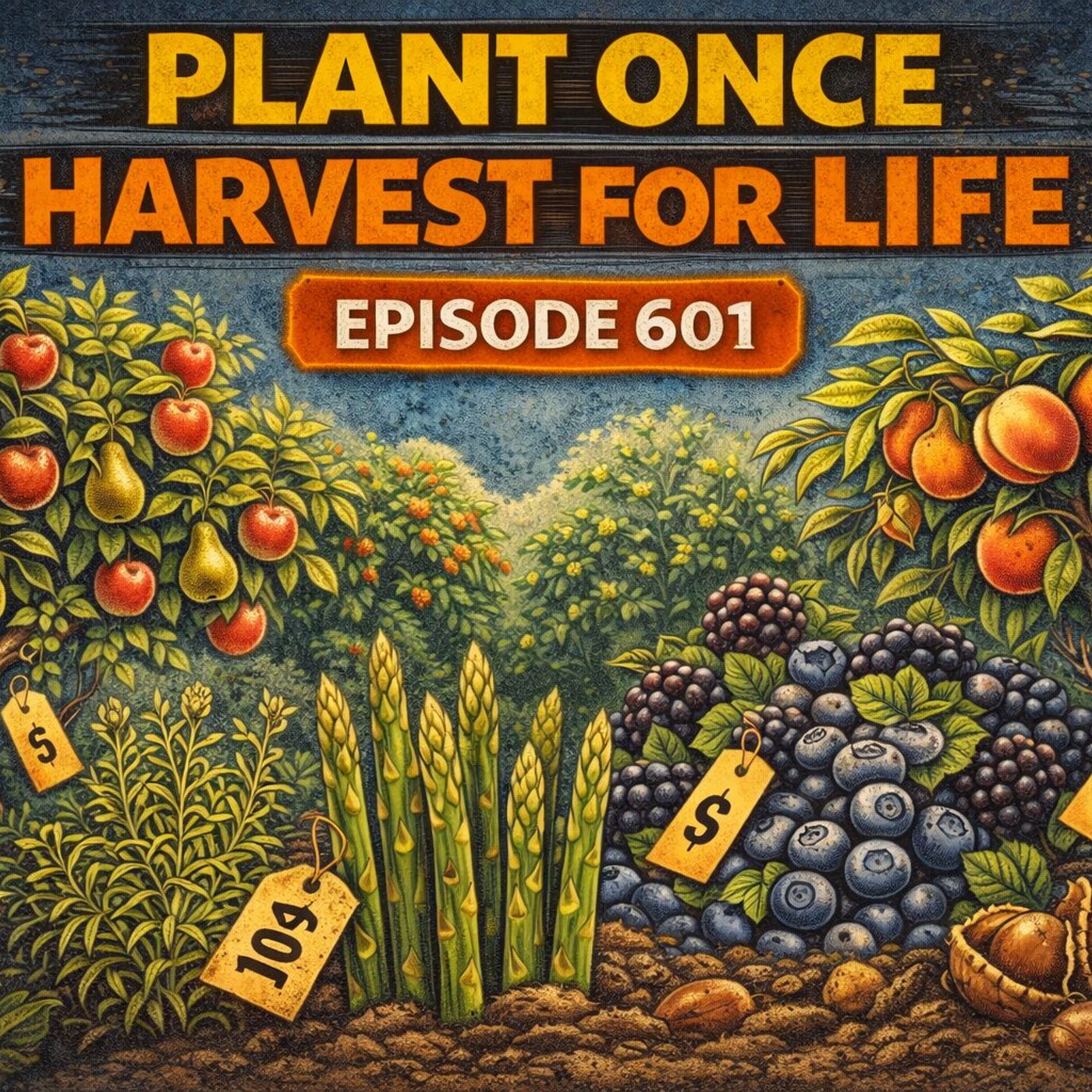
About this episode
Want To help make sure there is a podcast Each and every week? Join us on Patreon Subscribe to the Survival Punk Survival Podcast. The most electrifying podcast on survival entertainment. Like this post? Consider signing up for my email list here > Subscribe Join Our Exciting Facebook Group and get involved Survival Punk Punk’s The post Plant Once, Harvest for Life | Episode 601 appeared first on Survivalpunk.
Get every episode summarized
Each time The Survival Punk Podcast publishes, we email you a written briefing from the transcript — the topics, who appeared, and any specific claims, with the ad reads skipped.
Email me new episodesFree for 3 shows. No card needed.
Hosts & guests
Transcript ready
276 searchable segments. Every word is indexed and playable.
Full transcript
The Survival Punk Podcast — Plant Once, Harvest for Life | Episode 601. Machine-transcribed; use the interactive transcript above to jump the player to any line.
Hey, it's James from SurvivalPunk.com, good morning. It is a slightly chilly morning, and I am not super running late this morning. I got my shit together where I'm leaving the door more or less around the right time. Today we were talking about things you can plant once in harvest for life. The other road bunny, you can harvest that bunny perennials that you can once you get them established, you'll be feeding yourself for the rest of your life or for quite a long time. Couple of these things don't actually last forever, but long enough, and if you establish another round, you can mitigate that. Before we get all that though, let's take a look at our morning theme music.
And we're back. Okay, we obviously know that growing food is a very important part of being a proper or a survivalist, unless you are a fucking retard and you're like, I'm not going to bother growing food because then when the shit hits the fan, the roving gangs of motorcycle people will see my garden and come murder me. If you're that person, just turn it off. Just stop listening. I'll have time for your retarded ass. Otherwise, keep listening. However, gardens are a lot of work. They certainly can be. Wouldn't it be nice to have something that you basically just set and forget what we're talking about today? We're going to start with talking about trees. Fruit trees.
Because later we're going to talk about nut trees. It is really foggy this morning. And one of my high beams is pointing at the sky, apparently. That's great. Or one of my not high beams. I'm going to need to adjust that. Anyway, fruit trees. Obviously, for any of these things, grow what you'd like. And if you don't know, you should probably try it. If you don't like anything, grow something and barter it. I don't know. Grow something to lure in the deer, but surely there's something you do like. And what I mean by that is, so apples trees, pears, plums, is it cherry tree, George Washington cut up cherry tree, supposedly. So apples, pears, plums, peaches, so that'd be the peach nectarine, your stone fruits
in general. I would grow a variety of each of those, obviously depending on space constraints and flavor, right? So and and hold on, you're not constrained by the same constraints, obviously, that your local grocery store has. So you don't have to grow a red, delicious and a granite. There are thousands, if not millions, of apple tree variants. So yes, you should absolutely grow what you like. However, there is there is some room to to kind of think outside the box to at least not be a boring bitch. I would I would probably so if you have enough land, some of this doesn't even it doesn't even like matter, right?
If you're establishing like 20 fruit trees to have like three experimental ones or five of experimental ones, it's not a big deal, right? I know recently I've had people asking me in my daytime job, which deals with a lot of fruits and vegetables and meat, but mostly fruits and vegetables. There's a new apple going around that has a pink core on the inside, so the inside is pink, not the core, but the whole inside, instead of like the white beige flesh, the meat, the inside of the damn apple, it's a pink color. It's called like a rose, rose apple or something like that. I forget the name of it, but I've had people asking and I've had to look them up. I would I would try to find a way to go sample some of these apples, right? If there's a farmer's market going on or you can even maybe look on eBay, I bet someone
is like nicely packaging and selling and shipping some of these, if you're going to grow one of these fancy things, there's no reason not to throw like the ability to sell it on like eBay. Sample some of them, right? Like maybe you're like, oh man, my there's a black flesh apple, so the skin is black. It looks gorgeous and a purple one. We're looking through, what is it, maybe it was the Baker seed catalog, but I got one of those like last year, like the rare seeds catalog. Some of those apples look fantastic, so the reason I'm talking about this, obviously not because it's a great survival topic, but we are moving, we will finally have land to be able to plant some of these things, and this is fairly soon. I want to get my perennials established, obviously the time to be planting these is yesterday,
so as soon as you can get them in the ground, the better. There's optimal times, but also there's just get the shit done, right? If you can trust some of these, and if they're great, you should plant them. Like I said, with that, you also have some ability to make some extra money there, right? You have enough of them, you sell them in your local market and you sell them on eBay. You can get, for some of these, if you're selling, if you're growing like Granny Smith and Regillicious apples, and you're taking those to like the farmer's market, no one gives a shit. You go to the farmer's market with those rows, apples, or you go to the farmer's market with a black apple, you're going to sell them. There's no way you're not. You might not just sell out, but you're going to sell your apples.
You can walk by a table with Granny Smith apples, and you're like, it's Granny Smith apple, and you're going to have to charge more than the grocery store, right? You at the farmer's market cannot compete with Walmart on a Granny Smith apple. You just can't do it. It's not worth your time, so that's dumb, right? There's people that do it. There's absolutely people that do it, and the thing you are kind of getting is you can market your apples as being a better quality, fresher apple. The apples in the store are not fresh at all. They sit in a warehouse for a long time on your cool storage, a long time. You're kind of able to entice people, right? But at the same time, everyone that looks at your Granny Smith apple is going, I can get that from Walmart or Kroger. I know it's better, but it's a fucking apple.
You walk by and you see a shiny black apple. You're like, have you ever seen that before? What does it taste like? I've got to try this. So based on novelty, if you can get repeat customers with flavor, though, even better, but grow the fucking weird apples. If you fucking love a Granny Smith, plant a Granny Smith. Or two, right? But don't go all in on fucking Granny Smith apples. One, if you have a monocrop, you invite some, like, if there's something that attacks that specific variety, then you've lost all your trees. There's a bunch of reasons not to do that, right? But I really feel like you're just leaving money and flavor on the table by growing the same bullshit you can buy in the grocery stores. Let's move on to the next thing. There's a lot of pairs. Grow the ones you like or grow some experimental ones, right? I really think that as you're planning your system, you should be thinking, yes, this
system is being put in place to feed me, supplement my food, in case it should hit the fan. I have a lot of, I have a lot of poor and nails that I can harvest from, but also can it provide money and benefits now? And that's where specialties come in, you know? I want to say, if I should name five kinds of apple, pretty much everyone is going to be able to name five kinds of apple, you know? Red delicious, Granny Smith, Golden delicious, Gala, Honeycris, bam. You can name like five apples at the top of their head. I could easily name five more if not ten more. I deal with a lot of apples. I could probably also name most of their barcode numbers, the PLU's, is that produce, look
up? Anyway, product, whatever the PLU means, yeah, go ahead. But if I tell most people in a name, five kinds of pear, I think they would struggle, right? I feel like most people would struggle. And there's definitely, there's definitely some taste experiences, right? I've tried, I've tried several. I want to say, if you've ever eaten up a pear, probably what you've eaten is a Bartlett. That's your typical green pear, the Golden one is a Bosch. You've probably had one of the two. The Asian ones are pretty good. There's a Donjou pear. It's pretty good. There's a red pear. Anyway, it's called red pear. I'm not just saying the colors, no, it's called red pear. Anyway, grow a pear, grow a pear, um, peaches.
I fucking love peaches, um, so grow, grow, grow some peaches. Peaches, plums, nectarines, we're just going to love all that together and move on. I feel like plums don't get quite the respect they, plums are delicious, um, there's a lot you can do with plums. And there, so there's a lot of ways, also, then maybe I should do an episode on preserving fruit. You can, um, the Japanese do a pickled plum. It is interesting to say the least. Has a lot of flavor. I can't say that I love it, but definitely has a lot of flavor. It's okay, um, you're not, it's not for snacking on, right? Um, if you, if you put it with a food, it imparts a lot of flavor to that, because it's salty. It's real salty and it's real sour, um, which is a unique flavor combination. And if you're mixing it in with something that's like fairly unseasoned white rice, um, it does a lot to give that rice flavor.
If you're munching on it, it is disgusting. Move on, berry bushes. This is another one. Um, obviously grow the bushes, grow the berries that you like. Like I said already, right? If you fucking hate blackberries, don't grow blackberries. But also, this is an excellent opportunity to grow the weird things. Grow the ones that no one else has grown, grow the ones that you want to eat, but they're expensive like goji berries and wolfberries and other berries are hazelnuts, a tree, or both. Anyway, I definitely, I definitely, I'm going to add, um, several berry bushes. I swear to God, blueberries are a tree. They're probably a bush, but I've, we went and we picked blueberries one time and to me, it feels like if it's taller than me, it's a tree and a bush is shorter than me.
I don't know what the actual, um, plantological definition is. So blueberries, blackberries, raspberries, um, they're easy to grow like all of these. They want you to establish them and they're just going to feed you for years. They're fun to pick, right? Because these trees aren't, these bushes aren't getting massively tall. Like I said, some of these were taller than me, but you're mostly able to reach up and pick your berries off of them. Some of these make good borders, isn't trying to say. I think it's blackberries. Blackberries are a very thorny bush, um, several raspberries. Blackberries for sure, very thorny, uh, and they can be a deterrent to things. So you get an added benefit of deterring people and creatures asparagus. This is one, I don't think, I mean, you, dear listener, probably know about this, but I
feel like if I, if I question most people, they one don't realize that asparagus is a, it's an interesting perennial. I don't think it does something where it like skips a year, um, takes two to three years to establish. Then producers for 15 to 20 years comes back every spring, uh, and it productive in the small area. So they, they grow up and they like have the little asparagus stalks that grow off of it. I swear to God, it's something like they produce one year, they don't produce the next year. And then they produce every year after that or some shit like that. It's something weird with asparagus. If you know, you know, I'll try to put that in the show notes. Hey chat, GBT, when you transcribe this, make sure to add the details about asparagus. Anyway, I don't, I don't know of anything else that's anything at all like that.
I don't know of any other vegetable type, um, plants that are perennial. If you live in a desert, um, the tomato plant will never die apparently and it was kind of, produce a lot. Anyway, rhubarb, rhubarb is interesting, rhubarb extremely hardy, cold, tolerant, produces huge stalks every year, no maintenance. Right for pies, jams, preservatives, I bought some rhubarb one time and meant to make something out of it. We just kind of sampled it, it's real, it's real bitter, um, definitely need some sugar to give it some flavor, but it was a good flavor. It looks like red celery. So why can't celery be perennial? Those that come back, examples, mint, oregano, thyme, chives, rosemary, what did I have? I had mint I think, I had mint that wouldn't die for years.
I think it finally did, I think it finally got killed off or something, but I had, I had mint that was just there for years. Um, herbs are good for medicinal uses, they're good for flavor. And a lot of herbs tend to be fairly expensive. And you save a lot of money by growing your own and it's fresh and available. I tend to, whenever I buy herbs, I just tend to end up wasting a bunch, right? Like I'll buy a bunch of cilantro and I use some for whatever it is a cilantro for and then I'll put the rest in my crisper and then like two months later, I pull out a bag of green liquid and I throw it away. You'd be way better to go out to the herbs spiral, clip off a little bit of cilantro, use that and it's just sitting out there waiting for me to use it again. And I also feel like you'll use more, right?
If a dish calls for first parsley and you're like, I don't have it, you're just going to skip it. Or you have so much of it sitting out there, you're just like, I'm just, I'm just going to go use it because I have it. And that'll be good for your health. Nut trees, we're going to fend on nut trees. Examples, cons, walnuts, chestnuts, nuts are great. They don't generally tend to store well because of the fat content, which is great because it's a little hard to get that in a survival situation because of the fat will go rancid. So unless you're harvesting animals that have fat, it's, yeah, you can store a bunch of oil, but it's not going to last forever. And you're not really going to be producing, like you're not growing olive trees on your property and pressing olive oil. You're just not.
If you live in like Texas, maybe you can, maybe Florida, maybe, I don't believe there are any, I'm sure someone's doing it, right? If motherfuckers can grow lemon trees on a mountain, you can probably grow an olive tree somewhere. But for the most part though, you're not growing olives and you're not going to be making olive oil yourself. And if you are, man, make sure you're, make sure you're doing a YouTube about it so I can watch it. Anyway, those are great. They're high calorie foods and they can produce for generations. Good luck on the chestnuts. I know there are people trying to bring back the American chestnut because blight took out billions, maybe, of chestnut trees, released to be everywhere and everyone had them all the time. Now they're basically gone. You can absolutely grow Chinese chestnuts and they do find they're not lighted.
But I think now though, I think now you can grow some American chestnuts. Just be aware of the blight problem. And with that, this has been James from StrongPunk.com DIY, it's five years ago. It's 14.4 cent broken strings, rubble songs and what it brings, back to the basic simple things. Freedom takes its wings, it was back all right, let's rock it all tonight, through the dark and light, we'll keep the fire bright, 30 sheets and leather coats, and our key in all our notes. We've got our own notes, one for all ain't over one, we'll keep marching till it's done, in this battle we'll have fun, riding like the sun, suppose it's back all right, let's
rock it all tonight, through the dark and light, we'll keep the fire bright. We've got our own notes, one for all ain't over one, we'll keep marching till it's done, in this battle we'll have fun, riding like the sun, suppose it's back all right, let's rock it all tonight, through the dark and light, we'll keep marching till it's done, in this battle we'll have fun, riding like the sun, suppose it's back all right, let's rock it all tonight, through the dark and light, we'll keep the fire bright.
We've got our own notes.
More episodes
More from The Survival Punk Podcast

Shelter Before Fire (Why You’ve Been Prioritizing It Wrong) | Episode 610
The Survival Punk Podcast

What’s Actually Wrong With Me (And Why It Matters for Survival) | Episode 609
The Survival Punk Podcast

Fire Starting Under Real Conditions | Episode 608
The Survival Punk Podcast

You’re Not Broke — You’re Leaking Money Everywhere | Episode 607
The Survival Punk Podcast