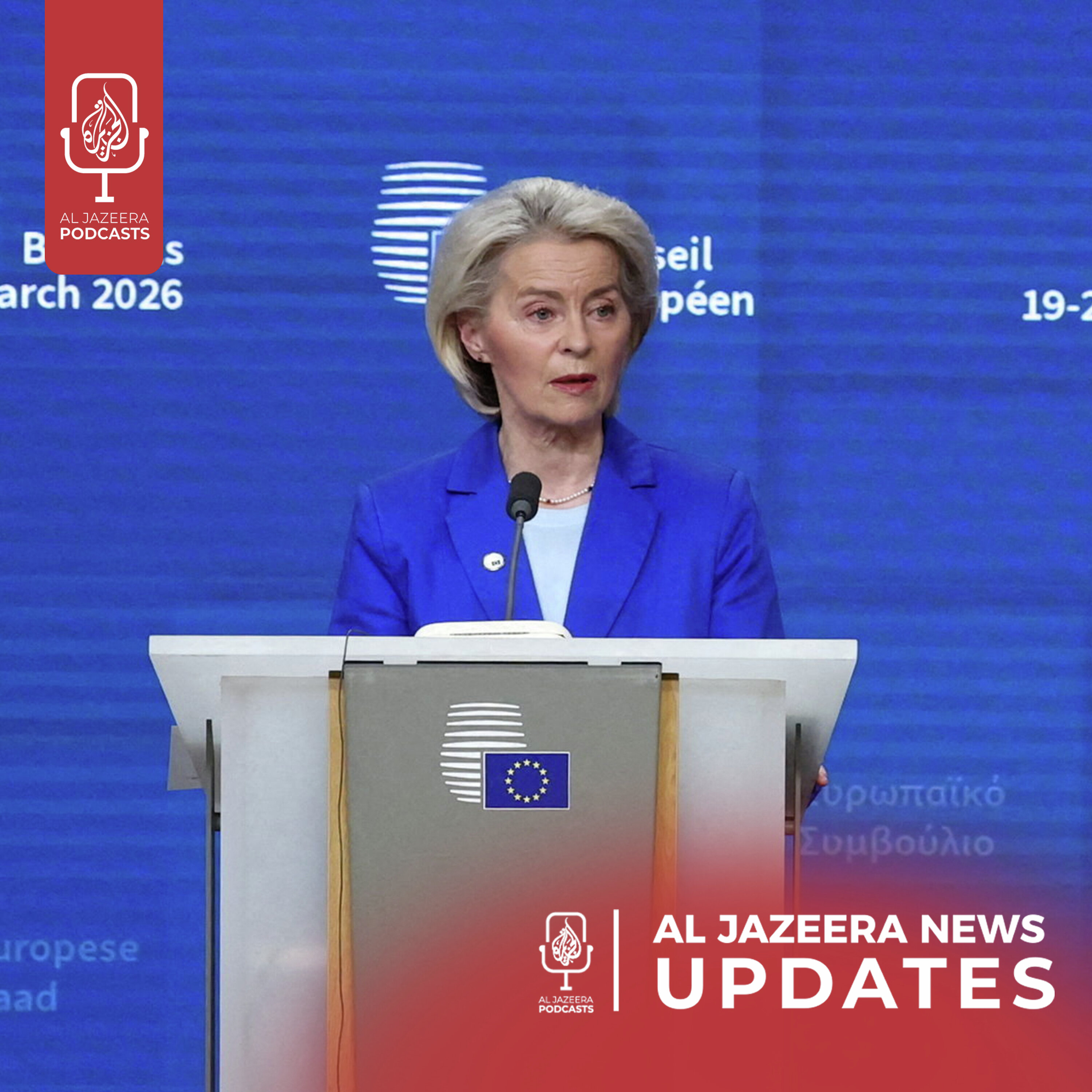
Pentagon asks for additional $200bn for Iran war, EU struggling with energy crisis
About this episode
Your daily news in under three minutes.
At Al Jazeera Podcasts, we want to hear from you, our listeners. So, please head to https://www.aljazeera.com/survey and tell us your thoughts about this show and other Al Jazeera podcasts. It only takes a few minutes!
Connect with us: @AJEPodcasts on Twitter, Instagram, Facebook, and YouTube
Get every episode summarized
Each time Al Jazeera News Updates publishes, we email you a written briefing from the transcript — the topics, who appeared, and any specific claims, with the ad reads skipped.
Email me new episodesFree for 3 shows. No card needed.
Hosts & guests

Transcript ready
27 searchable segments. Every word is indexed and playable.
Full transcript
Al Jazeera News Updates — Pentagon asks for additional $200bn for Iran war, EU struggling with energy crisis. Machine-transcribed; use the interactive transcript above to jump the player to any line.
The U.S. and Israel have tried to project a united front when it comes to the war in Iran, but three weeks into the conflict, the messages coming from the country's leaders are starting to diverge and shift. While U.S. President Donald Trump initially promised to swift into the conflict, he's now ambivalent about when the military campaign may end. The Pentagon has asked for an additional $200 billion to fund the fight, but Trump says he's not putting troops on the ground. That's in contrast to Israeli Prime Minister Benjamin Netanyahu. In a press conference on Thursday, he said a, quote, ground component would be needed. He added though that Iran's uranium enrichment and missile-building capabilities have been destroyed. Iran's retaliation has devastated Gulf economies that rely on energy exports. I thought that was Prime Minister Hamad bin Abdul-Humad Netanyahu says Iran has destroyed the nation's trust with its aggression. The U.N. Security Council held closed consultations
on the situation in the Middle East, laid on Thursday. Energy security and the member states affected were top of the agenda. Japan's Prime Minister came face-to-face with Donald Trump after recent calls by the U.S. President for allies to help reopen the Strait of Hormuz. Sana'i Takaiji has so far resisted military assistance. The European Union, on the other hand, is struggling to get a hold of the spike in energy costs. EU leaders have been holding talks in Brussels. They're demanding an end to attacks on energy and water infrastructure in the Middle East. The worst most immediate impact on Europe is on energy. At present, the European Union's physical security of supply is secure. However, Europe is not immune to global price spikes and as the conflict continues, energy prices continue to fluctuate. Just today, the gas price went up by 30 percent after attacks on Katari gas infrastructure.
Coming up on the take, drone strikes are hitting deep inside Pakistan. What happens when cheap technology starts challenging powerful militaries? That's the take by Al Jazeera. Find it wherever you get your podcasts.
More episodes
More from Al Jazeera News Updates

School fire in Congo kills at least 17 people, South Africa protests
Al Jazeera News Updates

Houthis capture Mocha, Israeli strike kills at least 4 Palestinians in Beit Lahi...
Al Jazeera News Updates

Yemen conflict, US strikes on Iranian tankers
Al Jazeera News Updates

Fighting intensifies in Yemen, Nepal flood aftermath
Al Jazeera News Updates