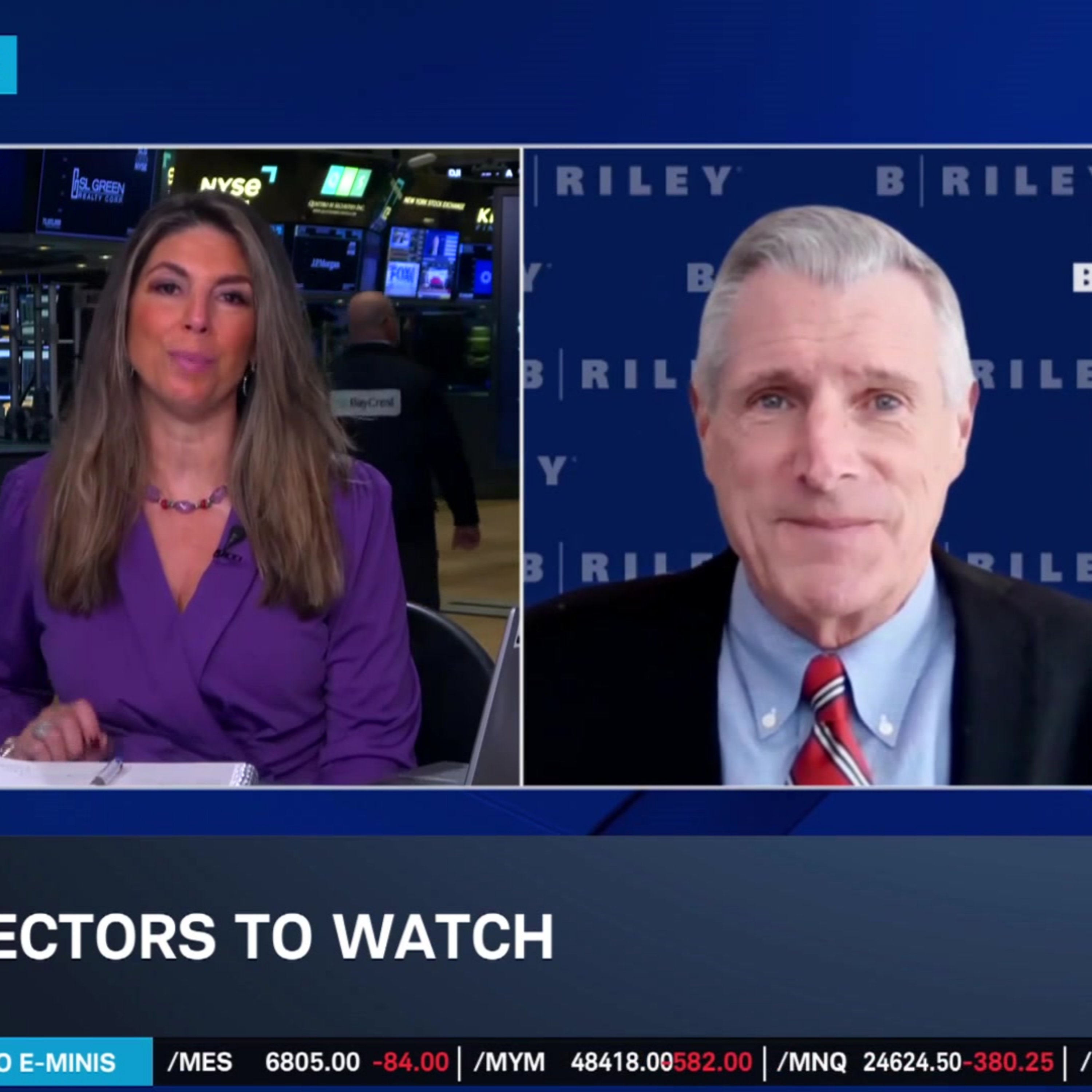
Opportunities in Energy, Financials, Technology to Open the Week
About this episode
Art Hogan says it’s “not the time to panic” or “make big changes in your portfolio,” laying out what investors should watch in the wake of U.S. & Israeli strikes on Iran. On the other hand, short-term traders may see opportunities in the volatility. He believes technology is “very oversold” and thinks we’ll see a bounce. He talks about the short-term spike he sees in energy and how disruptions to supply could make impacts globally.
======== Schwab Network ========
Empowering every investor and trader, every market day.
Options involve risks and are not suitable for all investors. Before trading, read the Options Disclosure Document. http://bit.ly/2v9tH6D
Subscribe to the Market Minute newsletter - https://schwabnetwork.com/subscribe
Download the iOS app - https://apps.apple.com/us/app/schwab-network/id1460719185
Download the Amazon Fire Tv App - https://www.amazon.com/TD-Ameritrade-Network/dp/B07KRD76C7
Watch on Sling - https://watch.sling.com/1/asset/191928615bd8d47686f94682aefaa007/watch
Watch on Vizio - https://www.vizio.com/en/watchfreeplus-explore
Watch on DistroTV - https://www.distro.tv/live/schwab-network/
Follow us on X – https://twitter.com/schwabnetwork
Follow us on Facebook – https://www.facebook.com/schwabnetwork
Follow us on LinkedIn - https://www.linkedin.com/company/schwab-network/
About Schwab Network - https://schwabnetwork.com/about
Get every episode summarized
Each time Schwab Network publishes, we email you a written briefing from the transcript — the topics, who appeared, and any specific claims, with the ad reads skipped.
Email me new episodesFree for 3 shows. No card needed.
Transcript ready
43 searchable segments. Every word is indexed and playable.
Full transcript
Schwab Network — Opportunities in Energy, Financials, Technology to Open the Week. Machine-transcribed; use the interactive transcript above to jump the player to any line.
Good morning. Welcome back to opening Bell right here live on Wall Street. I'm Nicole Pedalidis. We're on the corner of Wall and Broad and getting ready. This is a breaking news kind of day after all the geopolitical events over the weekend, war underway and Art Hogan, Chief Market Strategist, Be Rhinely, Wealth Management is with me as we are moments away from the opening bell. We're stocks are lower, oils higher, on the action that we may see this week here on Wall Street. What people can expect? Yeah Nicole, I think the setup coming today is exactly what you would expect normally. So, you know, a war breaks out over the weekend and there's a lot of concern in the credit markets over the weekend. So, those movements get a lot more extreme. So, at one point in time, the S&P was down 2%, looks like it's going to open down about 1%. Probably a pretty normal reaction. And on a sector basis, you're seeing everything you would expect to see get hit and bit up. And obviously the aerospace and fan stocks are a tip of the spear for that rotation and everything's coming out of travel stocks. And that makes a whole lot of sense. I think it's important for long-term investors to take a step back.
And look at history. Going all the way back to World War II, any time we had a breakout of violence and wars six months later, the market has been up about 70% of the time. So, these things are always scary and always seem like a worst-case scenario is playing out in front of us. But it's important if you're a long-term investor, this isn't the time to be changing your long-term investment plans. This is the time to take a step back, understand that, you know, there's a lot of things outside of our control. We don't know how long this is going to last. We don't know what the next regime in Iran is going to be. We don't know if they're going to be able to successfully close the straits of hormones and disrupt the supply of oil or 20% of the global oil comes out of. So, I think those are the things we need to pay attention to. But it's not the time to panic, make big changes in your portfolio. Obviously, if you're a trader, that's the other side of this. And you look at things like aerospace and defense, the energy companies obviously being bit up right now with the spike in oil prices. The bonds coming off a bit on that flight to safety and obviously run into precious metals, which makes sense as well. That's another flight to safety.
That's one we've seen for more than a year now in both gold and silver of late. But, you know, I think it's, you know, there's two different investors out there. There's the long-term investors that shouldn't be making major changes to their portfolios. And then there's the traders that will look at this and say, what's the intuitive thing to do in the here and now and we're seeing both of those things play out at the same time. And also, I think about what the Fed may or may not do if oil is likely to continue to stay elevated because we're seeing all of this and it may very well be so because you have at least four weeks of this to continue according to the president and the administration. Not likely to cut rates in an environment where inflation could really kick in, right? Yeah, there's two sides of that coin that call first or foremost, you look at that and say, does the Fed actually look at energy prices or do they really look at the core PCE in terms of inflation? And the reason for that is because of this volatility that we oftentimes see when there's a disruption to supply of energy products. So they tend to back that out of their thought process. But I would also say consensus doesn't have them doing anything until the month of June to begin with.
So I don't know that this is going to adversely affect any decisions that they make. We'll have plenty of data between now and then recently we got a PPI that was a bit hotter than expected. That's two months in a row. We'll see if that feeds into the PCE. It hasn't yet. But I think that when the Fed makes a decision and they look at their inflation mandate, they really focus on the core. That's going to back out this. What hopefully is a short term increase in energy prices and dissipates over time, especially if OPEC steps in releases more barrels and makes a decision to do that. Or if in fact, we can get some ships in and tankers in and out of the straits of hormones. Maybe going on the theory and you tell me of how, you know, these selloffs that occur sometimes with war and then you look, you know, six months later and you're higher, most of the time, 70% of the time is what you quoted. And tech, for example, has been beaten down anyway, right? Many of these mag seven names are still in the red for this year. Is this an incredible buying opportunity for tech or mag seven names? I certainly think technology has very oversold and that's that that has nothing to do with what happened this weekend and has everything to do with concerns about artificial intelligence, the massive amount of catbacks that's happening, those, those hyperscalers that are actually using debt instead of free cash flow for that build out.
And certainly when will there be a return on invested capital for those large players? And I think that trade's gotten over done at the same time we have this fear that artificial intelligence is going to disrupt all sorts of sectors and software has been hit the hardest on that. We're likely at a point in time where those concerns are very well priced in the markets and we'll see about we started to see that last week in the IGV, the software index, the ETF, which is very oversold on a technical basis and down some 25 or 30% from its recent peaks. So I think technology also seems to be agnostic to things like higher energy prices and demand for the services that all of these hyperscalers have don't really play into what we're concerned about right now. So it's not a sector that you look at and say they're going to really be adversely affected by what's going on in the world right now. It's likely the opposite that especially with these technology in general writ large trading at the multiples that we haven't seen in years in terms of the amount of draw downs we've seen. And what about some other sectors? So tech you say is oversold and had been even before this event. What about maybe buying energy? Is that an opportunity here?
Yeah, well, the difficulty with energy is right now it is absolutely taking a pop higher, right? So that's not the time to jump in but energy overall as a sector has not performed the SB if I've uttered this year for the first time in about five years. I think the demand for energy product is only going to increase across the board, especially with the data center buildouts and the balance of supply and demand on the global oil market, especially if we're going to have some sort of short term disruption if we're going to lose Iranian oil, which mostly goes to China. And that would cause a deficit of supply for a period of time, but the short term spike in energy companies that we saw overnight and certainly as they're opening this morning likely is not the time to jump in, but energy as a sector. I think is a very good value over the long term, but I'd give it a couple of days to see where that settles in. What other sectors do you like? I mean, I know you can't name a name, but is there another sector that you think could work in 2026, particularly for the folks that maybe a little more long term minded? Yeah, that's the long term investors. I think industrials have done very well and will continue to we've worked at the very early innings of the massive infrastructure work that we need to do and the build out of data centers.
It's not slowing down anytime soon. So the industrial complex is doing very well. We already mentioned energy. I think financials are one of the worst performing sectors this year and probably one of the best long term values. I think if three things that are going on, obviously interest rates are coming down, net interest margins are moving higher or in lighter regulatory touch environment right now. And I think there's going to be a massive amount of MNA opportunities. We have about 4,000 banks right now and that likely is more than we need, especially in the environment and how much it costs for technology. I think that, you know, that number is probably going to get cut in half over the next five to 10 years and that MNA activity is going to be good for the financial sector because they're going to process that business and there's going to be a lot fewer banks. You know, call it, you know, a decade from now. So look at the financials as a beneficiary of what's going on in the environment right now. All right. Thank you so much, Art Hogan. It's great to see you. I'm so glad you were able to join me this morning. Art, thanks for coming on and really giving us a sense of what's going on here ahead of the first opening bell after this weekend's escalation and war underway. Thank you.
Thank you.
More episodes
More from Schwab Network

Stock Market Today: ORCL & ADBE Earnings, AEO Plunges Near 52-Week Low
Schwab Network

Thursday's Final Takeaways: Crude Taps $103 & PPI Hotter than Expected
Schwab Network

Balancing High-Conviction AI With High-Dividend Diversification
Schwab Network

EARNINGS PANEL: ORCL, ADBE
Schwab Network