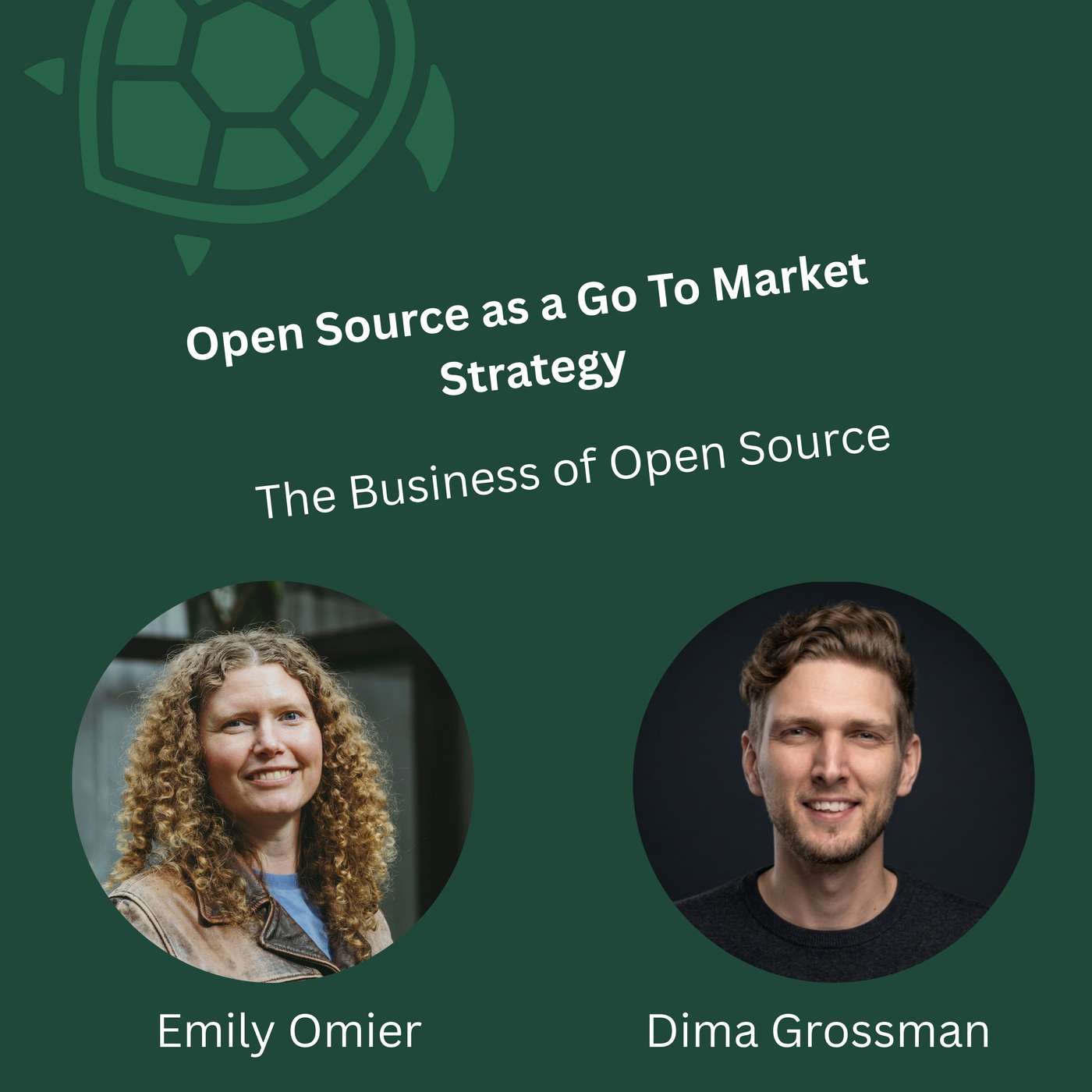
Open Source as a GTM Strategy with Dima Grossman of Novu
About this episode
In this episode of The Business of Open Source, I spoke with Dima Grossman, founder and CTO at Novu.
For Novu, being open source is part of the go to market strategy. Dima says a big part of the motivation behind going open source to get the widest possible adoption for Novu. It was also a way for Novu to be different in a relatively crowded market, one that serves many developers but that didn’t have a real open source player.
Aside from being a go to market strategy, Dima mentioned that while the team at Novu is only 15 people, there are over 450 contributors from around the world, contributing not just tangible things like code, but also ideas and feedback about the problem space. This tight connection with the user community ends up giving Novu a competitive advantage over other players.
Is your open source project part of your go to market strategy? Do you want to make it part of the GTM strategy? Reach out and we'll talk about how to leverage open source to build a thriving commercial business.
Get every episode summarized
Each time The Business of Open Source publishes, we email you a written briefing from the transcript — the topics, who appeared, and any specific claims, with the ad reads skipped.
Email me new episodesFree for 3 shows. No card needed.
Hosts & guests
Transcript ready
462 searchable segments. Every word is indexed and playable.
Full transcript
The Business of Open Source — Open Source as a GTM Strategy with Dima Grossman of Novu. Machine-transcribed; use the interactive transcript above to jump the player to any line.
I'm Emily O'Mear, host of the Business of Open Source and a position in consultant for open source companies. If you want to figure out how to focus your product, marketing, and sales strategies for the AI era and increase your conversion and retention rates, you should reach out. Welcome to the Business of Open Source, everyone. I am Emily O'Mear, your host. Today I'm chatting with Dima Grossman, who is the founder and CTO of Novo. Dima, thank you for joining me. With pleasure, with pleasure, Emily, thank you for having me here. So for people who don't know you and who don't know Novo, can you introduce us to yourself and also the company? Yeah, with pleasure. So my name is Dima, I'm married with a dog. Lovely husky. I'm a somber here in the room, I guess. I've been in the kind of entrepreneurial world for the past 10 years and Novo is my
third company, together with the same co-founder, Tomer, who is the CTO at Novo currently and my co-founder for the past 10 years now. Novo really came to be, I would say, out of a personal pain point in our previous businesses. So we co-founded CRM software for the insurance industry, which we bootstrapped and then later it was acquired by a financial company in the local market here. And another business we did that served around the marketplace for recreational sports and kind of a decor, what we've seen is the challenges with communication with customers, right? So how is the product communicating with users? How do we do it in the right way? I'm not speaking about necessarily the marketing automation type of communication, but more of the transactional type of you have an invite for an event, you know, somebody sent your friend request, you've been tagged in a post or something like this. And we've tried to find solutions of the shelf.
Unfortunately, the market was saturated with a lot of marketing automation tools like Habsport and Salesforce and intercom and different players in the field. But we ended up recreating this internal transaction, our notification system in house multiple times. When we sat and we said, okay, what do we want to do next? We've been doing things in quite varied industries, I would say, and kind of, you know, finance industry and then the recreational sports. One of the things that was important for us is an industry that we can relate to, right? It's coming from a personal pain, which was a little bit different to the previous businesses we've done, which was finding a problem and then kind of just rolling with it, finding the experts and building the company around it. And this time we really wanted a problem, you know, we felt ourselves. And this is really how novel came to be. And novel in short is the, today is the biggest open source communication infrastructure platform on GitHub. We have, it's kind of the old school vanity metric, I think around the 40,000 stars up until
today, serving more than today around five to six thousand customers. We also have some open source users that we don't know how many of them are there, but I only know about the numbers from the cloud service. And really novel is kind of, you can operate it, I would say, in two modes and you reach to us when you need notifications for your product. And we recently did shift, I would say, in the last few months with the market, with our customers towards kind of the more of the agenda communication parts, which I'm happy to, you know, discuss it a little bit later. But yeah, this is us. We are fully remote. Today, we are around 15 people in the company. From all across the world, we have people from Europe, from Asia, from the States. Yeah, you said it. So why did you decide to create an open source project?
And let me ask it a different way. What came first? Did you start the open source project and then decide to pursue it as a business, or did you decide this was a business, but you started with it, but you decided intentionally to create the open source project? So it was an intentional decision, right? I've been part of the open source community for quite a while now. I've been an owner of multiple, multi-million kind of weekly downloads and the end packages on GitHub and I've been participating in the open source world. From the early of my career stage, this is where I get a lot of the ideas, where I study a lot from, you know, how to build something. This was a lot of quite an important place for us. And initially when we started Novo, we had a thesis, right, which was a communication platform is something that product people buy. And we started and we ran a small POC and then very quickly we realized that although
the product teams are owning the problem, right, they are the ones that are responsible for the engagement of their products and so on, still they don't really have a very clear budget. And fortunately, you know, they're kind of operating under the bigger R&D umbrella, but really the budget seats, a lot of the time or like the more free budget seats at the engineering team or kind of more of the R&D aspect of it. So this was the lesson, the first lesson we learned while kind of pitching the POC and showing it to people and trying to get the first customers. And what we've seen, we've seen another problem is now the handoff from product to engineering, right? And we've seen a lot of the technical because now the product manager came and said, oh, this is an amazing thing, you have to use it. And the engineering team immediately, they kind of were like, guarded, you know, I don't want you to tell me what to do, right? And the other funny thing we saw when we spoke with the engineering teams directly immediately there was this kind of exciting moment because they already built something like these six
times before and they really don't want to do it again. So once we realized that, we started to look, okay, you know, so this is the buying persona, I would say, for this product, what's the best way to get to as many people as we can, right, as fast as we can? And there were two reasons for that. The first one, of course, from the business side, it was a part of our go-to-market strategy, right? There is a lot of companies out there, what's unique about us? And what unique angle are we taking in this market? So this was bullet number one. And bullet number two for us was we're trying to solve a common problem for a lot of developers in the world. How can we learn the challenges they're facing, right? And to us, you can do it in many ways, of course, but to us, it was being open, right? And collaborate. Today, Novo, you know, I mentioned to you, we are 15 people, but Novo today is more than 450 contributors from all around the world. So all of the different ideas came, right?
The challenges, the problems that shaped the product it is today came from our community. So that were the two main reasons we did this shift to open source. It is. And when you say that this is a common problem that a lot of developers are facing, why do they, like, who's telling them that this is a problem they need to solve? You mean like the communication in front? In the end, you know, the need is simple, right? Something in the product happens when you to send an email. And it starts simple, right? It's when you have one channel, it's like you're using directly the same grid API or the AWS, yes, API. So this is simple, but then your product grows suddenly some power users are getting 100 emails a day, you know, okay, how do I digest it into a single email? And then you introduce another channel, let's say SMS and then some users say, don't want to get this over email. So how do I start to manage preferences?
And then in the future, the users are asking, okay, can we see it in one place, right? Can we see it in one inbox component? This is the inbox bell that Novo provides as a component. So the problem starts simple, but as the organization matures, the problem kind of grows. And we're seeing this from very early stage startups, right? This is maybe just a solo builder or something like this up to Fortune 500 companies that kind of see the same problems, but the way of them, right, is much bigger, of course, with the bigger the organization, the more customers you have and so on. So it's something, you know, we as engineers, of course, the world is changing, right? But previously, before the AI era, engineering resource was very expensive, right? To do. And even today, when engineering resources are quite, you know, you can, you can write a lot of code today. You still have a focus for your company, you know, what's unique about the company or
your product. And notification almost in all the cases was not the unique selling point. It was a means to enend, right? Something they had to do to create engagement with the product. So you mentioned that there was a over 400, 450 outside contributors to the open source project. What are your contributors strategy? Do you actively look for contributions? The answer is no. We do not actively look for contributions. In the early days we did, we did, you know, kind of try to engage with people from different places today. We do not do it actively. We scale the result of challenges, right, with keeping up with contribution and I think AI did it even worse. Unfortunately, we're dealing right now with a lot of slope of contributors, which still take our time because in the end, the responsibility of the shipped product, of the shipped version,
of NOVO is on us, right? We have customers who rely on us. We have open source users who rely on us and the responsibility is ours. So we have to see that the gate between, you know, a slope contribution and a genuine contribution of somebody who really wants to help and be able to identify it and create the measures of how do you measure it even, right? So this is something that it's kind of a double edge sort of I would say in that sense that, you know, it kind of, it's a blessing in a case in the list. So tell me a little bit more about how the contributions have changed as a generative AI has become more used in encoding and in open source contributions. Yeah, I'm not sure if it's kind of what the type of policy you have here on the podcast
with the care swords, but it's a lot of slope. And what we're seeing is that the small percentage of the contributions is actually meaningful things. And you can see it by a lot of the time, the level of details in the pull requests, right? Did they provide a reproduction video, right? Or it's just like AI generated description, which they even didn't test it, right? On the right. Did it actually solve the problem? Is it the best way to solve the problem? Is there actual human impender? Or they try to get some green boxes on the Gita profile, which is something we do not appreciate to be honest. And it's quite across the board with the open source community right now. And unfortunately, the way that Gita works and it kind of provides the metrics to the contributors is by merge pull requests, where today what we are seeing, the biggest impact I would say to the project would be around creating a descriptive issue, right?
Because we can also run other than models on top of that. And the other end is testing that the actual fix the problem and was it reproducible and so on. So a lot of the actual meaningful impact today is not about the code generated. It's all the other things. And a bad pull request focuses only about the code and about the other things. What value do you get as a company? Other especially now when shall we say like writing code isn't as valuable as it used to be? What value do you get from the community contributing to the project? So not a lot. I would be honest, right? We built the product in a way to encourage meaningful contribution. And I'll explain how. So I think contributors work very well in places where you have a very good plug-in system,
right? You have a very defined interfaces where community can contribute small pieces, well-defined pieces that have only one responsibility. And for us, this type of responsibility were the communication channels, right? So now what do they have more than, I think, 50 or 60 different integrations with different vendors, different email providers, different SMS providers, different push providers? So those are, I think, the most meaningful communication in the contributions we're seeing today. And the other majority of things are, it's like small typos, documentation. So if you look at the code base of novel, 99.9% was generated by our core team. So the code contribution is the smallest aspect of community we care about. There are other important things that community can do. But code is just not one of them for us at least. So tell me about the other important things.
You talked about detailed issues. Are there anything else that you really see as a value of community? So value of community, if you look at the go-to-market aspect of it, right, is you are creating enthusiastic people for the cause, for the problem. People call them ambassadors, you can name it with different names. And generating those types of enthusiastic people about the problem space you're doing helps to spread the word, right? It helps to create, because they're not excited about necessarily the product. They're excited about the problem. They're excited about there is like a lot of people here in the world for the same cause. This is also one of the biggest things that people say, oh, we just will go to open source and they do things that are not relatable, right? You need to find a relatable problem. This is where I told you in the beginning that people related, like the engineers related,
they felt the pain of doing that before. So on the go-to-market and spreading the word, it's super important. And you start to see it right now. We're seeing waves of developers who use NOVA for their personal project. They brought NOVA to their workplace. They switched the workplace and they brought NOVA again. They created content. They shared it about on social media. So there is a lot of aspects from kind of the viral effect or from the flying wool effect of NOVA that came through the community doors, right? The second one is the learning. And I told you this earlier as well is how can we learn and improve our product by getting feedback, right? In open allows our users to dive deep. They will not contribute code, but they will look at how NOVA build, how the API is structured and how can we change it to facilitate their needs as well. And the other one is a little bit more on the sales related, right? So when you look at very big companies or Fortune 500 companies or very big enterprises,
only saying the word procurement takes you into a three months journey, just to start to speak about it. And NOVA by having the MIT license self-hosted version, by the time we are getting to the enterprise conversation for the sales motion of our enterprise edition, NOVA is already running. The team is already sold on it. They already run the technical proof of concept and they were not stopped by doing procurement and doing the legal staff to just open a user name, right, on your cloud system. So this serves as almost as a procurement vehicle for us, for companies to see the value of the product, right, even start using it and then mature into an enterprise deal. A few months later. So this is another very big impact open source does on business. And again, it's not true for a 10 line library, you know, you've put on GitHub.
You know, there is of course different variations to that, but at least for us, this is what worked. So you mentioned that you recently repositioned the company around agent communication. Can you tell me a little bit about how you made that decision, why you thought it was necessary, and what exactly that means? So, you know, if I'm looking at our vision, right, vision page from four years ago, it really haven't changed, right? Our goal was to improve the communication between products and people, right? This was like we wrote it in one line and it really stayed there. Initially, when we thought about what, how the best notification system looks like and behaves, right, is almost having like a very smart assistant that sits in front of your door, right? And it will not interrupt you, right? It will condense multiple messages, it will only surface to you the important things.
It will try to close some things even before the reach you, right? So this is what we saw like four or five years ago is kind of the ideal notification system. And unfortunately the technology was not there yet to build it, right? What we're seeing right now is a shift from notifications are pointers to work, right? Here is a notification, somebody tagged you in a project, click here to go there, right? Intonotifications becoming the work, right? This is where work happens. This is where you get things done, right? If I got a notification that somebody requires your attention on Slack, you can reply to this notification and then an agent can pick it up and then he can do some other things to grab more context and ask you a question and then to complete the task or the assignment you needed to go. You didn't need to go even to the product, right? You could finish your task right from the notification itself. And this is where the shift we are seeing right now in the industry, where agent is a part of the product experience, right?
And what we identified is the gap of, okay, the agent is there. How do we connect it to people, right? And we are, we've been in the business of connecting products to people for the past four years. And this is, we're using a lot of our existing infrastructure and platform capabilities which handles billions of notifications every month into this new persona, right? Right now it's not our backend server. It's an entity that works and it has access to tools and it can communicate more freely, less in a less structured way. So how can we bring both of those work together with a simple cause in the end, right? We just want to make the end user experience better. It's a tool to what we actually want. And to us this kind of new world really merged into our original vision quite well, I would say. And yeah, that's what we've been doing since. I'm actually not sure if I understand. So I apologize to.
Does the agent receive the notification? Or does the person receive the notification if I'm one of your users? Yeah. So if I will try to explain it in a simple terms, right? Up until today, a system, right, was sending a notification to a person. Right? It's in the one way type of conversation, I would say. Or in some cases, it was a user who's tagged another user and then he would send a notification through the system. Like a three point. Now a user can send a notification to the agent, right? You can tag Claude in Slack. You can send a notification to your favorite iMessages agent, right? Now you are the initiator of the call. And the agent need to get this notification. In many cases from multiple channels, it can happen on Microsoft Teams and Google chat. It can happen from Zoom, from Gera, from linear, from Telegram, from WhatsApp.
Right? So Novo normalizes this layer. So the agent gets a unified message state, right? Okay, here is the context. We are very opinionated about the communication part. We are unopinated about the intelligence part, right? If you are using a ISDK or a long channel for managed agents, this is like we are agnostic to that part of how the agent is actually built. You know, you can bring your distinct technology there. And once the agent crunched the result and it has a reply, Now Novo takes it to the other end, right? So now we have replied to the message. Now we need to send it back to the correct thread in Slack and so on. So this is the shift we are seeing is that now not the system starts the conversation, but the user starts the conversation or the agent starts the conversation. But the important fact is a conversation. It's not a one-sided notification that's being sent anymore. So how does this impact me if what I previously got was a notification about the,
about a product, a product that I use. Does this, so I'm, I'm, where's the, where's the human in the loop? That's what I'm trying to understand. So yeah, I'm again, I'm not, I'm not familiar with, you know, with what you're doing. But if you're using any of the modern tools that surfaced an agent in your Slack workspace, or, you know, in any of the other mediums, so today our team uses, we're customers of linear, for example, that have quite an amazing agent that's doing, kind of quite, quite impressive communication layer there. So today when a new, you know, customer, let's say, support inquiry comes from our customer support platform, our agents there, kind of, crunches it, it posts a message on our Slack channel. Then our team can evaluate it. We are tagging the linear agent to actually take the work and create a ticket on our ticketing system. Right. And then another agent takes the work from there, a cursor or a cloud, right?
The actual code changes. And then if it needs a question, it will ask you, say, hey, do you want to watch direction they want to choose ABC? You know, like, we need to make some architectural decisions. This is the human look flows, right? You answer it to it. The agent finishes. It's a mid-support request, full request and kicked off. Then you have another agent that reviews the code, and it finds finding and it tells you, I found the bug and you need to reply to it, right? So it's all a conversation, right? From a moment the customer request came in, until we have a ship, a feature available in production, a conversation was involved, right? Between agent and agent, between human and agent, but a conversation was happening, which was basically the thread of the history of what happened from the super ticket to the fixing production. So it's all over the place. If you kind of look at it from those eyes and there's various examples we can go into in that front. Got it. So I think if I understand correctly,
but it sounds actually more like a shift from the product talking to the customer, to the customer talking to the product. Yes. It's a wonderful idea. That it's addressed to your agent, but if you're, if you're a product, I'm a user of a product and that they have an update that they need to send to me, that's where I was confused. That I was still, I was still yet in less, in less I've set up an agent to. Yeah, so you do have to try the agent of course, right? So you need to get the response on the other end. We have some use cases, which is completely static. You just lock the message somewhere, but the more kind of new use cases and the new wave of companies we're seeing right now is that. Usually there was a policy of no reply to notifications and I'm sure you've seen it. You know, you got an notification, but the reply email is no reply, right? And what we're pushing is for yes, reply, right? I got a notification. I am lacking some context. I need to do something with this information. Allow me to reply, right? And what we lack is this kind of entity that could get an unstructured reply from the user.
Do something with it and complete a task. Got it. So tell me a little bit about how, you know, you mentioned the go-to-market benefits of the open source project. How do you, shall we say, take advantage of those benefits? What do you do as a company to make sure you're maximizing the go-to-market benefits from the open source project? Yeah. So, you know, it's a question I've been asked a lot in those types of sessions. And my answer is simple, right? I'm always looking at the open source community or kind of the open source motion as a garden, right? You can, you know, let's say you put some water and you put a seed and a flower gets out, right? If you put twice as much water or three times as much water, it doesn't mean that the flower will, you know, the garden will grow twice as much or three times as much faster. So our approach is to create the most beneficial kind of atmosphere, right, for the garden, to create the right humidity, to create the right amount of watering and help where we need it or like a tree or a clean, where it's needed.
But in the end, it's kind of out of our control at some point, right? The word of mouth, kind of the novel brand is something that is, you know, if we would speak in three or four years ago, my answer would be a little bit different today. You know, it's bigger than us, I would say, right? So there is nothing we can do to say, oh, let's press this button to maximize more. There are a few strategies, you know, you are taking place to build a healthy community to, you know, build a brand that listens, right, and takes feedback and does something with it because people at some point, you know, when you don't do nothing with it, they get tired, right? And they will stop doing that. And on the other hand, is also, you know, kind of building the right separation. This is a little bit more on the tactical stuff, but okay, you know, what is your commercial offering? Is it exactly as the open source offering or not? Is it like some sort of core open source and close kind of outer layer? There is different, you know, you can Google it and there is a lot of answers on that front. But in reality, you know, you kind of have to create the right ambience and atmosphere to grow a healthy open source project and the rest will come.
And you can do, you know, some small tweaks, but in reality, you know, what I've seen in the past is that some things, it just doesn't work to rush them. But you need to focus on solving a problem, you know, people experience building a healthy community around it, making a product that is easy to unbord, easy to interact with, right? And once you have that, the final is happening and the rest of the activities are unrelated to open source. So, what is what any SaaS company will do, right, to build a business and marketing and all of those things that are not unique to open source in this sense. And tell me a little bit more about how you have made decisions about what you have, what's different between the open source and the commercial offering. To ask it was quite simple, right, everything that an individual developer needs is open source, everything that accompanies it and an enterprise needs is not right.
So we're segmenting away the value we're giving to the individual person, the tech enthusiast, the developer who is building the solar project, we give it for free. And this is quite big part of NOVO today. And anything that is organizational, you know, like deep user management or some branding and styling restrictions or things like localization, there is like some outer layers that there are the needs of companies, not individuals. And this is how we structure NOVO. It's not the only way you can see other successful open source projects that did different approaches, but this is what we've done and this is what worked for us. What do you see as the biggest risk from being an open source company? Where to begin, right. You can look at it from multiple perspectives, right. One perspective is you can become so successful, right, as an open source product and so much adopted and you will not figure out the commercial benefit of it.
And there's been numerous examples of such success. One recent one, we an unfortunate case of the one of the maintainers of I tell wind, which is today, especially with the agent crisis, one of the biggest libraries of writing, you know, styling in react. I meant this growth month over month, it's like exploding. It did defact to all the agents choose to date to write code with, but they unfortunately were not able to figure out the commercial aspect of it in a good way. And I think they're still trying to do so, but it didn't work out very well. So this is risk number one is that you are not figuring out the place of where is the monetization coming versus the core of your open source product is. And this is I think one of the biggest ones. So I think that's that that sounds like a risk to sort of a general risk. I want to know for you specifically, do you see any risk to know to be a mentor?
As I mentioned, you know, when we started today, it's a little bit different to us. We're looking at different things and I'll get to them in a moment. But in the early days, the question is, can we monetize this right? Can we build a sustainable business? We're seeing success on the open source. And we've focused in the first two years of no window in parallel community product. And the question there was, is okay, maybe this will be successful, but we will not be able to create an actual business out of it. Right. So I think it's a huge one also for us. Again, today it's a little bit different. Right. Today, what we are looking for is you can look at the security element of it, right, are especially with with with the eye agents and models that are getting quite good, especially open weight models compared to maybe restricted models like Fable. You know, our code is out there. We have some enterprise modules that of course are not and they're responsible for the authentication and like some of the stricter parts of novel, but core of novel is public, right.
And people are like going crazy with seeing the thoughts from Carl.com that decided to go close source because of this reason, right, that they kind of it starts it's hard to keep up. You know, with what is going on, but on the other hand, it pushes us to be even better at security, right, it pushes hundreds of security researchers from around the world to help our project, right, because they will get the visibility if they find something for us, right. And it's a collaboration that is again, it's bigger than us today, where being open forces us to invest more on those areas and we're seeing it almost as an advantage right because a lot of costs or companies have a lot of security problems in them. And usually if somebody will find them, it will be very painful. And what happens with us is because you know, we're out there. Those things are found very early sometimes on the full request level, right, before it even hits any oversellers. And again, we're collaborating with a lot of people that are part of the open source ecosystem that want to help. So it's a risk, but you know, we're working with it today.
But it's something that I think every open source project, you know, kind of is thinking. What is the biggest challenge that you're facing right now? In terms of? What's the biggest thing that you're struggling with? A lot, a lot, you know, I said we can start with the, with every department, we can have one hour conversation about this if you want to. You know, in general, what we're seeing today, right, is the world of software is changing, right, in front of a rise, the value, which in the past, you know, a SaaS company could provide. Right, it could be quantified to engineering hours and then you would say, okay, today like writing software as I mentioned to you, it's kind of the easiest part, right, you can write a lot of software. And you have to find the mold as a company, right, and what is your mold? And this is something, you know, we are kind of writing the book on it still, right, and we have our thesis, we have the things that hold customers with us for multiple years and growth of customers.
Of new types of customers that are coming in right now, and one of the things we are trying to identify today is this new builder person, right, the person who builds products today is not the person who was building products before, right, today we can have people we have, which have no background in engineering. And that we need to adjust our onboarding to facilitate somebody who doesn't know how to code, right, and how can we make no accessible to an agent to code code to unwords to complete the entire integration without a human intervention, right, and this is something that we are focusing heavily right now as an organization to understand that there is a new type of builders, right, a new type of developers and how do we structure the product to facilitate their needs. But also provide a capable platform that can handle billions of notifications of Fortune 500 company, right, and this duality is very difficult. At the company at our stage, at our size is that you have to choose right, you have to be careful with your decisions and focus.
But also I think it creates a lot of opportunity in the market right now where you know we are extremely bullish on again to us it's the technology doesn't really matter. We are kind of in the business of communication and whether it's an agent to human, human to human, product to human like to us this is the domain we are most excited about and this is where you know customers who. Or this in our thesis you know are sticking with us and to provide the value in this space to provide the opinion in the space like what's best right. And yeah, I think this is one of the kind of thing that a lot of companies facing right now is you know the buying persona is changing the decision maker is changing and how do we create a good product for this new by decision maker. What do you think is a mistake that you've made I like to phrase this as the most interesting mistake if you have something related to open source that's that's the best way to answer this for this particular audience.
But let me just explain the question when I think about the most interesting mistake it's not necessarily the biggest as in the one that you you feel like have the sort of worst impact on your on your business because sometimes big mistakes are also sort of obvious and you don't you don't learn anything really interesting from them. But do you have any any mistakes you've made that you think were particularly interesting or insightful or that you learned you learned something interesting from. Again, I'll be honest a lot of the kind of mistakes we've done are you know open source is not kind of a core factor I think those are mistakes of building a business right and to me. It's always I think being one of the main learnings you know you you are going through is you know people to me right is is that you are hiring the wrong people is that you are not letting them go fast enough once you do realize that this happens right to me this is one of the key learnings and I've seen it with you know a lot of our high risk also from open source contributor so it is connected in a way right so you get connected emotionally to specific people and you know.
There were good friends up until this day but they were not the right fit for the company at the time right and to me people is kind of the most difficult challenge to to crack out is how do you bring the best people at the right time and how do you convince them to come and join and stay right and how do you make sure that you are all working in in the same direction and to us this is not only us but this is you know 400 other people which we don't know from. Thousands of different countries and languages from all around the world so how do you clean the noise how do you make sure that you are all marching towards the same goal and this is something you know you are kind of making the mistakes in but you are with the evolving ecosystem marketplace talents space especially today with the eye is something you have to really learn you know every every week every month that's going on. Excellent anything else you'd like to add before we wrap up.
I know thank you for having us here. All right well thank you so much how can people connect with you or follow you if they would like to. Yeah I'm available on Twitter so you can search me out at Demagrosman or yeah or check us out on GitHub and see what we do there. Excellent all right well thank you so much. Fantastic.
More episodes
More from The Business of Open Source

A Product Strategy Framework for Going from Closed to Open Source
The Business of Open Source

Giving your Users a Well-Lit Path with Matt Watson
The Business of Open Source

Interviewing your Target Customers to Accelerate Product-Market Fit
The Business of Open Source

Making AI an Opportunity with Joshua Drake
The Business of Open Source