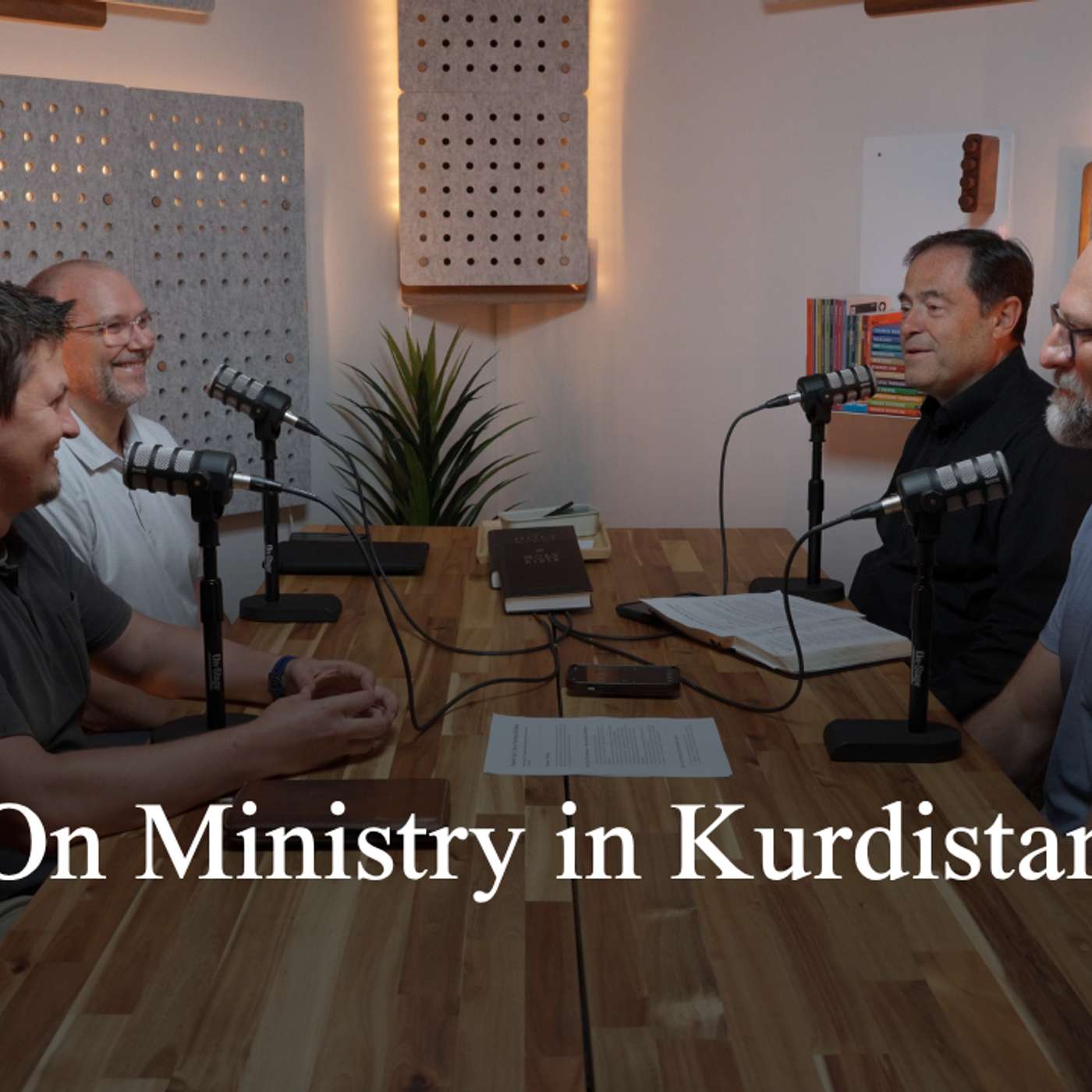
About this episode
In this episode of Pastors Talk, Jonathan Leeman and Mark Dever are joined by David Lawrence, pastor of Erbil Baptist Church, and Jeremy Barker of the Mustard Seed Foundation, to discuss gospel work in Kurdistan — the semi-autonomous Kurdish region of northern Iraq.
Get every episode summarized
Each time Pastors Talk - A podcast by 9Marks publishes, we email you a written briefing from the transcript — the topics, who appeared, and any specific claims, with the ad reads skipped.
Email me new episodesFree for 3 shows. No card needed.
Hosts & guests

Transcript ready
638 searchable segments. Every word is indexed and playable.
Full transcript
Pastors Talk - A podcast by 9Marks — On Ministry in Kurdistan (Ep. 340). Machine-transcribed; use the interactive transcript above to jump the player to any line.
Hi, this is Jonathan Lehman. This is Mark Devar. Welcome to this episode of Nine Marks Pastors Talk. Nine marks exist to help pastors build healthy churches, learn more at ninemarks.org, or to help support the ministry, go to ninemarks.org forward slash talk. But what if you're wanting to support the ministry in Kurdistan? Well, that's what we're going to think about today. Oh, what a transition. Okay. Two guests with us today. Grateful to have both of you guys here. David Lawrence. Yes. Who is the senior pastor, lead pastor, something pastor? Either or both. I am a pastor of preaching and vision at Urbio Baptist Church. Yes. Or do you call yourself a missionary? I would say I'm both a missionary and pastor. Okay. And this is in Iraq. This is an urbio, Urbio Northern Iraq, a British region. Which is kind of northern part. It's not a state.
It's a province. A semi-autonomous region of Iraq. Of Kurdistan, that's right. And with us also is Jeremy Barker, who is a member of Capital Hill Baptist for a decade. About five years. Five years. Okay. Working for the religious freedom foundation or institute. And but now is there in the same church with David. And you've been there since 2021. That's right. Five years. And you are director of operation, not operation. Programming for the mustard seed foundation, which is in GO, that helps facilitate that kind of work in that part of the globe. Somewhat redundant. We would say we're a church-centered parachurch organization. Okay. I like it. Yes. I like it. That works. And church planning in Kurdistan is not like church planning in other parts of Iraq. Definitely not. Okay. Yeah. Help us understand that. Well, firstly, as a semi-autonomous region, it has its own government.
And it's recognized by the main civil government. Yes. So it's underneath the federal Iraqi government. But it is semi-autonomous. They have their own flag. They have their own president. They have their own standing army. But they operate underneath federally rock. So it's not like the US government to Maryland government or even US government to Puerto Rico. No. It's more like Catalan Spain to the rest of Spain, which didn't go well for Catalan. But we hope it goes better for Kurdistan. Kurdistan. Yes. And so that region is, you could say it's kind of like the eye of a hurricane in the sense that we have political chaos swirling around us. We have. The Lebanon. Syria to the Iraq. Iraq. If West Turkey to the North, Iran to the east, Baghdad and the rest of Iraq to the south. And religious intolerance there. But in this little center is relative political stability and religious tolerance.
So now as most of Kurdistan is going to be Muslim. Yes. 99% Muslim. But there's a lot of religious tolerance. Other people think of those as kind of contradiction. How is it more tolerant? It's unique. And why? They have eight recognized religions that operate under the Ministry of Endowment and Religious Affairs. One of those is Christianity. And so a year and a half ago, no, two years ago, or Beale Baptist Church was officially recognized as a church within the Kurdistan region. Now we're not official in the rest of Iraq. We are there. How many, how many Kurds in this, in the area? Yeah. Close to eight million, seven and a half, eight million. That's the entire stimulus on this region. Yes. Yeah. Globally about 35 million Kurds. And those are going to be in Iran, Syria, Turkey, Turkey and a diaspora. Now, in a number of such countries, while religious freedom is on the books, it kind of isn't.
Right. And so, for instance, certain states of India, thinking about other places. What are things that we would take for granted that we can do here that you guys couldn't do there just to give our listeners an idea? Well, some of the troubles that we would face. So a person converting from Islam to Christianity, for instance, they would not face governmental persecution. But they would receive pressure from family and tribe. So they still have tribe in the Kurdistan region. And it can be significant. So it's physically violent? Sometimes. And do the police look the other way? Oh, yeah. They would look the other way. At times there's been protection, but tribal influences will show up in there. And so it's, will depend family to family tribe to try. So if an 18 year old male converts to Christianity, his problems are going to be one, there's no
place for him to be buried to play. There's no one for him to marry, at least inside the majority of the population. Now he'll marry a Christian of UK, but then that'd be, that'd be its own. And we kind of like his baptism. Oh, nice. He's going to be disowned by family and make work, finding work hard. And so religious identity is on their identity cards. It's their, it's from before you're born, until after you're, after your death. So that established religion creates tensions for, if it's a man to marry a Muslim background man, to marry a Christian woman would be fine. But the Muslims would leave in the validity of the conversion from other religions to their religion. Yes. So you can do that. Oh, yeah. So, and Kurdistan has allowed greater flexibility than most. And so in some ways as they've wanted to talk the talk of being the other Iraq, a more tolerant, in some ways they felt the oppression of a forced religion, a forced aerobization under Saddam and others.
They've aimed to do something different. And so it's, it's been an example of good governance is beneficial to the community generally and the church in particular. And probably the good antidotal case for that is back in the early 2000s, there were a group of Kurds who had become Christians. And they went to the mayor of the city at that time there was no religious authority at that time encouraged him. They went to the mayor and said, we've become Christians, we would like to organize as a church. And he said, okay. And these are, these are Muslim background. Muslim background, yeah. And so the Kurds, that's all you got. That's all you got. There's not with Arabs. There's a tradition of ethnic Arab churches. Yeah, there's a series of Caldeans. But with Kurds there is no tradition of that. So they, they know if you're Kurdish, you're Muslim. You're Muslim. And so the building that we meet in right now is actually from those early converts. The building was built and there are no longer meeting anymore, but we are meeting in
that building. Now, had Kurds been oppressed by Iraqis more broadly. And so that plays into it a little bit. Yeah, absolutely. So the political violence from the Saddam years and before was significant. And so they, they feel that. And so I think that's one reason why they're more open to extend the time of tolerance. And then you mentioned the historical Christian traditions, the Syrian, the Syriac. As good as it is now, there are tensions between the Kurdish communities and the Syrian Syriac Christians that's been there. So it's better than most. There are deep-standing historic tensions. Right now they come out mostly less towards evangelicals and in that way towards Protestants. Before between kind of ethnic communities that are contesting land, history, narrative of, there's a Christian tradition back to physically the second century, likely the
first generation of the Apostles went into this part of Iraq. So you still have monasteries that were formed in the second and third century. Some of the earliest translation out of Greek in Hebrew was into Syriac, which is still spoken by many of our neighbors. That's kind of my last question. I want to anticipate it. My last question is for the area generally. Does that ancient Christian history, first, second century, in the memory of it shape anything there today? Or for instance, I was in back in seminary. I spent a month in Uzbekistan. And I remember the missionary there saying to me, it's first century. It's like there's nothing here. There was no reformation. There was no tin, you know, you were like in a split. You were like in a living Bible background commentary. Yeah, that's right. And, but you guys have a little bit of ancient history. Does that show up at all?
Yeah, it does. I mean, there's still monasteries that there's a monastery that's still in effect today. And it's dated back to the fifth or sixth century. So it's still there. You can go visit it. But does it impact the, I don't know, the sense of the people at all? I remember having, we had an event where we brought students up from the Emirates to do Bible discussion on a campus in the in Herbeale. And while I was talking with one of the young men, he said, you know, Christianity is very interesting to us. You know, we haven't been Muslims that long, only 700 years. And he didn't mean to be ironic when he said that. Yeah. So he said, we're very interested in Christianity. So. Okay. Now, this is my way of transitioning to your particular church, the Herbeale as well as mustard seed and what it does.
This morning we were having breakfast, Mark, and he was showing me some books that they were going to translate from from nine marks. But as the woman, she was doing a carry-former book. And as she was translating it, she found in order to adapt it to context, just more and more became original to make illustrations and the applications and so forth work. Until finally, she's like, I just, my name needs to be on the, or somebody suggested your name needs to be on the cover of this book. And it's, it's actually, and so in the, in the notes, the beginning, it says, hey, all the ideas are coming from carry-former, but we had to really do it ourselves. Yeah. And because so the principles are all the same, the passages are the same, biblical passages. But. And you were explaining to me, that's because a woman who's a new comfort in that context is experiencing such different things. Yeah. Then, you know, typical American woman is experiencing that it really had to be kind of fresh, writing and illustrating and so forth.
And you unpack that at all, because now this is like, this is what you're pastoring now, I trust. Right. So the issues that we're dealing with are much different than you would deal with here at CHBC, for instance. You know, it's not, you know, do I go with my corporate job or, you know, mother my children, or how do I balance that? That's not the concern for many of the women that we're dealing with. So some of the ideas had to be, you know, more contextualized to the things that they're dealing with. What do I deal with a non-believing husband who perhaps is beating me, you know, for instance, or how do I, how do I deal with context in which my family doesn't appreciate or acknowledge my faith at all? So these are some of the issues that, what does it mean then for that woman to thrive in the local church? So those are just some of the things that we had to issues wise had to look at as well as some of the illustrations we had to readjust to more of our context.
Give us a quick snapshot of pastoring women and then pastoring men in that context and how, so you're speaking to an American audience, at least in part, how does it feel different? Yeah, it is definitely different, dealing with men and women in our context. The, for a lot of the singles, I would say they're looking at marriage and seeing very limited possibilities, especially if they're coming from Muslim background, because for a woman especially, you know, if she's got Muslim on her identity card, because it's all, it's kept in the system, the governmental system. Technically she's not allowed to marry outside of that. And so we're still trying to wrestle with how do we help these young women to get married? Even the men though, one of our, one of our guys Ali, you know, was struggling with how
do I face my mother who keeps bringing these women, Muslim women for me to marry? How do I keep telling her no? And finally, he just told his mom, mom, I need to marry a Christian woman. And when she got angry at him, she said, why do you have to do this? He said, come and see. She actually came to the church. And it was the first time she saw a Christian environment and she was compelled. She started reading the Bible with a friend. Now she has not come to faith, but she did understand enough so that when he did find a Christian woman to marry, she blessed the marriage. Oh, man. That's wonderful. So marriage is one of the difficulties that we face in our context, especially with Muslims. Yeah, but that would not be a difficulty if there weren't these centuries of tradition and explicit teaching and at least two religions.
So I mean, these are things in a place like a rebeal that you anticipate. Yeah. But I guess when you're dealing with an English-speaking congregation, which you are, you would expect maybe a little bit less of running into this. Well, we do have an English congregation, but, you know, we have more Muslim background believers in our church than we do Americans. Well. And so, 150 members, did you tell me? 117 members. 17. 117 members and over 25% are from Muslim background. Okay. Now, is that a good thing for you to say? We can say that. We are recognized church in our context. We don't. But certainly your context prefers people not to convert. I think generally speaking. Some of those are not local curts. Some of them are from Syria or from Iran. In fact, the last three members that we've brought into our church are from Iran, baptizing
one of them. You know, that so they're coming from different contexts, not just from Kurdistan. And so you feel a special opportunity and obligation to give yourself and disciple in these people? Absolutely. Absolutely. And one of the ways that we're doing that, because we are an English language church, we're providing translation of the sermons and in part the whole service in an application that translates the service while they're, while they're, it's going on. But they, we also have language-specific home groups that meet during the week. So we have one in Arabic. We have one in Farsi. We have actually one in Portuguese. Yeah. Because we have a lot of Brazilians that are with us now. How many different ethnicities in your church? There's just under 25 different ethnic backgrounds are presented. But they're all speaking English. So about, even if their main language is on group in Portuguese or whatever.
So for some, they might only be, you know, 10%, 20% English language that they've, and that's not necessarily the goal to stay in that. So, you know, didn't mention a Kurdish home group. And that's, we used to have that, but we don't anymore. Because about two and a half years ago, sent out and planted a Kurdish-speaking church that came out of EBC. So that English language congregation led to the planting of a local language congregation. Which is what you'd like to see happen with those English-speaking churches around the world. Exactly. Yeah. We have an Arabic group that's about, there's about 15 or 16 members in our church. They meet on Monday night and they have about 30 to 40 people meeting together. And they hope to become a church by the end of this year. And so one of our elders is from Syria. He went through our intern training program, our pastoral internship, and became an elder
in EBC. He's a fabulous elder. And it's going to hurt to have him go, but we're thrilled. That's what we're there to do. Now, this is precisely where I eventually want to go. I want to think, one of the things I'm excited about this conversation and what's going on in your church is the kind of proliferation out of this church. But before we get there, I'll just back it up for a second. Okay. How did the church start? How did you get there? Why did you join it? Just kind of in a nutshell, very briefly. Here. So I went over to the United Air Emirates with Mac styles, Brian Parks, to start up University Student Ministry. We had 2000 and 2002. Okay. Yeah. And so we saw that happen. We handed it off. There's more about that on Storm in the desert. Good plug. Storm in the desert. Check it out. But then Mac and I were out of jobs. So Andy Johnson from here. Andy asked us to go and check out this church up in Herbeal.
Going up there, it felt very similar to the ECD. Even John Christian Churched it to buy. Prior to it being reformed. Yeah. And John was coming. Right. So it felt very similar. So we thought, hey, if the Lord could do it in the Emirates, could he do it in Iraq? Right. We were warm to go and Mac moved in 2017. I moved in 2018. And we have seen great growth in the church and we hope more expansion. Would you even call it a re-quit unquote revitalization projects since you got there? I would say it was something between revitalization and planting because if there was a church there, it started in 2010 by the great Brazilian Baptist brother. But they had no structure, no form. They did have elders and they were preaching. But it wasn't expositional and they didn't have any statement of faith. They didn't have a constitution.
So really there was no form to the church. Mac came, he put those things in place. And he helped him along. And I helped him along as well. And then Mac left in what year? 2020. Early 2020. And so you've been leading since then. You joined in 21. Why did you leave a life in DC and religious freedom institute to go over there? So a couple twists in the story. With your wife. And Tending actually go to Southern coast of the UK to study PhD. COVID interrupted that. My fieldwork though was actually going to be focused on the working Kurdistan. And some of what we were talking about earlier about the realities of religious freedom, religious diversity in that part of the world. I done it professionally. It was ready in the dissertation focused on that. And so when we moved in 21, so there was work reasons. There were study reasons. And neither was a good church that we could plug in and be a part of. And so moved there. The first couple of years, we were doing a few things in partnership.
And as we looked at what was growing there and the opportunity to help strategically kind of give infrastructure to help support church growth, church work that led to. I have, this is getting far more of my time attention and desire than what I'm doing in DC. And so about two and a half years ago shifted from doing that full time to being full time with mustard seed and helping as an entity help with that infrastructure in place to help support not just one church, but planting a multiple churches and strengthening work as well. One of the things in that was education. And so my wife led to starting high Christian Academy of Herbiel in 2022. A K through this year, we'll have our first 12th grader. So started in September 11th, 2022 with seven families of 18 students. This last year had about 35 families over 60 students.
And so that's what drew us there. Which was part started as I recall conversations with you a year ago, Jeremy, to help keep good workers on the field. That's right. Because you know, you have these families that leave because their kids can't get educated or at least it's just too tough. We had seen over 10 families, family units leave. And nine of them cited education as the main reason they left. So yeah, we, the NGO that we have, the non-governor organization, is perfectly situated to do something like this. And so we put it on the front burner and thankfully, Kylie, she had this dream for a decade to start a Christian school. And we just happened, our paths collided right at the same time. So she put a 23 page proposal on my desk in about three days. So the school is a part of mustard seed foundation. Is it related to herbal Baptist church?
At the moment, it's not, but we're thinking we need to bring it under the church more directly so that we can keep the Christian influence of the curriculum. Especially if we end up going with the Ministry of Education and getting, you know, officially recognized as a school. So it's a covenant school where we have really eight different churches that people are coming from that are part of that. And it's on one hand serving workers, those that are coming, those explicit for gospel reasons, but also first generation Christians, including those that, if they're from a Muslim background, if they're in the public schools, they'd be required to go to Islamic classes. If they're not, they're facing hostility within the, within their class as either converts or even if they're from a Christian background. And so it's a school also where we're seeing those first generation Christians being helped in what does it look like for the first time that they've ever seen it to raise kids?
Yeah. And if you're an admittable Lord. Yeah. Amen. Now, you guys both know there's been a little bit of a debate in mission circles over the whole question of an international church. And I'm a fan and I think you're a fan, Mark, of the kind of four lanes as Brooks Buser has described them. In international church, I think is lane two and lane, lane one is pasture training. Lane two is international church. Lane three is majority language missions work like being a missionary in Turkish and Turk ear, whatever. And then lane four is unreach language groups. And nine marks is always wanted to say yes and a man, doll four. Yeah. You know, different churches have different strengths and giftings and resources. And let's lean in and so far as we can doll four and be deliberate if we can. And so far as we can about all four lanes, you would agree with all that. And one of the arguments or utilities of lane two is that it engenders a lot of lane three.
And that's what you guys are kind of on the cuss and beginning to experience. Can you talk about that? Yeah. And I would also say we also can influence lane four as well. Okay. So right now we have we have 23 different ethnic, this is 24 different ethnicities in our church. One of those used to be Kurdish in the local dialect. But a year and a half ago, we planted a Kurdish church from our church taking eight or nine members from our church to plant that church. The lead pastor is American Joe Carroll who did the internship here at CHBC. His Kurdish is good as phenomenal. And he's preaching in Kurdish every week. He's also giving opportunities to others to preach in Kurdish, both locals as well as other others who were there from America.
And so that church has now grown. It's grown from those original eight or nine members to now almost 20. It's the only openly meeting Kurdish church in the entire city of 1.6 million Kurds. And so it is reaching a significant, unreached population. If you look at Kurds even in these, you know, majority cities, the number of Kurds who have come to faith, it's not 0.2. It's not 0.02%. It's 0.02%. It's very unreached still. So in some ways, you could say it's way deep into the unreached, unengaged areas. Now Brooks would say yes, but they do have a trade language. And I would agree with him. But there are some that are further out that we're also attempting to plant churches in, which would be sending somebody to a place where there is no English spoken at all.
It's all in Kurdish. And if we even ask you about that, would you be able to talk to about that or not really? I mean, it's not far enough along really, but we do have a couple folks from reaching in teaching who are in language training now through the NGO. They're able to focus their full time on that because of our NGO. And so they're getting equipped faster so that they can then go and plant this church. We've been talking with two couples about the possibility of going and doing that in this other city. So you have the one Kurd plant from a year and a half ago, but there's at least two more. There's in the works. Yes, there's Arabic, which we hope by the end of this year, so there's plant in Arabic church. We have a Syrian man who joined our interim program. He went through that. He became an elder at EBC. We've the church affirmed him in that role. And he's leading a group of about 30 to 40 Arab speakers in a home group on midweek.
And that is getting set up to be a church plan. I hope we'll be done before Christmas this year. And we also have a man who's Persian. And he came through our interim program as well. He's a candidate to be an elder, hopefully by September. The church will affirm him as well. Our philosophy in this is that churches plant churches. And in Acts 13, it was the church that affirmed the elders to go and plant other works. And so we feel like that's a model for the church. So not only should they come through our interim program, they should also be elders in a church. It doesn't have to be our church, but they need to be an elder in a church before they go off and become the lead elder in a church plan. That's incredibly that. You've already seen that create goodwill and interest in congregations. Yeah. In fact, it's also been inspiring to other local language folks to rise to the occasion.
So we had another young man who came through occurred, came through our interim program last year or year before last. And he has now become an elder in the church. The church. The church. So now there's plurality of others there. So we hope the same that will happen this year with another Egyptian Arabic speaker with the new Arabic church plan. So so this Persian guy, we hope in the next 18 to 24 months, we could have a Persian church. Crazy. Well, one of the things that I march like to do is discover, highlight, celebrate, equip, whatever, different hubs of activity around the globe. And you know, obviously we've talked about Dubai and former and styles and part you as well, have done over the years there and is featured in Storm in the Desert. And so as I've been hearing about what you guys are doing and the burgeoning activity there,
yeah, that excites me as well. Other ways any listeners can pray, can help churches get behind it, get involved. Absolutely. Yeah, we're multiple ways. Okay. Multiple avenues to get involved. I mean, prayer obviously, you know, unless the Lord builds the house, the laborers labor in vain. Sure. So if he's not behind all of this, then all our work is meaningless. I just preached through Ecclesiastes. So meaningless is on my mind. And I don't want it to just fade away in 10 years. We want this to be a lasting work well beyond our lifetimes. So prayer is one. Secondly, people, we need, we need people to come and be a part of the work. So at the school, we need teachers to come and be part of the, not just the teaching side, but even the administrative and support side. And then we're also looking for people to come for various other things.
I mean, we're just starting a work in faith entrepreneurial program. And so having people who could come with skills that could also help us to, you know, integrate people into the church, train them up with, with skills that they could keep in the Kurdistan region, keep them in the Kurdistan region, be a part of the church and help see the church progress. So we need a lot of people. You also need money for a building. We do. We are currently in the negotiating process with an owner of a facility. It's 6,600 square meters. Is that right? 57, 100. Okay. Well, you tell more about it. You're more up on it. Yeah. So a property that will serve as a hub for these different ministries. The church, the school, Master'seed Foundation. Yeah. Yeah. I'm training. So we hear pastoral training. I'm a pastoral training. And I guess you saw that in Dubai.
Sort of the idea. Yeah. Yeah. And the value of property. And so right now, a lot of this work is scattered across four or five properties across the city. The synergy that comes in putting those pieces together. And just long term stability, David mentioned the current property that we're in. That was the fruit of a church that's now defunct, but their property has now been stewarded. Like, God's grace, we've outgrown it on the church side, on the school side, as well as these other ministries publishing and elsewhere. And so in the process, I have someone who's helping us, the initial purchase to acquire it, paying for that over time. And continuing to develop it over the long term is still ongoing work. And so there's our hope is that the pieces we're putting in place will last far at last, the work that either of us are doing. If somebody wanted to learn more about all of that, is there a website to go to or what did they do? They could go to mustard seed dot foundation.
Okay. And contact us there. Okay. Or they could also go to urbielbaptist.church and contact us through that as well. Okay. Yeah. Thank you so much for sharing about all of this with us. And I'm excited to hear what the Lord does in coming years. Maybe one or two prayer requests. Yeah. Pray that the negotiation that's ongoing, even this week, we're hoping to hear back from this owner. We've made counter offers to try to bring the price down a little bit. And so we're hoping to hear back from him this week. Pray that that'll go through. Pray for new elder candidates. We have two new elder candidates who are coming up. And then pray also, I mean, we're in the midst of escalation in the region with this war. And so it affects movement, how sometimes they close the airports and other things.
So just pray that for safety of the work there, pray that the war will not drive people away, but rather that will sustain through all of that. Guys, thanks for your time. Thank you very much. Thank you. Yeah. Yeah. Yeah. Yeah. Yeah. Yeah. Yeah. Yeah. Yeah. Yeah. Yeah. Yeah.
More episodes
More from Pastors Talk - A podcast by 9Marks

On Let the Word Dwell Richly (Ep. 339)
Pastors Talk - A podcast by 9Marks

On the Pleasures of God with John Piper (Ep. 338)
Pastors Talk - A podcast by 9Marks

Special Episode: On Preaching About the American Revolution (Ep. 337)
Pastors Talk - A podcast by 9Marks

Special Episode: On Lessons from Mark's Medical Event (Ep. 336)
Pastors Talk - A podcast by 9Marks