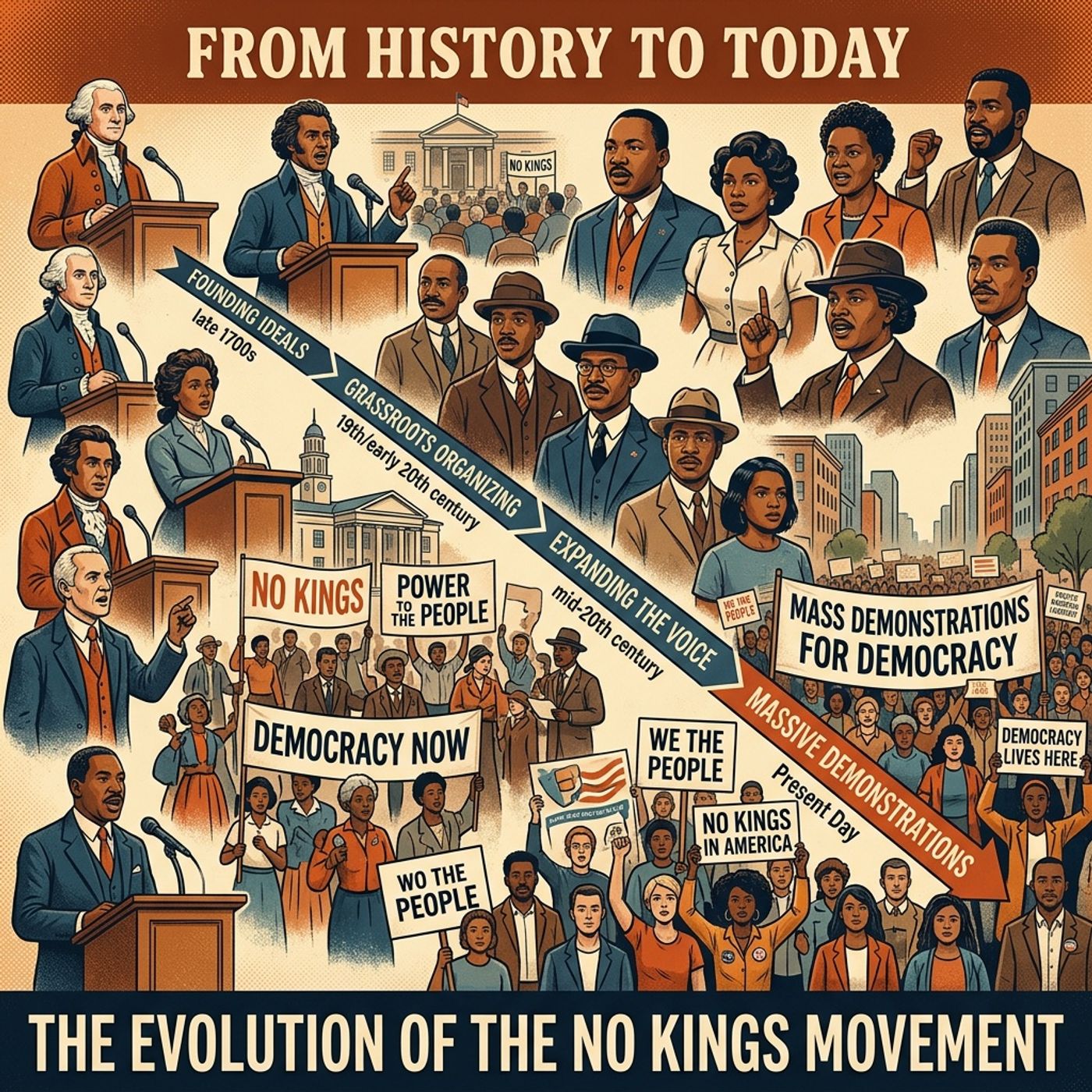
No Kings: The Architecture of Rebellion
About this episode
Become a supporter of this podcast: https://www.spreaker.com/podcast/conspiracy-theories-exploring-the-unseen--5194379/support.
Get every episode summarized
Each time Conspiracy Theories Exploring The Unseen publishes, we email you a written briefing from the transcript — the topics, who appeared, and any specific claims, with the ad reads skipped.
Email me new episodesFree for 3 shows. No card needed.
Hosts & guests
Transcript ready
47 searchable segments. Every word is indexed and playable.
Full transcript
Conspiracy Theories Exploring The Unseen — No Kings: The Architecture of Rebellion. Machine-transcribed; use the interactive transcript above to jump the player to any line.
The No Kings movement is fascinating, not only for its massive engagement, over 8 million people have participated in demonstrations, but also for its strong historical roots. Take a moment to think back to the 18th century, a time when communities of enslaved and free black individuals in the American colonies celebrated what they called Negro Election Day. This was no mere celebration. It was an act of self-governance, a bold assertion of identity, and a challenge to the oppressive systems of monarchical rule. Ceremonially, a leader, often dubbed black king or black governor, was elected, representing their collective interests and practicing a form of democracy that was otherwise denied to them. Fast forward to today, and it's clear that the spirit of that resistance has blossomed anew in the No Kings movement, which arose as a response to what many see as rising authoritarianism in the U.S. government. The very name No Kings serves as a powerful rejection of dictatorial rule,
reflecting a strong collective desire for a government that is genuinely of the people, by the people, and for the people. It's an evolution of thought, a call for democracy that resonates deeply with a modern audience. So, who are these participants? A survey from the October 2025 demonstration in D.C. gives us some intriguing insights. The typical attendee was a white woman in her 40s, college educated, and politically aligned to the left. In fact, nearly 90% of those surveyed identified as somewhat left-leaning, with 86% of participants being white. It's worth noting that while the demographic is somewhat homogenous in terms of race and education, it reflects a substantial concern among educated individuals toward the political landscape, suggesting that many feel a sense of urgency about the direction the nation is headed. But let's not overlook the broader implications of such a massive turnout. This isn't just about numbers. It signifies a collective dissatisfaction with perceived authoritarianism
and a strong yearning for a democracy that truly reflects its citizens. The emphasis on non-violent action in the No Kings protests speaks volumes about the commitment to uphold democratic values and institutions. Yet we must also ask ourselves, can these large-scale demonstrations lead to substantive political change? It's one thing to gather millions in the streets, but translating that passion into long-lasting policy reform is the real challenge. As we look to the future, the No Kings movement stands as a significant chapter in the ongoing story of democracy and justice in the United States. Its historical foundations provide us context, while its diverse participation lets us know that many voices are joining in this vital conversation. The struggles and aspirations of today's activists echo those of the past, reminding us that the fight for a more equitable society is a continuous journey. So as we wrap up this episode, let's carry forward the lesson that history has taught us.
Each voice counts, and every protest can be a catalyst for change. In the end, the No Kings movement is more than just a series of rallies. It's a crystallization of hopes for a democracy that listens, represents, and uplifts everyone. Thanks for joining the Fortune Factor podcast.
More episodes
More from Conspiracy Theories Exploring The Unseen

The Digital Mirage_ AI and the Death of Authentic Romance
Conspiracy Theories Exploring The Unseen

The Trust Trap_ AI and the Future of Romance
Conspiracy Theories Exploring The Unseen

The Ghost in the Machine_ Navigating AI Romance
Conspiracy Theories Exploring The Unseen

The Love Recession_ Why Digital Romance is Offline for Good
Conspiracy Theories Exploring The Unseen