About this episode
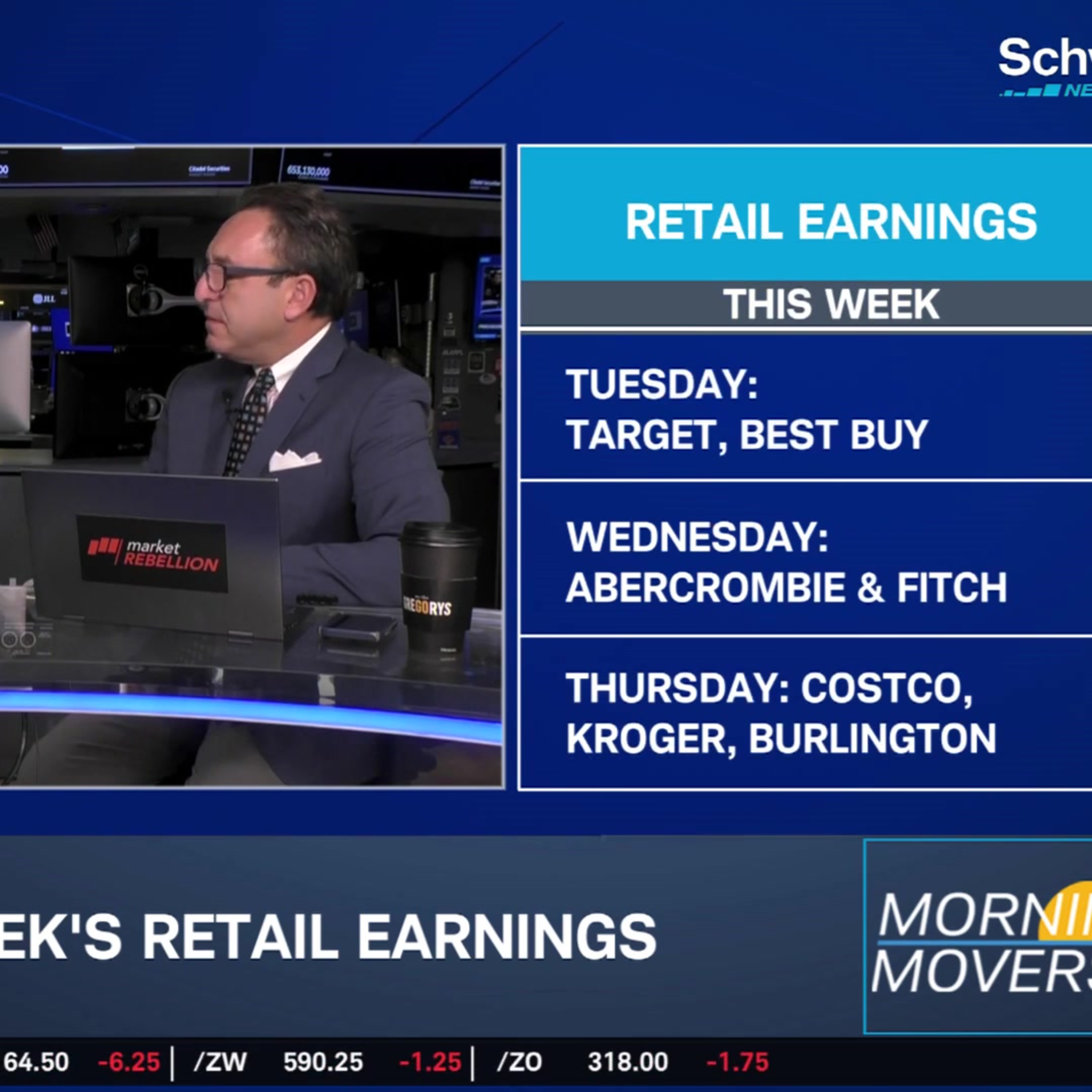
@MarketRebellion's Marc LoPresti says today's focus will be set fully on the evolving war in the Middle East. As crude oil spikes and volatility ramps, he says clarity on next steps in the conflict will be essential to calming markets. As for the U.S. economy, he sees a "silver lining" in the FOMC's view on interest rates. Marc also tells investors to watch for retail earnings, from Target (TGT) and Best Buy (BBY) to Abercrombie & Fitch (ANF).
======== Schwab Network ========
Empowering every investor and trader, every market day.
Subscribe to the Market Minute newsletter - https://schwabnetwork.com/subscribe
Download the iOS app - https://apps.apple.com/us/app/schwab-network/id1460719185
Download the Amazon Fire Tv App - https://www.amazon.com/TD-Ameritrade-Network/dp/B07KRD76C7
Watch on Sling - https://watch.sling.com/1/asset/191928615bd8d47686f94682aefaa007/watch
Watch on Vizio - https://www.vizio.com/en/watchfreeplus-explore
Watch on DistroTV - https://www.distro.tv/live/schwab-network/
Follow us on X – / schwabnetwork
Follow us on Facebook – / schwabnetwork
Follow us on LinkedIn - / schwab-network
About Schwab Network - https://schwabnetwork.com/about
Get every episode summarized
Each time Schwab Network publishes, we email you a written briefing from the transcript — the topics, who appeared, and any specific claims, with the ad reads skipped.
Email me new episodesFree for 3 shows. No card needed.
Transcript ready
169 searchable segments. Every word is indexed and playable.
Full transcript
Schwab Network — Next Steps for Market in Iranian Conflict & Retail's Big Week. Machine-transcribed; use the interactive transcript above to jump the player to any line.
You want to welcome in our next guest, that's Mark Lopez, CEO of a market rebellion. Mark, I would say it feels like today, seems like it's going to be a market in rebellion, but it's kind of, you know, it's kind of the reaction that you expect when you see geopolitical conflicts, such as this, the strikes in Iran over the weekend. There's been some retaliation. Volatility is picking up. What's your reaction to this kind of geopolitical shock? Does it make sense to you? Yeah, I think we're seeing exactly what we would expect, particularly since this happened over the weekend that's always fun for volatility spiking. We're noticing, by the way, that futures are off from the lows of the morning. Traders watching very carefully, the press conference that's being conducted right now from representatives of the Department of War. I think what we're really going to be looking for is how long do we expect this conflict to continue? Number one, because, of course, markets hate uncertainty. That's right. And number two, do we expect that it can be contained?
I think the big concern, the big wild card here at Diane, that only for global geopolitics, but for traders and markets, is can this be contained and not extend out to other parts of the region as it looks like there might be a chance that that may already be happening? That's right. And that explains, you know, the shutdown of air space and, you know, the worries about some key points in the Middle East. Now, there's obviously now the bubbling up concern about inflation risk from the energy as it relates to this. We're already seeing oil prices spike. We're sitting above $72 a barrel for WTI. Brent is rising as well. When you think about that risk, what's your concern as it relates to reigniting inflation potentially? Oh, I actually think it's a good thing, right? I mean, not that war is ever a good thing, but conflict at this scale in a part of the world that is so impactful as it relates to the energy supply chain, particularly for oil and natural gas, is by definition inflationary.
And the good side of that coin, if one can find that. I was wondering where are we getting to the good side. With monetary policy and interest rates, right? I've been very clear and very public about the fact that I think that this fed, that not only Drone Pal, but the Board of Governors has been too late, as the president would like to say, in getting interest rates down. I think that this type of thing could be the kind of inflationary impact that could perhaps inspire them to take action prior to this. We were seeing some watchers, even our favorite CME Fedwatch tool, at one point indicating we might get no rate cuts this year. We had gone from 75 to 50 to 25. To potentially zero, I think that would be a bad thing for the economy and for monetary policy. So the extent we could see a silver lining in this, it could be that. Well, we're not expecting one. Nothing has changed as it relates to the next Fed meeting, so we're not expecting one then. And it's doubtful we'll get one before the end of Powell's term.
So we shall see. Let's talk a little bit about the road ahead and the consumer health check, because we just let into this our conversation with Target and the change on a rating there. We've got some retail results coming in this week. What are you watching out for on that front? We have a big week, of course, for retail, particularly against the backdrop of last week's inflation print, showing inflation cooling, still heading in the wrong direction, but cooling getting closer to the Fed's 2% magic number. But it was a little bit the opposite direction where the Fed would want it to do. It did, there's absolutely no doubt about that. I think though on a tariff adjusted basis on a global geopolitical basis, you have to look at it as actually heading in the right direction. I think it is heading in the right direction. We're going to be looking very carefully at Costco's numbers. Target's got a little bit of complication, some changes to the business model. I think Target's struggling a little bit. I was surprised to see that price target increase that we reported on just before we went live from Mizuho.
But I think that Target, I'm going to be looking more at Costco as a bellweather than I am target this week when I'm looking at retail. Costco, I think, a healthier, better run business, seeing sustained growth not only in membership, foot traffic, renewals of the membership, which is great when you can have that recurring revenue or renewals of membership automatically recurring. By comparison, I think Target is sort of looking to find itself as they introduce higher end. We saw higher end shoppers or higher income shoppers coming into Target, which was great, but they didn't necessarily have the product demand fit, I think, right? So I'm a little bit more sanguine about Target, but I think Costco, the street is looking for Costco to at least beat if not exceed expectations. I think Costco's going to exceed expectations and going to do very well. And it's going to demonstrate that the consumer is healthy and strong, particularly at the higher income level. Okay, and then I want to get back to the bigger picture here today.
For a day like today, what's the playbook? Because I was talking to one of my colleagues earlier today. They said one of the things that typically happens in this situation is by day eight, the market starts pricing in, where the geopolitical risk stands. And it often can, this can often present an opportunity for those who are waiting to get in the market, sitting on the sidelines in terms of those who are interested in risk assets. What's your thought? I think that's exactly right. And I think if we look at how markets have historically responded to this kind of conflict, including the last time we had military action against Iran last year, you have that sell off, that volatility, that sell the news. It does create buying opportunities for smart investors. And I think you don't need to be a Warren Buffett to guess where some of the good opportunities are. We like, in particular, the drone makers, who by the way, Diane, were among those, particularly the smaller ones, the RCATs, Red Cat, a V-Wave, aerovent, AVAV.
These are all the names that we follow that we have in the portfolio from time to time that have been sold off as part of sort of the technology and the AI sell off that I think we're already, particularly if you look at the small names like an RCAT, might actually be pretty attractively priced right now and be keeping an eye on the critical mineral supply chain as well. This kind of conflict makes, and of course, the airspace and defense that your bowings and your global dynamics type names as well. So that's, yeah, that's what we're looking at today. Thank you, Mark. I appreciate it. Thank you. Good place to put a pin in our conversation. That's Mark Lopresti. He's the CEO of Market Rebellion. Our thanks to Mark for joining us.
More episodes
More from Schwab Network

Stock Market Today: ORCL & ADBE Earnings, AEO Plunges Near 52-Week Low
Schwab Network

Thursday's Final Takeaways: Crude Taps $103 & PPI Hotter than Expected
Schwab Network

Balancing High-Conviction AI With High-Dividend Diversification
Schwab Network

EARNINGS PANEL: ORCL, ADBE
Schwab Network