About this episode
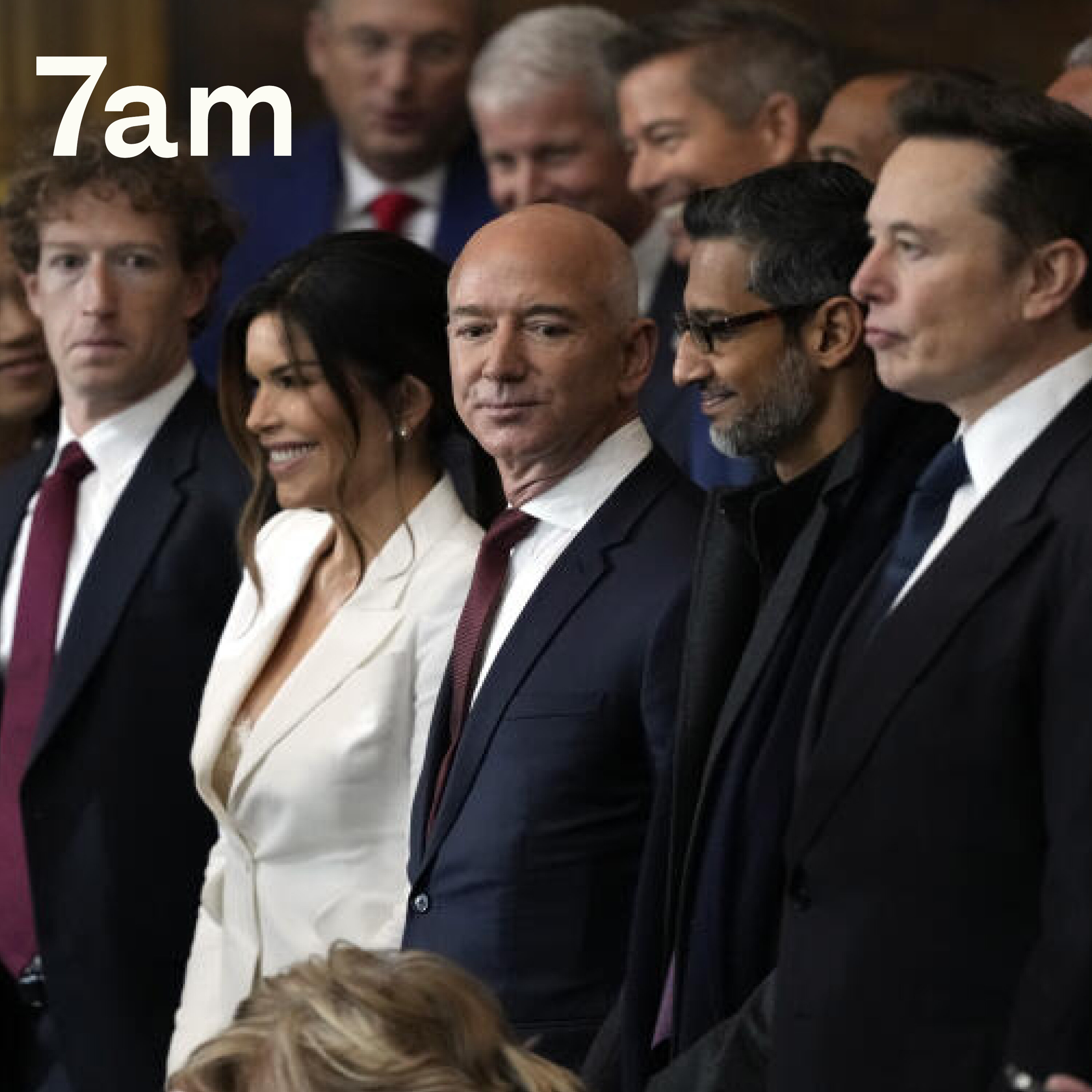
When Donald Trump was sworn in for a second time, some of the most powerful men in the tech world had the best seats in the room.
Elon Musk, Jeff Bezos, Mark Zuckerberg – a display of just how close silicon valley had aligned itself to the administration.
But within that world, journalist Gil Durán says, is a smaller, more radical group with a much bigger ambition: get rid of democracy, and use technology to build a new order in its place, controlled by a wealthy elite. And in his new book, The Nerd Reich, Gil traces how these once-fringe ideas have moved closer to the White House than ever before.
Today, Silicon Valley journalist and author Gil Durán, on the group he’s dubbed the “Nerd Reich’, the ideas driving them, and how they became part of Trump’s political project.
If you enjoy 7am, the best way you can support us is by making a contribution at 7ampodcast.com.au/support.
Socials: Stay in touch with us on Instagram
Guest: Author of The Nerd Reich Gil Durán
Photo: AP Photo/Julia Demaree Nikhinson
See omnystudio.com/listener for privacy information.
Get every episode summarized
Each time 7am publishes, we email you a written briefing from the transcript — the topics, who appeared, and any specific claims, with the ad reads skipped.
Email me new episodesFree for 3 shows. No card needed.
Transcript ready
257 searchable segments. Every word is indexed and playable.
Full transcript
7am — “Nerd Reich”: Are big tech billionaires at war with democracy?. Machine-transcribed; use the interactive transcript above to jump the player to any line.
When Donald Trump was sworn in for a second time, some of the most powerful men in the tech world had the best seats in the room. Ladies and gentlemen, the President-elect of the United States, the Honorable Donald John Trump. Elon Musk, Jeff Bezos, Mark Zuckerberg, a display of just how close Silicon Valley had aligned itself to the administration. From this moment on, America's decline is over. But within that world, journalist Gil Durran says, is a smaller, more radical group with a much bigger ambition, get rid of democracy and use technology to build a new water in its place, controlled by a wealthy elite. And in his new book, The Nerd Rack, Gil traces how these once-fringe ideas have moved closer to the White House than ever before. I'm Ruby Jones, and you're listening to 7am.
Today, Silicon Valley journalist and author Gil Durran, on the group he's dubbed The Nerd Rack, the ideas driving them and how they became part of Trump's political project. It's Friday, September 11. Well the claim at the heart of your book is a big one, that a small group of tech billionaires don't just want more influence over democracy, they actually want to make democracy obsolete. What convinced you that that idea was actually a coherent political project? A lot of my book is told in the words of the men that I write about. They give long interviews, they give speeches, they write long blog posts, they fund writers in movements. What my book does is expose how over a period of decades now, this small cult of Silicon Valley billionaires with apocalyptic ideas has fantasized about the end of American democracy
and bringing about some kind of new tech regime to rule the country, if not the world and the universe. During this Trump administration, Trump's return to power, the same group of people has not only cornered the Trump administration and become a major funder and supporter of Donald Trump, especially the crypto industry, has now become the major funder of right wing politics in our country. But these same people are also cornering AI, crypto, defense technology, surveillance. And so my book is about how they have bundled together all of these different institutions and sectors of power and are aligning behind Donald Trump at a moment when he is threatening to destroy the American democratic experiment. And so I felt that what they have been talking about for years is what they're now clearly doing. And I felt that people should at least entertain the idea that they are doing what they've been talking about doing. Okay, so this cult of Silicon Valley billionaires, tell me more about who you're talking about
there and what it is that unites them. At the center of all this is Peter Till, the co-founder of PayPal and Palantir, who's been a big Trump supporter for a very long time. I'm not a politician, but neither is Donald Trump. He is a builder and it's time to rebuild America. And he was greatly inspired by a 1997 book called The Sovereign Individual. And it predicted that in the 21st century, technology would render democracy obsolete. And that nation states like the United States and the United Kingdom would crumble. And there would be a new world order in which these ruthless, wealthy elites who would invest it wisely and prepared for the collapse would now roam free as sovereign individuals to different jurisdictions that would now cater to their whims because everybody would be competing for a slice of this gazillionaire bananza money that they would spread around the world. You could actually unilaterally change the world without having to constantly convince
people and beg people and plead with people who are never going to agree with you through technological means. And this is where I think technology is this incredible alternative to politics. And it was a kooky crazy apocalyptic thesis back in 1997. The book was poorly reviewed. It was not a bestseller. It was dismissed as an apocalyptic exercise that is not convincing. But this book so impressed Peter Till that he has credited it with being part of the inspiration for PayPal, which he saw as an effort to get ahead of this coming digital currency that would change the entire world. And so my book really looks at how Till goes on to become a multi-millionaire and then a billionaire and then fund writers like Curtis Jarvin, democracy is the rule of the many, oligarchies the rule of the few and monarchy is the rule of one. I'm happy to be a monarchist. Curtis Jarvin was this fascist blogger, anonymous for a long time, who argued that American democracy was an obsolete form of software that needed to be upgraded to dictatorship.
He wrote that the federal government should be purged by a future president who would act as a dictator and fire civil servants on mass. And we saw these ideas realized underdoge. Anything that works is a monarchy. People like biology, schrinivasan. Now what we can do is actually rebuild democracy, internet first. We've done it for capitalism with crypto. Now I think we'll do it with democracy. The sort of cabal of billionaires around Peter Till for the past 25 or 30 years rises to unprecedented levels of power and wealth in the United States and are now the animating force behind much of what Trump is doing in Washington. So in my view, these things have become very real and we have to take them seriously. And I think that's the difference between me and a lot of other journalists in my country is that I'm listening very closely to what these guys say and I feel like we should take them very seriously. And so for many years, those ideas that you're talking about, they existed on obscure blogs,
talked about in Silicon Valley circles. Tell me more about how they actually made their way to the White House. How did someone like Till gain traction and influence? Well, first of all, he has a lot of money and in the United States, you can buy influence and power until he's spread his money around to both Democrats and Republicans. Well, his major surveillance technology company Palantir has become a massive government contract or all throughout our military and our intelligence agencies and our law enforcement agencies and our hospitals and our businesses. So Palantir has become quite sweeping throughout our society. And what he did was fund different thinkers and writers who agreed with his ideas and promoted them. And so what happens is this thing goes from being a fringe, weirdo ideology into the mainstream of the Republican Party and perhaps there's no better way to understand that than by examining the role of JD Vance. So Till quite famously has close ties to Vance. You could put it that way definitely. I like to say that JD Vance is almost entirely a creation of Peter Till.
If you look at the last 15 or so years of Vance's life since Yale Law School, he has been promoted and funded by Peter Till. You know, he's always been a friend of mine. He's always been one of the smartest people I've ever met. Oh, really? Just a very thoughtful dude. But he's literally never asked me once for anything. So he just believed in you? He believed in me. He agreed with me on a lot of issues. Vance decided not to be a lawyer after law school because he was inspired by a speech that Peter Till gave. He went out to Silicon Valley and became a venture capitalist, a mediocre venture capitalist at a venture fund founded by Peter Till. When he ran for Senate, it was with unprecedented amount of money. And when it was time to think about trying to get on the vice presidential ticket with Donald Trump, JD Vance had a big problem, which was that he had previously called Trump America Sittler. And it was Peter Till and his fellow venture capitalists who made the peace and got Vance on the ticket. And what's worse is that back in 2021, when Vance was running for Senate, he gave an interview
in which he quoted the ideas of Curtis Jarban, specifically the idea that the government, the US government should be purged or denotified. And that a president Trump, he predicted Trump would return to power in 2024 and that Trump should defy the law and challenge the justices to force him to follow the law. And this is crazy anti-American, anti-constitutional stuff and as a Yale educated lawyer, Vance certainly knows that. But these were the ideas of Curtis Jarvan and JD Vance said so. So here's a guy who's quoting Curtis Jarvan, who's been created by Peter Till and his heart beat away from the presidency. Still to come, the project to create billionaires cities around the world. How should we think about who is influencing who here? Because I remember particularly around the time of Trump's inauguration in 2025, people
were watching on as those text CEOs sat behind Trump and thought that they were really being forced to sort of kiss the ring. Our goal is to lead a sweeping transformation of the federal government's technology that will deliver dramatically better services for citizens, stronger protection from cyber attacks. But do you think that when looking at that relationship, backwards is Trump deferring to them now? It's a partnership of sorts. The best way to look at that is Donald Trump used to call crypto a scam. And on the day he returned to the White House, he became a crypto billionaire. And basically, the Trump family is now acting like venture capitalists, opening their own firms, opening their own tech companies. So basically, Donald Trump has been bought off and is going along with a lot of this stuff because that's what he is in business to do as president, to cash in. And I don't think it's all of the Silicon Valley billionaires who are so deep into this ideology. I think there's a core of them who are very dedicated to the collapse of democracy and
see it as their destiny. The rest of the billionaires who just cowards who will go along with whatever happens and say nothing against the government or against their fellow billionaires. And I think that's what we're seeing. I think cowardice is the main element here from people like Mark Zuckerberg and Jeff Bezos. They share the same hopes, I think, of having themselves celebrated as the kings of the universe and of humanity. But I don't think they're the zealous core. I think they're followers and they're cowards and their silences is a form of complicity, but it's not leadership. And at the most radical end of this at the zealous core, some of these figures talk about not only wanting to take control of or collapsing existing governments. They talk about creating these entirely new network states, so privately governed cities and even countries that are funded by billionaires. Is that a project that we should think about seriously? Without a doubt, keep an eye on the plan to build billionaire cities all over the world.
We see it happening in real time. There's a prototype already in Honduras called Prospera, where a group of billionaires bought a piece of an island and negotiated with the corrupt government to give them partial sovereignty over regulations and laws. Prospera Incorporated provides investors an opportunity to accelerate the city's growth and participate in the upside. Prospera is building the future of human governance, privately run and for profit. In addition, in his 2024 campaign plan, Donald Trump announced a plan for something called Freedom Cities, which would be ten new major American cities built on federal land. After a competition where different corporations would forward their best proposals in Donald Trump and true game show fashion would pick the winners. These Freedom Cities will reopen the frontier, reignite American imagination and give hundreds of thousands of young people and other people, all hard working families, a new shot at home ownership and in fact the American dream. And the other place we see this idea of building these new tech cities popping up is in Gaza,
where Donald Trump's son and law juror Kushner is part of a proposal to build a new tech utopia city on the ruins of Gaza. In Gaza's waterfront property, it could be very valuable to if people would focus on kind of building up, you know, livelihoods, you think about all the money that's gone into this. Last year, Trump tweeted out a photo of an AI-generated future Gaza with a big Trump casino and resort on the beach. I don't want to be a wise guy, but the river era of the Middle East, this could be something that could be so bad, this could be so magnificent. In Greenland, which Donald Trump keeps threatening to steal, there's a proposal to build a new tech city there called Praxis, again, funded by the same group of people, and Dreson, and Teal, and others. And other billionaires are now openly proposing building new cities in Guantanamo Bay, Cuba, in Venezuela, in El Salvador, and they're currently plans to build a crypto-megacity in Kazakhstan. So suddenly, there's all this need to build these big new venture capital-funded cities, but nobody seems very interested in explaining why that is.
My book explains why that is. And here in Australia, Palantir has a significant foothold. Our government has spent tens of millions of dollars on its technology. So what safeguards should governments like Australia's be demanding when it comes to working closely with companies like this? I don't think any democratic government should work with any company whose leaders do not support democracy and speak quite openly against it. Palantir is pretty militantly fascist at this point if you read Alex Carp's manifesto, which called for Silicon Valley to partner with the military and sort of go to war against inferior cultures, whatever that means, called for national service to be compulsory. I tweeted about the Palantir manifesto in April and got permanently banned from Twitter as a result. So it's not clear to me why a company whose leadership has such extreme ideas would be allowed into the most sensitive parts of our government, our military, and our intelligence
agencies. It seems to me like a massive failure of intelligence agencies around the world. Either they completely missed it or they kind of like it and are complicit in it. And you end your book calling for some aggressive measures, breaking up the technologies, tougher AI regulation, even banning crypto. Do you think that those measures are possible and where would you start? Well, anything is possible. The billionaires are imagining a future where they don't even live on this planet anymore and where they defeat death and conquer the universe. If you go deeper into this ideology and I write about this in my book, this is all rooted in this very apocalyptic sort of religious view that technology, especially AI, is about to create godlike powers for a handful of people. And so while some of these ideas seem far fetched in the moment, I think we're living through a time where the extremism and the radicalization of the billionaire class has become a real threat to everyone's livelihood and safety. If the United States makes it out of this terrible predicament, a big if, then we have to
reckon with the fact that the billionaire class betrayed us and tried to destroy our country and take our freedom. And we are not only entitled to vengeance, it is a moral responsibility that we make sure this never happens again. We can have billionaires or we can have democracy. We can't have both. Girl, thank you so much for your time. Thank you. Also in the news, the federal government is set to introduce new laws to crack down on the Australia's illegal tobacco trade. The changes will target organised crime groups, distributors and shops selling black market cigarettes. And allow things like suspiciously cheap prices or illegal packaging to be used as evidence tobacco was unlawfully imported. Labor has ruled out the coalitions proposed to cut the tobacco exercise by 80 per cent to make the black market less lucrative.
Arguing stronger enforcement is the better way to tackle the problem. And the Greens have agreed to support a controversial carbon credit scheme that could help fund New South Wales Great Coala National Park. The New South Wales Labor government plans to stop logging across 176,000 hectares of 90 forest. But critics say the government had already committed to protect the park and shouldn't get credits that allow polluters to keep emitting. The Greens secured changes in return for their support, including restrictions on coal and gas companies using the credits. But the decision has split the party, with three senators planning the cross to floor and voting against it. I'm Daniel James, thanks for listening to 7am, we'll be back tomorrow.
More episodes
More from 7am

Why Jacqui Lambie’s not done fighting veteran health caps
7am

Why are the conservative parties suddenly obsessed with super?
7am

The far right is winning. Could Australia’s neo-Nazis be next?
7am

Have the Greens lost their appetite for a fight?
7am